
◆ Research Methods
How do you write a lab report in chemistry that a marker can follow?
Category: research-methods
Last updated: 2026-09-04
A student learning how to write a lab report runs a clean synthesis, gets a 78% yield, and writes it up over 6 pages. The report comes back in the credit band with one comment: too much description, not enough interpretation. The chemistry was correct. What the marker could not find was the boundary between what happened in the fume hood and what the student concluded from it.
Direct answer: A chemistry lab report follows the IMRAD spine of Introduction, Methods, Results and Discussion. Each section answers a different question, and marks are lost when they blur. Results state what the instruments recorded, and Discussion states what those numbers mean.
The rule that decides most of your marks. The University of North Carolina Writing Center (n.d.) states the Results boundary in one sentence: "Nothing your readers can dispute should appear in the Results section"; verified on 4 September 2026. That single line settles where a yield figure goes, where an error analysis goes, and why a sentence beginning "this suggests" belongs 2 sections later.
This guide covers the 4 IMRAD sections and what belongs in each, the Experimental section conventions specific to chemistry, ACS citation basics, and the 5 conventions that separate a credit report from a distinction report.
◆ Question 1 / 5 · What goes
What goes in the Introduction of a chemistry lab report?
Direct answer: State the chemical principle under test, the specific aim of this experiment, and the hypothesis or expected outcome. Keep it to 3 moves and around 150 to 250 words in an undergraduate report. Background belongs here only where it is needed to understand the aim.
The UNC Writing Center describes the scientific report format as one that "mirrors the scientific method but fleshes out the process a little", which is the reason the Introduction must contain a testable expectation rather than a general survey of the topic. A first-year Organic Chemistry report on an SN2 reaction does not need the full history of nucleophilic substitution, but it does need a stated prediction about stereochemistry, written in 1 sentence.
Mensh and Kording (2017), writing in PLOS Computational Biology, set out 10 rules for structuring papers and put the same demand on an opening: name the gap, then name what this work does about it. In a lab report the gap is narrower, usually a property to be measured or a mechanism to be confirmed, and 1 clear sentence of aim is worth more than 3 paragraphs of context.
A 150-word Introduction that names the aim outscores a 250-word one that surveys the topic, because the marker is reading for a testable expectation. Write the Introduction in the present tense for established chemistry and the past tense for what you did. Established facts such as boiling points and reaction mechanisms stay in the present, because they remain true after your experiment finished.
◆ Question 2 / 5 · How do you write
How do you write the Experimental section?
Direct answer: Describe what you did in enough detail that another student could repeat it and get comparable numbers. Give quantities, concentrations, apparatus and conditions in the past tense. State results nowhere in this section, and give the rationale for any non-obvious procedural choice.
The UNC guide is explicit about the boundary: "don't write what the results were, not yet. Here, you're merely stating exactly how you went about testing your hypothesis" (University of North Carolina Writing Center, n.d.), verified on 4 September 2026. Students lose marks by slipping an observation such as a colour change into the procedure, where a marker reading for reproducibility does not expect it.
Chemistry has its own conventions inside this section. Materials and Methods are often split, with reagent grade, supplier and purity listed first, then the procedure written as continuous prose rather than as numbered steps copied from the lab manual. Annesley (2010), writing in Clinical Chemistry, describes the methods section as answering who, what, when, where, how and why, and the why is what separates a written method from a transcribed recipe.
Verb tense follows a rule the UNC guide states directly: "you should use past tense to refer to everything you did during the experiment" (University of North Carolina Writing Center, n.d.), verified on 4 September 2026. A procedure written in the imperative, such as "add 5 mL of the acid", reads as instructions to the reader rather than as a record of what you did, and most chemistry departments mark that as a formatting error.
Kotz and Cals (2013a), writing in the Journal of Clinical Epidemiology, note that a methods section should be written so a reader can judge the validity of the results before seeing them. In a chemistry report that means stating the concentration, the temperature, the reaction time and the purification route, because each of those choices constrains the yield you are about to report.
◆ Question 3 / 5 · What belongs in Results
What belongs in Results, and what belongs in Discussion?
Direct answer: Results report the numbers, spectra and observations without interpretation. Discussion explains what they mean, whether they support the hypothesis, how they compare with literature values, and what the sources of error were. The word "because" almost always signals a Discussion sentence.
What belongs in Results and what belongs in Discussion
Each row names a section and what the post puts in it.
Section
What it holds
Results
Results report the numbers, spectra and observations without interpretation.
Results, for example
A yield of 78%, a melting point range of 132 to 134 degrees Celsius and an IR absorption at 1710 per centimetre belong here, because no reader can dispute them.
Discussion
Discussion explains what the numbers mean, whether they support the hypothesis, how they compare with literature values, and what the sources of error were.
Discussion, for example
A sentence explaining that the depressed melting point indicates residual solvent belongs here, because a reader can dispute it.
Save this figure
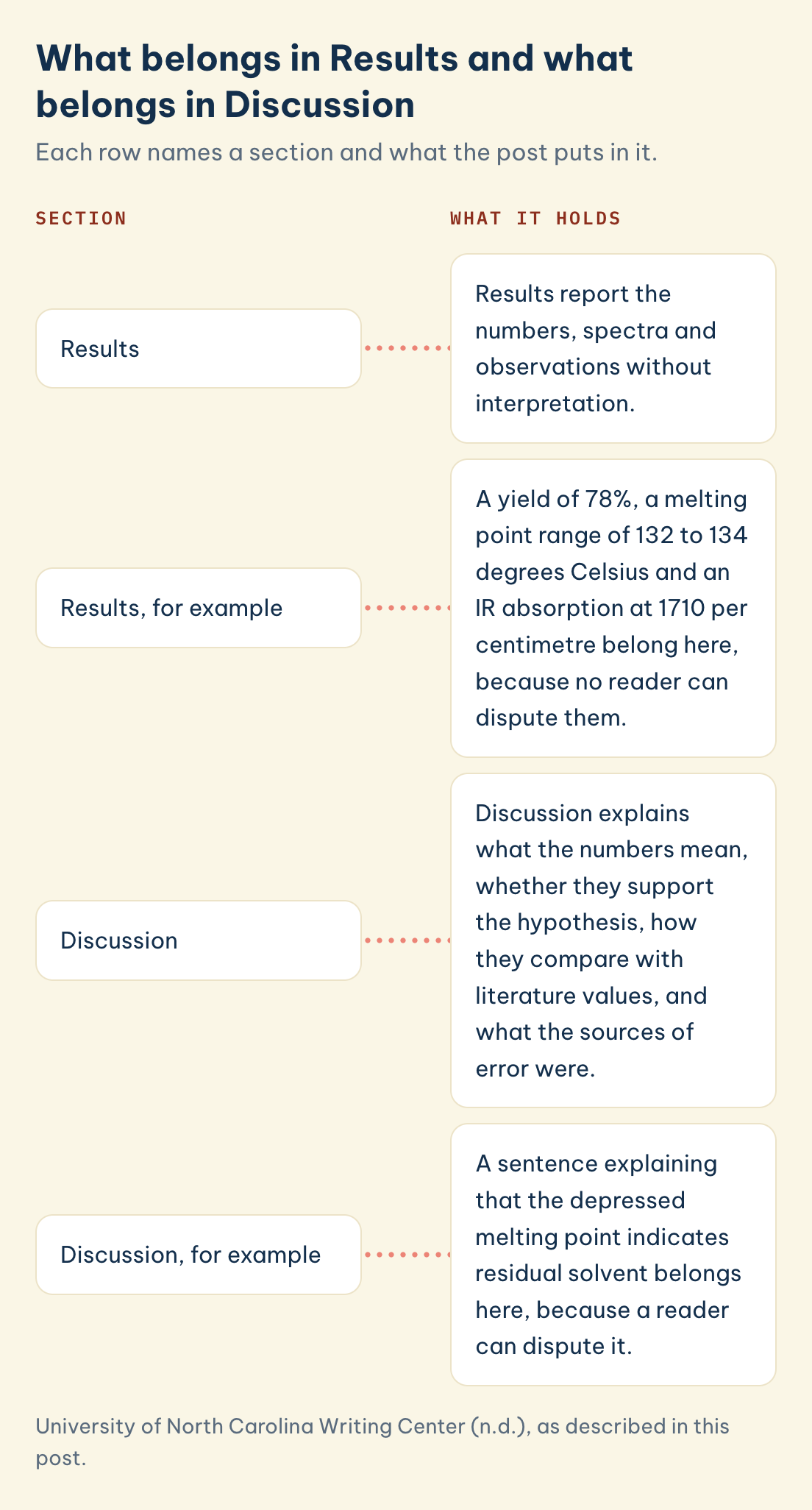
The UNC boundary rule does the work here. A yield of 78%, a melting point range of 132 to 134 degrees Celsius, and an IR absorption at 1710 per centimetre all belong in Results because no reader can dispute them. A sentence explaining that the depressed melting point indicates residual solvent belongs in Discussion, because a reader can dispute it.
Present numerical data in a table and spectra as labelled figures, each with a caption that stands alone. Kotz and Cals (2013b) devote a separate Journal of Clinical Epidemiology paper to tables and figures precisely because a well-built table carries information the running text should not repeat. State the yield once, in the place the marker expects it, rather than 3 times across 3 sections.
The Discussion carries 4 moves in a chemistry report. State whether the data support the hypothesis, compare your values with literature values and account for the difference, analyse the sources of error quantitatively where you can, and state what the result means for the chemical question you opened with. An error analysis naming "human error" without quantifying it earns nothing, whereas one attributing a 4% yield shortfall to a transfer loss of 0.12 grams you actually weighed earns credit.
◆ Question 4 / 5 · How does ACS citation style
How does ACS citation style work?
Direct answer: ACS style allows 3 in-text formats, namely superscript numbers, italic numbers in parentheses, and author-date. Most undergraduate chemistry departments require superscript numbers, cited sequentially, with the reference list ordered by first appearance rather than alphabetically. The superscript sits outside the sentence punctuation, which is where marks are most often lost on a first report.
West Virginia University Libraries (n.d.) describes the first option plainly: superscript numbers "will appear small and outside the punctuation of the sentence"; verified on 4 September 2026. That placement outside the punctuation is the opposite of several other styles, and it is the detail most often marked wrong on a first report.
Sequential numbering has a consequence students often miss. Because references are numbered by first appearance and listed in that order, inserting a new source into the middle of a finished report renumbers everything after it. Building the list in a reference manager such as Zotero or Mendeley avoids a renumbering pass that is easy to get wrong in the final 2 hours before submission.
ACS is not the only style a chemistry department may require, and the choice is departmental rather than universal. Our Harvard referencing guide and APA 7th referencing guide cover the 2 author-date systems you are more likely to meet outside the sciences, and the underlying rule is the same in all 3: follow the guide your department publishes.
◆ Question 5 / 5 · What separates a credit
What separates a credit report from a distinction report?
Direct answer: Five conventions do most of the work, namely quantified error analysis, literature comparison with ACS citations, correct significant figures, self-contained tables and figures, and a Discussion that answers the question raised in the Introduction. None of the 5 requires extra experiments or extra time in the laboratory.
Significant figures are marked more strictly in chemistry than students expect. A balance reading to 4 decimal places does not license a yield quoted to 5 significant figures, and a calculated value cannot be more precise than the least precise measurement feeding it. Reporting 78.4213% from a measurement good to 3 significant figures signals that the arithmetic was copied off a calculator without thought, and most Chemistry Departments deduct marks for it.
Literature comparison is the fastest available upgrade. Quoting your melting point beside an accepted literature value, with an ACS citation, converts a bare observation into evidence about purity. Mensh and Kording (2017) argue that a paper earns credibility by connecting its own numbers to what is already known, and a lab report follows the same logic at a smaller scale.
The last convention is structural. A Discussion that never returns to the aim stated in the Introduction leaves the report unfinished, in the same way an unanswered research question leaves a thesis unfinished. Read your Introduction and your final paragraph together, and if the final paragraph does not answer the question the first one asked, the report is not yet done.
Frequently asked questions
How long should an undergraduate chemistry lab report be?
Most first and second year reports run 1,500 to 2,500 words excluding tables, figures and references. Check the unit outline, because counts vary by institution and some departments specify a limit of 8 to 10 pages instead.
Should I use first person in a chemistry report?
Departments differ, and both conventions remain current in 2026. Passive constructions such as "the mixture was heated" remain common in chemistry, while some departments now accept "we heated the mixture". Follow the unit guide, and stay consistent throughout.
Where does the error analysis go?
In the Discussion, not the Results. Results record what you measured, and an error analysis is an interpretation of why the measurement differs from the expected value, which makes it disputable and therefore a Discussion item.
Do I need to cite the lab manual?
Yes, if you followed its procedure. Cite it in ACS format as you would any other source, and note any deviation from the published procedure in your Experimental section, because a deviation the marker cannot see reads as an error rather than a choice.
Related resources
- How to write a university report: the general report structure this specialises
- How to write the methods section of a research paper: the same reproducibility standard at research level
- How to write the results section: reporting numbers without interpreting them
- Harvard referencing guide: the author-date system many other departments require
- Academic Support service: coaching through Outline, Draft and Final with a discipline-matched expert
Ready to start? Book a free 20-minute consultation. Bring your lab manual and your marking rubric, and we will match you to a mentor in your discipline within 48 hours.
References
- Annesley, T. M. (2010). Who, what, when, where, how, and why: The ingredients in the recipe for a successful methods section. Clinical Chemistry, 56(6), 897–901. https://doi.org/10.1373/clinchem.2010.146589
- Kotz, D., & Cals, J. W. L. (2013a). Effective writing and publishing scientific papers, part IV: Methods. Journal of Clinical Epidemiology, 66(8), 817. https://doi.org/10.1016/j.jclinepi.2013.01.003
- Kotz, D., & Cals, J. W. L. (2013b). Effective writing and publishing scientific papers, part VII: Tables and figures. Journal of Clinical Epidemiology, 66(11), 1197. https://doi.org/10.1016/j.jclinepi.2013.04.016
- Mensh, B., & Kording, K. (2017). Ten simple rules for structuring papers. PLOS Computational Biology, 13(9), Article e1005619. https://doi.org/10.1371/journal.pcbi.1005619
- University of North Carolina Writing Center. (n.d.). Scientific reports. Retrieved September 4, 2026, from https://writingcenter.unc.edu/tips-and-tools/scientific-reports/
- West Virginia University Libraries. (n.d.). In-text citations: ACS citation style guide. Retrieved September 4, 2026, from https://libguides.wvu.edu/acs/intext
This article is part of the MAAS Journal series for Vietnamese international students. With MAAS Academic Support, a discipline-matched expert coaches you through the Outline, Draft and Final stages against your marking rubric. We guide students through worked examples, drafts and feedback so they report their own experimental work accurately, and we do not write lab reports on students' behalf.
A free 20-minute consultation is a conversation about your situation, with your lab manual and marking rubric in hand.
Book a free consultation ▸