
◆ Study Hacks
How do you revise GCSE Combined Science practicals and 6-markers?
Direct answer: Revise the 21 required practicals as methods you can write out from memory, because AQA says questions drawing on them count for at least 15% of the marks. Then practise six-mark answers against real mark schemes, which reward a complete, logically ordered method rather than a list of loose facts.
This guide is written for students sitting AQA GCSE Combined Science: Trilogy (specification code 8464) in England. It was checked on 23 October 2026 against the AQA specification (Version 1.1) and a June 2023 AQA mark scheme. If you sit Edexcel or OCR, the idea of required or core practicals is similar, but the list and paper structure differ, so open your own board's specification before you build a plan from this page.

◆ Question 1 / 8 · The six papers
What is in the GCSE Combined Science exams?
Direct answer: AQA Combined Science: Trilogy has six written papers, two each in biology, chemistry and physics. Every paper lasts 1 hour 15 minutes, carries 70 marks and is worth 16.7% of the GCSE, and each is sat at Foundation or Higher Tier.
AQA (2019) sets each paper at 1 hour 15 minutes and 70 marks, so each of the six carries 16.7% of the qualification. It lists the question types on every paper as multiple choice, structured, closed short answer and open response. The open-response items are where the six-mark questions sit. The qualification is a double award, so you receive two grades on what AQA (2019) calls "a 17-point scale: 1–1 to 9–9". Foundation Tier students can reach grades from 1–1 to 5–5, and Higher Tier students from 4–4 to 9–9, which matters when you and your teacher decide which tier you enter.
Because each paper covers distinct topics, it helps to know which practicals belong to which paper before you plan your weeks. The table below groups the 21 required practicals by paper, following the order in which they appear in the specification.
| Paper | Topics assessed (AQA, 2019) | Required practicals |
|---|---|---|
| Biology 1 | Cell biology, organisation, infection and response, bioenergetics | 1 microscopy, 2 osmosis, 3 food tests, 4 amylase and pH, 5 photosynthesis |
| Biology 2 | Homeostasis, inheritance and evolution, ecology | 6 reaction time, 7 field investigations |
| Chemistry 1 | Atomic structure, bonding, quantitative chemistry, chemical changes, energy changes | 8 making salts, 9 electrolysis, 10 temperature changes |
| Chemistry 2 | Rates, organic chemistry, chemical analysis, atmosphere, resources | 11 rates of reaction, 12 chromatography, 13 water purification |
| Physics 1 | Energy, electricity, particle model, atomic structure | 14 specific heat capacity, 15 resistance, 16 I–V characteristics, 17 density |
| Physics 2 | Forces, waves, magnetism and electromagnetism | 18 force and extension, 19 acceleration, 20 waves, 21 infrared radiation |
◆ Question 2 / 8 · Why practicals matter
Why do the required practicals matter so much?
Direct answer: AQA builds a fixed share of the written papers around them. There is no separate practical exam, so the marks come from questions that ask you to describe, improve or analyse the experiments you carried out in class, often with data from a version you have not seen.
The specification is explicit on this point: "Questions in the written exams will draw on the knowledge and understanding students have gained by carrying out the practical activities listed below. These questions will count for at least 15% of the overall marks for the qualification" (AQA, 2019, p. 173). The same page adds that many questions "focus on investigative skills and how well students can apply what they know to practical situations often in novel contexts".
That phrase "novel contexts" is the reason memorising a single worksheet is not enough. You might be asked about the photosynthesis practical with a different light source, or about rates of reaction using a reaction you have never done. What carries across is the structure: the independent variable you change, the dependent variable you measure, the control variables you keep the same, the apparatus, and how you would make the result valid. Revising each practical in that five-part shape lets you adapt to an unfamiliar version on the day.
◆ Question 3 / 8 · Revising practicals
How should you revise each required practical?
Direct answer: For every practical, write the method from memory as numbered steps, name the three types of variable, and state one risk and one way to improve the results. Then check your version against your class notes and fix the gaps, rather than rereading the method first.
The check-afterwards order is deliberate. Dunlosky et al. (2013) rated practice testing and distributed practice as the two techniques with high utility across ages and tasks, and rated rereading and highlighting low. A later systematic review of classroom studies by Agarwal et al. (2021) coded 49 effect sizes from real school settings and found that 57% of them showed medium or large benefits from retrieval practice. Writing a method out cold is retrieval practice, and checking it is the feedback that makes it stick.
A workable cycle for the 21 practicals looks like this:
- Pick three practicals from different papers, so one session mixes biology, chemistry and physics.
- For each, write the method, the variables and the expected pattern of results without notes.
- Mark your own version against your class notes or a textbook, in a different colour.
- Come back to the same three a few days later and repeat, before adding new ones.
- Once a practical comes out cleanly twice, move it to a weekly check rather than dropping it.
If your general revision timetable still needs building, our guide on how to revise for final exams effectively covers spacing across subjects. This page stays with what is specific to science.
◆ Question 4 / 8 · Six-mark marking
How are six-mark questions marked?
Direct answer: AQA marks them with a level of response scheme. The examiner places your whole answer in Level 1, 2 or 3, each worth two marks, and then picks the mark within that level. Quality and logical order decide the level, not the number of points you list.
How a six-mark method answer is levelled
Tap each level to see what the examiner looks for.
Level 1
1 to 2 marks: some relevant steps, but links between them are not made clear (AQA, 2023, p. 8).
Level 2
3 to 4 marks: most steps identified, but the plan is not fully logically sequenced (AQA, 2023, p. 8).
Level 3
5 to 6 marks: all key steps identified and logically sequenced, leading to a valid outcome (AQA, 2023, p. 8).
Save this figure
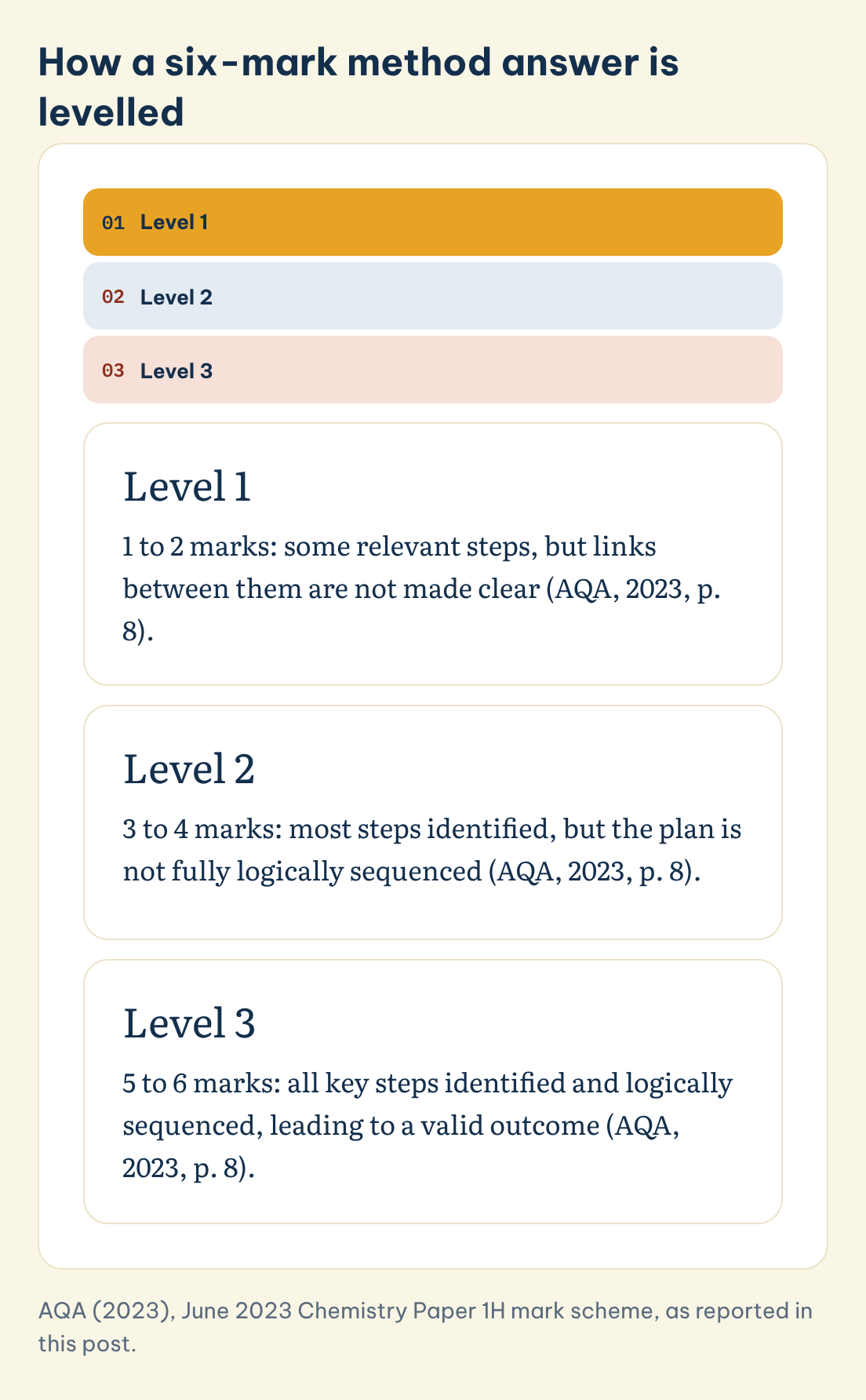
The marking instructions in AQA mark schemes describe the process step by step. "There are two marks in each level" (AQA, 2023, p. 5), and the examiner starts at the lowest level and moves up "until you have a match between the level descriptor and the answer" (AQA, 2023, p. 6). The next page also tells examiners that indicative content "is not intended to be exhaustive", that "Students do not have to cover all of the points mentioned in the indicative content to reach the highest level", and that "full marks can be awarded only if there are no incorrect statements that contradict a correct response" (AQA, 2023, p. 6).
The June 2023 Chemistry Paper 1 Higher mark scheme shows how this works for a method question on collecting carbon dioxide from calcium carbonate and hydrochloric acid. Level 3, worth 5 to 6 marks, needs a method that "would lead to the production of a valid outcome. All key steps are identified and logically sequenced", while Level 2 has most steps "but the plan is not fully logically sequenced" (AQA, 2023, p. 8).
| Level | Marks | What the examiner looks for (AQA, 2023, p. 8) |
|---|---|---|
| Level 3 | 5–6 | Method leads to a valid outcome; all key steps identified and logically sequenced |
| Level 2 | 3–4 | Method would not necessarily give a valid outcome; most steps identified, order not fully logical |
| Level 1 | 1–2 | Some relevant steps, but links between them are not made clear |
| No relevant content | 0 | Nothing that answers the question |
◆ Question 5 / 8 · Practice questions
How do you practise GCSE science revision questions?
Direct answer: Use real past papers and their mark schemes from your exam board, and mark your answers against the level descriptors yourself. Start untimed with one six-marker a day, then move to full timed papers in the final weeks, marking each one before you start the next.
AQA (n.d.) publishes past papers and mark schemes for 8464 on its assessment resources page, and these are the most reliable "questions and answers" you can practise with, because they show exactly how marks were awarded. Question banks and revision PDFs from other sites can be useful for quick recall, but check that the paper code matches Combined Science: Trilogy rather than separate biology, chemistry or physics, which have more content.
When you mark a six-marker, do it in two passes. First, decide the level using the descriptor, as an examiner would. Second, compare your answer with the indicative content and ask which missing step would have moved you up a level. For method questions, that is usually a repeat, a named measuring instrument, or a control variable. Writing the improved answer straight away turns a mark into a lesson, which is worth more than attempting another question.
◆ Question 6 / 8 · Chemistry focus
Which chemistry topics need the most practice?
Direct answer: Chemistry papers combine required practicals with calculations, so quantitative chemistry and rates of reaction deserve extra time. Practise the method for each chemistry practical and the calculations that go with it, such as Rf values in chromatography and the volume of gas collected over time.
The specification wording for required practical 12 asks students to investigate "how paper chromatography can be used to separate and tell the difference between coloured substances" and to "calculate Rf values" (AQA, 2019). Required practical 11 asks for rates measured both by the volume of gas produced and by a second method, so be ready to describe both rather than only the one you did most recently.
AQA (2019) also sets out mathematical requirements for Combined Science, and states that on Higher Tier papers these questions will not be lower in demand than Foundation Tier GCSE Mathematics. Arithmetic means, significant figures, standard form and ratios turn up across all three sciences, which is why short daily calculation practice pays off beyond chemistry.
◆ Question 7 / 8 · Books and videos
Are revision books and videos worth using?
Direct answer: Yes, as a way in, but not as the whole plan. A revision guide or video explains a topic quickly, while the marks come from what you can recall and write yourself. Watch or read once, then close it and test yourself.
The research behind this is the same as for the practicals. Dunlosky et al. (2013) found that passive techniques such as rereading gave little benefit, and Agarwal et al. (2021) found retrieval practice helped across many content areas and age groups in real classrooms. A video on the specific heat capacity practical is a good first step if you missed the lesson. The revision happens when you pause it and write the next step before it is shown.
For Year 10 students, the useful habit is small: after each practical in class, write a short version of the method in your own words that week. By Year 11 you then revise from your own notes rather than starting from a blank page.
◆ Question 8 / 8 · Getting help
Where can you get help with GCSE science?
Direct answer: Your science teacher is the first stop, especially for practicals you missed, because only your school can tell you which ones you completed. Outside school, a tutor can work through six-mark answers with you and show you how to move up a level.
Your science teacher can mark six-mark answers against the AQA scheme. MAAS's subject tutoring is for university modules, so it fits later, once you are studying science at degree level; it does not set a target grade, and if a tutor is not the right fit you can ask to change tutors.
Frequently asked questions
How many required practicals are in AQA Combined Science?
There are 21 required practicals in AQA GCSE Combined Science: Trilogy (8464), spread across biology, chemistry and physics (AQA, 2019).
What percentage of marks come from the required practicals?
AQA states that questions drawing on the practicals count for at least 15% of the overall marks (AQA, 2019, p. 173).
How many marks is each level in a six-mark question worth?
Two. AQA's level of response schemes have three levels with two marks each, and the examiner picks the mark within the level (AQA, 2023).
Do I need every point in the mark scheme to get full marks?
No. AQA says students do not have to cover all the indicative content to reach the top level, but an incorrect statement that contradicts a correct one prevents full marks (AQA, 2023).
How long is each Combined Science paper?
Each of the six papers lasts 1 hour 15 minutes and carries 70 marks (AQA, 2019).
Is rereading my notes a good way to revise science?
It is one of the weaker techniques. Testing yourself and spacing that practice over days were rated far more useful (Dunlosky et al., 2013).
References
Agarwal, P. K., Nunes, L. D., & Blunt, J. R. (2021). Retrieval practice consistently benefits student learning: A systematic review of applied research in schools and classrooms. Educational Psychology Review, 33(4), 1409–1453. https://doi.org/10.1007/s10648-021-09595-9
AQA. (2019). GCSE Combined Science: Trilogy (8464) specification (Version 1.1). https://filestore.aqa.org.uk/resources/science/specifications/AQA-8464-SP-2016.PDF
AQA. (2023). GCSE Combined Science: Trilogy 8464/C/1H Chemistry Paper 1H: Mark scheme, June 2023. https://filestore.aqa.org.uk/sample-papers-and-mark-schemes/2023/june/AQA-8464C1H-MS-JUN23.PDF
AQA. (n.d.). GCSE Combined Science: Trilogy 8464: Assessment resources. Retrieved October 23, 2026, from https://www.aqa.org.uk/subjects/science/gcse/combined-science-trilogy-8464/assessment-resources
Dunlosky, J., Rawson, K. A., Marsh, E. J., Nathan, M. J., & Willingham, D. T. (2013). Improving students' learning with effective learning techniques: Promising directions from cognitive and educational psychology. Psychological Science in the Public Interest, 14(1), 4–58. https://doi.org/10.1177/1529100612453266
Not sure how this guide applies to your own case? Talk it through with MAAS in a free 20-minute consultation.
Book a free consultation ▸