
◆ Engineering
ENGR391: how do you approach Numerical Methods in Engineering?
ENGR 391 Numerical Methods in Engineering is a 3-credit Engineering Core course at Concordia University's Gina Cody School, and in the Fall 2026 eConcordia section 80% of the grade sits in two exams. The six assignments carry only 20%, yet they are the main place you learn the methods. This guide sets out how MAAS mentors read the course, with attention to questions Vietnamese engineering students in Montreal often bring to us.
◆ Question 1 / 7 · Course and who takes it
What does ENGR 391 cover, and who has to take it?
Direct answer: ENGR 391 teaches the standard toolkit for solving engineering mathematics that has no neat closed-form answer: roots of equations, linear systems, interpolation, regression, differentiation, integration and ordinary and partial differential equations. It sits in the Engineering Core, the shared set of courses most BEng students at Concordia take.
Evidence: The 2026-2027 Undergraduate Calendar (section 71.60) lists the course at 3 credits, with 3 hours of lecture and 1 hour of tutorial per week, and adds an introduction to machine learning, reliability, conditioning and error analysis, all implemented in GNU Octave or MATLAB. Section 71.20.5 lists it beside ENGR 213, ENGR 233, ENGR 301 and ENGR 371 in the Engineering Core. Two programs are exempt: the Computer Engineering and Software Engineering BEng programs reduce their core from 30.5 to 27.5 credits precisely because ENGR 391 is not required of them.
Example: A mechanical engineering student who arrives from a Vietnamese high-school maths background usually has the calculus already, since ENGR 213 and ENGR 233 are the stated prerequisites. What is often new is the idea that an answer can be deliberately approximate and still be correct, provided you can state how large the error is.
◆ Question 2 / 7 · Grading
How is the Fall 2026 section graded?
Direct answer: In the Fall 2026 eConcordia section taught by Dr. Rolf Wuthrich, assignments are worth 20%, the midterm 35% and the final exam 45%. To pass you must score above 50% both overall and on the final itself, so a strong term mark cannot carry a weak final.
ENGR 391 grade weighting, Concordia University, Fall 2026 eConcordia section
These weightings come from the course outline for the Fall 2026 eConcordia section.
Assignments
20
% of the grade
Midterm exam
35
% of the grade
Final exam (must be above 50% to pass the course)
45
% of the grade
Save this figure
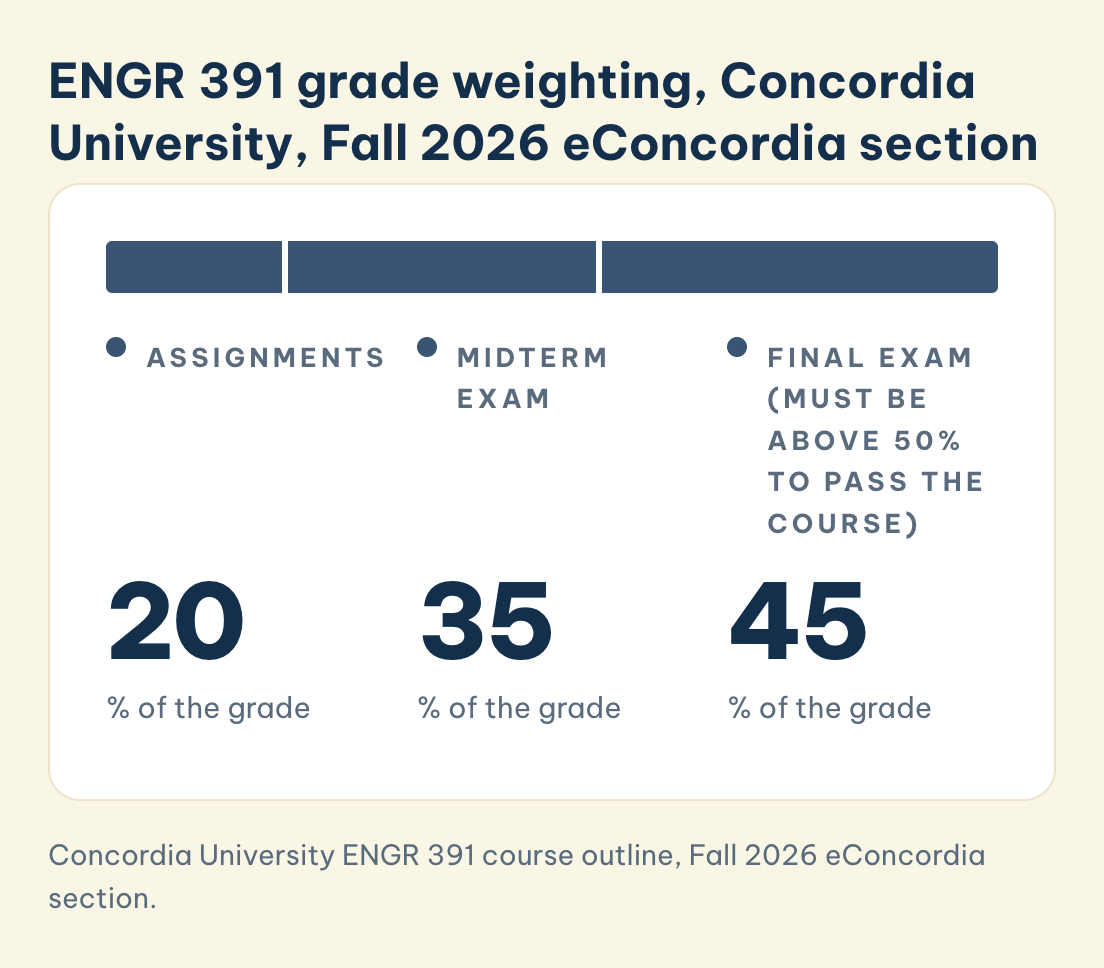
Evidence: The course outline for Fall 2026 lists six assignments, of which Assignment 1 is a training assignment that does not count. Assignments 2 to 6 count, with the lowest dropped, so four assignments share the 20%, roughly 5% each. The midterm is scheduled for Sunday 1 November 2026, 14:00 to 15:30 Montreal time, and covers the first four lessons. The final covers every lesson except Lesson 5, the introduction to machine learning. The outline also states that a student whose total before the final is below 40% and who does not sit the final receives an R grade, which blocks a deferral and means retaking the course.
| Component | Weight | What it covers | Rule that matters |
|---|---|---|---|
| Assignments 2 to 6 | 20% | Most lessons have one, solved in Octave | Lowest of five dropped; Assignment 1 is practice |
| Midterm exam | 35% | Lessons 1 to 4 | 1 November 2026, online, no make-up |
| Final exam | 45% | All lessons except Lesson 5 | Must be above 50% to pass the course |
Example: Other sections and later terms can use a different split, so read your own outline in the first week. A common planning error is to treat the 20% of assignments as optional marks, when the outline itself says exam questions will be "very similar" to assignment questions.
◆ Question 3 / 7 · Code or calculation
Do the exams test code or hand calculation?
Direct answer: Both, in MAAS mentors' reading of the course. The assignments expect you to solve problems in Octave, while the midterm and final are online exams whose questions, the outline says, resemble the assignments. You need to understand what the code is doing, not just have code that runs.
Evidence: The Fall 2026 outline says assignments contain "general knowledge check questions and questions which will require to be solved by calculations", and that students are expected to use Octave. All tests are conducted online, and the course may use Safe Exam Browser, a locked browser that blocks other applications during an assessment; students must complete a practice test with it by the week of 19 October 2026. Where Safe Exam Browser is used, you should not expect to run your own scripts during the exam.
Example: A student who has written a working Newton-Raphson function can still lose marks if asked why the method failed to converge from a given starting point. The code answers "what is the root"; the exam often asks "why did the iteration behave like that", which is a question about the derivative near the starting guess.
◆ Question 4 / 7 · Choosing a method
How do you choose the right method?
Direct answer: Choose by what the problem guarantees and what it costs. Bracketing methods are slow but safe, open methods are fast but can diverge, and every integration or ODE scheme trades step size against error order. Markers look for the reason behind your choice, not only the number it produced.
Evidence: The standard results below appear in any numerical analysis text, including Sauer's Numerical Analysis and Wuthrich and El Ayoubi's 2025 Numerical Methods for Engineering and Data Science, both listed as optional texts for the Fall 2026 section.
| Problem | Simple, robust choice | Faster or more accurate choice | What to state in your answer |
|---|---|---|---|
| Root of f(x) = 0 | Bisection: bracket halves every step | Newton-Raphson: quadratic convergence near the root | Why the bracket or starting guess is valid |
| Linear system Ax = b | Gaussian elimination with partial pivoting | LU decomposition when solving for several b | The condition number, if the system is sensitive |
| Definite integral | Trapezoidal rule, error of order h² | Simpson's 1/3 rule, error of order h⁴ | Step size and an error estimate |
| Initial value ODE | Euler's method, first order and simplest to check | Fourth-order Runge-Kutta | Step size and a check against a smaller step |
Example: Bisection on an interval of length 1 needs about 20 iterations to reach a tolerance of 10⁻⁶, because 2²⁰ is just over one million. Writing that one line of reasoning shows the marker you understand the method's cost, which a bare final answer does not.
◆ Question 5 / 7 · The assignments
How should you use the six assignments?
Direct answer: Treat each assignment as a rehearsal for the exam question it previews. Solve two small cases by hand, then in Octave, and compare the two until you can explain any difference. The marks are modest, but in the Fall 2026 section the understanding they build is what the 80% of exam weight tests.
Evidence: Research on numerical methods courses links weekly preparation with final exam results. Studying 146 students over two semesters of a flipped numerical methods course, the research team reported: "Final examination scores were found to be correlated with the raw score of the adaptive lessons" (Kaw et al., 2019, p. 663). In plain terms, students who scored well on the weekly preparation lessons tended to score well on the final, a correlation rather than proof of cause. Comparing four teaching formats, Clark and Kaw (2020a) reported a Cohen's d of 0.34 for open-ended-response performance in the flipped classroom with adaptive lessons, relative to the other formats, and concluded it may be the best of the four for that course.
Example: The Fall 2026 schedule places Assignment 2 on 25 September and Assignment 3 on 9 October, both before the midterm on 1 November. A student who submits both but copies the method from a worked example has the marks and not the skill, and in our mentors' experience the midterm tends to expose that gap early.
◆ Question 6 / 7 · Midterm and final
How do you prepare for the midterm and final?
Direct answer: Build a one-page card per method with the formula, the stopping criterion, the error order and one failure case, then practise under time pressure without your scripts. In the Fall 2026 section the midterm is 90 minutes on four lessons, so speed on routine steps frees time for the questions that ask you to interpret.
Evidence: The outline states that midterm questions are "very similar to the ones from the assignments" and that the final follows the assignments and midterm in the same way. No make-up exams or assignments are given, and a missed midterm is not replaced. On teaching format, the evidence is more mixed than students tend to assume: Clark and Kaw (2020b) note that an earlier three-school study found differences between blended and flipped instruction in a numerical methods course were not statistically significant, with small effect sizes. The format you are taught in is therefore a weak excuse either way.
Example: A Vietnamese student who studies best alone often reads every lecture slide twice and then struggles with timing. Timed practice on old assignment questions, 20 minutes per question, tends to reveal which steps are still slow; in sessions with MAAS mentors, the pivoting bookkeeping in Gaussian elimination is a frequent one.
◆ Question 7 / 7 · Common errors
What do students most often get wrong?
Direct answer: Three errors recur. Students report too many decimal places without an error estimate, apply a method outside its conditions, and confuse round-off error with truncation error. Each one is a reasoning error rather than an arithmetic slip, which is why partial marks disappear with it.
Evidence: Error analysis opens the course in the calendar description and in Lesson 1 of the Fall 2026 schedule. The course also maps onto two graduate attributes set by the Canadian Engineering Accreditation Board: a knowledge base for engineering at the advanced level, and use of engineering tools at the intermediate level, including awareness of a tool's limitations. A method applied outside its conditions is exactly the kind of limitation that second attribute asks you to recognise.
Example: Truncation error comes from the method itself, such as cutting a Taylor series after two terms, while round-off error comes from finite machine precision. Shrinking the step size h reduces the first and can increase the second, which is why an error curve against h often has a minimum rather than falling forever.
Frequently asked questions
Which university offers ENGR 391 Numerical Methods in Engineering?
Concordia University in Montreal, through the Gina Cody School of Engineering and Computer Science. Other institutions use the code ENGR 391 for unrelated courses, so confirm the title before using any study material.
How many credits is ENGR 391?
It is worth 3 credits, with 3 hours of lecture and 1 hour of tutorial each week, according to the 2026-2027 Undergraduate Calendar.
What are the prerequisites?
ENGR 213 and ENGR 233, plus one programming course from COMP 248, COEN 243, MECH 215, MIAE 215 or BCEE 231.
Do all engineering students take ENGR 391?
No. The Computer Engineering and Software Engineering BEng programs are not required to take it, which is why their Engineering Core is 27.5 credits rather than 30.5.
What software does the course use?
GNU Octave or MATLAB. The Fall 2026 eConcordia outline expects Octave for the assignments.
Is the grading the same in every section?
Not necessarily. This guide uses the Fall 2026 eConcordia section outline, with assignments at 20%, the midterm at 35% and the final at 45%. Check the outline for your own section.
Related reading
- ENGR201 Professional Practice and Responsibility: the other Concordia Engineering Core course, assessed through written ethical reasoning rather than calculation
- MECH371 Analysis and Design of Control Systems: a later Concordia mechanical course where numerical and modelling skills are applied to feedback design
- MECH343 Heat Transfer and Aerodynamics: another engineering subject where the numerical check matters as much as the number
- COMM305 Managerial Accounting: a second Concordia course where most of the grade sits in exams
- FNCE370 Overview of Corporate Finance: calculation-heavy work with a different set of rules
- How to revise for final exams effectively: spaced and mixed practice before a final worth 45% in the Fall 2026 section
Where MAAS fits
- Subject tutoring, one to one: 60 or 90 minute sessions with a tutor matched to your subject area, useful for working through a method you cannot yet explain. Tutoring is advisory, so it carries no grade target; if the tutor is not the right fit, you can ask to change expert
- Coursework and assignment support: developmental feedback on your own draft through the Outline, Draft, Final model with a discipline-matched expert
- Course-code assignment coaching: how MAAS mentors approach any unit assignment
References
- Clark, R. M., & Kaw, A. (2020a). Adaptive learning in a numerical methods course for engineers: Evaluation in blended and flipped classrooms. Computer Applications in Engineering Education, 28(1), 62–79. https://doi.org/10.1002/cae.22175
- Clark, R. M., & Kaw, A. K. (2020b). Benefits of adaptive lessons for pre-class preparation in a flipped numerical methods course. International Journal of Mathematical Education in Science and Technology, 51(5), 713–729. https://doi.org/10.1080/0020739X.2019.1617439
- Kaw, A., Clark, R., Delgado, E., & Abate, N. (2019). Analyzing the use of adaptive learning in a flipped classroom for preclass learning. Computer Applications in Engineering Education, 27(3), 663–678. https://doi.org/10.1002/cae.22106
Tools & resources
- Concordia University. (2026). Section 71.20.5 Degree requirements. In Undergraduate calendar 2026-2027. https://www.concordia.ca/academics/undergraduate/calendar/current/section-71-gina-cody-school-of-engineering-and-computer-science/section-71-20-beng/section-71-20-5-degree-requirements.html
- Concordia University. (2026). Section 71.60 Engineering courses. In Undergraduate calendar 2026-2027. https://www.concordia.ca/academics/undergraduate/calendar/current/section-71-gina-cody-school-of-engineering-and-computer-science/section-71-60-engineering-course-descriptions/engineering-courses.html
- eConcordia. (2026). ENGR 391 Numerical methods in engineering. https://econcordia.com/home/coursedetails.aspx?id=5508
- Wuthrich, R., & El Ayoubi, C. (2025). Numerical methods for engineering and data science. CRC Press. https://doi.org/10.1201/9781003262121
This article is part of the MAAS Journal series for Vietnamese international students. MAAS Assignment & Essay Support is an academic support partner; we coach students through the Outline, Draft, Final delivery model with developmental feedback from discipline-matched experts. We do not write or submit work on a student's behalf.
A free 20-minute consultation is a conversation about where you are with ENGR 391.
Book a free consultation ▸