
◆ Engineering
ENGR301: how do you approach engineering management and economics?
ENGR 301 at Concordia University is easy to underrate, because the economics half looks like simple arithmetic and the management half looks like common sense. Both halves make that assumption expensive. The course is one of ten required courses in the 30.5-credit Engineering Core of the Gina Cody School of Engineering and Computer Science, worth 3 credits with 3 hours of lecture and 1 hour of tutorial a week, and it has no listed prerequisite. This guide explains how MAAS mentors read the course description and what that means for how you practise.
◆ Question 1 / 7 · Course and who takes it
What does ENGR 301 cover, and who has to take it?
Direct answer: ENGR 301 joins two toolkits. The first is project management: delivery systems, the manager's role, organisational charts, cost estimating, planning and control. The second is engineering economics: interest, time value of money, discounted cash flow, project evaluation, depreciation, business tax, decision trees and sensitivity analysis.
The 2026-2027 Undergraduate Calendar (section 71.60) lists exactly those topics, and section 71.20.5 places ENGR 301 among the ten courses of the Engineering Core. That section records exemptions for several other core courses (Computer and Software Engineering skip ENGR 391, Chemical, Mechanical, Industrial and Aerospace Engineering skip ELEC 275), but it lists no exemption for ENGR 301, so every BEng student should expect to take it. The course also carries weight beyond Concordia. The Canadian Engineering Accreditation Board, run by Engineers Canada, names "economics and project management" as one of the 12 graduate attributes an accredited program must show, defined as the ability to incorporate economics and business practices into engineering and "to understand their limitations". ENGR 301 is a natural place for that attribute to be assessed.
Assessment weights, dates and permitted calculators differ between sections and instructors, and no official outline with weights is published openly. Read the outline for your own section in the first week, and treat any grade split you find on a note-sharing site as unverified.
◆ Question 2 / 7 · Cash-flow problems
Why are cash-flow problems harder than they look?
Direct answer: Because the mathematics is simple and the reading is hard. The common errors are placing a cash flow in the wrong period, mixing a nominal rate with an effective one, or choosing the wrong equivalence factor. Drawing a cash-flow diagram before any calculation catches most of them.
Nicholls, Lewis and Eschenbach (2014), three engineering economy instructors writing for the American Society for Engineering Education, describe the trap directly. Such problems usually arrive as word problems, "where a slight change in the wording can dramatically alter the intended interpretation" (Nicholls et al., 2014, p. 2). An end-of-year payment and a beginning-of-year payment look almost identical on the page, yet they sit one period apart on the timeline and produce different present values.
The evidence on self-assessment is sharper still. Kauffmann, Wilck and Lynch (2015) compared 171 students across three engineering economics sections at two universities, matching a self-rating survey against assessed work on 8 learning outcomes, seven of them through shared exam questions. Across all 171 students, self-ratings ran higher than results on equivalence and interest rates, uniform series and present worth analysis, which were covered early in the semester, and lower than results on depreciation, taxes and inflation, which were covered last. The authors suggest the timing of the material may explain the pattern. Either way, the early, familiar material is where confidence ran ahead of accuracy.
A small worked case shows why the diagram matters. A payment of $10,000 received at the end of year 5, discounted at 6% a year, has a present worth of $10,000 ÷ 1.06⁵, about $7,473. Move that same payment to the start of year 5, which is the end of year 4, and the present worth rises to about $7,921. A 12% rate compounded monthly is also not 12% a year: the effective annual rate is 1.01¹² − 1, about 12.68%.
◆ Question 3 / 7 · Choosing a method
How do you choose between present worth, annual worth and IRR?
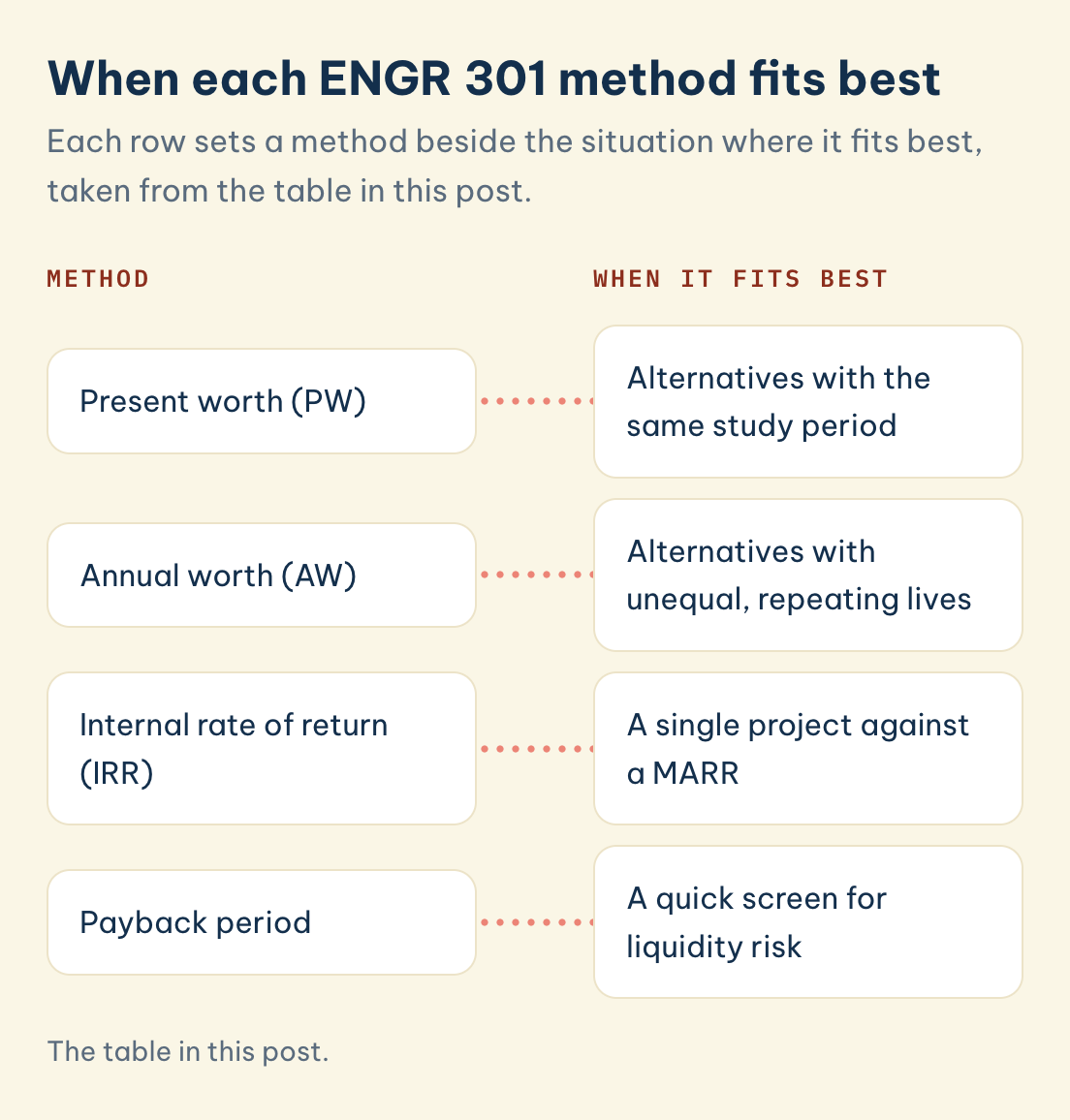
Direct answer: Use present worth when alternatives share a study period, annual worth when their lives differ and repeat, and IRR only with care, because ranking mutually exclusive projects by IRR alone can pick the wrong one. A strong answer gives the reason for the method as well as the number.
When each ENGR 301 method fits best
Each row sets a method beside the situation where it fits best, taken from the table in this post.
Method
When it fits best
Present worth (PW)
Alternatives with the same study period
Annual worth (AW)
Alternatives with unequal, repeating lives
Internal rate of return (IRR)
A single project against a MARR
Payback period
A quick screen for liquidity risk
Save this figure
| Method | When it fits best | What to state in your answer |
|---|---|---|
| Present worth (PW) | Alternatives with the same study period | The discount rate (MARR) and the study period |
| Annual worth (AW) | Alternatives with unequal, repeating lives | The repeatability assumption behind the comparison |
| Internal rate of return (IRR) | A single project against a MARR | For two or more mutually exclusive projects, use incremental IRR |
| Payback period | A quick screen for liquidity risk | That payback ignores cash flows after the payback point |
Annual worth is where many students stall, because the capital recovery factor looks unfamiliar. A $50,000 machine recovered over 5 years at 8% costs about $12,523 a year, since the factor 0.08 × 1.08⁵ ÷ (1.08⁵ − 1) is roughly 0.2505. Once that number is on the page, comparing it against a rival machine's annual cost is a single subtraction.
Incremental IRR deserves its own practice set. Two projects can each clear a 10% MARR, yet the larger one may be better even if its IRR is lower, because the extra investment itself earns more than 10%. This case is worth practising because it separates following a rule from understanding why the rule exists.
◆ Question 4 / 7 · Depreciation and tax
How do depreciation and tax change the numbers?
Direct answer: Depreciation is not a cash flow, but it lowers taxable income, and the tax saving is a cash flow. After-tax analysis therefore needs a depreciation schedule, a tax rate and the timing of each tax effect. In a Canadian course this usually means Capital Cost Allowance (CCA); check whether your section uses it.
The calendar names "depreciation methods" and "business tax regulations" as separate topics. Textbook methods such as straight-line and declining balance describe how an asset's book value falls. The Canada Revenue Agency's CCA system sets the rates that apply for tax: for example, 20% declining balance for Class 8 property such as machinery and furniture, and 4% for most Class 1 buildings acquired after 1987. For a $30,000 Class 8 machine, the normal first-year claim is $6,000. Where the half-year rule applies, that first-year claim is halved to $3,000, although the government has suspended or modified the rule for some classes and periods, so a problem statement should tell you which treatment to use.
The Kauffmann et al. (2015) results suggest students underrate themselves here, which is an argument for practising depreciation and tax problems earlier rather than leaving them for the week before the final.
◆ Question 5 / 7 · Decision trees
How do decision trees and sensitivity analysis appear?
Direct answer: Both handle uncertainty. A decision tree weighs outcomes by probability to give an expected monetary value; sensitivity analysis asks how far one input can move before the decision changes. The interpretation, such as a break-even value, is the part worth writing out in full.
Consider a project with a 60% chance of adding $200,000 in present worth and a 40% chance of losing $100,000. The expected value is 0.6 × 200,000 − 0.4 × 100,000, or $80,000, so the project looks worthwhile on average. Sensitivity analysis then asks the more useful question for a manager: at what probability of success does the expected value fall to zero? Solving 200,000p − 100,000(1 − p) = 0 gives p of about 0.33. If the team's real confidence is close to one in three, the positive expected value is fragile, and saying so in one sentence shows the kind of judgment the graduate attribute on understanding limitations asks for.
◆ Question 6 / 7 · Project management
How do WBS, critical path and earned value questions work?
Direct answer: The project management half is assessed through artefacts you can produce, not definitions you can recite. You should be able to break a project into a work breakdown structure, find the critical path in a network, and compute cost and schedule variances with earned value.
A four-activity network is enough to practise the logic. Suppose activity A takes 3 days, B and C both follow A and take 4 and 6 days, and D follows both B and C and takes 2 days. Path A-B-D takes 9 days and path A-C-D takes 11, so the critical path is A-C-D, the project takes 11 days, and activity B has 2 days of float.
Earned value follows the same pattern of a few definitions applied carefully. Take a project with a budget at completion of $100,000. By week 5 the plan called for $50,000 of work (planned value), 40% of the work is done (earned value of $40,000), and $45,000 has been spent (actual cost). The cost variance is $40,000 − $45,000, or −$5,000, and the schedule variance is $40,000 − $50,000, or −$10,000. The cost performance index is about 0.89 and the schedule performance index 0.80, so the project is both over budget and behind schedule. A strong answer states that conclusion in words after the numbers.
◆ Question 7 / 7 · Exam preparation
How should you prepare for the exams?
Direct answer: Practise with the tools your section allows, under time, and write one sentence of interpretation after every calculation. Confirm early whether interest tables, a financial calculator or a spreadsheet are permitted, because the fastest route to an answer depends on it.
Eschenbach and Lewis (2011), writing in The Engineering Economist, argue that students should be able to use tables, financial calculators and spreadsheets, and that courses can improve by minimising the time spent on tabulated factors. The practical lesson for ENGR 301 is not that any one tool is allowed on your exam; it is that you should know which one is, and rehearse with it until the arithmetic stops consuming your time.
A fast, correct calculation can still leave the question unanswered if it stops before the written conclusion, the one line that says which alternative to choose and why. Building that line into every practice problem is a small habit with a large return.
Frequently asked questions
Which university offers ENGR 301 Engineering Management Principles and Economics?
Concordia University in Montreal, through the Gina Cody School of Engineering and Computer Science. Other institutions use ENGR 301 for unrelated courses, so confirm the title before using any study material.
How many credits is ENGR 301, and does it have prerequisites?
It is worth 3 credits, with 3 hours of lecture and 1 hour of tutorial a week. The 2026-2027 Undergraduate Calendar lists no prerequisite.
Do all BEng students take ENGR 301?
It is one of ten required courses in the Engineering Core, and the calendar lists no program exemption for it, unlike ENGR 391 or ELEC 275.
How is ENGR 301 graded?
Weights differ by section and instructor, and no official outline with weights is published openly. Use the outline for your own section.
Is the course more economics or more management?
The calendar description gives both halves roughly equal space. How your section weights them in assessment is set out in your section outline.
Related reading
- ENGR201 Professional Practice and Responsibility: the other Concordia Engineering Core course, assessed through written ethical reasoning rather than calculation
- ENGR391 Numerical Methods in Engineering: the other Engineering Core course where reasoning about method choice earns the marks
- MGMT3002 Techniques for Business Project Management: critical path and scheduling seen from a business school
- FNCE370 Overview of Corporate Finance: discounted cash flow and capital budgeting in a finance course
Where MAAS fits
- Subject tutoring, one to one: 60 or 90 minute sessions with a tutor matched to your subject area, useful for working through cash-flow or network problems you cannot yet explain. Tutoring is advisory, so it carries no grade target; if the tutor is not the right fit, you can ask to change expert
- Coursework and assignment support: developmental feedback on your own draft through the Outline, Draft, Final model with a discipline-matched expert
- Course-code assignment coaching: how MAAS mentors approach any unit assignment
References
- Eschenbach, T., & Lewis, N. (2011). The roles of tabulated factors, financial calculators, and spreadsheets in engineering economy teaching. The Engineering Economist, 56(4), 283–294. https://doi.org/10.1080/0013791X.2011.624891
- Kauffmann, P. J., Wilck, J., & Lynch, P. C. (2015). Comparison of engineering economics learning outcomes and student perception [Paper presentation]. 2015 ASEE Annual Conference & Exposition, Seattle, WA, United States. https://doi.org/10.18260/p.23717
- Nicholls, G. M., Lewis, N., & Eschenbach, T. (2014). Teaching time value of money: A few winning strategies from the front lines [Paper presentation]. 2014 ASEE Annual Conference & Exposition, Indianapolis, IN, United States. https://doi.org/10.18260/1-2--23105
Tools & resources
- Canada Revenue Agency. (n.d.). Classes of depreciable property. https://www.canada.ca/en/revenue-agency/services/tax/businesses/topics/sole-proprietorships-partnerships/report-business-income-expenses/claiming-capital-cost-allowance/classes-depreciable-property.html
- Concordia University. (2026). Section 71.20.5 Degree requirements. In Undergraduate calendar 2026-2027. https://www.concordia.ca/academics/undergraduate/calendar/current/section-71-gina-cody-school-of-engineering-and-computer-science/section-71-20-beng/section-71-20-5-degree-requirements.html
- Concordia University. (2026). Section 71.60 Engineering courses. In Undergraduate calendar 2026-2027. https://www.concordia.ca/academics/undergraduate/calendar/current/section-71-gina-cody-school-of-engineering-and-computer-science/section-71-60-engineering-course-descriptions/engineering-courses.html
- Canadian Engineering Accreditation Board. (2025). 2025 accreditation criteria and procedures. Engineers Canada. https://engineerscanada.ca/sites/default/files/2025-12/2025-Accreditation_Criteria_Procedures-EN.pdf
This article is part of the MAAS Journal series for Vietnamese international students. MAAS Assignment & Essay Support is an academic support partner; we coach students through the Outline, Draft, Final delivery model with developmental feedback from discipline-matched experts. We do not write or submit work on a student's behalf.
A free 20-minute consultation is a conversation about where you are with ENGR 301.
Book a free consultation ▸