
◆ Business & Management
MGMT3002: why can no one tell you what the report is worth?
Ask three AI assistants what the MGMT3002 report is worth and you get three confident answers. Ask the Australian National University and you get a placeholder. The 2026 course page lists the written report with an oral presentation and then, in the space where a percentage should sit, prints a zero and the sentence that details "will be made available via the Class Summary." The number does not exist yet, and every specific figure circulating online was invented somewhere else.
◆ Question 1 / 6 · Which course
Which MGMT3002 are you enrolled in?
Direct answer: Three Australian universities sit behind codes that look alike. Only one of them is currently teaching under this exact code, and it is the project management version at ANU. The other two belong to organisational change, one of them archived, and neither shares any content with it.
Which course sits behind each look-alike MGMT3002 code
Each row sets a university's code beside the course name, school, credit value, status and subject area, taken from the table in this post.
University and code
Course, school, credit value, status and subject area
ANU MGMT3002
Techniques for Business Project Management, Research School of Management, 6 units, current with a 2026 offering listed, project management and business information systems
Curtin MGMT3002
Managing Change, School of Management, 25 credits, archived 2020 handbook version 1, organisational change
UniSQ MGT3002
Managing Change, School of Business, 1 unit, course synopsis published, organisational change
Save this figure
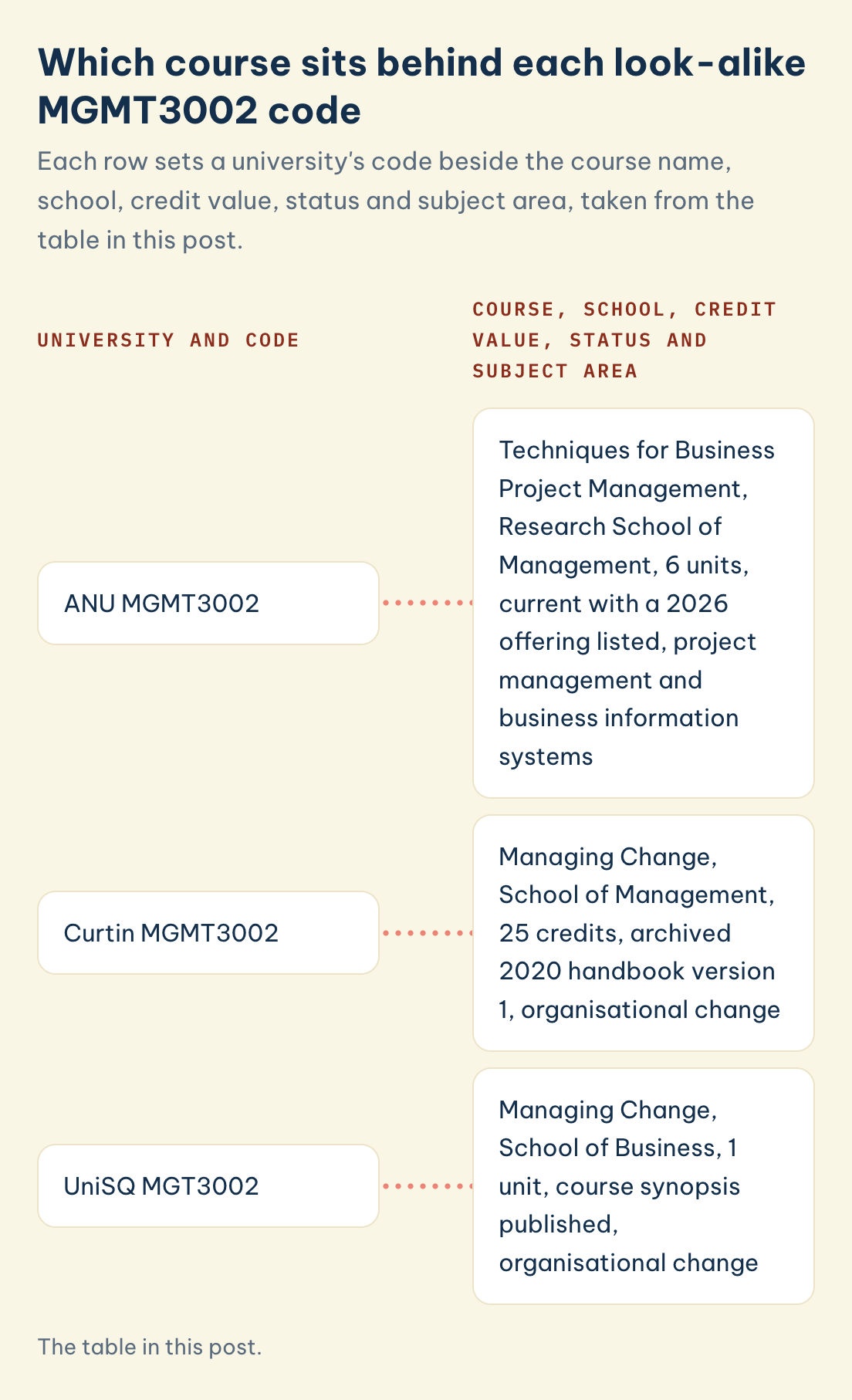
Evidence: The codes look interchangeable and are not. ANU delivers Techniques for Business Project Management through the ANU College of Business and Economics, at a unit value of 6, which is one eighth of a standard full-time year, because ANU counts 1 EFTSL as 48 units and a normal load as eight 6-unit courses. The Curtin entry for MGMT3002 Managing Change carries 25 credits with three contact hours through the School of Management, and it appears in an archived 2020 handbook rather than a current one. UniSQ's MGT3002 Managing Change is a 1-unit course in its School of Business.
That distinction matters more than it looks, because it is the reason so much MGMT3002 material online contradicts itself. A student searching the bare code will land on notes for a change management course, then on notes for a project management course, and the two share no content beyond the discipline label. Confirm the course title on your own enrolment record before you trust any study note that names only the code.
| ANU MGMT3002 | Curtin MGMT3002 | UniSQ MGT3002 | |
|---|---|---|---|
| COURSE NAME | Techniques for Business Project Management | Managing Change | Managing Change |
| SCHOOL | Research School of Management | School of Management | School of Business |
| CREDIT VALUE | 6 units | 25 credits | 1 unit |
| STATUS | Current, 2026 offering listed | Archived 2020 handbook, version 1 | Course synopsis published |
| SUBJECT AREA | Project management, business information systems | Organisational change | Organisational change |
Everything below works from the ANU course, because that is the version currently teaching.
◆ Question 2 / 6 · ANU assessment
What does ANU actually publish about MGMT3002 assessment?
Direct answer: Almost nothing numerical. The 2026 course page lists two assessment lines, one carrying the marker (100) and one carrying (0), both mapped to all six learning outcomes, and both deferring the real detail to the Class Summary released to enrolled students.
Evidence: The first line reads that typical assessments "may include, but is not restricted to: in-class exercises, written and oral assignments, quizzes, examinations, group project tasks, oral presentation, and other assessment deemed appropriate to show attainment of the learning outcomes set for the course." The second names a written report with oral presentation and states that further details, including the percentage value, arrive via the Class Summary. Neither line commits to a weighting, a word count, a referencing style, or a submission format.
That blank is a deliberate design, not an omission. The handbook fixes the learning outcomes and the workload; the convener fixes the assessment each time the course runs. Read against that, the two numbers on the page are structural placeholders rather than real weights, which is exactly the detail that automated summarisers strip out when they rewrite the page.
What ANU does commit to is the shape of the work. Students are expected to commit 130 hours to the course, typically three hours per week in class and at least seven hours per week on reading, research, writing and assessment across the teaching weeks. Enrolment requires at least 72 units already completed, which places MGMT3002 firmly in third year, after two full years of prior study. There are no inherent requirements. In 2026 the course is offered in Second Semester, at Student Contribution Band 34, with a domestic fee-paying rate of $5,520 and a load of 0.125 EFTSL.
◆ Question 3 / 6 · AI engines
What did the AI engines say, and were they right?
Direct answer: They gave specific figures that ANU has not published, and they disagreed with each other. On 9 September 2026 Google's AI Mode returned a 2,500-word limit, a 4,000-word variant for a major group report, and a three-tier penalty schedule, attributing the answer to the Australian National University. Perplexity, answering the same morning, proposed a 2,000-word limit instead.
Evidence: The Google answer was unusually detailed. It stated that reports have "a strict limit of 2,500 words (including tables)", that a 2024 iteration set 4,000 words for the primary comprehensive report, and that exceeding the shorter cap draws a 5% penalty at 200 to 250 words over, 10% at 251 to 300, and 20% beyond that, with examiners simply ceasing to mark past 4,000 words on the longer format. It added that marking grids are published on Canvas in Week 4 and that referencing is "typically" Harvard. Perplexity, working from a different source set, suggested structuring the report "to hit every rubric point while staying under the 2000-word limit."
None of that appears on the ANU page. The word limits differ between the two engines, the penalty schedule has no published counterpart, and the referencing style is hedged with "typically" while ANU names no style at all. The sources Perplexity leaned on are visible in its own citation list and include Studocu and two commercial writing sites, which is where numbers of this kind usually originate: a real word limit, from a real course, at a different university, repeated until it acquires the authority of a fact.
The practical lesson is narrow and worth stating plainly. An assistant that cannot see your Class Summary will fill the gap with the most common number in its training data, and it will present that number without any signal that it was reconstructed rather than retrieved. Sadler (2005) argued that criteria-based grading only works when students hold the same interpretation of the criteria as the marker; a fabricated word limit installs a different interpretation before you write your first paragraph.
◆ Question 4 / 6 · Learning outcomes
What do the learning outcomes tell you about the marking?
Direct answer: Four of the six outcomes are analytical verbs and only one is descriptive, which signals a rubric weighted towards critique rather than explanation. The published outcomes ask students to describe context, examine contemporary issues, apply tools, critically analyse frameworks, appraise a strategic perspective, and produce a report in written and verbal forms.
Evidence: Read the verbs in order and the hierarchy is visible. "Describe" appears once, attached to the organisational context in which projects operate. Everything after that escalates: examine contemporary issues in project management both globally and in Australia, apply tools and techniques to monitor and control projects, critically analyse project management frameworks and tools, appraise a strategic perspective on the linkages between organisational and project-level issues. The final outcome, producing a report in written and verbal forms, is what pairs the written submission with the oral presentation.
The course introduction reinforces the same emphasis. It states that the focus is on "the development, use and integration of management tools and their adjustment to the project environment," and that throughout the course the emphasis falls on taking a managerial view of the situation and implementing tools to support decision making. Adjustment and integration are the operative words. A report that presents a clean Gantt chart, a tidy work breakdown structure and a risk register, with no argument about why those tools suit this project and what they miss, has satisfied the descriptive outcome and none of the analytical ones.
Research on project management teaching makes the same point about where the learning sits. One study of project management teaching states that "By immersing students in realistic and collaborative scenarios, gamified environments foster the development of strategic competencies and adaptive problem-solving behaviours crucial for successful portfolio management" (El Raoui et al., 2025, p. 1). The competency is built by working inside a scenario, not by summarising the tool that describes it, and that is the same distinction the MGMT3002 outcomes draw between describing and appraising.
Jonsson and Svingby (2007), reviewing the rubric literature, found that rubrics improve marking consistency mainly when the criteria describe qualities of reasoning rather than presence of components. That is the gap most third-year project reports fall into: the components are all present and the reasoning about them is thin.
◆ Question 5 / 6 · Building the report
How should you build the report before the brief arrives?
Direct answer: Work on the parts that cannot change. The case analysis, the choice of tools, the argument for that choice and the academic grounding behind it are all yours to draft regardless of weighting. Only the formatting, the length and the submission rules have to wait for the Class Summary to appear.
Evidence: Splitting the work this way protects you from the failure mode the AI answers create, which is planning a report around an invented constraint. The stable elements come from the outcomes themselves. You will need a defined project context, because outcome one requires it. You will need at least one contemporary issue positioned against both the global and the Australian setting, because outcome two names both. You will need applied tools with monitoring and control evidence, and a critique of the frameworks those tools come from.
Winter et al. (2006), reporting the findings of a UK government-funded research network on project management, argued that the field's classical models under-describe the messy, political reality of actual projects, and that practitioners need to treat frameworks as partial rather than complete. That argument is directly usable in the critique section of a MGMT3002 report, because it gives you a published basis for saying where a tool stops working rather than merely applying it. Similarly, Mitchell, Agle and Wood (1997) provide a defensible theory of stakeholder salience, built on power, legitimacy and urgency, if your case requires a stakeholder analysis that goes past a two-by-two grid.
| STABLE BEFORE THE BRIEF | WAITS FOR THE CLASS SUMMARY |
|---|---|
| Choice and definition of the project case | Word limit and what counts towards it |
| Which tools you apply, and your argument for them | Percentage weighting of report versus presentation |
| Critique of the frameworks behind those tools | Referencing style and formatting rules |
| Academic sources supporting your analysis | Individual or group submission |
| The Australian and global issue framing | Submission date and late penalty |
A reasonable sequence is to spend the early weeks reading the case and the literature, drafting the analysis sections first, and leaving the introduction and any executive summary until the structure is settled. Nicol and Macfarlane-Dick (2006) set out seven principles of good feedback practice, and the one that applies here is self-regulation: students who check their own draft against explicit criteria improve more than students who wait to be told. You cannot do that against a rubric you do not have, but you can do it against the six published learning outcomes, which are available now.
◆ Question 6 / 6 · Failure modes
What are the common failure modes in a project management report?
Direct answer: Three failures recur. The first is describing what a tool is instead of applying it to the case in front of you. The second is recommending an action with no analytical basis anywhere in the report. The third, and the most costly, is treating project success as self-evident rather than as something the report has to define.
Evidence: The third one is the least recognised and the most costly. Ika (2009), reviewing how project success has been treated across project management journals, showed that the field has repeatedly shifted its definition of success, from the classical iron triangle of time, cost and scope towards measures that include stakeholder satisfaction and strategic benefit. A report that judges a project purely on schedule and budget adherence is applying one definition without acknowledging that it chose one, and outcome five asks specifically about the linkage between organisational and project-level issues, which is precisely where the narrow definition breaks.
The other two failures are visible in structure. If a section opens by explaining what a work breakdown structure is, in general terms, it is teaching the marker something the marker already knows. Turn that around: apply the structure to the case, then spend the paragraph interpreting what the result reveals about the project. Recommendations follow the same rule. "Improve communication" is a category, not a recommendation; naming who communicates what, to which stakeholder group, at what point in the schedule, and what your analysis predicts it will change, is a recommendation.
The oral presentation deserves its own preparation rather than a slide dump of the report. Outcome six pairs written and verbal forms deliberately, which suggests that the two are assessed as distinct competencies even when they share content.
Frequently asked questions
Is ANU MGMT3002 the same course as Curtin MGMT3002?
No. ANU's MGMT3002 is Techniques for Business Project Management, worth 6 units through the Research School of Management. Curtin's MGMT3002 is Managing Change, a 25-credit unit that appears in an archived 2020 handbook. They share a code and nothing else, so study notes found by code alone may belong to the wrong course entirely.
What is the word limit for the MGMT3002 report?
ANU does not publish one on its course page. The figures circulating online, including 2,000, 2,500 and 4,000 words, come from AI summaries and third-party study sites rather than from ANU, and they contradict each other. Your Class Summary is the only source that applies to your semester.
How much is the report worth?
The course page shows a placeholder rather than a weighting, and states that the percentage value will be made available via the Class Summary. Any specific percentage you find elsewhere was not published by ANU.
What prerequisites does MGMT3002 have?
You must have completed at least 72 units to enrol, which normally means two full years of study. The course lists no inherent requirements, and in 2026 it is offered in Second Semester.
How much time should I plan for MGMT3002?
ANU states an expected commitment of 130 hours across the course, typically three hours per week in class plus at least seven hours per week on reading, research, writing and assessment during teaching weeks.
If you are working through a third-year project management report and want a mentor to review your analysis before you submit, our academic support team works with students on structure and argument. You can also read our guide on how to approach an architecture design studio for a related take on project-based assessment.
References
El Raoui, H., Finn, D., Melissourgos, A., & Garnier Artinano, A. (2025). A gamified approach to teaching project portfolio management [Conference paper]. ICERI2025 Proceedings. https://strathprints.strath.ac.uk/95195/
Ika, L. A. (2009). Project success as a topic in project management journals. Project Management Journal, 40(4), 6–19. https://doi.org/10.1002/pmj.20137
Jonsson, A., & Svingby, G. (2007). The use of scoring rubrics: Reliability, validity and educational consequences. Educational Research Review, 2(2), 130–144. https://doi.org/10.1016/j.edurev.2007.05.002
Mitchell, R. K., Agle, B. R., & Wood, D. J. (1997). Toward a theory of stakeholder identification and salience: Defining the principle of who and what really counts. Academy of Management Review, 22(4), 853–886. https://doi.org/10.2307/259247
Nicol, D. J., & Macfarlane-Dick, D. (2006). Formative assessment and self-regulated learning: A model and seven principles of good feedback practice. Studies in Higher Education, 31(2), 199–218. https://doi.org/10.1080/03075070600572090
Sadler, D. R. (2005). Interpretations of criteria-based assessment and grading in higher education. Assessment & Evaluation in Higher Education, 30(2), 175–194. https://doi.org/10.1080/0260293042000264262
Winter, M., Smith, C., Morris, P., & Cicmil, S. (2006). Directions for future research in project management: The main findings of a UK government-funded research network. International Journal of Project Management, 24(8), 638–649. https://doi.org/10.1016/j.ijproman.2006.08.009
Tools & resources
Australian National University. (2026). Techniques for Business Project Management (MGMT3002). Programs and Courses. https://programsandcourses.anu.edu.au/2026/course/MGMT3002
A free 20-minute consultation is a conversation about where you are with MGMT3002.
Book a free consultation ▸