
◆ Business & Management
MGMT10002 Principles of Management: critique theories for marks
In MGMT10002 Principles of Management at the University of Melbourne, 80% of your grade is earned alone: a 1000-word individual assignment worth 10%, five quizzes worth 4% each, and a two-hour exam worth 50%. The group assignment carries the remaining 20%. Across all four tasks, the third learning outcome asks you to "identify and critique management approaches", and critique is the skill most first-year answers leave out.
◆ Question 1 / 7 · The subject
What is MGMT10002, and who takes it?
Direct answer: MGMT10002 Principles of Management is a level 1 undergraduate subject worth 12.5 points, taught on campus at Parkville in Semester 1 and Semester 2 (University of Melbourne, 2026). It has no prerequisites, runs as one 2-hour lecture and one 1-hour tutorial per week, and the 2026 Handbook sets a total time commitment of 170 hours.
Evidence: At 12.5 points, MGMT10002 is a standard full subject, and 170 hours works out to far more than the 3 contact hours each week, so most of the load is independent reading. The subject is also offered as breadth in the Bachelor of Arts, Bachelor of Science, Bachelor of Biomedicine, Bachelor of Design and Bachelor of Music, so your tutorial may mix commerce students with people who have never read a management textbook. The 2026 Handbook organises the content into four domains. Managing self covers personal motivation, creativity and purpose. Managing others covers teams, conflict, diversity and leadership. Managing organisations covers the role of firms, new businesses, competitive advantage and social purpose. Managing eco-systems covers value chains, innovation and stakeholder management.
In Semester 2, 2026 the teaching period runs from 27 July to 25 October 2026, with Professor Danny Samson as principal coordinator. The census date was 31 August 2026, the last date to withdraw without fail is 25 September 2026, and the assessment period ends on 20 November 2026.
The code has a history worth knowing when you search for old notes. Between 2010 and 2013 the Handbook listed MGMT10002 as Managing and Leading Organisations, assessed by a 2-hour examination worth 50% and assignments of up to 5000 words worth 50%. Notes from that era describe a different subject under the same code.
◆ Question 2 / 7 · Assessment
How is MGMT10002 assessed in 2026?
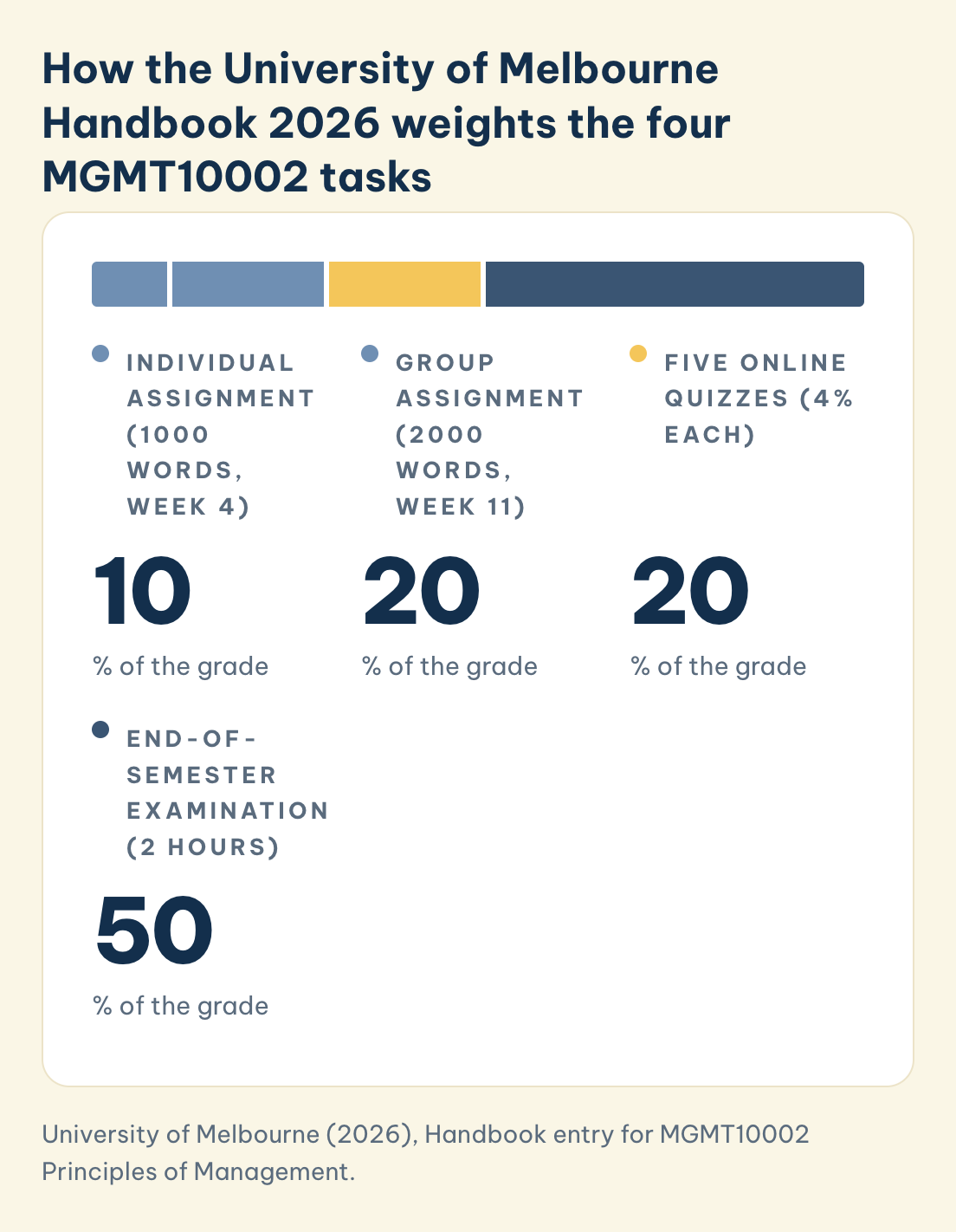
Direct answer: Four tasks count (University of Melbourne, 2026). An individual assignment of 1000 words is worth 10% in Week 4. A group assignment of 2000 words, for groups of 3 to 5 students, is worth 20% in Week 11. Five online quizzes are worth 4% each, 20% in total. A two-hour end-of-semester examination is worth 50%.
How the University of Melbourne Handbook 2026 weights the four MGMT10002 tasks
These are the weights the Handbook lists for MGMT10002, shown as a share of the grade.
Individual assignment (1000 words, Week 4)
10
% of the grade
Group assignment (2000 words, Week 11)
20
% of the grade
Five online quizzes (4% each)
20
% of the grade
End-of-semester examination (2 hours)
50
% of the grade
Save this figure
| Task | Weight | Timing | Size in the Handbook |
|---|---|---|---|
| Individual assignment | 10% | Week 4 | 1000 words |
| Group assignment | 20% | Week 11 | 2000 words, groups of 3 to 5 students |
| Five online quizzes | 20% (4% each) | Throughout the semester | 750 words equivalent |
| End-of-semester examination | 50% | Examination period | 2 hours |
Evidence: The 2024 Handbook lists exactly the same four tasks, weights and word counts, so this structure has held for at least 3 years. That stability helps you in one way: past students' descriptions of the task types are probably still accurate. It does not settle the details. When MAAS asked Google AI Mode about MGMT10002 on 14 September 2026, it named quiz weeks, a quiz length and an exam format that it drew from student note-sharing sites, and none of those details appear in the Handbook. Perplexity stayed with the Handbook figures. Your Canvas subject guide for the current semester is the document that binds the marker.
What to do about it: Read the weighting as a signal about where to spend effort. The exam alone is worth 5 times the individual assignment, and the quizzes are worth as much as the group report. A student who treats the quizzes as optional reading checks gives away a fifth of the grade.
◆ Question 3 / 7 · Critique over description
Why does MGMT10002 reward critique over description?
Direct answer: Because three of the five learning outcomes ask for more than recall. Outcome 2 asks you to apply theories to generate realistic recommendations, outcome 3 asks you to critique management approaches, and outcome 5 asks you to appraise frameworks for their impact on organisational performance. A 1000-word answer that only defines a theory meets outcome 1 and stops there.
Evidence: The first outcome, describing basic theories and models, is the only one a summary can satisfy. The generic skills listed in the Handbook point the same way: problem solving is fostered through case studies "where students have to apply theoretical material to a mixture of hypothetical and real-world case studies". Perplexity gave the same advice when MAAS tested it, telling students not to spend most of the word count defining concepts.
The word limit makes the choice sharper. In 1000 words, a student who spends 400 words explaining a model has 600 words left for application and evaluation. A student who defines the model in 2 sentences and moves straight to its assumptions has almost the whole assignment for the part that earns the higher outcomes.
What to do about it: Before you write, turn the question into three smaller ones. What does this theory assume about people or organisations? Where has research tested that assumption? In which situation would a manager who follows the theory make a worse decision?
◆ Question 4 / 7 · Critiquing a theory
How do you critique a management theory without just listing weaknesses?
Direct answer: Attack the evidence and the assumptions, not the theory's age. Wahba and Bridwell (1976) reviewed studies of Maslow's need hierarchy and found "only partial support for the concept of need hierarchy". Mintzberg (1975) compared the textbook picture of the manager with observed managerial work. Each critique says what the theory predicts and where observation departs from it.
Evidence: Wahba and Bridwell (1976) examined ten factor-analytic studies and three ranking studies. Cross-sectional studies showed no clear evidence for Maslow's claim that deprived needs dominate behaviour, except for self-actualisation, and longitudinal studies gave no support to the claim that satisfying one need activates the next. That is a far stronger point than "Maslow is outdated", because it names the specific proposition that failed.
Mintzberg (1975), writing in Harvard Business Review, set what he called folklore about managers against fact. The folklore pictures a reflective, systematic planner, the manager of the planning, organising, leading and controlling model. The managers he observed worked in brief, varied and fragmented episodes, and he described their work through ten roles. The article won the McKinsey Award for the best Harvard Business Review article of 1975.
Ghoshal (2005) pushed critique one level higher. He argued that "by propagating ideologically inspired amoral theories, business schools have actively freed their students from any sense of moral responsibility". His target was not a single model but the assumptions shared by many, especially the exclusion of human intention and choice. That argument connects directly to the social purpose topics in the managing organisations domain.
What to do about it: Build each critical paragraph in four moves: state the claim the theory makes, cite the evidence that tests it, give the condition under which it fails, and say what a manager should do instead in your case.
◆ Question 5 / 7 · Recommendations
What does a strong MGMT10002 recommendation look like?
Direct answer: A strong recommendation follows from a diagnosis, names who acts, and admits a trade-off. Outcome 2 asks for "realistic solutions and recommendations", so advice such as "the manager should use transformational leadership" scores poorly unless the case evidence explains why that style fits and what it would cost.
Example: Suppose a case describes a retail team with high turnover after a restructure. A descriptive answer lists Herzberg's hygiene factors and motivators. A critical answer notes that pay and job security, both hygiene factors, changed in the restructure, recommends restoring clarity about roles before adding recognition schemes, and then admits the limit of the diagnosis: a case study rarely gives enough data to separate a motivation problem from a leadership one.
Evidence: Outcome 4 adds a second test. It asks you to analyse the external and internal environments that affect the organisation and evaluate their influence on innovation and entrepreneurship. Recommendations that ignore the environment, such as proposing expansion during a documented supply shortage, fail that outcome even when the theory is applied correctly.
◆ Question 6 / 7 · Group assignment
How should a group of 3 to 5 students run the group assignment?
Direct answer: Plan for uneven contribution, because the 2000-word report is shared by up to 5 people. Aggarwal and O'Brien (2008) found that "the incidence of social loafing increases with the scope of the project and the size of the student group" (Aggarwal & O'Brien, 2008, p. 255). Hall and Buzwell (2013) found free-riding was the greatest group work concern across disciplines.
Evidence: Hall and Buzwell (2013) surveyed 205 students from all faculties and analysed their free-text answers. They reported that non-contribution was not always apathy: some willing students fell behind for other underlying reasons. Aggarwal and O'Brien (2008) also found that multiple peer evaluations during a project reduced social loafing. The MGMT10002 Handbook entry does not say how group marks are distributed, so check your Canvas guide before you assume every member receives the same mark.
A second risk is structural. A group of 5 that splits 2000 words into five 400-word sections tends to produce five mini-essays using five different frameworks. Markers read that as a list of theories, not an argument.
What to do about it: Agree on one central diagnosis of the case in your first meeting, then allocate sections that each support that diagnosis. Set an internal deadline several days before Week 11, and give one member the job of editing the whole report for a single line of reasoning. If a member stops responding, raise it with your tutor early rather than in the final week.
◆ Question 7 / 7 · The exam
How should you prepare for the two-hour exam worth 50%?
Direct answer: Prepare to apply and evaluate theories under time pressure, not to reproduce definitions. The exam is worth half the subject, and the learning outcomes it tests include applying theories to organisational problems and appraising frameworks. Build each topic summary around assumptions, evidence and limits, so that you can critique a theory within a timed answer.
Evidence: The Handbook does not publish the exam format, and the formats that circulate on note-sharing sites cannot be checked against it. What the Handbook does fix is the scope: the four domains, from personal motivation through to stakeholder management, and five learning outcomes. A summary sheet per topic that records the theory's purpose, its key assumption, one study that tested it, one limitation and one short example covers every outcome from description to appraisal.
What to do about it: Use the quizzes as practice for the exam. After each quiz, write one paragraph explaining which theory best fits a situation from that week and why an alternative theory fits it less well. Across 5 quizzes, that gives you 5 practised critical paragraphs before the examination period.
Frequently asked questions
What is the MGMT10002 assessment breakdown in 2026?
The individual assignment is worth 10%, the group assignment 20%, five online quizzes 20% in total, and the end-of-semester examination 50%. The 2024 Handbook lists the same structure.
Does MGMT10002 have prerequisites?
No. The 2026 Handbook lists no prerequisites, corequisites or non-allowed subjects, and the subject is available as breadth in several bachelor degrees.
How many students are in an MGMT10002 group?
The Handbook sets groups of 3 to 5 students for the 2000-word group assignment. Check your Canvas subject guide for how groups are formed and how the mark is shared.
Is it too late to withdraw from MGMT10002 in Semester 2, 2026?
The Handbook lists 25 September 2026 as the last date to withdraw without fail. Withdrawal after the census date still counts toward the Student Learning Entitlement for Commonwealth Supported students.
Does MAAS write MGMT10002 assignments for students?
No. MAAS works as an academic advisor. A mentor can help you practise turning a theory into a critique and a recommendation, so that you write your own assignment and sit the exam yourself.
Related reading
For another first-year organisational subject, see our guide to MGMT1135 Organisational Behaviour, which asks why evidence should outrank intuition. For a postgraduate foundations course, read BUSM40005 Foundations of Management. If you want regular practice building critical answers, our 1-on-1 university subject tutoring pairs you with a mentor for weekly problem sets.
References
Aggarwal, P., & O'Brien, C. L. (2008). Social loafing on group projects: Structural antecedents and effect on student satisfaction. Journal of Marketing Education, 30(3), 255–264. https://doi.org/10.1177/0273475308322283
Ghoshal, S. (2005). Bad management theories are destroying good management practices. Academy of Management Learning & Education, 4(1), 75–91. https://doi.org/10.5465/amle.2005.16132558
Hall, D., & Buzwell, S. (2013). The problem of free-riding in group projects: Looking beyond social loafing as reason for non-contribution. Active Learning in Higher Education, 14(1), 37–49. https://doi.org/10.1177/1469787412467123
Mintzberg, H. (1975). The manager's job: Folklore and fact. Harvard Business Review, 53(4), 49–61.
University of Melbourne. (2026). Principles of Management (MGMT10002). The University of Melbourne Handbook. https://handbook.unimelb.edu.au/2026/subjects/mgmt10002
Wahba, M. A., & Bridwell, L. G. (1976). Maslow reconsidered: A review of research on the need hierarchy theory. Organizational Behavior and Human Performance, 15(2), 212–240. https://doi.org/10.1016/0030-5073(76)90038-6
Tools & resources
- University of Melbourne Handbook 2026, MGMT10002 assessment for the task weights and word counts
- University of Melbourne Handbook 2026, MGMT10002 overview for the four domains and learning outcomes
- University of Melbourne Handbook 2026, MGMT10002 dates and times for census and withdrawal dates
- University of Melbourne Handbook 2024, MGMT10002 assessment for the earlier, identical structure
A free 20-minute consultation is a conversation about where you are with MGMT10002.
Book a free consultation ▸