
Most first-year business units start from zero. Organisational behaviour does not. Students arrive already holding views about motivation, personality, teamwork and leadership, absorbed from popular management books and workplace training. Much of that inheritance is not supported by evidence, and some of it has been directly contradicted, which is why the unit treats an evidence-based approach as a stated learning outcome rather than an assumption. It teaches students to ask where a claim came from.
Author: MAAS Editorial Team · Reviewed by a MAAS subject mentor
Last updated: 2026-08-12
Category: business-management

What is the unit, and where does it sit?
Direct answer: At the University of Western Australia, MGMT1135 is Organisational Behaviour, a Level 1 unit available in non-standard teaching periods and both semesters, taught by Management and Organisations. It is incompatible with MGMT2235, and is a core unit of the Bachelor of Commerce alongside ACCT1101, ECON1101 and MKTG1203. Contact is up to 3 hours a week.
Evidence: Its structural importance shows up in what depends on it. MGMT1135 is a prerequisite for HRMT2237 Human Resource Management, INMT2232 Project Management, MGMT2311 Organisational Learning and Innovation, MGMT2341 International Management and EMPL2202 Australian Employment Relations. A first-year unit gating five different Level 2 units is not an introductory formality.
Example: A student planning a human resource management major treated this unit as general background to be passed and moved past. Two years later the habits it was supposed to install, particularly asking what evidence sits behind a management claim, were the habits her Level 3 assignments assumed she had.
What are the learning outcomes actually asking for?
Direct answer: MGMT1135 lists six learning outcomes, including explaining OB theories across cultures, describing evidence-based management, and interpreting problems at the individual, interpersonal or group level. They separate interpreting, analysing and creating as distinct operations, each tested through participation, assignments and the examination, so satisfying one outcome does not cover the rest.
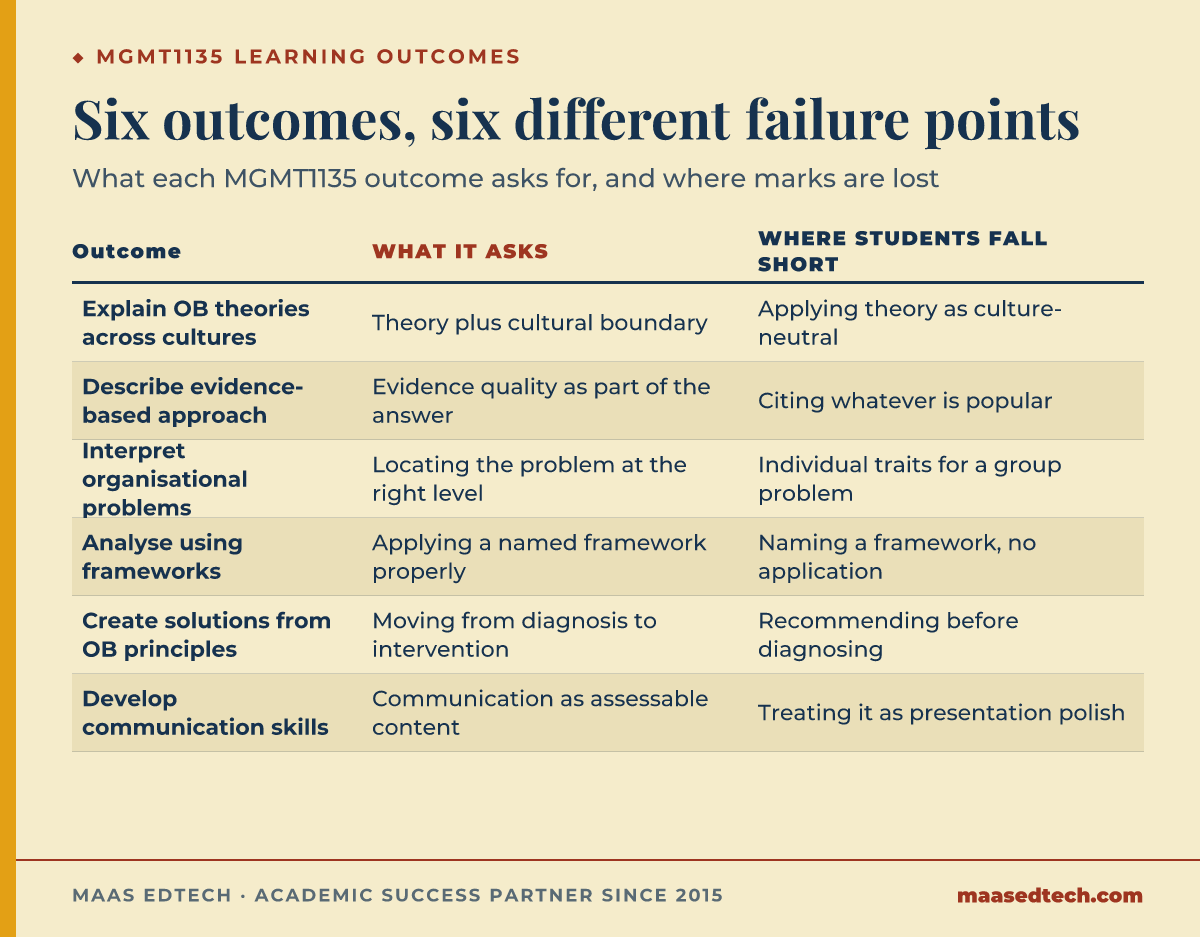
| Outcome | What it asks | Where students fall short |
|---|---|---|
| Explain OB theories and concepts across cultures and nations | Theory plus cultural boundary conditions | Applying a theory as if it were culture-neutral |
| Describe the importance of an evidence-based approach | Treating evidence quality as part of the answer | Citing whatever is popular |
| Interpret organisational problems in terms of individual, interpersonal and group processes | Locating the problem at the right level | Explaining a group problem with individual traits |
| Analyse problems using established theoretical frameworks | Applying a named framework properly | Naming a framework and then arguing without it |
| Create solutions through well-researched OB principles | Moving from diagnosis to intervention | Recommending before diagnosing |
| Develop oral and written communication skills | Communication as assessable content | Treating it as presentation polish |
Evidence: Note that the outcomes separate interpreting, analysing and creating. Those are three distinct operations, and the assessment structure of participation, assignments and examination gives each of them somewhere to be tested. A submission that interprets a case well and stops has satisfied one outcome out of three that the assignment is likely reaching for.
Example: Given a case about a team missing deadlines, one student diagnosed low conscientiousness among members and recommended hiring differently. Another asked whether the problem was individual at all, identified a coordination and role-clarity failure at the group level, and proposed an intervention aimed there. The second answer used the third outcome as the outcome intends.
Why does "evidence-based" appear in a first-year outcome at all?
Direct answer: Because management as a field has a documented gap between what research shows and what practice does, the gap Rousseau (2006) named in her presidential address, and business graduates have historically been part of the problem rather than the correction.
Evidence: The idea has a specific origin students can cite. Rousseau (2006), in her Academy of Management presidential address, examined the promise organisational research offers for management practice and how it falls short, using evidence-based medicine as the exemplar for closing what she called the research–practice gap, the failure of organisations and managers to base practices on the best available evidence. Reviewing the field a decade later, Rynes and Bartunek (2017) trace how the movement developed and report a finding worth remembering: a survey of more than 800 syllabi from required courses in management programs found only about 26% appeared to be teaching evidence-based management principles, with the proportion higher in organisational behaviour courses, where it reached roughly 48% (Charlier et al., 2011, as cited in Rynes & Bartunek, 2017).
Read that second figure carefully. Organisational behaviour is the best-performing course type on this measure, and it still sits below half. Your unit naming the outcome explicitly puts it in a minority.
Example: A student wrote an assignment recommending a personality assessment to improve team composition, citing a consultancy white paper. A stronger submission made a similar recommendation but noted which measures have peer-reviewed validity evidence behind them and which are popular without it. Same recommendation, entirely different standard of argument.
What does a discredited claim look like, and how do you handle one?
Direct answer: Carefully, and with the literature rather than with confidence, the standard Pashler et al. (2008) apply to the learning-styles debate. The most useful skill is not knowing which popular ideas are wrong, but knowing how to check, and being willing to report a mixed picture when that is what you find.
Evidence: Learning styles are the standard illustration, and the way the debate has moved is more instructive than the headline. Pashler et al. (2008) set out what evidence would be required to validate learning-styles-based instruction, specifically a crossover interaction where the instructional method best for one style group is not the method best for another, and concluded that they could find virtually no evidence meeting that standard, with several well-designed studies contradicting the hypothesis outright. In their own words, they concluded that "the literature fails to provide adequate support for applying learning-style assessments in school settings" (Pashler et al., 2008, p. 116). That conclusion became widely repeated as settled. Yet the question has continued to be examined, and later meta-analytic work reports a small effect while still finding that most learning outcomes show no crossover interaction, and that studies which did show one largely failed quality standards.
Example: A student wrote that learning styles have been debunked, full stop. A better paragraph said that the evidence required to justify tailoring instruction to learning styles has not been produced, that the strongest claims made for the idea are unsupported, and that this is different from proving no effect exists anywhere. The second version is more accurate and demonstrates the second learning outcome instead of merely gesturing at it.
How do you handle the cross-cultural outcome without stereotyping?
Direct answer: By treating culture as a boundary condition on a theory rather than as a set of national characteristics you attach to people. The outcome asks you to explain theories across cultures, which is a question about where a finding holds.
Evidence: Most foundational OB research was conducted in a narrow band of contexts, so the honest question for any theory is where it has been replicated and where it has not. That framing is defensible and evidence-led. Listing traits by nationality is neither, and it also fails the ethical dimension the Management major separately names.
Example: Asked to apply a motivation theory in an international subsidiary, a weaker answer asserted that employees in that country are motivated by group harmony. A stronger one asked which components of the theory have cross-cultural support, noted where the evidence is thinner, and proposed how the organisation could find out rather than assume.
A practical order of work
Direct answer: Trace each framework's origin and evidence before diagnosing the level of the problem, individual, interpersonal or group. Separate diagnosis from recommendation, check whether a popular claim has peer-reviewed support, report mixed evidence as mixed rather than a debunking, and treat the communication outcome as marked content, not polish.
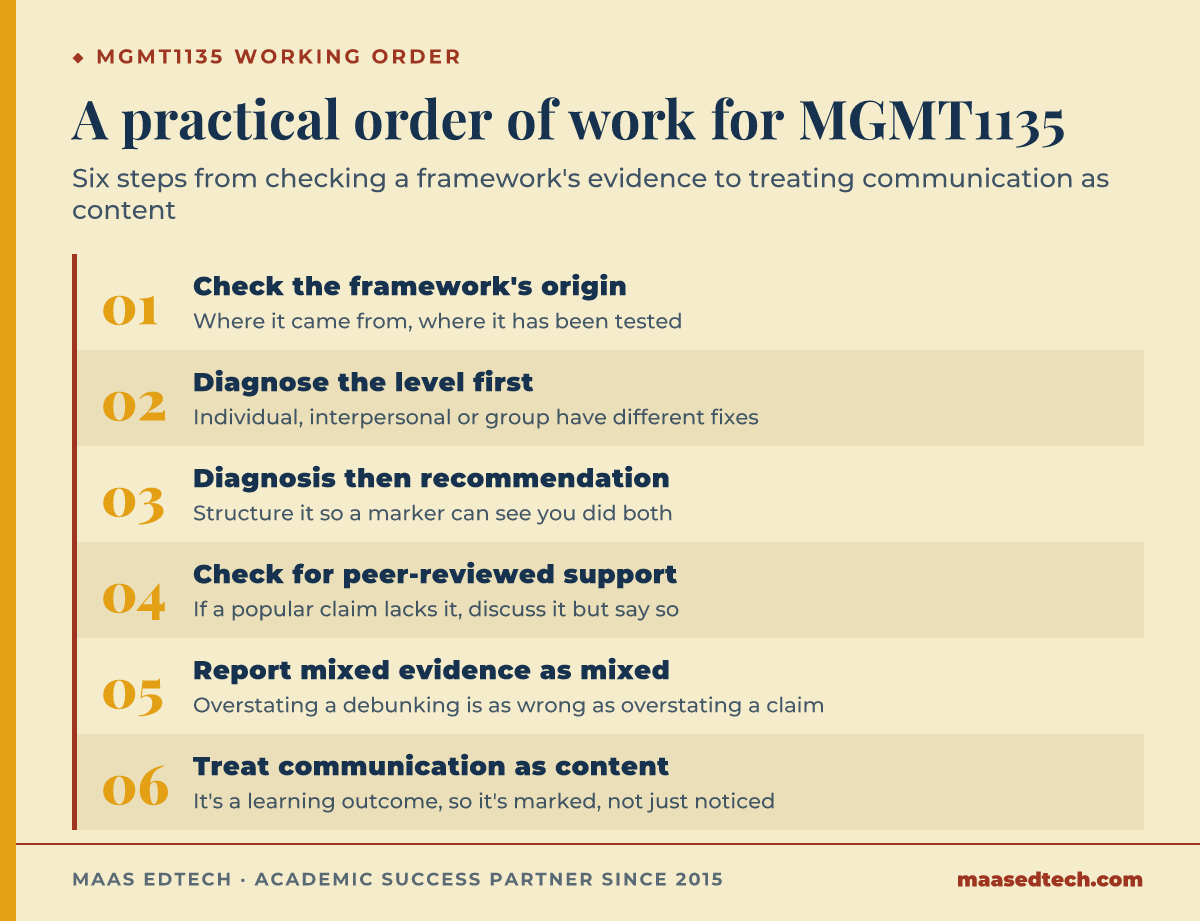
- Before using any framework, write one line on where it came from and one line on where it has been tested.
- Diagnose the level before choosing the theory. Individual, interpersonal and group problems have different explanations and different fixes.
- Separate the diagnosis from the recommendation in your structure, so a marker can see you did both.
- When you cite something popular, find out whether it has peer-reviewed support. If it does not, you can still discuss it, but say so.
- Report mixed evidence as mixed. Overstating a debunking is the same error as overstating a claim.
- Treat the communication outcome as content. It is listed as a learning outcome, which means it is being marked, not just noticed.
Frequently asked questions
Is organisational behaviour an easy unit because it has no maths?
It has no calculation, which is not the same as being easy, and Rynes and Bartunek (2017) would say the argument-quality problem is exactly what the evidence-based management movement was built to fix. The difficulty sits in argument quality, and specifically in resisting the plausible-sounding explanation that has no evidence behind it.
Can I use examples from my own work experience?
Usually yes, and it often strengthens an answer, but personal experience is an illustration rather than evidence, the same distinction Rynes and Bartunek (2017) draw between anecdote and a tested finding. Anchor the argument in the literature and use your example to show the mechanism.
What if my textbook presents a model the research has questioned?
Follow your unit outline first, applying the same evidentiary caution Pashler et al. (2008) apply before accepting an instructional claim. Where you have room, the strongest move is to present the model as the unit teaches it and add a sentence on the state of the evidence. That demonstrates the second outcome rather than contradicting your materials.
How do I know whether a source is credible enough?
Ask whether the claim has been tested and reported somewhere that required review, the peer-review bar Rousseau (2006) treats as the minimum for calling a practice evidence-based. A consultancy report can be a useful description of practice, but it is not the same category of evidence as a peer-reviewed study.
Does MGMT1135 matter if I am not majoring in management?
It is a Bachelor of Commerce core unit and a prerequisite for five Level 2 units across management and human resources, so it will constrain your options regardless of major.
Where MAAS fits
MAAS mentors work alongside students on units like this rather than in place of them, asking the same "how do you know that" question Rousseau (2006) and Rynes and Bartunek (2017) put at the centre of evidence-based practice. In organisational behaviour, the most valuable half hour is usually spent on a single question asked repeatedly about your draft: how do you know that? It surfaces the claims resting on something you read once, separates diagnosis from recommendation, and turns a fluent essay into an argued one. The writing stays yours. If that is useful, our academic support service and our tutoring service are the two places to start.
References
Pashler, H., McDaniel, M., Rohrer, D., & Bjork, R. (2008). Learning styles: Concepts and evidence. Psychological Science in the Public Interest, 9(3), 105–119. https://doi.org/10.1111/j.1539-6053.2009.01038.x
Rousseau, D. M. (2006). Is there such a thing as "evidence-based management"? Academy of Management Review, 31(2), 256–269. https://doi.org/10.5465/amr.2006.20208679
Rynes, S. L., & Bartunek, J. M. (2017). Evidence-based management: Foundations, development, controversies and future. Annual Review of Organizational Psychology and Organizational Behavior, 4, 235–261. https://doi.org/10.1146/annurev-orgpsych-032516-113306
Tools & resources
The University of Western Australia. (2026). Organisational Behaviour [MGMT1135], Handbook 2026. https://www.handbooks.uwa.edu.au/unitdetails?code=MGMT1135