
◆ Business & Management
BUSM40005 Foundations of Management: how do you approach the assignment?
BUSM40005 Foundations of Management is a first-year course that looks easy and marks hard. The content is broad and familiar, management theories, structure, ethics, change, so students assume the assignment rewards coverage. It rewards instead the ability to take one management concept and use it to improve a real organisation, through a 15-minute group presentation and a 1500-word individual report. This guide answers the seven questions Vietnamese students ask MAAS mentors most often before they start BUSM40005.

◆ Question 1 / 8 · The module
What is BUSM40005 Foundations of Management about?
Direct answer: BUSM40005 Foundations of Management is a Level 4 (first-year) undergraduate module from the University of Staffordshire, delivered at partner campuses including British University Vietnam. It surveys management theory, principles and functions, organisational structure and culture, and managing people and teams. The point is to apply one part of this to an organisation well enough to give constructive advice.
Evidence: The module's own learning outcomes are explicit about this progression. Outcome 1 asks you to demonstrate knowledge of management concepts and the link to ethics; outcome 2 asks you to show how to manage change; and outcome 3 asks you to apply management knowledge to an organisation so that "constructive advice can be given to improve organisational performance" (University of Staffordshire, 2026). Notice that only the first is about knowing; the higher-weighted work is about applying and advising. The module descriptor is specific about the workload behind that progression: BUSM40005 is worth 20 credits at Level 4, built from 48 hours of scheduled learning and teaching set against 152 hours of independent study, a 200 hour total, and it runs in UG Semester 1 not only at Staffordshire's Stoke Campus but also at partner sites including British University Vietnam, CECOS College London, and the Asia Pacific Institute of Information Technology's Colombo and Kandy campuses in Sri Lanka (University of Staffordshire, 2026). That 200 hour figure is not arbitrary: under the UK's credit framework, 1 credit is typically defined as 10 notional hours of learning, so a 20 credit module works out to almost exactly 200 hours once scheduled teaching and independent study are added together (Quality Assurance Agency for Higher Education, 2021). At 20 credits, BUSM40005 is one slice of a full-time undergraduate year built from 120 credits in total, which is why a student's whole first year rests on several modules of comparable size, not on this one alone.
Most Vietnamese students meet BUSM40005 through British University Vietnam, established in 2009 and teaching from its Ecopark campus in Hung Yen (British University Vietnam, n.d.). BUV delivers University of Staffordshire programmes under a collaborative agreement, and University of Staffordshire (n.d.) states that students are accepted onto its programmes at BUV under entry requirements similar to those applied in the UK.
Example: A Vietnamese student arrived at MAAS with pages of notes on every management theory in the module. Her mentor asked which one organisation she would advise, and about what. She had no answer. Once she chose a single company and a single problem, and picked the two theories that actually spoke to it, the assignment stopped being a memory test and became an argument.
◆ Question 2 / 8 · Assessment
What assessment does the BUSM40005 assignment usually involve?
Direct answer: BUSM40005 is assessed by two linked tasks: a group presentation of about 15 minutes weighted at 40%, and an individual 1500-word report weighted at 60%. The presentation typically covers management concepts and theories and the connection between management practice and ethics. The individual report is where most of the marks sit and is usually focused on change management in an organisation and its impact on improving performance. Always confirm the exact brief, topic and weighting on your own module page, because partner campuses and semesters vary.
Evidence: Because the report carries 60% and targets outcomes 2 and 3, the assessment is weighted toward application, not description. A 1500-word limit is deliberately tight; it forces you to choose one organisation, one change, and one or two frameworks, and to spend your words on analysis rather than on summarising theory the marker already knows.
Example: A student split his 1500 words evenly across five theories and ran out of room before saying anything about the actual company. His mentor did not add content; she cut three theories. The report that used two frameworks in depth, on one real change, marked far higher than the tour of five would have.
◆ Question 3 / 8 · Marking
How is BUSM40005 graded, what does the rubric actually reward?
Direct answer: BUSM40005 rewards four things, roughly in this order: (1) applied analysis, whether you use theory to explain a real organisation rather than describe the theory; (2) constructive advice, whether your recommendations follow from your analysis and are realistic; (3) critical use of sources, whether you question models rather than repeat them; and (4) structure and referencing, whether the argument is easy to follow and properly cited. The move from a pass to a strong mark is almost always the shift from "here is a theory" to "here is what this theory reveals about this company, and what it should do next".
Five BUSM40005 rubric focuses and what the higher band does
Each row sets one rubric focus beside what the higher band does, which is to apply and advise rather than describe.
Rubric focus
Apply and advise (higher band)
Management theory
Uses the theory to explain a specific organisation's behaviour
Change
Judges whether the model fits this change and this context
Ethics and CSR
Shows where an ethical tension actually arose and what it cost
Recommendations
Gives advice that follows from the analysis and is feasible here
Sources
Cites critiques and limits of the model, not just the model
Save this figure
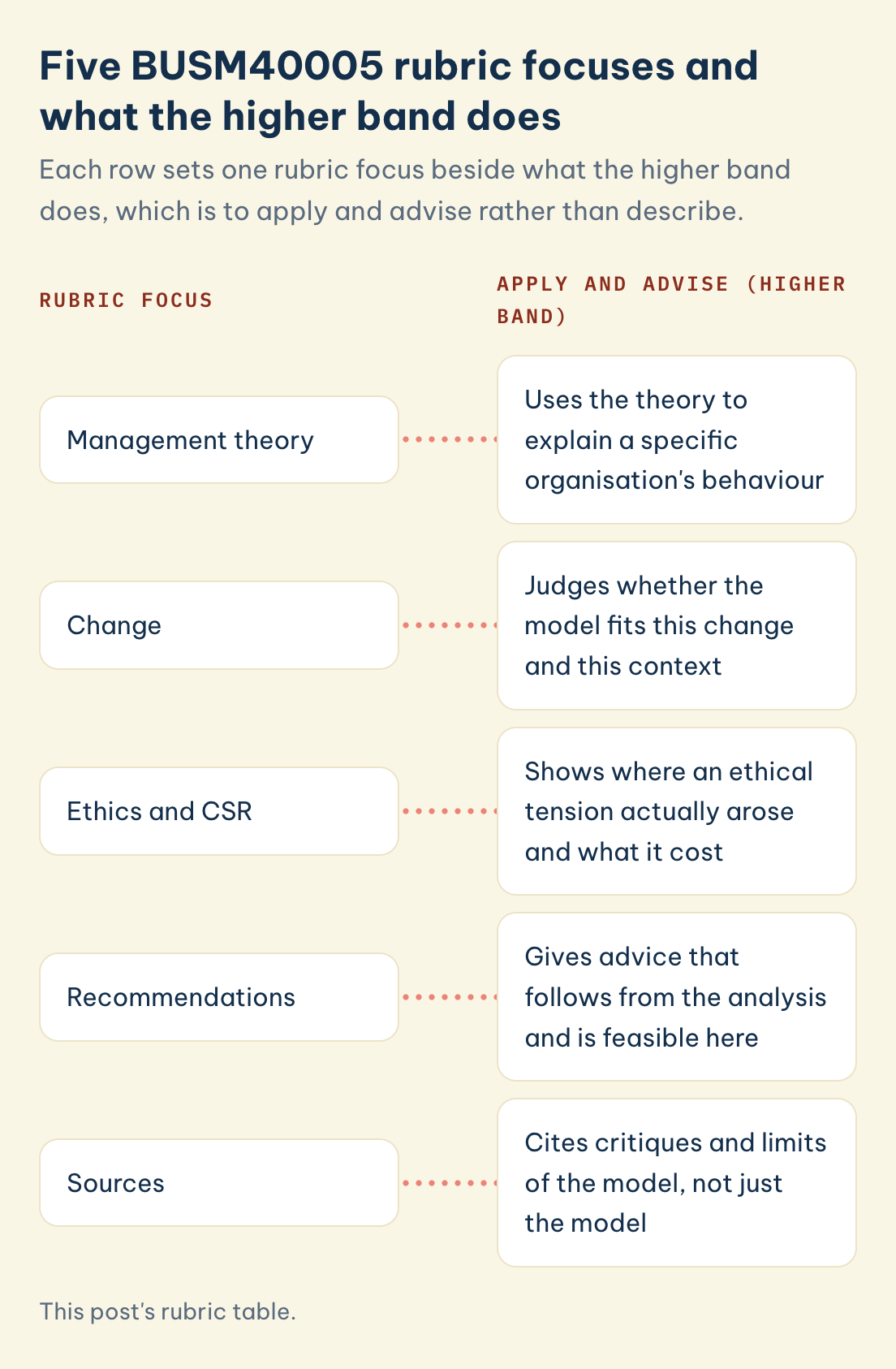
Evidence: UK Level 4 marking criteria reserve the higher bands for application, analysis and evaluation rather than recall. Because outcome 3 explicitly names "constructive advice can be given to improve organisational performance", a report that analyses but never advises has left marks on the table, and one that advises without grounding the advice in analysis has skipped the step that earns them.
| Rubric focus | Describe (lower band) | Apply and advise (higher band) |
|---|---|---|
| Management theory | Summarises what a theory says | Uses the theory to explain a specific organisation's behaviour |
| Change | Lists the steps of a change model | Judges whether the model fits this change and this context |
| Ethics and CSR | States that ethics matters | Shows where an ethical tension actually arose and what it cost |
| Recommendations | Offers generic good advice | Gives advice that follows from the analysis and is feasible here |
| Sources | Cites the model's originator | Cites critiques and limits of the model, not just the model |
Example: A MAAS mentor marked a student's draft against this table and found every row sitting in the left column. The student rewrote nothing about the company; he added, for each theory, one sentence on what it revealed and one on what the firm should do. Two bands.
◆ Question 4 / 8 · Frameworks
Which frameworks and concepts should you use in BUSM40005?
Direct answer: Use a small, well-chosen set rather than the whole syllabus. For the management-and-ethics presentation, the durable anchors are the classic management functions (planning, organising, leading, controlling), Mintzberg's (1989) ten managerial roles grouped into interpersonal, informational and decisional categories, and a recognised ethics framework such as Carroll's (1991) CSR pyramid.
For the change-management report, use an established model, most students use Kotter's (1995) eight steps or Lewin's unfreeze-change-refreeze, but treat it as something to test against the case, not a template to fill. Pick the frameworks your chosen organisation actually needs and apply them.
Evidence: These frameworks are examiner-recognised because they turn observation into analysis. But the higher bands reward using them critically, and change management is the clearest place to show that. The widely repeated claim that "70% of change efforts fail" is not supported by valid empirical evidence. Hughes (2011) traced the figure across five sources and found none with sound data behind it; a systematic review of 563 change studies in the Journal of Applied Behavioral Science found that only 2% had strong internal validity (Barends et al., 2014); and a 2026 evidence synthesis concluded that failure prevalence is a distribution that depends on how "failure" is defined, not a fixed 70%. Even Kotter's own eight steps are not settled doctrine: Appelbaum et al. (2012) revisited the model roughly 16 years after Kotter's 1996 book and argued that later research has qualified or contested several of the original steps, one more reason to test the model against your case rather than quote it as fixed fact.
Example: A Vietnamese student opened her report with "since 70% of change fails". Her mentor asked where the number came from. She could not say. Rewritten to note that the statistic is popular but unevidenced, and to argue instead from what actually happened in her chosen company, the same report moved from a descriptive account to a critical one, which is exactly what the marking criteria reward.
◆ Question 5 / 8 · The organisation
How do you choose and analyse the organisation for your report?
Direct answer: Choose one organisation you can find real information about, ideally one that has been through a documented change (a restructure, a merger, a digital shift, a leadership change). Then narrow to a single change and a single question: what did they change, why, and did it improve performance? Analyse it with your chosen framework, judge honestly whether the change worked and why, and let your recommendations grow out of that judgement. A well-known company with public reporting beats a company you admire but cannot evidence.
Evidence: Outcome 3 asks for advice that improves organisational performance, which is impossible to give well about a company you cannot see clearly. Specificity is also what separates bands: "the firm should communicate better" is generic; "the firm skipped Kotter's step of building a guiding coalition, which is why middle managers resisted, so it should have secured their buy-in before announcing the restructure" is analysis with advice attached.
Example: A student picked a global brand because it was impressive, then found he could evidence almost nothing about its internal change. His mentor had him switch to a Vietnamese company with public news coverage of a restructure. The analysis got sharper immediately, because he could finally point to what actually happened.
◆ Question 6 / 8 · Generative AI
How should you handle generative AI and academic integrity in BUSM40005?
Direct answer: Check your module's specific statement on AI before you use any tool, because Foundations courses often set clear limits, and follow the university's rule to acknowledge and reference any permitted use. The safe approach is the same one the research recommends: use tools for supportive tasks only if allowed, verify everything they produce, and declare the use plainly. Management models and company facts are exactly the kind of content where an unverified AI output can be confidently wrong.
Evidence: Non-disclosure is the documented failure mode, and it is usually driven by fear rather than intent to deceive. A study at King's Business School found that 74% of students did not declare their AI use on the mandatory coursework coversheet, with fear of penalties, ambiguous guidelines, inconsistent enforcement and peer influence all reported as barriers (Gonsalves, 2025). For a course that assesses your ability to cite critiques and evidence claims, passing off an unverified, unsourced AI summary as analysis fails on the exact criterion the report is marked against.
Example: A student asked a MAAS mentor whether using a tool to outline his report structure was allowed. The mentor's answer was procedural: check the module statement, and if it permits supportive use, note it in one line. He did, verified every fact the tool suggested against real sources, and the transparency read as good practice rather than as a risk.
◆ Question 7 / 8 · Common mistakes
What are the most common mistakes Vietnamese students make in BUSM40005?
Direct answer: The recurring mistakes are: describing theories instead of applying them; trying to cover the whole syllabus in 1500 words; choosing an organisation they cannot evidence; quoting the "70% of change fails" statistic uncritically; giving generic recommendations that do not follow from the analysis; and treating the group presentation as separate from the report rather than as its foundation. Each loses marks even when the writing is clean.
Evidence: Because the module is application-led and tightly word-limited, breadth is actively penalised. A report that names five frameworks cannot analyse any of them within 1500 words, so it stays in the lower, descriptive bands by default. Students trained to demonstrate coverage in exams often carry that instinct into a report that rewards depth on one case instead.
Example: A Vietnamese student's report mentioned nine concepts and analysed none. His mentor did not add analysis; she asked him to delete everything except the two frameworks his company actually needed. What remained had room to breathe, and to advise, and it marked a full band higher.
◆ Question 8 / 8 · Mentor help
How can a MAAS mentor help you approach BUSM40005 without crossing the line?
Direct answer: A MAAS mentor works alongside you, not instead of you. The mentor helps you decode the brief, choose one organisation and one change you can evidence, select the two frameworks that fit, and test whether your analysis actually leads to your recommendations. You keep authorship of every slide and every word of the report; the mentor raises the ceiling of what you can defend on your own.
Evidence: Because BUSM40005 is graded on applied analysis and constructive advice rather than coverage, the durable gain is the habit of using one framework well on one real case. That habit is the core of every management role you will hold, where you will be asked to diagnose a situation and recommend an action, not to recite theory. Coaching that builds that reasoning is what moves marks and, more importantly, what survives into your career.
Example: A Vietnamese student arrived able to recite management theory but unable to apply any of it. Over a few sessions her MAAS mentor did nothing but ask "what does this reveal about your company, and what should they do" until the answers came without prompting. She wrote and presented everything herself. The mark rose, and so did her confidence in her first internship, where diagnosing and advising was the actual job.
Frequently asked questions
Is BUSM40005 hard for international students?
The content is manageable; the difficulty is discipline. A 1500-word report punishes breadth, so students who try to show everything they learned score lower than those who analyse one case in depth. The skill to build is choosing what to leave out.
What is the BUSM40005 report usually about?
It is typically an individual 1500-word report on change management in an organisation and its impact on performance, weighted at 60%. You analyse one real change with a chosen framework and give evidence-based recommendations.
Which change model should I use, Kotter or Lewin?
Either works. What matters is that you test the model against your case rather than fill it in. Note where it fits, where it does not, and what that reveals about the change.
Does MAAS write the BUSM40005 assignment for me?
No. MAAS provides mentoring and review. A mentor helps you decode the brief, choose a case, apply the frameworks, and test your reasoning, but you remain the author of every slide and every word you submit.
How do I make my recommendations strong?
Make each one follow from your analysis and be feasible for that specific organisation. "Communicate better" is weak; "secure middle-manager buy-in before the announcement, because that is where resistance formed" is strong.
Can I use AI tools in BUSM40005?
Only if your module statement permits it, and only with acknowledgement per your university's guidance. Verify any fact or model a tool gives you, because unverified AI output is exactly what this report is designed to catch.
How MAAS mentors support BUSM40005 students
If you are approaching the BUSM40005 Foundations of Management assignment and want a clearer path, MAAS offers a free 20-minute consultation to review your brief and map your approach. Bring your assignment brief and we will match you with a subject mentor within 48 hours when our network already covers that field. If it does not, MAAS opens a dedicated recruitment round for your case, which usually takes about 2 weeks. Around 23% of MAAS experts hold a PhD, and our management mentors are experienced practitioners who work with you to raise what you can defend on your own, never to write the work for you.
Related reading: for the first-year version of these ideas at the University of Melbourne, see how MGMT10002 Principles of Management rewards critique of theory over description. See also our guides to BUSM3312 Managing Change and BUSM2570 Business Decision Making, and our academic support service for how mentoring works end to end.
References
Appelbaum, S. H., Habashy, S., Malo, J.-L., & Shafiq, H. (2012). Back to the future: Revisiting Kotter's 1996 change model. Journal of Management Development, 31(8), 764–782. https://doi.org/10.1108/02621711211253231
British University Vietnam. (n.d.). About BUV. Retrieved August 21, 2026, from https://www.buv.edu.vn/about-buv/
University of Staffordshire. (n.d.). British University Vietnam. Retrieved August 21, 2026, from https://www.staffs.ac.uk/partnerships/international/british-university-vietnam
Barends, E., Janssen, B., ten Have, W., & ten Have, S. (2014). Effects of change interventions: What kind of evidence do we really have? The Journal of Applied Behavioral Science, 50(1), 5–27. https://doi.org/10.1177/0021886312473152
Carroll, A. B. (1991). The pyramid of corporate social responsibility: Toward the moral management of organizational stakeholders. Business Horizons, 34(4), 39–48. https://doi.org/10.1016/0007-6813(91)90005-G
Gonsalves, C. (2025). Addressing student non-compliance in AI use declarations: Implications for academic integrity and assessment in higher education. Assessment & Evaluation in Higher Education, 50(4), 592–606. https://doi.org/10.1080/02602938.2024.2415654
Hughes, M. (2011). Do 70 per cent of all organizational change initiatives really fail? Journal of Change Management, 11(4), 451–464. https://doi.org/10.1080/14697017.2011.630506
Kotter, J. P. (1995). Leading change: Why transformation efforts fail. Harvard Business Review, 73(2), 59–67.
Mintzberg, H. (1989). Mintzberg on management: Inside our strange world of organizations. Free Press.
Quality Assurance Agency for Higher Education. (2021). Higher education credit framework for England: Advice on academic credit arrangements (2nd ed.). Retrieved August 21, 2026, from https://www.qaa.ac.uk/docs/qaa/quality-code/higher-education-credit-framework-for-england.pdf
University of Staffordshire. (2026). Foundations of Management (BUSM40005): Module descriptor. Retrieved August 21, 2026, from https://evision.staffs.ac.uk/module_descriptors/BUSM40005.html
Tools & resources
- Staffordshire module descriptor search: look up the current descriptor for your own module by code
A free 20-minute consultation is a conversation about where you are with BUSM40005.
Book a free consultation ▸