
BUSM2570 Business Decision Making rewards students who show the reasoning that produced a decision: the options, the criteria, the evidence, the biases checked, not those who present a conclusion and defend it afterwards. Most students who struggle with this RMIT business course are not short on opinions. They pick an answer early and assemble support for it, exactly the pattern the course exists to teach you to avoid, which is what the seven questions below work through.
Author: MAAS Editorial Team
Last updated: 2026-07-20
Category: business-management

What is BUSM2570 Business Decision Making about?
Direct answer: BUSM2570 is an RMIT business course about how decisions are actually made in organisations and how to make them better, covering the structured decision process, rational and bounded-rational models, cognitive biases, and decision-making under uncertainty. The course assesses your reasoning process, so a well-argued decision that turns out debatable can outscore a popular conclusion with no visible reasoning.
Evidence: The teaching frame rests on established decision research: Simon's bounded rationality for why real decisions satisfice rather than optimise, Kahneman and Tversky's work on heuristics and biases for the systematic errors that follow, Kahneman's two-system framing for when intuition is and is not trustworthy, and Janis's groupthink research for how group processes suppress dissent. Tversky and Kahneman frame the core problem directly: "this article shows that people rely on a limited number of heuristic principles which reduce the complex tasks of assessing probabilities and predicting values to simpler judgmental operations" (Tversky & Kahneman, 1974, p. 1124).
Example: A Vietnamese student at RMIT Vietnam arrived at MAAS with a report recommending a supplier and three paragraphs explaining why it was the best. Her mentor asked what the other two options were and on what criteria they lost. The rebuilt report showed the comparison rather than asserting the winner, and her mark moved from a Pass-level draft to a Distinction.
What assessment does the BUSM2570 assignment usually involve?
Direct answer: Decision-making courses at this level are commonly assessed through an individual case analysis of a real or set decision, often with a group decision exercise or simulation, a reflective piece on your own decision process, and sometimes a short applied task using decision tools.
You are typically asked to frame the problem, generate and evaluate options against criteria, identify the biases and uncertainties at play, and recommend a course of action with its risks. Always confirm the exact task, word count, and weighting in your own Canvas shell, because assessment structure changes by semester and campus.
Evidence: RMIT business assessments are criterion-referenced, meaning marks are awarded against published rubric criteria rather than ranked against classmates. This is set out in RMIT's Assessment policy, which is why decoding the rubric matters far more than how confident your recommendation sounds.
Example: A Vietnamese RMIT student spent half of a 1,500-word report describing the company and the market before reaching the decision. His MAAS mentor cut the context to a paragraph and reallocated the words to the option-evaluation matrix. Same case, same word count, the reasoning-led version earned a clear Distinction.
How is the BUSM2570 assignment graded, what does the rubric actually reward?
Direct answer: Decision-making rubrics at this level reward four things, roughly in this order: (1) a clearly framed problem; you show that you defined the right question before answering it, (2) genuine options evaluated against explicit criteria rather than one preferred option with alternatives named for form, (3) critical awareness of bias, uncertainty, and what evidence is missing, and (4) a justified recommendation with risks and a review point, plus academic writing and Harvard referencing. Confidence is not a criterion; visible reasoning is.
Evidence: RMIT business rubrics use criterion bands (Pass / Credit / Distinction / High Distinction). The jump from Credit to Distinction is almost always defined by the words "critical" and "justified", critical evaluation of options and evidence, and a justified choice, not by a bolder recommendation.
Example: A MAAS mentor marked one Vietnamese student's draft by asking of each paragraph: is this reasoning, or is this justification after the fact? Two thirds was after-the-fact justification. After a rewrite that presented the criteria before the options, the same case moved up two full rubric bands.
Which frameworks should you use in BUSM2570?
Direct answer: Anchor the report in a small set of tools that carry the reasoning. Use a structured decision process to organise the work; a weighted criteria matrix to compare options transparently; a bias checklist to name the specific errors most likely in this decision rather than listing every bias you know; an uncertainty treatment such as scenarios or expected value where outcomes are probabilistic; and a stakeholder or ethics lens where the decision distributes benefit and harm unevenly. Each tool must visibly change what you conclude.
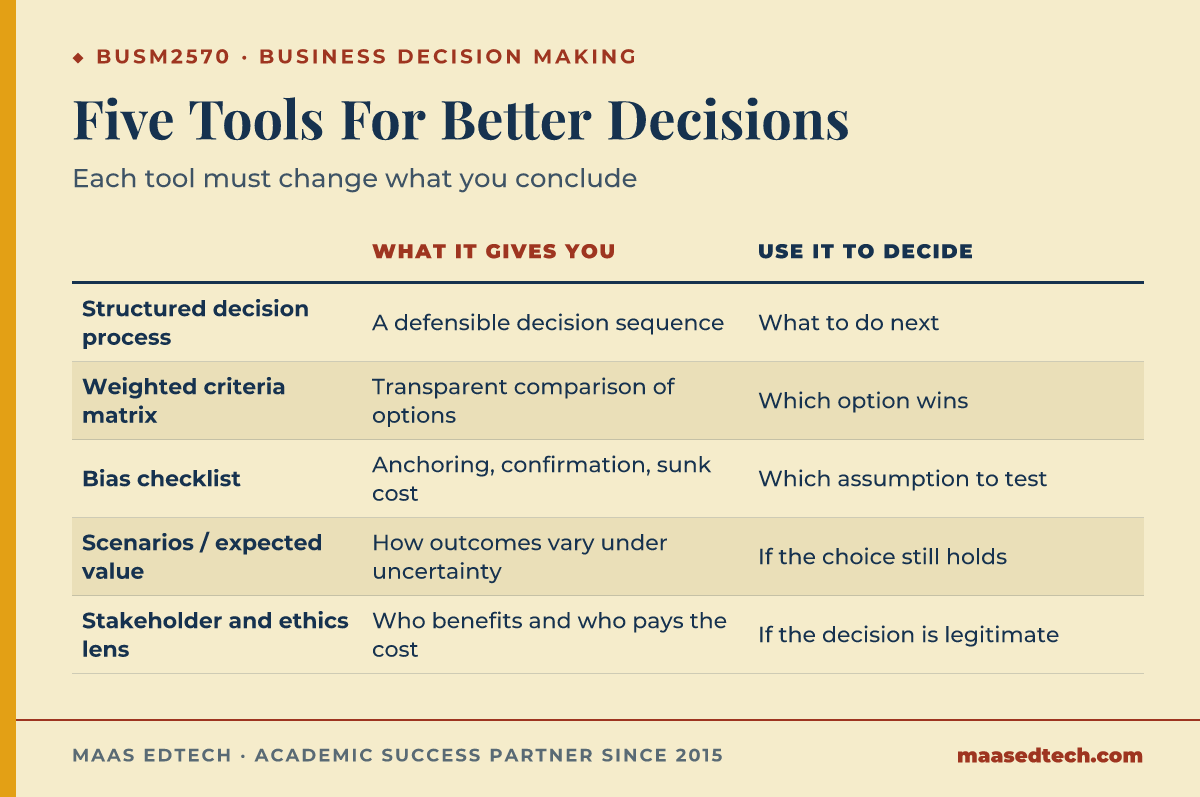
| Tool | What it gives you | Use it to decide |
|---|---|---|
| Structured decision process | A defensible sequence: frame, generate, evaluate, choose, review | What to do next and how to show your reasoning |
| Weighted criteria matrix | A transparent comparison of options on stated criteria | Which option wins, and how sensitive that is to the weights |
| Bias checklist (anchoring, confirmation, sunk cost) | The specific errors most likely in this decision | Which assumption to test before committing |
| Scenarios / expected value | How outcomes vary under uncertainty | Whether the choice holds if the world turns out differently |
| Stakeholder and ethics lens | Who benefits and who bears the cost | Whether a defensible decision is also a legitimate one |
Evidence: These tools rest on examiner-recognised foundations: Simon (1955) for bounded rationality, Tversky and Kahneman (1974) for heuristics and biases, Kahneman (2011) for the two-system account, Janis (1982) for groupthink, and Bazerman and Moore (2013) for the applied managerial decision framework most courses of this type follow. Note that debiasing is hard, awareness alone rarely removes a bias, so a Distinction-level report proposes a process change such as a devil's advocate or a pre-mortem rather than "being aware of confirmation bias".
Example: A Vietnamese RMIT student listed eight biases in a table with textbook definitions. Her MAAS mentor kept two that were actually operating in the case, anchoring on the incumbent supplier's price and sunk-cost thinking about a prior investment and showed where each appeared in the case evidence. Fewer biases, real application, higher mark.
How should you structure the BUSM2570 report?
Direct answer: Use a reasoning-led structure: (1) the decision to be made and why it matters, with context under 10% of the word count, (2) the problem framing, including how you defined the question and what you deliberately excluded, (3) the criteria, stated and weighted before the options are compared, (4) the options evaluated against those criteria with evidence, (5) biases and uncertainties, named specifically and with a process response, and (6) the recommendation with risks, a monitoring measure, and a review point. Present the criteria before the options, this alone signals genuine evaluation rather than post-hoc justification.
Evidence: Criterion-referenced rubrics weight "problem framing", "evaluation of options", and "critical awareness" far above "description of the situation". Matching your word budget to the rubric weighting is the most reliable way to lift a grade without finding new material.
Example: A Vietnamese RMIT student submitted a report that named a recommendation in the first paragraph and spent the rest supporting it. His MAAS mentor moved the recommendation to the end and inserted the criteria matrix in the middle. Same content, reordered, the report moved from a borderline Credit to a Distinction because the reasoning became visible.
What are the most common mistakes that lose marks in BUSM2570?
Direct answer: Three recurring mistakes show up across MAAS management coaching. First, the conclusion is chosen first and the analysis is built to support it, which markers detect easily because the rejected options are never seriously considered. Second, biases are listed as definitions rather than identified in the actual case with evidence. Third, uncertainty is ignored, a single-point recommendation with no scenario, no sensitivity check, and no statement of what would change the answer. Fixing these three lifts most drafts by at least one rubric band.
Evidence: Across MAAS management coaching, marker feedback before intervention clusters heavily on "alternatives not seriously evaluated" and "assumptions not tested", the two phrases that most often separate a Credit from a Distinction in decision-making rubrics.
Example: A Vietnamese student's report evaluated three options, but two were obviously unviable, a straw-man comparison. His MAAS mentor asked him to build the strongest possible case for the runner-up, then explain why it still lost. The stronger comparison made the recommendation credible and earned full marks on the evaluation criterion.
How long is the BUSM2570 assignment and what referencing style does it use?
Direct answer: Confirm the exact word count and style in your assessment brief, individual business reports at this level commonly sit between 1,200 and 2,000 words, with matrices, appendices, and reference lists often excluded from the count, and use Harvard referencing, which is RMIT's default business style. Stay within the 10% tolerance band, cite decision theorists from the source or a current edition rather than a summary website, and reference any case facts, figures, or market claims you rely on.
Evidence: RMIT's Business school uses RMIT Harvard as its standard referencing style, documented in RMIT's Easy Cite referencing tool. Markers routinely deduct marks for secondary citations of Kahneman or Simon, unreferenced case claims, or inconsistent Harvard formatting even when the reasoning is strong.
Example: A Vietnamese RMIT student lost several marks because he cited "System 1 and System 2" through a blog post and his in-text citations did not match his reference list. A MAAS pre-submission audit closed the gaps in under an hour. On his next BUSM2570 task, clean sourcing recovered marks on a criterion requiring no extra analysis.
Frequently asked questions
Is BUSM2570 a hard course?
It is deceptively hard. The content feels intuitive because everyone makes decisions, but the course marks whether you can show a process rather than assert a conclusion and most people's natural style is to decide first and explain second.
Does my recommendation have to be the "right" answer?
No. These assessments mark the quality of reasoning, not agreement with a preferred answer. A well-framed, transparently evaluated, honestly caveated recommendation scores highly even where a marker would have chosen differently.
How many options should I evaluate?
Usually three genuine options is enough, including the status quo where relevant. What matters is that each is viable and seriously assessed, two real alternatives beat five where three are obviously filler.
Can I use a decision from my own experience?
Often yes, especially in reflective components, and it can make the bias analysis concrete. Keep it analytical, connect what happened to the process and name what you would change, rather than narrative, and anonymise anyone identifiable.
What referencing style does BUSM2570 use?
RMIT Harvard is the default for business courses. Cite classic decision theorists from the source or a current edition rather than a website summary, and use RMIT's Easy Cite tool to format entries consistently.
Can MAAS help me with BUSM2570?
Yes. MAAS Assignment & Essay Support coaches you through the assignment with the Outline, Draft, Final model, testing the problem framing, building a defensible criteria matrix, applying bias analysis to real evidence, and a pre-submission referencing audit, all with discipline-matched experts. We coach your work; we do not write it for you.
Ready to approach BUSM2570 with a clear strategy?
If you have the case but not the reasoning on the page, that is exactly where a discipline-matched expert helps most. MAAS Assignment & Essay Support is an academic support partner; we work alongside you through Outline, Draft, Final so the thinking stays yours and the structure earns the marks.
Bring your BUSM2570 brief and we will match you to a management mentor, 23% of our 100+ experts hold a PhD, within 48 hours when our network already covers that field. If it does not, MAAS opens a dedicated recruitment round for your case, which usually takes about two weeks.
Book a free 15-minute BUSM2570 consultation with MAAS Assignment & Essay Support →
Related guides
- How to approach the MGMT302 Strategic Management assignment?: for evaluating strategic options against criteria
- How to approach the BUSM4771 Managing Performance assignment?: for diagnosing before designing an intervention
- Assignment command words explained: what "evaluate", "analyse", and "justify" actually require
- MAAS Academic Mentoring service: 1:1 coaching with PhD-level mentors in your discipline
- Course-code assignment coaching: pillar guide on tackling any unit assignment with a MAAS mentor
References
- Bazerman, M. H., & Moore, D. A. (2013). Judgment in managerial decision making (8th ed.). Wiley.
- Janis, I. L. (1982). Groupthink: Psychological studies of policy decisions and fiascoes (2nd ed.). Houghton Mifflin.
- Kahneman, D. (2011). Thinking, fast and slow. Farrar, Straus and Giroux.
- Simon, H. A. (1955). A behavioral model of rational choice. The Quarterly Journal of Economics, 69(1), 99–118. https://doi.org/10.2307/1884852
- Tversky, A., & Kahneman, D. (1974). Judgment under uncertainty: Heuristics and biases. Science, 185(4157), 1124–1131. https://doi.org/10.1126/science.185.4157.1124
Tools & resources
- RMIT University. (n.d.). Assessment and exams. Retrieved July 20, 2026, from https://www.rmit.edu.au/students/student-essentials/assessment-and-exams
- RMIT University. (n.d.). Easy Cite referencing tool. Retrieved July 20, 2026, from https://www.rmit.edu.au/library/study/referencing
This article is part of the MAAS Journal series for Vietnamese international students. MAAS Assignment & Essay Support is an academic support partner; we coach students through the Outline, Draft, Final delivery model with developmental feedback from discipline-matched experts. We do not write or submit work on a student's behalf.