
MGMT302 Strategic Management asks students to reach a defensible strategic recommendation for one firm, not to run every framework they were taught. Students who struggle with this capstone-level unit are rarely short on effort: they produce a tidy PESTEL, a five forces diagram, and a SWOT, then recommend to diversify and invest in digital without showing how the analysis led to that choice. This guide answers the seven questions Vietnamese students ask MAAS mentors before starting MGMT302.
Author: MAAS Editorial Team
Last updated: 2026-07-20
Category: business-management

What is MGMT302 Strategic Management about?
Direct answer: MGMT302 is a capstone-level business unit about how firms create and sustain competitive advantage. It covers external and internal analysis, business-level strategy such as cost leadership and differentiation, corporate diversification, international expansion, and strategy implementation and governance. The unit is integrative: it asks you to connect analysis to a decision, as a strategy consultant would.
Evidence: The teaching frame rests on the established strategy literature: Porter's five forces and generic strategies for industry structure and positioning, Barney's resource-based view and the VRIO test for internal sources of advantage, Teece's dynamic capabilities for adapting in changing environments, and Kim and Mauborgne's blue ocean logic where the question is about escaping direct competition.
Example: A Vietnamese student in Australia arrived at MAAS with a draft containing four complete frameworks and a two-sentence recommendation. Her mentor cut two frameworks entirely and asked one question of the survivors: what does this analysis rule out? Once the frameworks were used to eliminate options rather than to fill sections, the recommendation followed from the evidence, and her mark moved from a Pass-level draft to a Distinction.
What assessment does the MGMT302 assignment usually involve?
Direct answer: Strategic management units at this level are commonly assessed through an individual case analysis or strategic report on a real or set company, often with a group component such as a consulting-style project or presentation, and sometimes a reflective or in-class assessment.
You are typically asked to analyse the external and internal position of the firm, identify the strategic issue, evaluate realistic options, and recommend and justify one course of action with an implementation outline. Confirm the exact task, word count, and weighting in your own subject outline, because structure varies by provider and by teaching period.
Evidence: Australian higher-education assessment in this field is criterion-referenced: marks are awarded against published rubric criteria rather than by ranking students against each other. That is why reading the rubric closely matters far more than how many frameworks you include.
Example: A Vietnamese student spent half of a 2,000-word report on company history and a full PESTEL before reaching the strategic issue. His MAAS mentor cut the history to a paragraph, kept only the three PESTEL factors that actually changed the firm's options, and reallocated the words to option evaluation. Same company, same word count, the decision-led version earned a clear Distinction.
How is the MGMT302 assignment graded, what does the rubric actually reward?
Direct answer: Strategy rubrics at this level reward four things, roughly in this order: (1) analysis that leads somewhere, each framework produces an implication, not just a filled-in template, (2) evaluation of realistic alternatives against explicit criteria such as fit, feasibility, and risk, (3) a specific, justified recommendation with an implementation outline and a way of measuring success, and (4) evidence quality plus academic writing and correct referencing. A complete set of frameworks with a generic recommendation is the classic Credit-level submission.
Evidence: Criterion bands in these units typically run Pass / Credit / Distinction / High Distinction, and the jump from Credit to Distinction is usually defined by the words "critical" and "justified", critically evaluated options and a justified recommendation, not by more frameworks or a longer environmental scan.
Example: A MAAS mentor marked one Vietnamese student's draft sentence by sentence, labelling each as "describe", "analyse", or "decide". The draft was 70% describe and had no rejected options at all. After one restructuring pass that named three realistic options, scored them against stated criteria, and explained why two were rejected, the same analysis moved up two full rubric bands.
Which frameworks should you use in MGMT302 and how many?
Direct answer: Use fewer frameworks and go deeper. A workable spine is: PESTEL only for the two or three macro forces that genuinely change the firm's options; five forces to establish where industry profit pools sit and why; VRIO to test whether a claimed strength is actually a source of sustainable advantage; generic strategy to name the firm's competitive position and check it is internally consistent; and dynamic capabilities where the case is about adapting to disruption. Every framework you include must produce an implication that survives into the recommendation, if it does not, cut it.
| Framework | What it explains | Use it to decide |
|---|---|---|
| PESTEL (selective) | Which macro forces are actually changing the firm's options | Which external shifts the strategy must respond to |
| Porter's five forces | Where industry profit sits and why rivalry is intense or muted | Whether this industry is worth competing in, and on what terms |
| VRIO (Barney) | Whether a resource is valuable, rare, hard to imitate, and organised for use | Which internal strength is a real advantage rather than a nice feature |
| Generic strategies (Porter) | Whether the firm competes on cost, differentiation, or focus | Whether the current position is coherent or stuck in the middle |
| Dynamic capabilities (Teece) | How firms sense, seize, and reconfigure in changing environments | Whether the firm can actually execute the change you recommend |
Evidence: These frameworks are examiner-recognised, textbook-level foundations: Porter (1980) for industry structure and Porter (1985) for generic strategies, Barney (1991) for the resource-based view, Teece, Pisano and Shuen (1997) for dynamic capabilities, and Kim and Mauborgne (2015) for value-innovation logic. Teece, Pisano and Shuen (1997) define dynamic capabilities as "the firm's ability to integrate, build, and reconfigure internal and external competences to address rapidly changing environments" (Teece et al., 1997, p. 516). Note the standard critique of five forces; it describes a static industry snapshot and handles fast-moving, platform-based markets poorly. Naming that limit and then using the framework carefully is exactly the critical move that earns Distinction-level marks.
Example: A Vietnamese student analysing a retailer applied six frameworks in 2,000 words. His MAAS mentor kept two, five forces to show margin pressure was structural rather than temporary, and VRIO to show the firm's supplier relationships were not actually rare. Fewer frameworks, deeper application, higher mark.
How should you structure the MGMT302 report?
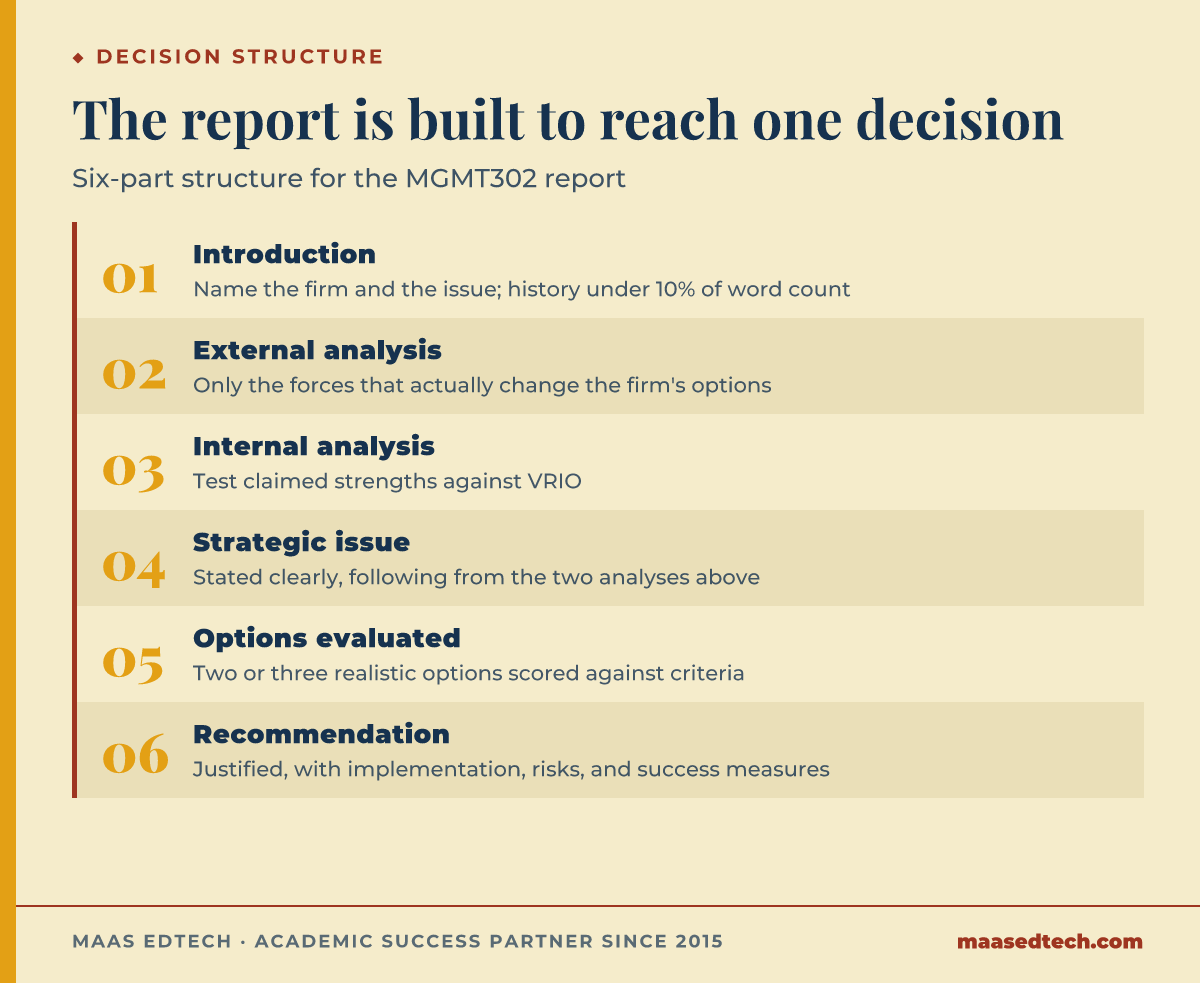
Direct answer: Use a decision-led structure: (1) a short introduction naming the firm and the strategic issue, with history under 10% of the word count, (2) external analysis restricted to forces that change the firm's options, (3) internal analysis testing claimed strengths with VRIO, (4) a clearly stated strategic issue that follows from parts two and three, (5) two or three realistic options evaluated against explicit criteria, and (6) a justified recommendation with an implementation outline, resourcing, risks, and success measures. Put full framework tables in labelled appendices and carry only the implications into the body.
Evidence: Criterion-referenced rubrics weight "evaluation of options", "justification", and "implementation" far above "environmental scanning". Matching your word budget to the rubric weighting is the most reliable way to lift a grade without gathering new material.
Example: A Vietnamese student submitted a report with eight pages of analysis and a closing paragraph recommending "expand into Southeast Asia". His MAAS mentor moved the framework tables to appendices and used the freed words to compare three entry modes on cost, control, and risk. Same research, the report moved from a borderline Credit to a Distinction because a decision was finally being made and defended.
What are the most common mistakes that lose marks in MGMT302?
Direct answer: Three recurring mistakes show up across MAAS strategy coaching. First, framework dumping, every model applied completely, none of them connected to the recommendation. Second, no rejected options: a single recommendation appears with nothing weighed against it, so the evaluation criterion cannot be met. Third, recommendations with no implementation reality, "invest in digital transformation" with no sequencing, no cost, no capability check, and no measure of success. Fixing these three lifts most drafts by at least one rubric band.
Evidence: Across MAAS strategy coaching, marker feedback before intervention clusters heavily on "analysis not linked to recommendation" and "options not evaluated", the two phrases that most often separate a Credit from a Distinction in strategic-management rubrics.
Example: A Vietnamese student recommended that a mid-sized manufacturer pursue both cost leadership and premium differentiation at once. His MAAS mentor asked what each position requires, scale and process discipline for one, brand investment and margin for the other and whether the firm's balance sheet supported both. The revised report named the trade-off explicitly, chose focused differentiation, and explained what the firm would deliberately stop doing. That earned full marks on the criterion the both-at-once answer had failed.
How long is the MGMT302 assignment and what referencing style does it use?
Direct answer: Confirm the exact word count and style in your subject outline, individual strategic-management reports at this level commonly sit between 2,000 and 3,000 words, with appendices, tables, and reference lists often excluded from the count. Referencing style varies by provider: APA 7th and Harvard are both common in Australian business programs, so use whichever your outline specifies and apply it consistently. Cite frameworks from the source or a current edition rather than a website summary, and reference every company claim, financial figures, market share, strategy statements, to an annual report, regulator filing, or reputable database.
Evidence: Australian business programs typically nominate a single referencing style in the subject outline and mark consistency as part of academic-writing criteria. Markers routinely deduct marks for secondary citations of Porter or Barney, unreferenced company data, or reference lists that do not match in-text citations, even when the strategic analysis is strong.
Example: A Vietnamese student lost several marks because his market-share figures came from an undated news article and he cited Porter through a consultancy website. A MAAS pre-submission audit closed the gaps in under an hour, company data re-sourced to the annual report and primary strategy sources restored. On his next assessment, clean sourcing recovered marks on a criterion that requires no extra analysis at all.
Frequently asked questions
Is MGMT302 a hard unit?
It is integrative rather than technically hard. Each framework is straightforward on its own; the difficulty is combining them into one coherent argument and then committing to a decision. Students who treat it as "apply every model" struggle; students who treat it as "advise this firm" do well.
How many frameworks should I actually include?
Usually two to four, applied deeply, unless your brief specifies otherwise. A framework earns its place only if it produces an implication that changes the recommendation. Full tables can sit in an appendix; the body should carry the conclusions, not the templates.
Can I choose a Vietnamese company as my case?
Often yes, unless your brief sets the company, and it can work well when you can access annual reports or credible market data. The risk is a thin evidence base, check that you can source financials and market information before committing, because unreferenced company claims cost marks.
Do I need financial analysis?
Some quantitative grounding almost always helps, revenue trend, margin, or market share is often enough to show the strategic issue is real rather than asserted. Check your brief: some assessments require ratio analysis, others simply expect evidence-based claims.
What referencing style does MGMT302 use?
It depends on the provider, APA 7th and Harvard are both common in Australian business programs. Use the style named in your subject outline and apply it consistently, including for annual reports and industry databases.
Can MAAS help me with MGMT302?
Yes. MAAS Assignment & Essay Support coaches you through the assessment with the Outline, Draft, Final model, narrowing the frameworks, sharpening the strategic issue, building an option-evaluation matrix, making the implementation concrete, and a pre-submission referencing audit, all with discipline-matched experts. We coach your work; we do not write it for you.
Ready to approach MGMT302 with a clear strategy?
If you have the analysis but not the decision, that is exactly where a discipline-matched expert helps most. MAAS Assignment & Essay Support is an academic support partner; we work alongside you through Outline, Draft, Final so the thinking stays yours and the structure earns the marks.
Bring your MGMT302 brief and we will match you to a strategic management mentor, 23% of our 100+ experts hold a PhD, within 48 hours when our network already covers that field. If it does not, MAAS opens a dedicated recruitment round for your case, which usually takes about two weeks.
Book a free 15-minute MGMT302 consultation with MAAS Assignment & Essay Support →
Related guides
- BUSM3312 assignment: how do you approach Managing Change?: for the implementation half of any strategy recommendation
- How to approach the BUSM4699 Cross Cultural Management assignment?: useful when the strategy involves international expansion
- How to approach the HOSP204 Hospitality Experience assignment?: sibling guide for the service-sector case setting
- MAAS Academic Mentoring service: 1:1 coaching with PhD-level mentors in your discipline
- Course-code assignment coaching: pillar guide on tackling any unit assignment with a MAAS mentor
References
- Barney, J. (1991). Firm resources and sustained competitive advantage. Journal of Management, 17(1), 99–120. https://doi.org/10.1177/014920639101700108
- Kim, W. C., & Mauborgne, R. (2015). Blue ocean strategy (Expanded ed.). Harvard Business Review Press.
- Porter, M. E. (1980). Competitive strategy: Techniques for analyzing industries and competitors. Free Press.
- Porter, M. E. (1985). Competitive advantage: Creating and sustaining superior performance. Free Press.
- Teece, D. J., Pisano, G., & Shuen, A. (1997). Dynamic capabilities and strategic management. Strategic Management Journal, 18(7), 509–533. https://doi.org/10.1002/(SICI)1097-0266(199708)18:7<509::AID-SMJ882>3.0.CO;2-Z
Tools & resources
- Tertiary Education Quality and Standards Agency. (n.d.). Higher education good practice hub. Retrieved July 20, 2026, from https://www.teqsa.gov.au/guides-resources/higher-education-good-practice-hub
This article is part of the MAAS Journal series for Vietnamese international students. MAAS Assignment & Essay Support is an academic support partner; we coach students through the Outline, Draft, Final delivery model with developmental feedback from discipline-matched experts. We do not write or submit work on a student's behalf.