
BUSM4699 Cross Cultural Management rewards students who use cultural frameworks to explain a specific management problem and then decide what a manager should do. Most students who struggle with this RMIT course are not short on effort; they reproduce Hofstede's dimensions and stop, without applying them to a decision or acknowledging that a national average never describes an individual. This guide answers the seven questions Vietnamese students at RMIT ask MAAS mentors most often before they start BUSM4699.
Author: MAAS Editorial Team
Last updated: 2026-07-20
Category: business-management

What is BUSM4699 / BUSM4719 Cross Cultural Management about?
Direct answer: BUSM4699 is an RMIT management course (BUSM4719 is the parallel code for a different cohort or campus, same content) about managing people and organisations across cultural boundaries. It covers frameworks for national cultures, cultural intelligence, cross-cultural communication and leadership. The course wants you to use culture as an analytical lens on a management decision, not a catalogue of national traits.
Evidence: The teaching frame rests on the established comparative literature: Hofstede's dimensions from the original IBM study, the GLOBE project's distinction between cultural practices and values, Trompenaars and Hampden-Turner's dilemma-based dimensions, Hall's high- and low-context communication, and Earley and Ang's cultural intelligence construct for individual capability. These are the models most cross-cultural assessments are built around.
Example: A Vietnamese student at RMIT Vietnam arrived at MAAS with a draft that scored Vietnam and Australia on six Hofstede dimensions and then concluded that "the cultures are different". Her mentor reframed the task: pick the one dimension that actually explains the management failure in the case, and say what the manager should change. Once the draft answered a decision rather than a comparison, her mark moved from a Pass-level draft to a Distinction.
What assessment does the BUSM4699 assignment usually involve?
Direct answer: Cross-cultural management courses at this level are commonly assessed through an individual case analysis or report on a cross-cultural management problem, a failed expatriate assignment, a struggling multicultural team, a stalled negotiation, or a market-entry people strategy, often with a group component such as a multicultural team project and a reflective piece on your own cultural intelligence.
You are typically asked to diagnose the cultural dynamic, apply a framework, and recommend a managerial response. Always confirm the exact task, word count, and weighting in your own Canvas shell, because assessment structure changes by semester, code (BUSM4699 vs BUSM4719), and campus.
Evidence: RMIT business assessments are criterion-referenced, meaning marks are awarded against published rubric criteria rather than ranked against classmates. This is set out in RMIT's Assessment policy, which is why decoding the rubric matters far more than how many frameworks you can reproduce.
Example: A Vietnamese RMIT student spent half of a 1,500-word report tabulating country scores before reaching the case problem. His MAAS mentor cut the table to two relevant dimensions and reallocated the words to what the manager actually got wrong in the meeting described. Same case, same word count, the diagnosis-led version earned a clear Distinction.
How is the BUSM4699 assignment graded, what does the rubric actually reward?
Direct answer: Cross-cultural rubrics at this level reward four things, roughly in this order: (1) accurate application of a cultural framework to the specific situation rather than a country profile, (2) evidence from the case or context supporting the diagnosis, (3) critical evaluation, including the limits of the framework, the risk of stereotyping, and alternative explanations such as structure, power, or incentives, and (4) a practical managerial recommendation plus academic writing and Harvard referencing. Reproducing dimension scores without applying them is the classic Credit-level submission.
Evidence: RMIT business rubrics use criterion bands (Pass / Credit / Distinction / High Distinction). The jump from Credit to Distinction is almost always defined by the words "critical" and "justified", critical use of the framework and a justified recommendation, not by covering more countries or more dimensions.
Example: A MAAS mentor marked one Vietnamese student's draft sentence by sentence, labelling each as "describe", "apply", or "evaluate". The draft was 70% describe: national profiles with no case attached. After one restructuring pass that tied two dimensions to specific incidents in the case and named a non-cultural alternative explanation, the same material moved up two full rubric bands.
Which frameworks should you use in BUSM4699?
Direct answer: Anchor your analysis in two or three frameworks that fit the problem rather than surveying all of them. Hofstede's dimensions work for broad comparative framing; GLOBE is stronger when you need to separate what people do from what they say they value; Trompenaars helps when the case turns on a dilemma such as rules versus relationships; Hall's high- and low-context distinction is the sharpest tool for communication breakdowns; and cultural intelligence shifts the analysis from the country to the individual manager's capability to adapt. Choose the frameworks the case evidence can actually support.
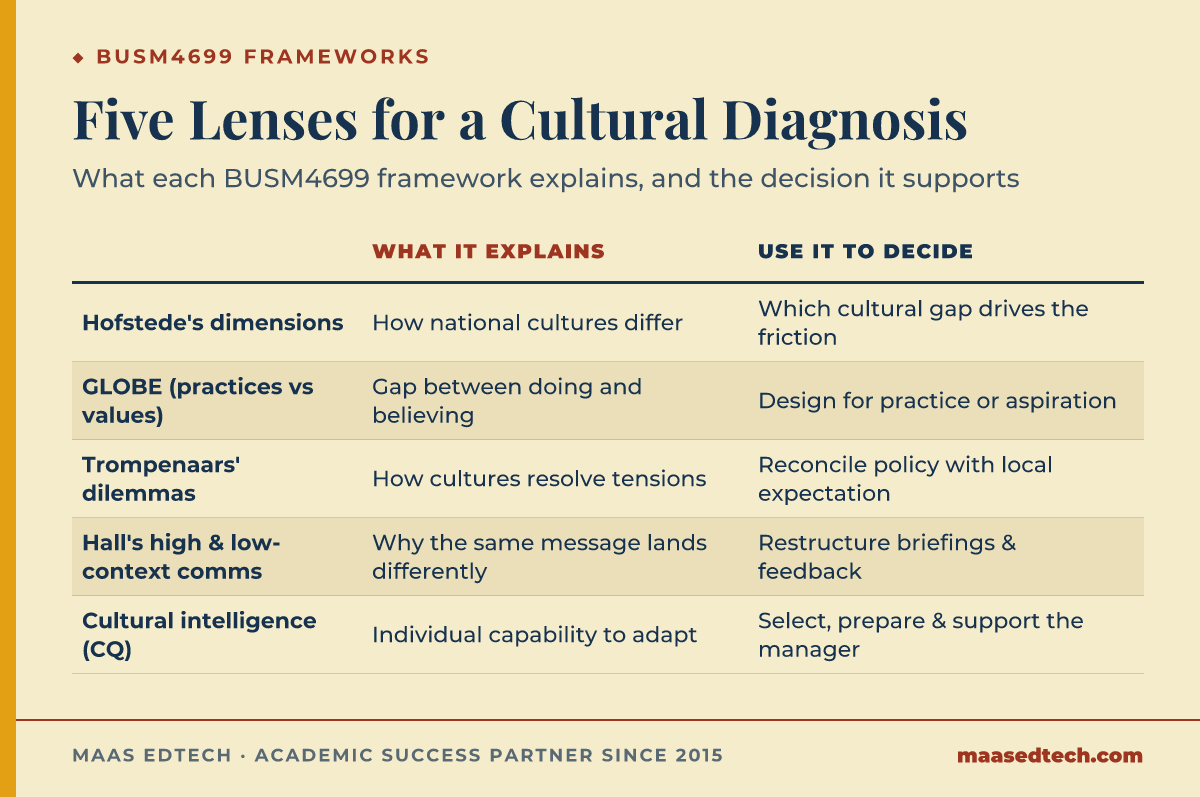
| Framework | What it explains | Use it to decide |
|---|---|---|
| Hofstede's dimensions | How national cultures differ on power distance, individualism, uncertainty avoidance and more | Which broad cultural gap is most likely driving the friction |
| GLOBE (practices vs values) | The gap between how things are done and how people believe they should be | Whether to design for current practice or stated aspiration |
| Trompenaars' dilemmas | How cultures resolve tensions such as universalism versus particularism | How to reconcile a global policy with local expectation |
| Hall's high- and low-context communication | Why the same message is heard differently across cultures | How to restructure briefings, feedback, and written instructions |
| Cultural intelligence (Earley & Ang) | An individual's capability to function effectively across cultures | How to select, prepare, and support the manager or expatriate |
Evidence: These five frameworks are examiner-recognised, textbook-level foundations: Hofstede, Hofstede and Minkov (2010) for the dimensions, Trompenaars and Hampden-Turner (2020) for the dilemma-based dimensions, House et al. (2004) for the GLOBE project, Hall (1976) for context in communication, and Earley and Ang (2003) for cultural intelligence. The GLOBE researchers define culture itself as follows: "Shared motives, values, beliefs, identities, and interpretations or meanings of significant events that result from common experiences of members of collectives that are transmitted across generations" (House et al., 2004). Note the standing critique, Hofstede's dimensions describe national averages from a single-corporation sample and cannot predict an individual's behaviour. Saying so, and then using the framework carefully anyway, is exactly the critical move that earns Distinction-level marks.
Example: A Vietnamese RMIT student analysing a failed Australian–Vietnamese project team tried to apply four frameworks shallowly. Her MAAS mentor cut it to two, Hall's context distinction to explain why indirect feedback was missed, and cultural intelligence to argue what the team leader should develop. Fewer frameworks, deeper application, higher mark.
How should you structure the BUSM4699 report?
Direct answer: Use a diagnosis-led structure: (1) an introduction stating the cross-cultural management problem and your position, keeping country background under 10% of the word count, (2) the cultural analysis applying your chosen framework to specific evidence from the case, (3) alternative or contributing explanations that are not cultural, reporting lines, incentives, language proficiency, workload, considered seriously, (4) a critical evaluation including the limits of the framework you used, and (5) a practical recommendation a manager could act on. Any table of dimensions must be interpreted in the text, not left to speak for itself.
Evidence: Criterion-referenced rubrics weight "application", "critical evaluation", and "recommendations" far above "country description". Matching your word budget to the rubric weighting is the most reliable way to lift a grade without finding new material.
Example: A Vietnamese RMIT student submitted a report with a 450-word cultural profile of two countries and a one-line recommendation to "improve communication". His MAAS mentor inverted the balance, giving the recommendation room to specify what would change in meeting structure, feedback channel, and decision rights. Same case, same sources, the report moved from a borderline Credit to a Distinction because the advice became actionable.
What are the most common mistakes that lose marks in BUSM4699?
Direct answer: Three recurring mistakes show up across MAAS management coaching. First, students slide from analysis into stereotyping, "Vietnamese employees avoid conflict" stated as a fact about every individual rather than a tendency in aggregate with wide variation. Second, culture is treated as the only explanation, when the case often also contains a structural cause such as unclear authority or an incentive misalignment. Third, recommendations are generic, "provide cultural training", with no specification of who, what content, and what would change as a result. Fixing these three lifts most drafts by at least one rubric band.
Evidence: Across MAAS management coaching, marker feedback before intervention clusters heavily on "avoid generalisation" and "needs deeper application", two phrases that most often separate a Credit from a Distinction in RMIT cross-cultural rubrics.
Example: A Vietnamese student wrote that "Asian team members do not speak up in meetings." His MAAS mentor pushed him to rewrite it as a testable claim: in this case, junior members did not raise objections in an open forum, which is consistent with higher power distance and with the fact that the project lead also set their performance rating. Naming both explanations, and saying how to tell them apart, earned full marks on the analysis criterion the generalisation had failed.
How long is the BUSM4699 assignment and what referencing style does it use?
Direct answer: Confirm the exact word count and style in your assessment brief, individual cross-cultural management reports at this level commonly sit between 1,500 and 2,500 words, with tables, appendices, and reference lists often excluded from the count, and use Harvard referencing, which is RMIT's default business style.
Stay within the 10% tolerance band and cite frameworks from the source or a current edition rather than a website summary. If you use dimension scores, cite where the scores come from and note their date, because the underlying survey data is decades old in places.
Evidence: RMIT's Business school uses RMIT Harvard as its standard referencing style, documented in RMIT's Easy Cite referencing tool. Markers routinely deduct marks for secondary citations of classic theorists, uncited dimension scores, or inconsistent Harvard formatting even when the analysis is strong.
Example: A Vietnamese RMIT student lost several marks because he cited Hofstede through a consultancy website and his in-text citations did not match his reference list. A MAAS pre-submission audit closed the gaps in under an hour, primary sources restored, scores attributed and dated, Harvard entries aligned. On his next BUSM4699 task, clean sourcing recovered marks on a criterion that requires no extra analysis at all.
Frequently asked questions
Is BUSM4699 a hard course?
It is judgement-heavy rather than technically hard. The frameworks are easy to learn and deceptively hard to apply well, because good analysis requires holding a generalisation and its exceptions at the same time. Students who treat it as "describe cultural differences" struggle; students who treat it as "diagnose a management problem through a cultural lens" do well.
What is the difference between BUSM4699 and BUSM4719?
They are parallel course codes for substantially the same Cross Cultural Management content, used across different cohorts, programs, or campus offerings. The theory you need is the same; the assessment brief, weighting, and due dates can differ, so always work from the brief in your own Canvas shell rather than a classmate's.
Is it acceptable to use Hofstede when the model is so criticised?
Yes; it remains a core teaching framework and markers expect you to know it. What separates a Distinction is using it and naming its limits: national averages, dated survey data, a single-corporation sample, and no predictive power for individuals. Acknowledging the critique strengthens rather than weakens your analysis.
Can I write about my own cross-cultural experience?
Often yes, especially in reflective components, and a lived example makes the analysis concrete. Keep the reflection analytical, connect what happened to a framework and to what you would do differently, rather than narrative, and anonymise anyone identifiable.
What referencing style does BUSM4699 use?
RMIT Harvard is the default for business courses. Cite classic theorists from the source or a current edition rather than a website summary, and use RMIT's Easy Cite tool to format entries consistently.
Can MAAS help me with BUSM4699?
Yes. MAAS Assignment & Essay Support coaches you through the assignment with the Outline, Draft, Final model, sharpening the diagnosis, choosing the right framework, avoiding the stereotyping trap, and a pre-submission referencing audit, all with discipline-matched experts. We coach your work; we do not write it for you.
Ready to approach BUSM4699 with a clear strategy?
If you have the case but not the diagnosis, that is exactly where a discipline-matched expert helps most. MAAS Assignment & Essay Support is an academic support partner; we work alongside you through Outline, Draft, Final so the analysis stays yours and the structure earns the marks.
Bring your BUSM4699 or BUSM4719 brief and we will match you to an international management mentor, 23% of our 100+ experts hold a PhD, within 48 hours when our network already covers that field. If it does not, MAAS opens a dedicated recruitment round for your case, which usually takes about two weeks.
Book a free 15-minute BUSM4699 consultation with MAAS Assignment & Essay Support →
Related guides
- BUSM4187 assignment: how do you approach International Human Resource Management?: sibling RMIT guide on managing people across borders
- How to approach the BUSM4777 Human Resource Development assignment?: for the capability-building side of people management
- Assignment command words explained: what "evaluate", "analyse", and "justify" actually require
- MAAS Academic Mentoring service: 1:1 coaching with PhD-level mentors in your discipline
- Course-code assignment coaching: pillar guide on tackling any unit assignment with a MAAS mentor
References
- Earley, P. C., & Ang, S. (2003). Cultural intelligence: Individual interactions across cultures. Stanford University Press.
- Hall, E. T. (1976). Beyond culture. Anchor Press.
- Hofstede, G., Hofstede, G. J., & Minkov, M. (2010). Cultures and organizations: Software of the mind (3rd ed.). McGraw-Hill.
- House, R. J., Hanges, P. J., Javidan, M., Dorfman, P. W., & Gupta, V. (Eds.). (2004). Culture, leadership, and organizations: The GLOBE study of 62 societies. Sage.
- Trompenaars, F., & Hampden-Turner, C. (2020). Riding the waves of culture: Understanding diversity in global business (4th ed.). Nicholas Brealey.
Tools & resources
- RMIT University. (n.d.). Assessment and exams. Retrieved July 20, 2026, from https://www.rmit.edu.au/students/student-essentials/assessment-and-exams
- RMIT University. (n.d.). Easy Cite referencing tool. Retrieved July 20, 2026, from https://www.rmit.edu.au/library/study/referencing
This article is part of the MAAS Journal series for Vietnamese international students. MAAS Assignment & Essay Support is an academic support partner; we coach students through the Outline, Draft, Final delivery model with developmental feedback from discipline-matched experts. We do not write or submit work on a student's behalf.