
BUSM4777 Human Resource Development rewards students who diagnose a real learning need and design an intervention that can be evaluated, not those who summarise training theories. Students often explain what Kolb's cycle or the ADDIE model is, but never use a model to make a defensible decision about a specific workforce problem. This guide answers the seven questions Vietnamese students at RMIT ask MAAS mentors most often before they start BUSM4777.
Author: MAAS Editorial Team
Last updated: 2026-07-20
Category: business-management

What is BUSM4777 / BUSM4778 Human Resource Development about?
Direct answer: BUSM4777 is an RMIT management course (BUSM4778 is the parallel code for a different cohort or campus) about how organisations build capability in their people. It covers training needs analysis, adult learning theory, design and delivery of learning interventions, talent development, coaching, and evaluation of outcomes. The course wants you to diagnose a capability gap and recommend a defensible intervention.
Evidence: The course sits on the established HRD literature: Knowles' andragogy for how adults learn differently from children, Kolb's experiential learning cycle for how experience becomes capability, the ADDIE instructional-design process for how interventions are built, and Kirkpatrick's four-level model for how outcomes are evaluated. These are the models most HRD assessments are structured around. Kolb states the goal of this theory directly: "The aim of ELT is to create, through a synthesis of the works of the foundational scholars, a theory that helps explain how experience is transformed into learning and reliable knowledge" (Kolb, 2015, p. xxi), which is exactly the mechanism a BUSM4777 diagnosis has to argue for, not merely assume.
Example: A Vietnamese student at RMIT Vietnam arrived at MAAS treating BUSM4777 as "a course about running training courses". Her mentor reframed it: every topic answers one practitioner question, what capability is missing, why, what intervention closes it, and how you would know it worked. Once she wrote from that lens, her draft stopped describing training methods and started arguing why coaching beat a workshop for that specific gap, and her mark moved from a Pass-level draft to a Distinction.
What assessment does the BUSM4777 assignment usually involve?
Direct answer: HRD courses at this level are commonly assessed through an individual report that diagnoses a development need in a real or case organisation and proposes a learning intervention, often accompanied by a group component, a proposal or plan, and a reflective piece on your own development.
You are typically asked to conduct or justify a training needs analysis, select and defend a design approach, and set out how the intervention would be evaluated. Always confirm the exact task, word count, and weighting in your own Canvas shell, because assessment structure changes by semester, code (BUSM4777 vs BUSM4778), and campus.
Evidence: RMIT business assessments are criterion-referenced, meaning marks are awarded against published rubric criteria rather than ranked against classmates. This is set out in RMIT's Assessment policy, which is why decoding the rubric matters far more than how many models you name.
Example: A Vietnamese RMIT student spent half of a 2,000-word report describing his chosen company's history and org chart before reaching the needs analysis. His MAAS mentor cut the profile to a short paragraph and reallocated the words to justifying the capability gap with evidence. Same company, same word count, the diagnosis-led version earned a clear Distinction.
How is the BUSM4777 assignment graded, what does the rubric actually reward?
Direct answer: HRD rubrics at this level reward four things, roughly in this order: (1) a diagnosis grounded in evidence rather than assumption; you show why the gap exists, (2) correct application of learning and development theory to that specific gap, (3) critical evaluation of alternatives, constraints, and how success would be measured, and (4) academic writing and Harvard referencing. Recommending "more training" without a diagnosis is the single most common way to cap a mark at Credit.
Evidence: RMIT business rubrics use criterion bands (Pass / Credit / Distinction / High Distinction). The jump from Credit to Distinction is almost always defined by the words "critical" and "justified", a justified diagnosis and a critically evaluated recommendation, not by covering more theory.
Example: A MAAS mentor marked one Vietnamese student's draft sentence by sentence, labelling each as "describe", "diagnose", or "evaluate". The draft was 65% describe, with a recommendation that arrived without evidence. After one restructuring pass that tied the intervention to a specific, evidenced gap and named what would be measured, the same case moved up two full rubric bands.
Which HRD frameworks should you use in BUSM4777?
Direct answer: Anchor your analysis in two or three frameworks that match the stage of the problem you are solving, rather than listing the syllabus. A workable spine is: a training needs analysis at organisational, task, and person levels to establish the gap; andragogy and experiential learning to justify how the intervention should be delivered to working adults; ADDIE to structure the design; the 70:20:10 principle to argue for on-the-job and social learning rather than a classroom default; and Kirkpatrick's four levels to specify evaluation. Pick the ones your case evidence can actually support.
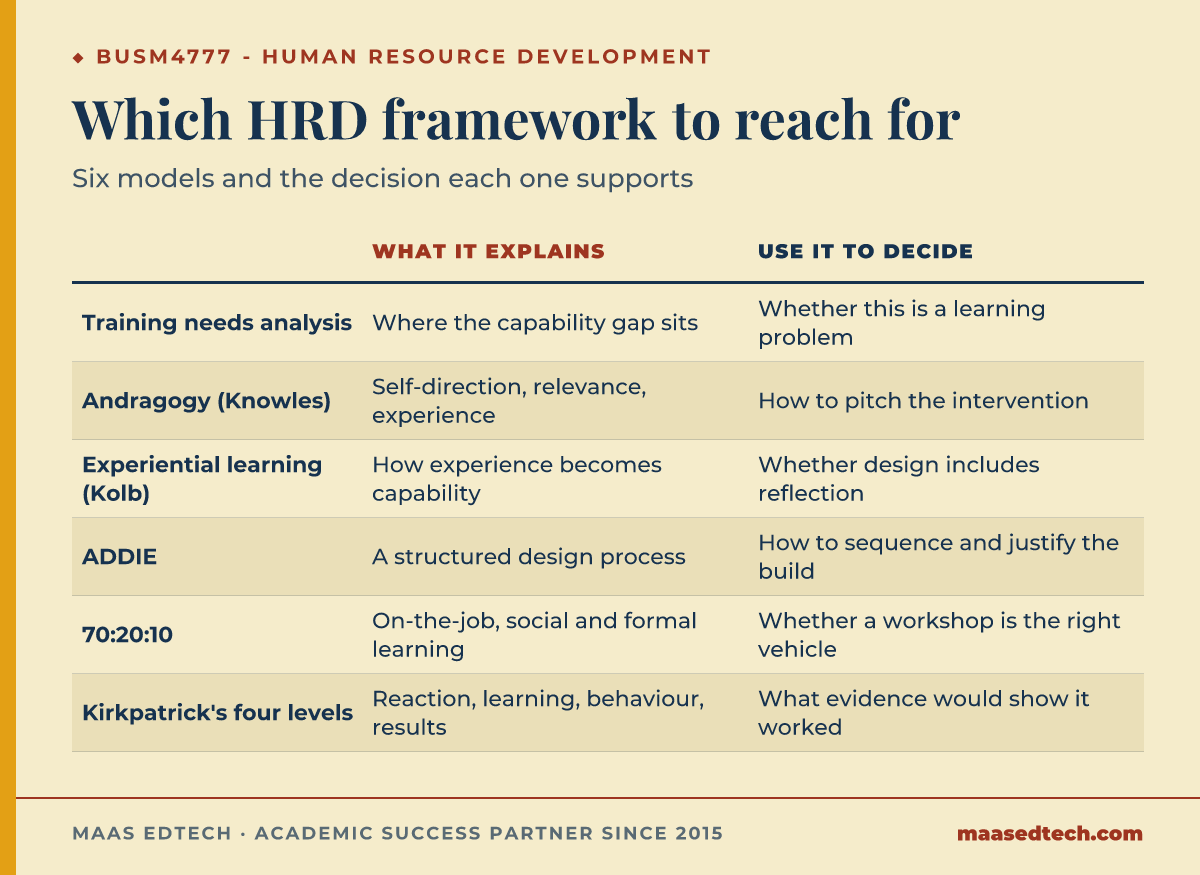
| Framework | What it explains | Use it to decide |
|---|---|---|
| Training needs analysis (organisation / task / person) | Where a capability gap actually sits and what causes it | Whether the problem is a learning problem at all |
| Andragogy (Knowles) | How adult learners differ, self-direction, relevance, experience | How to pitch and frame the intervention for working adults |
| Experiential learning cycle (Kolb) | How experience turns into capability through reflection | Whether your design includes practice and reflection, not just content |
| ADDIE | A structured design process: analyse, design, develop, implement, evaluate | How to sequence and justify the build of the intervention |
| 70:20:10 | The mix of on-the-job, social, and formal learning | Whether a workshop is the right vehicle at all |
| Kirkpatrick's four levels | Reaction, learning, behaviour, results | What evidence would show the intervention worked |
Evidence: These frameworks are examiner-recognised, textbook-level foundations: Knowles, Holton and Swanson (2020) for adult learning, Kolb (2015) for experiential learning, Kirkpatrick and Kirkpatrick (2016) for evaluation, Noe (2020) for the training-and-development process as a whole, and Werner (2021) for how talent development sits inside the wider HRD field the course title names. Note that 70:20:10 is a widely used practitioner heuristic rather than a precisely measured law, say so when you use it, because acknowledging the limits of a model is itself a Distinction-level move.
Example: A Vietnamese RMIT student analysing onboarding at a manufacturing firm tried to apply six models shallowly. Her MAAS mentor cut it to two, a person-level needs analysis to locate the gap, and Kirkpatrick to define what success would look like at the behaviour level. Fewer models, deeper application, higher mark.
How should you structure the BUSM4777 report?
Direct answer: Use a diagnosis-led structure: (1) a brief introduction stating the organisational problem and your position, with company context under 10% of the word count, (2) the needs analysis, showing evidence for the gap and its cause, (3) the proposed intervention with its design justified by learning theory, (4) a critical evaluation of constraints, risks, alternatives you rejected, and how the intervention would be evaluated, and (5) a justified recommendation. Any table, a needs-analysis summary, a design outline, an evaluation plan, must be referred to and interpreted in the text.
Evidence: Criterion-referenced rubrics weight "analysis", "application of theory", and "critical evaluation" far above "organisational background". Matching your word budget to the rubric weighting is the most reliable way to lift a grade without finding new material.
Example: A Vietnamese RMIT student submitted a report with a 500-word company profile and a three-line evaluation section. His MAAS mentor inverted the balance, giving the evaluation room to weigh cost, manager buy-in, and release time against the expected behaviour change. Same case, same sources, the report moved from a borderline Credit to a Distinction because the trade-offs were finally argued.
What are the most common mistakes that lose marks in BUSM4777?
Direct answer: Three recurring mistakes show up across MAAS management coaching. First, students recommend an intervention before diagnosing the gap, training is proposed for a problem that is really about workload, reward, or process design. Second, theory is described in a standalone section and never used again, so the recommendation floats free of the models. Third, evaluation is an afterthought: "we will collect feedback forms" with no link to behaviour or organisational results. Fixing these three lifts most drafts by at least one rubric band.
Evidence: Across MAAS management coaching, marker feedback before intervention clusters heavily on "needs deeper analysis" and "theory not applied", the two phrases that most often separate a Credit from a Distinction in RMIT business rubrics.
Example: A Vietnamese student's report proposed a two-day communication workshop for a team missing deadlines. His MAAS mentor pushed him to test the assumption: interviews in the case material showed unclear handovers and no shared tracker, which is a process gap rather than a skills gap. The revised report recommended a smaller, targeted intervention and named the process fix and earned full marks on the analysis criterion the workshop proposal had failed.
How long is the BUSM4777 assignment and what referencing style does it use?
Direct answer: Confirm the exact word count and style in your assessment brief, individual HRD reports at this level commonly sit between 1,500 and 2,500 words, with tables, appendices, and reference lists often excluded from the count, and use Harvard referencing, which is RMIT's default business style. Stay within the 10% tolerance band, cite every model and every claim about the organisation, and put detailed instruments, a needs-analysis questionnaire, a session plan, in clearly labelled appendices referred to from the text.
Evidence: RMIT's Business school uses RMIT Harvard as its standard referencing style, documented in RMIT's Easy Cite referencing tool. Markers routinely deduct marks for uncited models, secondary citations of classic theorists, or inconsistent Harvard formatting even when the analysis is strong.
Example: A Vietnamese RMIT student lost several marks because he cited Kolb through a website summary rather than the source, and his in-text citations did not match his reference list. A MAAS pre-submission audit closed the gaps in under an hour, primary sources restored and Harvard entries aligned. On his next BUSM4777 task, clean sourcing recovered marks on a criterion that requires no extra analysis at all.
Frequently asked questions
Is BUSM4777 a hard course?
It is judgement-heavy rather than technically hard. There is little quantitative work, but the course rewards diagnosis and defensible design applied to a messy organisational situation. Students who treat it as "describe training theories" struggle; students who treat it as "solve a capability problem" do well.
What is the difference between BUSM4777 and BUSM4778?
They are parallel course codes for substantially the same Human Resource Development content, used across different cohorts, programs, or campus offerings. The theory you need is the same; the assessment brief, weighting, and due dates can differ, so always work from the brief in your own Canvas shell rather than a classmate's.
Can I use my own workplace or a Vietnamese company as the case?
Usually yes, and it often produces a stronger report because you can evidence the gap concretely. Two cautions: check whether your brief requires a set case, and anonymise anything confidential about individuals or performance.
Do I need primary data such as interviews or surveys?
Only if your brief asks for it. Many BUSM4777 tasks accept a needs analysis built from case material or publicly documented evidence. What is not optional is showing how you established the gap rather than asserting it.
What referencing style does BUSM4777 use?
RMIT Harvard is the default for business courses. Cite classic theorists from the source or a current edition rather than a website summary, and use RMIT's Easy Cite tool to format entries consistently.
Can MAAS help me with BUSM4777?
Yes. MAAS Assignment & Essay Support coaches you through the assignment with the Outline, Draft, Final model, sharpening the diagnosis, choosing the right frameworks, structuring the evaluation, and a pre-submission referencing audit, all with discipline-matched experts. We coach your work; we do not write it for you.
Ready to approach BUSM4777 with a clear strategy?
If you have the case but not the diagnosis, that is exactly where a discipline-matched expert helps most. MAAS Assignment & Essay Support is an academic support partner; we work alongside you through Outline, Draft, Final so the analysis stays yours and the structure earns the marks.
Bring your BUSM4777 or BUSM4778 brief and we will match you to a Human Resource Management mentor, 23% of our 100+ experts hold a PhD, within 48 hours when our network already covers that field. If it does not, MAAS opens a dedicated recruitment round for your case, which usually takes about two weeks.
Book a free 15-minute BUSM4777 consultation with MAAS Assignment & Essay Support →
Related guides
- BUSM4187 assignment: how do you approach International Human Resource Management?: sibling RMIT HR guide on managing people across borders
- BUSM2617 assignment: how do you approach Managing People for the Future?: the strategic-HR companion to this development-focused course
- Assignment command words explained: what "evaluate", "analyse", and "justify" actually require
- MAAS Academic Mentoring service: 1:1 coaching with PhD-level mentors in your discipline
- Course-code assignment coaching: pillar guide on tackling any unit assignment with a MAAS mentor
References
- Kirkpatrick, J. D., & Kirkpatrick, W. K. (2016). Kirkpatrick's four levels of training evaluation. ATD Press.
- Knowles, M. S., Holton, E. F., & Swanson, R. A. (2020). The adult learner: The definitive classic in adult education and human resource development (9th ed.). Routledge.
- Kolb, D. A. (2015). Experiential learning: Experience as the source of learning and development (2nd ed.). Pearson Education.
- Noe, R. A. (2020). Employee training and development (8th ed.). McGraw-Hill Education.
- Werner, J. M. (2021). Human resource development: Talent development (8th ed.). Cengage Learning.
Tools & resources
- RMIT University. (n.d.). Assessment and exams. Retrieved July 20, 2026, from https://www.rmit.edu.au/students/student-essentials/assessment-and-exams
- RMIT University. (n.d.). Easy Cite referencing tool. Retrieved July 20, 2026, from https://www.rmit.edu.au/library/study/referencing
This article is part of the MAAS Journal series for Vietnamese international students. MAAS Assignment & Essay Support is an academic support partner; we coach students through the Outline, Draft, Final delivery model with developmental feedback from discipline-matched experts. We do not write or submit work on a student's behalf.