
HOSP204 The Hospitality Experience asks you to analyse how a guest experience is designed and delivered, not to describe a hotel or a restaurant you like. Most students who struggle with this hospitality unit are not short on industry interest. They write a warm account of good service, but never break the experience into stages or name what creates or destroys value at each one. This guide answers the seven questions Vietnamese students ask MAAS mentors most often.
What the marker is looking for is the judgement supported with service-management theory. The questions below are the ones Vietnamese students studying hospitality in Australia ask MAAS mentors most often before starting a HOSP204 assessment.
Author: MAAS Editorial Team
Last updated: 2026-07-20
Category: health-education

What is HOSP204 The Hospitality Experience about?
Direct answer: HOSP204 is a hospitality unit about how guest experiences are designed, staged, and evaluated across accommodation, food and beverage, events, and tourism settings. It covers service nature, the guest journey, servicescape, expectation management, emotional labour, service failure and recovery, and measuring guest satisfaction and loyalty. It wants you to analyse an experience as a designed system, not review a venue.
Evidence: The teaching frame rests on the established services literature: Pine and Gilmore's experience economy for the idea that experiences are staged rather than delivered, Bitner's servicescape for the physical environment's effect on behaviour, Parasuraman, Zeithaml and Berry's SERVQUAL for the expectation–perception gap, and the service-recovery paradox literature for what happens after something goes wrong.
Example: A Vietnamese student in Australia arrived at MAAS with a draft describing a five-star hotel stay in glowing detail. Her mentor reframed it: map the stay as a sequence of touchpoints, then identify the two moments where perceived value was actually created and the one where it leaked. Once the draft analysed a designed journey instead of recounting a nice weekend, her mark moved from a Pass-level draft to a Distinction.
What assessment does the HOSP204 assignment usually involve?
Direct answer: Hospitality experience units at this level are commonly assessed through a staged set of tasks, often an individual analysis of a real guest experience or venue, a case-based report on a service problem, a group project designing or improving an experience, and a reflective piece.
Because the unit is about experience, assessments frequently ask you to observe a real setting, map the journey, and evaluate it against service theory. Confirm the exact task, word count, and weighting in your own subject outline or learning-management system, because structure varies by provider and by teaching period.
Evidence: Australian higher-education assessment in this field is criterion-referenced: marks are awarded against published rubric criteria rather than by ranking students against each other. That is why reading the rubric closely matters far more than the number of examples you include.
Example: A Vietnamese student spent half of a 1,500-word report describing a restaurant's décor and menu before reaching the analysis. His MAAS mentor cut the description to a short scene-setting paragraph and reallocated the words to the wait-time failure he had observed and how it was handled. Same venue, same word count, the analysis-led version earned a clear Distinction.
How is the HOSP204 assignment graded, what does the rubric actually reward?
Direct answer: Hospitality experience rubrics at this level reward four things, roughly in this order: (1) systematic analysis of the experience rather than description or personal opinion, (2) correct application of service-management theory to what you observed, (3) critical evaluation that weighs operational constraints, cost, and staff capability rather than listing ideal fixes, and (4) practical recommendations plus academic writing and correct referencing. "The staff were friendly and the room was clean" is description; naming which touchpoint created value and why is analysis.
Evidence: Criterion bands in these units typically run Pass / Credit / Distinction / High Distinction, and the jump from Credit to Distinction is usually defined by the words "critical" and "justified", critical evaluation of the experience and justified recommendations, not by covering more venues or more theory.
Example: A MAAS mentor marked one Vietnamese student's draft sentence by sentence, labelling each as "describe", "analyse", or "evaluate". The draft was 75% describe, and its recommendations were a wish list with no cost or staffing implications. After one restructuring pass that tied each recommendation to a specific observed gap and named what it would take to implement, the same fieldwork moved up two full rubric bands.
Which frameworks should you use in HOSP204?
Direct answer: Anchor your analysis in two or three frameworks rather than surveying the syllabus. A workable spine is: guest-journey or service-blueprint mapping to break the experience into stages and separate what the guest sees from what happens backstage; the servicescape to analyse how space, sound, lighting, and layout shape behaviour; the experience-economy lens to ask whether the venue is staging an experience or merely delivering a service; SERVQUAL's gap model to locate where expectation and perception diverge; and service recovery to evaluate what happens when something fails. Choose the frameworks your observations can actually support.
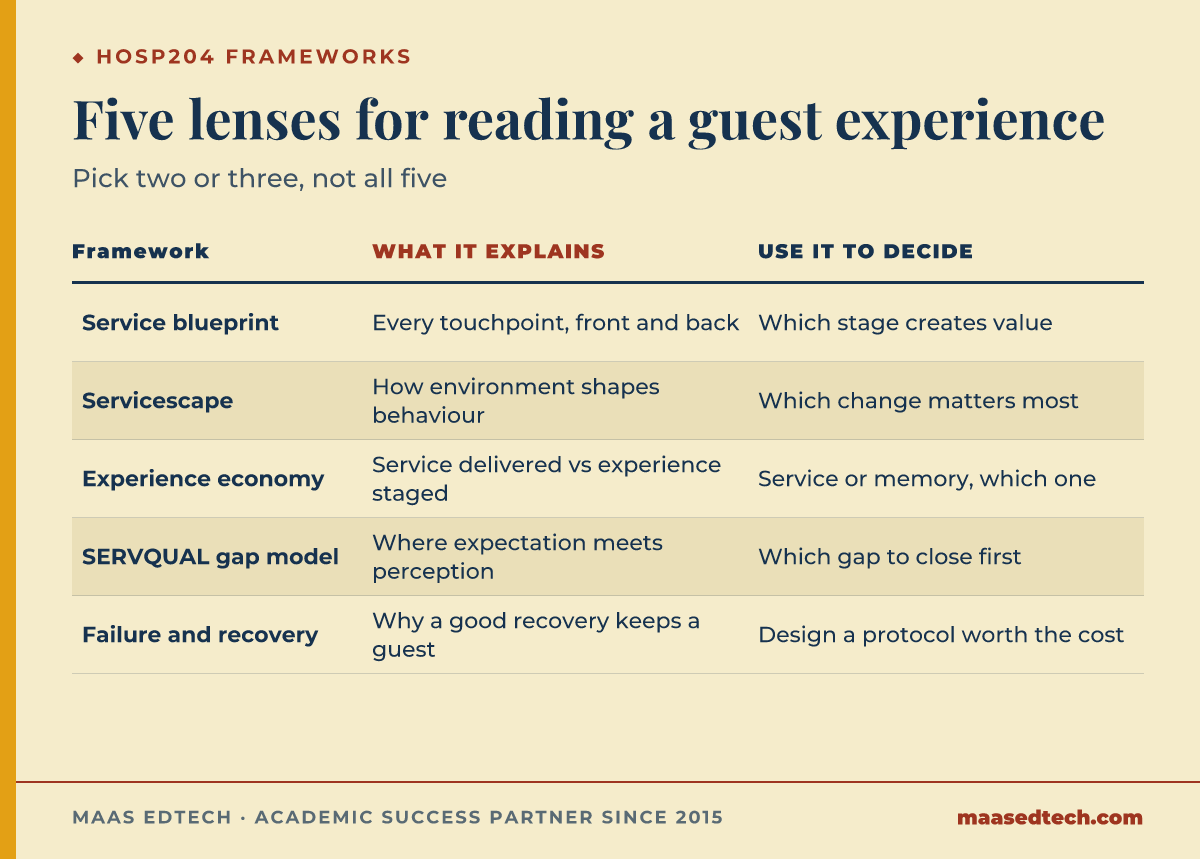
| Framework | What it explains | Use it to decide |
|---|---|---|
| Service blueprint / guest journey | Every touchpoint from pre-arrival to post-stay, front-of-house and backstage | Which stage actually creates or destroys value |
| Servicescape (Bitner) | How the physical environment shapes guest and staff behaviour | Which environmental change would alter the experience most |
| Experience economy (Pine & Gilmore) | The difference between delivering a service and staging an experience | Whether the venue is competing on service or on memory |
| SERVQUAL gap model | Where guest expectations and perceptions diverge, and why | Which gap to close first, promise, standards, delivery, or communication |
| Service failure and recovery | Why a well-handled failure can retain a guest | How to design a recovery protocol worth the cost |
Evidence: These frameworks rest on examiner-recognised foundations rather than trade commentary. Harvard Business Review's own editorial summary of the article that introduced the technique puts it in plain terms: "This very pragmatic article describes how the use of a blueprint can help a service developer not only to identify problems before they happen but also to see the potential for other market opportunities" (Shostack, 1984, p. 133). The same foundations run through the rest of the unit: Bitner (1992), in the Journal of Marketing, for the servicescape; Parasuraman, Zeithaml and Berry (1988), in the Journal of Retailing, for SERVQUAL; Pine and Gilmore (2011), published by Harvard Business Review Press, for the experience economy; and Wirtz and Lovelock (2022) for the services-marketing framing used in most hospitality curricula.
Example: A Vietnamese student analysing a café tried to apply five frameworks shallowly. Her MAAS mentor cut it to two, a journey map to locate the bottleneck at order-to-collection, and the servicescape to explain why the queue felt longer than it was. Fewer frameworks, deeper application, higher mark.
How should you structure the HOSP204 report?
Direct answer: Use an analysis-led structure: (1) a brief introduction stating the experience you analysed and your overall judgement, keeping venue description under 10% of the word count, (2) the journey or blueprint mapping the stages, (3) analysis of the critical moments applying your chosen framework to specific observations, (4) a critical evaluation that weighs operational and cost constraints and considers alternatives, and (5) prioritised, implementable recommendations. Include your journey map or observation table as a labelled figure and interpret it in the text, a map that no sentence explains earns nothing.
Evidence: Criterion-referenced rubrics weight "analysis", "application of theory", and "recommendations" far above "description of the venue". Matching your word budget to the rubric weighting is the most reliable way to lift a grade without collecting new fieldwork.
Example: A Vietnamese student submitted a report with a 500-word venue description and a closing line recommending "better training". His MAAS mentor inverted the balance, giving the recommendations room to specify which stage, which staff role, what the standard would be, and what it would cost in shift hours. Same fieldwork, the report moved from a borderline Credit to a Distinction because the advice became implementable.
What are the most common mistakes that lose marks in HOSP204?
Direct answer: Three recurring mistakes show up across MAAS hospitality coaching. First, the report reads as a review rather than an analysis, personal enjoyment stands in for evidence of designed value. Second, theory appears in one block and is never used again, so the analysis and the frameworks run on separate tracks. Third, recommendations are idealistic, more staff, better training, a refurbishment, with no attention to margin, rostering, or peak-period reality, which the evaluation criterion specifically tests. Fixing these three lifts most drafts by at least one rubric band.
Evidence: Across MAAS hospitality coaching, marker feedback before intervention clusters heavily on "too descriptive" and "recommendations not justified", the two phrases that most often separate a Credit from a Distinction in service-experience rubrics.
Example: A Vietnamese student recommended that a 40-seat restaurant add a dedicated greeter. His MAAS mentor asked what that costs across a week of trading, and whether the observed delay occurred at all times or only during a peak lasting 45 minutes. The revised recommendation was a peak-only host role with a defined greeting standard, cheaper, targeted, and evidence-based. It earned full marks on the evaluation criterion the original had failed.
How long is the HOSP204 assignment and what referencing style does it use?
Direct answer: Confirm the exact word count and style in your subject outline, individual hospitality reports at this level commonly sit between 1,200 and 2,000 words, with tables, figures, and reference lists often excluded from the count. Referencing style varies by provider: APA 7th and Harvard are both common in Australian hospitality programs, so use whichever your outline specifies and apply it consistently. Cite the theory from academic sources rather than blog summaries, and if you use observational data, state when and where you observed, because undated fieldwork weakens the analysis it supports.
Evidence: Australian hospitality and business programs typically nominate a single referencing style in the subject outline and mark consistency as part of academic-writing criteria. Markers routinely deduct marks for mixed styles, uncited frameworks, or reference lists that do not match in-text citations, even when the analysis is strong.
Example: A Vietnamese student lost several marks because he cited SERVQUAL through a marketing blog and mixed APA and Harvard formats in one reference list. A MAAS pre-submission audit closed the gaps in under an hour, primary sources restored and one style applied throughout. On his next assessment, clean referencing recovered marks on a criterion that requires no extra analysis at all.
Frequently asked questions
Is HOSP204 a hard unit?
It is analytically demanding rather than technically hard. The content feels familiar because everyone has been a guest, and that familiarity is the trap: writing from personal impression instead of structured observation is the most common reason a capable student sits at Credit.
Do I have to visit a real venue?
Many assessments in this unit expect real observation, and it usually produces a stronger report because you can evidence specific moments. If your brief allows a case study instead, treat the case material as your observation and map it just as systematically. Check your subject outline before choosing.
Can I analyse a hotel or restaurant in Vietnam?
Usually yes, unless your brief specifies a local venue, and it can work well because you can observe repeatedly and understand the guest expectations in context. Keep the analysis theory-led rather than turning it into a venue profile, and note any cultural differences in expectation that affect your judgement.
Do I need to interview staff or guests?
Only if your brief asks for it, and only within your provider's ethics requirements, student observation of a public space is normally fine, while interviewing people usually is not without approval. Structured observation with a clear record of what you saw and when is generally sufficient.
What referencing style does HOSP204 use?
It depends on the provider, APA 7th and Harvard are both common in Australian hospitality programs. Use the style named in your subject outline and apply it consistently throughout, including for any industry sources.
Can MAAS help me with HOSP204?
Yes. MAAS Assignment & Essay Support coaches you through the assessment with the Outline, Draft, Final model, designing the observation, mapping the journey, applying the right framework, making recommendations implementable, and a pre-submission referencing audit, all with discipline-matched experts. We coach your work; we do not write it for you.
How long is a typical HOSP204 report?
Individual reports at this level commonly sit between 1,200 and 2,000 words, with venue description kept under 10% of that total so the analysis, application of theory and recommendations carry the rest of the word count.
Ready to approach HOSP204 with a clear strategy?
If you have the observations but not the analysis, that is exactly where a discipline-matched expert helps most. MAAS Assignment & Essay Support is an academic support partner; we work alongside you through Outline, Draft, Final so the thinking stays yours and the structure earns the marks.
Bring your HOSP204 brief and we will match you to a hospitality and services mentor, 23% of our 100+ experts hold a PhD, within 48 hours when our network already covers that field. If it does not, MAAS opens a dedicated recruitment round for your case, which usually takes about 2 weeks.
Book a free 15-minute HOSP204 consultation with MAAS Assignment & Essay Support →
Related guides
- How to approach the MKTG1507 Digital Marketing assignment?: for the marketing-side view of customer experience and evidence
- How to approach the BUSM4699 Cross Cultural Management assignment?: useful when your guests or staff span cultures
- Assignment command words explained: what "evaluate", "analyse", and "justify" actually require
- MAAS Academic Mentoring service: 1:1 coaching with PhD-level mentors in your discipline
- Course-code assignment coaching: pillar guide on tackling any unit assignment with a MAAS mentor
References
- Bitner, M. J. (1992). Servicescapes: The impact of physical surroundings on customers and employees. Journal of Marketing, 56(2), 57–71. https://doi.org/10.1177/002224299205600205
- Parasuraman, A., Zeithaml, V. A., & Berry, L. L. (1988). SERVQUAL: A multiple-item scale for measuring consumer perceptions of service quality. Journal of Retailing, 64(1), 12–40.
- Pine, B. J., & Gilmore, J. H. (2011). The experience economy (Updated ed.). Harvard Business Review Press.
- Shostack, G. L. (1984). Designing services that deliver. Harvard Business Review, 62(1), 133–139.
- Wirtz, J., & Lovelock, C. (2022). Services marketing: People, technology, strategy (9th ed.). World Scientific.
Tools & resources
- Tertiary Education Quality and Standards Agency. (n.d.). Guidance notes. Retrieved July 20, 2026, from https://www.teqsa.gov.au/guides-resources/higher-education-good-practice-hub
This article is part of the MAAS Journal series for Vietnamese international students. MAAS Assignment & Essay Support is an academic support partner; we coach students through the Outline, Draft, Final delivery model with developmental feedback from discipline-matched experts. We do not write or submit work on a student's behalf.