
MKTG1507 Contemporary Issues in Digital Marketing rewards students who take a defensible position on a contested issue and support it with theory and evidence, not those who summarise the latest platform trends. Most students who struggle with this RMIT marketing course write a competent overview of AI, influencers, or privacy, but never argue a case or weigh the counter-position. This guide answers the seven questions Vietnamese students at RMIT ask MAAS mentors most often before they start MKTG1507.
Author: MAAS Editorial Team
Last updated: 2026-07-20
Category: marketing

What is MKTG1507 Contemporary Issues in Digital Marketing about?
Direct answer: MKTG1507 is an RMIT marketing course that examines current, unsettled debates in digital marketing rather than teaching the basic toolkit. It covers data-driven personalisation and privacy trade-offs, the post-cookie measurement environment, AI in content and targeting, influencer marketing disclosure, platform power, brand safety, and the ethics of persuasive design.
Evidence: The dominant frame in the course is the value-versus-privacy exchange, consumers trade personal data for relevance and convenience, and the marketer's problem is where that exchange stops being acceptable. Martin and Murphy (2017) set out the data-privacy framework used across marketing scholarship, and Lambrecht and Tucker's work on personalised advertising provides the evidence base showing personalisation does not always outperform.
Example: A Vietnamese student at RMIT Vietnam arrived at MAAS with a draft titled "The rise of AI in marketing" that read as a list of tools. Her mentor reframed it as a question with two defensible sides: does AI-generated content strengthen or erode brand trust, and for whom. Once the draft had a claim to defend, it stopped surveying tools and started arguing, and her mark moved from a Pass-level draft to a Distinction.
What assessment does the MKTG1507 assignment usually involve?
Direct answer: Contemporary-issues marketing courses at this level are commonly assessed through an individual report, critical essay, or issue analysis on a nominated topic, often with a group component such as a debate or presentation, and sometimes a portfolio of shorter reflections. You are typically asked to define the issue, review what the literature and evidence say, evaluate competing positions, and derive implications for marketing practice. Always confirm the exact task, word count, and weighting in your own Canvas shell, because assessment structure changes by semester and campus.
Evidence: RMIT business assessments are criterion-referenced, meaning marks are awarded against published rubric criteria rather than ranked against classmates. This is set out in RMIT's Assessment policy, which is why decoding the rubric matters far more than how many current examples you can cite.
Example: A Vietnamese RMIT student spent half of a 1,500-word report explaining how programmatic advertising works before reaching the issue. His MAAS mentor cut the mechanics to a short paragraph and reallocated the words to the evidence on ad-fraud and viewability. Same topic, same word count, the argument-led version earned a clear Distinction.
How is the MKTG1507 assignment graded, what does the rubric actually reward?
Direct answer: Contemporary-issues rubrics at this level reward four things, roughly in this order: (1) a clear, defensible position on the issue rather than a balanced-sounding survey, (2) engagement with academic literature, not only industry blogs and platform reports, (3) critical evaluation that takes the strongest counter-argument seriously before answering it, and (4) implications for practice plus academic writing and Harvard referencing. A report that explains an issue without taking a position is the classic Credit-level submission.
Evidence: RMIT business rubrics use criterion bands (Pass / Credit / Distinction / High Distinction). The jump from Credit to Distinction is almost always defined by the words "critical" and "justified", a justified position and critical engagement with alternatives, not by adding more current examples.
Example: A MAAS mentor marked one Vietnamese student's draft sentence by sentence, labelling each as "describe", "argue", or "evaluate". The draft was 70% describe and its conclusion sat on the fence. After one restructuring pass that committed to a position and answered the strongest objection to it, the same material moved up two full rubric bands.
Which frameworks and evidence should you use in MKTG1507?
Direct answer: Anchor your argument in two or three lenses that fit your issue rather than surveying the syllabus. A workable set is: the privacy calculus, which weighs perceived benefit against perceived risk of disclosure; the personalisation–privacy paradox, which explains why stated preferences and actual behaviour diverge; source credibility and parasocial relationship theory for influencer questions; attention and attribution economics for measurement debates; and a stakeholder or ethics lens for questions about persuasive design and vulnerable audiences. Then support each with peer-reviewed evidence, using industry data only for market facts.
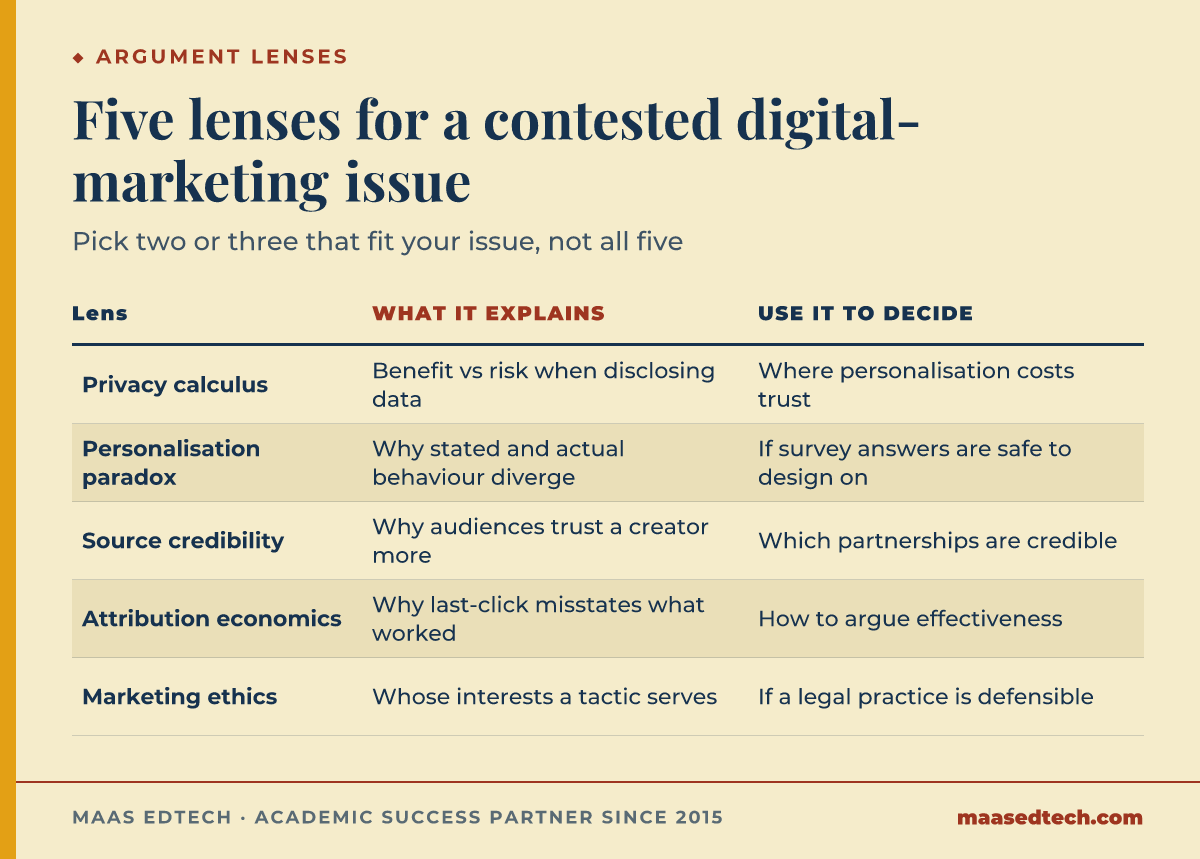
| Lens | What it explains | Use it to decide |
|---|---|---|
| Privacy calculus | How consumers trade perceived benefit against perceived risk when disclosing data | Where personalisation stops adding value and starts costing trust |
| Personalisation–privacy paradox | Why consumers say they value privacy yet behave otherwise | Whether survey-stated preferences are safe to design strategy around |
| Source credibility and parasocial ties | Why audiences trust a creator more than a brand | Which influencer partnerships are credible and where disclosure matters |
| Attention and attribution economics | Why last-click measurement misstates what actually worked | How to argue about media effectiveness without over-claiming |
| Stakeholder and marketing ethics | Whose interests a tactic serves and who bears the harm | Whether a legally permitted practice is defensible |
Evidence: These frameworks are examiner-recognised foundations rather than agency commentary: Martin and Murphy (2017) for the data-privacy framework, Lambrecht and Tucker (2013) for empirical limits of personalised advertising, Hollebeek and Macky (2019) for content marketing and consumer engagement, Wedel and Kannan (2016) for why attribution across a data-rich, multi-touch environment is harder than a last-click model admits, and Kietzmann et al. (2018) for the artificial-intelligence-in-advertising frame. Lambrecht and Tucker's field experiment makes the personalisation limit concrete: "the data suggest that dynamic retargeted ads are, on average, less effective than their generic equivalents" (Lambrecht & Tucker, 2013, p. 561). Use platform and agency reports for market facts, and label them as industry sources.
Example: A Vietnamese RMIT student writing about influencer marketing built her whole case from agency blog posts. Her MAAS mentor kept two industry statistics for market size and replaced the rest with peer-reviewed work on source credibility and disclosure. The argument became defensible, and the credibility criterion moved from Credit to Distinction.
How should you structure the MKTG1507 report?
Direct answer: Use an argument-led structure: (1) an introduction that frames the issue as a contested question and states your position, (2) the background needed to understand the debate, kept under 10% of the word count, (3) the evidence for your position drawn from academic literature, (4) the strongest counter-position taken seriously and then answered, and (5) implications for marketing practice and a justified conclusion. Any table, a comparison of positions, an evidence summary, must be referred to and interpreted in the text. The single biggest structural fix is replacing a neutral survey with a claim and a defence of it.
Evidence: Criterion-referenced rubrics weight "critical evaluation" and "engagement with literature" far above "description of the issue". Matching your word budget to the rubric weighting is the most reliable way to lift a grade without finding new material.
Example: A Vietnamese RMIT student submitted a report that presented three views on data privacy and concluded that "both sides have merit". His MAAS mentor asked him to commit: personalisation is defensible only where the consumer can see and control the exchange. Same evidence, same word count, the report moved from a borderline Credit to a Distinction because there was finally something to defend.
What are the most common mistakes that lose marks in MKTG1507?
Direct answer: Three recurring mistakes show up across MAAS marketing coaching. First, students describe an issue instead of arguing a position, and the conclusion sits on the fence. Second, the evidence base is almost entirely industry blogs, platform reports, and agency whitepapers, which markers read as promotional rather than scholarly. Third, the counter-argument is either absent or set up as a straw man, which caps the critical-evaluation criterion. Fixing these three lifts most drafts by at least one rubric band.
Evidence: Across MAAS marketing coaching, marker feedback before intervention clusters heavily on "needs a clearer argument" and "sources not academic", the two phrases that most often separate a Credit from a Distinction in RMIT business rubrics.
Example: A Vietnamese student's essay argued that AI-generated content is "the future of marketing" and dismissed the trust objection in one sentence. His MAAS mentor made him build the objection properly, disclosure norms, homogenised brand voice, and evidence on consumer reactions to machine-authored content and then answer it with conditions under which AI use holds up. The steel-manned version earned full marks on the criterion the dismissal had failed.
How long is the MKTG1507 assignment and what referencing style does it use?
Direct answer: Confirm the exact word count and style in your assessment brief, individual marketing reports and critical essays at this level commonly sit between 1,500 and 2,500 words, with reference lists usually excluded from the count, and use Harvard referencing, which is RMIT's default business style. Stay within the 10% tolerance band.
For this course specifically, aim for a majority of peer-reviewed sources published within roughly the last five years, and date-stamp any platform or market statistic, because the "contemporary" framing means an out-of-date figure undermines the argument it supports.
Evidence: RMIT's Business school uses RMIT Harvard as its standard referencing style, documented in RMIT's Easy Cite referencing tool. Markers routinely deduct marks for over-reliance on non-scholarly sources, unreferenced statistics, or inconsistent Harvard formatting even when the argument is strong.
Example: A Vietnamese RMIT student lost several marks because eleven of his fourteen sources were agency blog posts and his in-text citations did not match his reference list. A MAAS pre-submission audit closed the gaps in under an hour, the core claims re-sourced to journal articles, industry data kept but labelled and dated, Harvard entries aligned. On his next MKTG1507 task, clean sourcing recovered marks on a criterion that requires no extra analysis at all.
Frequently asked questions
Is MKTG1507 a hard course?
It is argument-heavy rather than technically hard. There is little quantitative work, but the course expects you to hold a position under pressure and support it with scholarship. Students who treat it as "write about digital marketing trends" struggle; students who treat it as "argue a contested question with evidence" do well.
Can I use industry reports and platform data as sources?
Yes, for market facts, audience size, spend, adoption, as long as you label them as industry sources and date them. What markers penalise is building the argument on promotional material. Keep the conceptual and evidential backbone peer-reviewed.
Can I write about a Vietnamese brand or the Vietnamese market?
Yes, and it often strengthens the report because you can evidence local platform behaviour and consumer attitudes concretely. Keep the case in service of the argument rather than turning the report into a brand profile, and source local statistics carefully.
How current do my sources need to be?
Recent enough to be defensible on a "contemporary issues" brief, aim for a majority of academic sources from roughly the last five years, plus current market data with dates. Foundational theory can be older; the evidence about today's environment should not be.
What referencing style does MKTG1507 use?
RMIT Harvard is the default for business courses, and it applies to industry reports and platform data as well as journal articles. Always confirm in your own brief and use RMIT's Easy Cite tool to format entries consistently.
Can MAAS help me with MKTG1507?
Yes. MAAS Assignment & Essay Support coaches you through the assignment with the Outline, Draft, Final model, sharpening the position, building the academic evidence base, steel-manning the counter-argument, and a pre-submission referencing audit, all with discipline-matched experts. We coach your work; we do not write it for you.
Ready to approach MKTG1507 with a clear strategy?
If you have the topic but not the argument, that is exactly where a discipline-matched expert helps most. MAAS Assignment & Essay Support is an academic support partner; we work alongside you through Outline, Draft, Final so the thinking stays yours and the structure earns the marks.
Bring your MKTG1507 brief and we will match you to a digital marketing mentor, 23% of our 100+ experts hold a PhD, within 48 hours when our network already covers that field. If it does not, MAAS opens a dedicated recruitment round for your case, which usually takes about two weeks.
Book a free 15-minute MKTG1507 consultation with MAAS Assignment & Essay Support →
Related guides
- MKTG1419 assignment: how do you approach Social Media and Mobile Marketing?: sibling RMIT marketing guide on social and mobile channels
- MKTG1294 assignment: how do you approach Introduction to Advertising?: the advertising-fundamentals companion course
- MKT3020 assignment: how do you approach Omnichannel Marketing?: for the channel-integration side of digital strategy
- MAAS Academic Mentoring service: 1:1 coaching with PhD-level mentors in your discipline
- Course-code assignment coaching: pillar guide on tackling any unit assignment with a MAAS mentor
References
- Hollebeek, L. D., & Macky, K. (2019). Digital content marketing's role in fostering consumer engagement, trust, and value. Journal of Interactive Marketing, 45, 27–41. https://doi.org/10.1016/j.intmar.2018.07.003
- Kietzmann, J., Paschen, J., & Treen, E. (2018). Artificial intelligence in advertising: How marketers can leverage artificial intelligence along the consumer journey. Journal of Advertising Research, 58(3), 263–267. https://doi.org/10.2501/JAR-2018-035
- Lambrecht, A., & Tucker, C. (2013). When does retargeting work? Information specificity in online advertising. Journal of Marketing Research, 50(5), 561–576. https://doi.org/10.1509/jmr.11.0503
- Martin, K. D., & Murphy, P. E. (2017). The role of data privacy in marketing. Journal of the Academy of Marketing Science, 45(2), 135–155. https://doi.org/10.1007/s11747-016-0495-4
- Wedel, M., & Kannan, P. K. (2016). Marketing analytics for data-rich environments. Journal of Marketing, 80(6), 97–121. https://doi.org/10.1509/jm.15.0413
Tools & resources
- RMIT University. (n.d.). Assessment and exams. Retrieved July 20, 2026, from https://www.rmit.edu.au/students/student-essentials/assessment-and-exams
- RMIT University. (n.d.). Easy Cite referencing tool. Retrieved July 20, 2026, from https://www.rmit.edu.au/library/study/referencing
This article is part of the MAAS Journal series for Vietnamese international students. MAAS Assignment & Essay Support is an academic support partner; we coach students through the Outline, Draft, Final delivery model with developmental feedback from discipline-matched experts. We do not write or submit work on a student's behalf.