
MKTG1294 Introduction to Advertising rewards a campaign you can analyse, not one you can admire and that distinction decides your grade. Most students who struggle with this RMIT course are not short on examples; they retell what a famous advertisement did but never connect it to an objective, an audience, and an advertising theory a marker would recognise. This guide answers the seven questions Vietnamese students at RMIT ask MAAS mentors most often before they start the MKTG1294 assignment.
Author: MAAS Editorial Team
Last updated: 2026-07-08
Category: marketing

What is the MKTG1294 Introduction to Advertising assignment about?
Direct answer: MKTG1294 is a first-year RMIT marketing course (offered at RMIT Melbourne and RMIT Vietnam) introducing advertising as a strategic, theory-driven discipline rather than creative decoration. The core assignment usually asks you to examine one real advertising campaign and explain how its objectives, audience, message strategy, and media choices work together, with emphasis on analysis, not description.
Evidence: Introductory advertising courses of this type follow the logic set out in standard texts such as Belch and Belch's Advertising and Promotion and the integrated marketing communications (IMC) tradition, where every advertising decision is justified against a communication objective and an audience. That framing, objectives, targeting, message, media, evaluation, is the backbone MKTG1294 assessments draw from.
Example: A Vietnamese student at RMIT Vietnam came to MAAS treating the MKTG1294 brief as "describe a cool advert I like". Her MAAS mentor reframed the task: analyse why the campaign was built the way it was and whom it was built for. Once she anchored each observation to an objective and an audience, her draft stopped narrating the ad and started explaining it and the mark moved from a Pass-level draft toward a clear Distinction.
What assessment does the MKTG1294 assignment usually involve?
Direct answer: Introduction to Advertising at this level is commonly assessed through a short individual analysis, frequently around 800 words for the first assignment (ASM1), in which you select and examine one advertising campaign. You are usually asked to identify the campaign's objective, describe the target audience, unpack the message and the type of appeal used (emotional, rational, fear, humour), comment on the media channels, and evaluate how well the pieces fit together. Always confirm the exact word count, campaign restrictions, and weighting in your own Canvas shell, the brief changes by semester and campus.
Evidence: RMIT business and marketing assessments are criterion-referenced, meaning marks are awarded against published rubric criteria rather than ranked against classmates. This is stated in RMIT's Assessment policy, which is why decoding the rubric (next section) matters far more than picking a spectacular campaign.
Example: A Vietnamese RMIT student spent most of an 800-word draft summarising the plot of a Super Bowl ad. His MAAS mentor showed him that at 800 words there is no room to narrate, every sentence must analyse. Same campaign, but by cutting the storytelling and adding audience-and-appeal analysis, the tight version turned a thin Pass into a Distinction because the argument finally earned the word count.
How is the MKTG1294 assignment graded, what does the rubric actually reward?
Direct answer: Introduction to Advertising rubrics at this level reward four things, roughly in this order: (1) analysis, the campaign explained against objectives, audience and theory rather than described, (2) correct use of advertising and IMC concepts, (3) evidence and examples drawn from the campaign itself, and (4) academic writing and APA referencing. Retelling what happened in the ad earns almost no marks; marks live in why this audience, why this appeal, and how the message serves the objective. Whenever you can replace a descriptive sentence with an analytical claim, do it.
Evidence: RMIT marketing rubrics use criterion bands (Pass / Credit / Distinction / High Distinction). The jump from Credit to Distinction is almost always defined by the words "analyse", "critical", and "justified", critical analysis and justified links to theory, not by choosing a more famous campaign or writing more words.
Example: A MAAS mentor labelled each sentence of one Vietnamese student's draft as "describe" or "analyse". The 800-word draft was 80% describe. After one restructuring pass that tied each observation to an advertising concept and the campaign's objective, the same analysis moved up two full rubric bands without a single new paragraph of research.
Which frameworks and concepts should you use in MKTG1294?
Direct answer: Anchor your analysis in a small set of established advertising concepts rather than name-dropping many, and make each one earn its place. The most useful for MKTG1294 are: a communication-objectives model (such as the hierarchy-of-effects or the DAGMAR awareness-to-action logic), a target-audience and positioning lens, the advertising-appeals typology (rational, emotional, fear, humour), and a simple media/creative frame from the IMC toolkit. Pick the two or three that genuinely fit your chosen campaign, a short assignment cannot carry more.
| Framework / concept | What it does | Use it to explain |
|---|---|---|
| Hierarchy of effects | Maps how an ad moves an audience from awareness to action | What stage the campaign's objective targets |
| DAGMAR (define objective, measure result) | Frames advertising around a specific, measurable communication goal | Whether the campaign has a clear, testable objective |
| Advertising appeals (rational / emotional / fear / humour) | Classifies the persuasion strategy | Why the message was designed this way for this audience |
| Target audience & positioning | Defines who the ad speaks to and the perception it builds | Why the media and message fit the intended segment |
| IMC consistency | Checks the message across channels | Whether the campaign speaks with one coherent voice |
Evidence: The hierarchy-of-effects logic (Lavidge & Steiner, 1961), the DAGMAR approach to setting advertising objectives, and the advertising-appeals typology are documented across the standard advertising and IMC literature (Belch & Belch, 2021; Kotler & Armstrong, 2021). Percy and Rossiter's brand awareness and brand attitude model sharpens the appeals choice further, matching a rational or emotional appeal to whether the campaign's actual goal is recognition or a shift in attitude (Percy & Rossiter, 1992). In their own words, "brand attitude strategy is seen as reflecting an interaction between a potential consumer's involvement with the purchase decision and the underlying motivation to purchase" (Percy & Rossiter, 1992, p. 263). These are examiner-recognised concepts, not blog-level opinions.
Example: A Vietnamese RMIT student tried to apply five models to an 800-word task and explained each in one shallow line. Her MAAS mentor cut it to two, the hierarchy of effects to locate the objective, and the appeals typology to explain the emotional message, applied with depth. Fewer concepts, deeper analysis, higher mark.
How should you structure the MKTG1294 advertising analysis?
Direct answer: Use a claim-driven structure that mirrors the rubric: (1) a one-line introduction naming the campaign and your analytical angle, (2) the campaign's objective and target audience, (3) the message and appeal, analysed against a concept, (4) the media and creative choices, (5) a short evaluation of how well the elements fit the objective, and (6) a brief conclusion. In an 800-word assignment the single biggest structural fix is spending fewer than 100 words describing the campaign and the rest analysing it, the description exists only to set up the analysis.
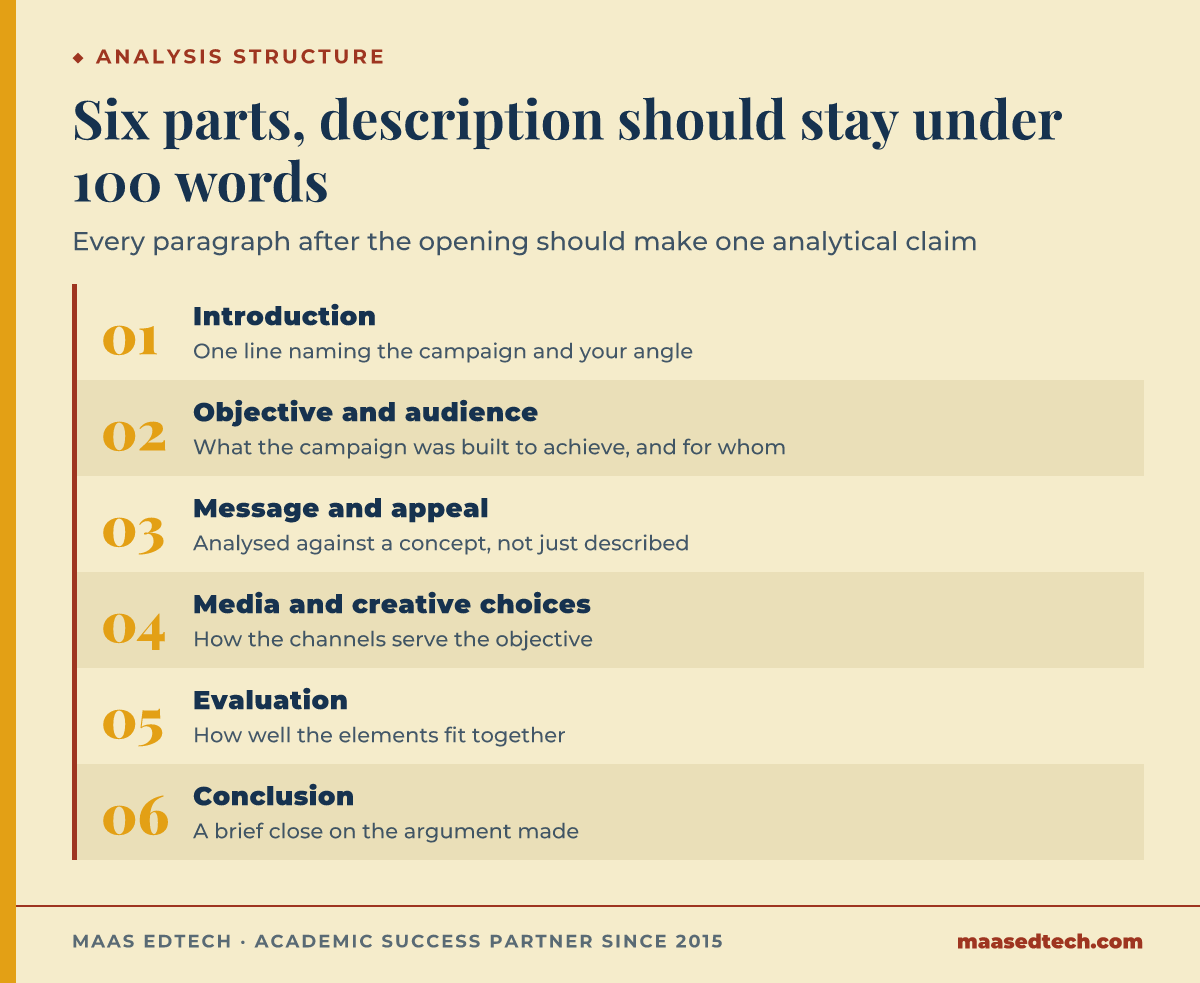
Evidence: Criterion-referenced rubrics weight "analysis and application of theory" far above "description of the campaign". Structuring the piece so each paragraph makes one analytical claim, backed by one concept and one piece of campaign evidence, is the most reliable way to lift a grade without new research.
Example: A Vietnamese student at RMIT submitted an analysis where the campaign description ran 400 of 800 words. His MAAS mentor flipped the ratio, a tight 90-word description, then four analytical paragraphs each built on one concept. Same campaign, same word count, but the mark rose from a borderline Credit to a Distinction because the theory finally had room to work.
What are the most common mistakes that lose marks in MKTG1294?
Direct answer: Three recurring mistakes show up across MAAS advertising coaching. First, students describe the campaign instead of analysing it, the piece becomes a plot summary. Second, they name a concept without applying it, so "this uses an emotional appeal" sits there unexplained. Third, they pick a campaign with too little public information, then cannot support any claim with evidence. Fixing these three lifts most short advertising analyses by at least one rubric band.
Evidence: Across MAAS marketing coaching, marker feedback before intervention clusters heavily on "too descriptive" and "theory not applied", the two phrases that most often separate a Credit from a Distinction in RMIT introductory-marketing rubrics.
Example: A Vietnamese student wrote "the campaign uses humour to appeal to young people" and moved on. His MAAS mentor pushed him to apply it: why humour suited that audience, how it served the awareness objective, and where it risked overshadowing the brand. The applied version earned full marks on the analysis criterion; the original earned almost none.
How long is the MKTG1294 assignment and what referencing style does it use?
Direct answer: Confirm the exact word count and style in your assessment brief, the first MKTG1294 assignment commonly sits around 800 words and uses APA, which RMIT supports through its Easy Cite tool. In a short piece, cite every concept and every campaign fact you did not observe first-hand, keep in-text citations and the reference list consistent, and do not let the reference list crowd out your 800-word analysis. Screenshots of the ad, if allowed, usually sit in an appendix and are referenced from the body.
Evidence: RMIT documents its supported referencing styles, including APA, through the Easy Cite tool, and the specific style for MKTG1294 is set in the assessment brief (this course's briefs point students to RMIT's APA guide). Markers routinely deduct marks for inconsistent or incomplete referencing even when the analysis is strong.
Example: A Vietnamese RMIT student lost several marks because her in-text citations did not match her reference list and one campaign statistic had no source. A MAAS pre-submission audit fixed both in under an hour, every claim traced to a source and the APA entries aligned. On her next MKTG1294 task, that clean-up recovered marks on criteria that require no extra research at all.
Frequently asked questions
Is MKTG1294 a hard course?
It is analytically demanding rather than technically hard; there is no maths, but the course expects you to analyse advertising against theory instead of describing ads you like. Students who treat it as "write about a cool advert" struggle; students who treat it as "explain why this campaign was built this way" do well.
Can I choose any advertising campaign?
Usually yes, within the brief's limits, the assignment often asks for an international campaign you select. Choose one with enough public information to support analysis, and check any restrictions (some briefs exclude campaigns already covered in lectures) in your own Canvas shell.
How many frameworks should I use?
For an 800-word task, two or three concepts applied with depth beat five named shallowly. Examiners reward applied analysis, using a concept to explain a campaign decision, not the number of models you can list.
What referencing style does MKTG1294 use?
APA is the style this course's briefs point to, supported through RMIT's Easy Cite tool. Always confirm in your own brief, and keep in-text citations and the reference list consistent.
Can MAAS help me with MKTG1294?
Yes. MAAS Assignment & Essay Support coaches you through the assignment with the Outline, Draft, Final model, campaign selection, concept choice, analytical feedback, and a pre-submission referencing audit, all with discipline-matched experts. We coach your work; we do not write it for you.
Ready to approach MKTG1294 with a clear analytical angle?
If you have chosen a campaign but not the argument, that is exactly where a discipline-matched expert helps most. MAAS Assignment & Essay Support is an academic support partner; we work alongside you through Outline, Draft, Final so the analysis stays yours and the theory earns the marks.
Bring your MKTG1294 brief and we will match you to a Marketing mentor, 23% of our 100+ experts hold a PhD, within 48 hours when our network already covers that field. If it does not, MAAS opens a dedicated recruitment round for your case, which usually takes about two weeks.
Book a free 15-minute MKTG1294 consultation with MAAS Assignment & Essay Support →
Related guides
- How do you approach the MKTG1419 Social Media and Mobile Marketing assignment?: sibling RMIT marketing guide on measurable social and mobile campaign strategy
- MKT3020 Omnichannel Marketing assignment: how do you approach it?: sibling RMIT marketing guide on integrating channels into one seamless experience
- How do you approach the BUSM2412 Marketing for Managers assignment?: sibling RMIT marketing guide on turning analysis into a justified decision
- How do you approach Marketing Insights at Monash (MKF2801)?: sibling marketing guide on turning market data into a decision-ready insight
- How to write a theoretical framework: for applying marketing concepts with academic depth
- MAAS Academic Mentoring service: 1:1 coaching with PhD-level mentors in your discipline
- Course-code assignment coaching: pillar guide on tackling any unit assignment with a MAAS mentor
References
- Belch, G. E., & Belch, M. A. (2021). Advertising and promotion: An integrated marketing communications perspective (12th ed.). McGraw-Hill.
- Kotler, P., & Armstrong, G. (2021). Principles of marketing (18th ed.). Pearson.
- Lavidge, R. J., & Steiner, G. A. (1961). A model for predictive measurements of advertising effectiveness. Journal of Marketing, 25(6), 59–62. https://doi.org/10.1177/002224296102500611
- Percy, L., & Rossiter, J. R. (1992). A model of brand awareness and brand attitude advertising strategies. Psychology & Marketing, 9(4), 263–274. https://doi.org/10.1002/mar.4220090402
Tools & resources
- RMIT University. (n.d.). Easy Cite referencing tool. Retrieved July 2, 2026, from https://www.rmit.edu.au/library/study/referencing
- RMIT University. (n.d.). Assessment and exams. Retrieved July 2, 2026, from https://www.rmit.edu.au/students/student-essentials/assessment-and-exams
This article is part of the MAAS Journal series for Vietnamese international students. MAAS Assignment & Essay Support is an academic support partner; we coach students through the Outline, Draft, Final delivery model with developmental feedback from discipline-matched experts. We do not write or submit work on a student's behalf.