
MKF2801 Marketing Insights rewards turning raw market data into a defensible, decision-ready insight, not collecting numbers or describing a market. Most students who lose marks stop at the data: they report a market size or a chart, but never tell the reader what it means or what a manager should do about it. This guide answers the seven questions Vietnamese students at Monash ask MAAS mentors most often before they start MKF2801.
Author: MAAS Editorial Team
Last updated: 2026-06-11
Category: marketing

What is MKF2801 Marketing Insights about?
Direct answer: MKF2801 Marketing Insights is a Monash undergraduate marketing-research unit teaching you to convert market data into insight: estimating market size, identifying segments, spotting patterns, and translating findings into a recommendation a manager can act on. The unit cares more about how you reason from evidence than how much data you gather. An insight changes a decision, not a fact found.
Evidence: Marketing scholarship draws a hard line between data, information, and insight. As one open marketing textbook puts the core task plainly: "Marketing research is the process of collecting, analyzing, and reporting marketing information that can be used to answer questions or solve problems so as to improve a company's bottom line" (Tanner & Raymond, 2015, p. 328). Wedel and Kannan (2016) argue that the value of marketing analytics in data-rich environments comes from the decisions the analysis enables, not the volume of data processed. MKF2801 is built around that same distinction, which is why a well-evidenced recommendation outscores a longer data dump.
Example: A Vietnamese student at Monash opened her MKF2801 draft with six exhibits of market data and almost no interpretation. Her MAAS mentor asked one question of each exhibit, "so what should the brand do?" and the answer became the spine of the report. Same data, but reframed around decisions, it moved from a Credit to a Distinction.
What does the MKF2801 market sizing assignment ask for?
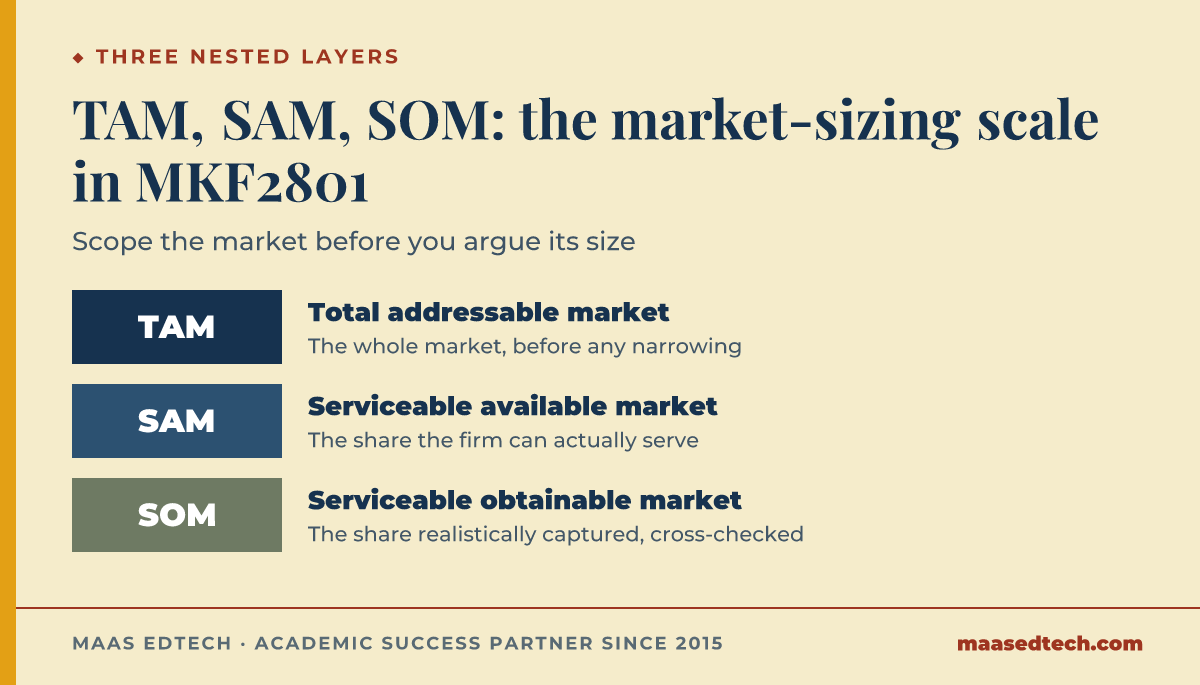
Direct answer: A common MKF2801 task asks you to estimate the size of a market in Australia and its key segments, then present the insight, often as a report, infographic, or short video presentation. You are expected to scope the market in layers (total, serviceable, obtainable), justify your numbers with cited sources and stated assumptions, and explain what the size and structure mean for a marketing decision. Always confirm the exact deliverable, word or time limit, and weighting in your own Moodle shell, because the brief varies by semester.
Evidence: Market sizing is a standard applied-marketing skill, normally taught through the nested TAM–SAM–SOM logic and the choice between top-down and bottom-up estimation (Malhotra, 2019). Markers reward a transparent method, clear assumptions, sources, and arithmetic, over a confident-looking single number with no working shown.
Example: A Vietnamese Monash student estimating an Australian consumer market quoted one headline figure from a news article and stopped. His MAAS mentor showed him how to triangulate: a top-down estimate from published industry data and a bottom-up estimate from households × adoption rate × average spend. Where the two estimates converged, his number became defensible and that defensibility is what the rubric rewards.
How is MKF2801 graded, what does the rubric reward?
Direct answer: The rubric typically rewards four things: (1) the quality of the insight and recommendation, (2) the rigour of the method, assumptions, sources, and triangulation, (3) the clarity of the data visualisation and communication, and (4) correct APA referencing. Describing the market earns little; analysing what its size and structure mean for a decision earns the marks. The communication criterion matters more here than in a standard essay because insights that cannot be understood quickly are treated as insights that do not land.
Evidence: Monash marketing rubrics are criterion-referenced, marks are awarded against published criteria, not ranked against classmates. The jump from Credit to Distinction is almost always defined by judgement and synthesis rather than by adding more data, mirroring the research-to-insight emphasis of the unit.
Example: A MAAS mentor colour-coded one Vietnamese student's draft into "data reported" versus "insight argued". It was 80% reported data. After one restructuring pass that put a one-sentence insight above every exhibit and cut the redundant tables, the same evidence lifted the mark two bands.
Which methods and frameworks should you use in MKF2801?
Direct answer: Use a small set of methods, applied transparently, rather than naming many. For a market-sizing and insights task, the core toolkit pairs a sizing method with a segmentation lens and disciplined data visualisation. Show your assumptions for every estimate.
| Method | Use it to | Source |
|---|---|---|
| TAM–SAM–SOM | Scope the market in nested layers (total → serviceable → obtainable) | Standard applied practice |
| Top-down sizing | Start from a large published figure and narrow it by share/segment | Malhotra (2019) |
| Bottom-up sizing | Build from unit economics: customers × price × frequency | Malhotra (2019) |
| Segmentation (STP) | Break the market into addressable, profiled segments | Kotler & Keller (2016) |
| Data visualisation principles | Present each number so its meaning is obvious at a glance | Knaflic (2015); Tufte (2001) |
Evidence: Triangulating a top-down and a bottom-up estimate is the most examiner-recognised way to defend a market size (Malhotra, 2019), while clear visual encoding, one message per chart, minimal clutter, is the difference between a number that informs and one that confuses (Knaflic, 2015; Tufte, 2001).
Example: A Vietnamese student sizing an emerging Australian product category used TAM–SAM–SOM to scope it, a bottom-up cross-check to validate the number, and a single clean bar chart per segment. Three methods, applied deeply and visualised cleanly, produced a clear Distinction.
How should you structure the MKF2801 report or presentation?
Direct answer: Use an insight-led structure: (1) a short framing of the market and the question, (2) the sizing method with stated assumptions and sources, (3) the segments and what distinguishes them, (4) the insight and recommendation, (5) a brief note on limitations. The biggest structural fix is leading with the insight, not the data, put the "so what" first and let the exhibits support it, rather than making the reader assemble the conclusion themselves.
Evidence: Effective analytical communication front-loads the message and uses evidence as support, a principle central to data storytelling (Knaflic, 2015). Criterion-referenced rubrics weight "insight" and "recommendation" above "description", so matching your word or time budget to that weighting is the most reliable way to lift a grade without new research.
Example: A Vietnamese Monash student submitted a video script that spent four of six minutes on background data and thirty seconds on the recommendation. His MAAS mentor inverted the ratio; the final version, same research, opened with the insight and used the data to prove it, and moved from a borderline Credit to a Distinction.
What mistakes most often lose marks in MKF2801?
Direct answer: Three recurring mistakes show up across MAAS coaching. First, students report data without arguing an insight, the exhibits sit on the page with no "so what". Second, market-sizing numbers appear with no stated assumptions or sources, so a marker cannot judge whether they are credible. Third, visualisations are cluttered or default-styled, burying the one message each chart should carry. Fixing these three lifts most drafts by at least one rubric band.
Evidence: Across MAAS coaching on Monash marketing assessments, marker feedback before intervention clusters on "needs deeper interpretation" and "assumptions not justified", the two phrases that most often separate a Credit from a Distinction in an insights unit.
Example: A Vietnamese student's market-size slide showed a number with no working. His MAAS mentor pushed him to add the assumption (adoption rate), the source (a cited industry report), and the arithmetic in a footnote. The number did not change, but it became defensible and the methods criterion went from a Pass to full marks.
How long is the MKF2801 assignment and what referencing style does it use?
Direct answer: Confirm the exact length in your brief, MKF2801 deliverables vary from a short written report to an infographic or a video presentation with a script of around 1,000–1,500 words. Monash uses APA 7th referencing as the default for business and marketing units. Cite every data source and every framework, state assumptions in-text or in notes, and make sure in-text citations and the reference list match exactly. Clean APA referencing is a quick, reliable source of marks many students leave on the table.
Evidence: Monash's marketing and business units document APA 7th as the citation standard, supported by the university's citing-and-referencing guides. Markers routinely deduct marks for inconsistent referencing even when the analysis is strong, and data-heavy tasks are especially exposed because every figure needs a traceable source.
Example: A Vietnamese Monash student lost several marks across two tasks for uncited data and mismatched references. A MAAS pre-submission audit caught the gaps in an hour; on her next MKF2801 task, every figure carried a source and clean APA recovered the marks she had been losing on a criterion that needs no extra research.
Frequently asked questions
Is MKF2801 a hard unit?
It is challenging because it asks you to reason, not just report but the workload is manageable once you lead with insight and show your assumptions. Students who struggle usually treat it as a data-collection task rather than a decision-support task.
What is market sizing and do I have to do it?
Market sizing estimates how large a market is, usually in nested layers (total, serviceable, obtainable). Many MKF2801 tasks require it. Triangulate a top-down and a bottom-up estimate so your number is defensible.
Top-down or bottom-up, which estimate should I use?
Use both. A top-down estimate scopes the market from published figures; a bottom-up estimate builds it from unit economics. Where they converge, your number is credible; where they diverge, you have something worth discussing.
What referencing style does MKF2801 use?
APA 7th is the Monash default for marketing units. Confirm in your brief and cite every data source, not just academic ones.
Can MAAS help me with MKF2801?
Yes. MAAS Assignment & Essay Support coaches you through the assignment with the Outline, Draft, Final model, method selection, assumption-checking, data-visualisation feedback, and a referencing audit, with PhD-level mentors. We coach your work; we do not write it for you.
Ready to approach MKF2801 with a clear strategy?
If you have the market data but your draft still reads like a report rather than an insight, that is exactly where a discipline-matched expert helps most. MAAS Assignment & Essay Support is an academic support partner; we work alongside you through Outline, Draft, Final so the analysis stays yours and the structure earns the marks.
Bring your MKF2801 brief and we will match you to a marketing-research mentor, 23% of our 100+ experts hold a PhD, within 48 hours when our network already covers that field. If it does not, MAAS opens a dedicated recruitment round for your case, which usually takes about two weeks.
Book a free 15-minute MKF2801 consultation with MAAS Assignment & Essay Support →
Related guides
- ECON90015 assignment: how do you approach Managerial Economics at Monash?: sibling Monash Business School guide on reasoning from economic models to a decision
- How do you approach the BUSM2412 Marketing for Managers assignment?: sibling marketing guide on building strategy from customer evidence
- How do you approach the MKTG1419 Social Media and Mobile Marketing assignment?: sibling marketing guide on turning channel data into campaign decisions
- How do you approach the ECON1269 Business in the Globalised Economy assignment?: sibling guide on reasoning from economic data and indicators
- How to write a methodology in an essay: for the assumptions-and-method half of any data-driven report
- MKT3020 Omnichannel Marketing assignment: how do you approach it?: sibling RMIT marketing guide on integrating channels into one customer journey
- MKTG1294 Introduction to Advertising assignment: how do you analyse a campaign?: sibling RMIT marketing guide on analysing an advertising campaign against objective, audience, and theory
- MAAS Academic Mentoring service: 1:1 coaching with PhD-level mentors in your discipline
- Presentation & design support: for the infographic or video-presentation deliverable: slides, script, and visuals coached to final
- Course-code assignment coaching: pillar guide on tackling any unit assignment with a MAAS mentor
References
- Knaflic, C. N. (2015). Storytelling with data: A data visualization guide for business professionals. Wiley.
- Kotler, P., & Keller, K. L. (2016). Marketing management (15th ed.). Pearson.
- Malhotra, N. K. (2019). Marketing research: An applied orientation (7th ed.). Pearson.
- Tanner, J. F., & Raymond, M. A. (2015). Principles of marketing. University of Minnesota Libraries Publishing.
- Tufte, E. R. (2001). The visual display of quantitative information (2nd ed.). Graphics Press.
- Wedel, M., & Kannan, P. K. (2016). Marketing analytics for data-rich environments. Journal of Marketing, 80(6), 97–121. https://doi.org/10.1509/jm.15.0413
Tools & resources
- Monash University. (n.d.). Citing and referencing: APA 7th. Retrieved June 11, 2026, from https://www.monash.edu/library/help/citing-and-referencing
- Monash University. (n.d.). Marketing research and data resources. Retrieved June 11, 2026, from https://www.monash.edu/library
This article is part of the MAAS Journal series for Vietnamese international students. MAAS Assignment & Essay Support is an academic support partner; we coach students through the Outline, Draft, Final delivery model with developmental feedback from discipline-matched experts. We do not write or submit work on a student's behalf.