
◆ Economics
ECON90015 Managerial Economics assignment: how to approach it?
ECON90015 Managerial Economics at Monash asks you to use economic models to justify a real decision, the rubric rewards analysis, not description. Most students who struggle with this Monash Business School unit are not weak at economics; they explain demand, cost, or market structure correctly but never use the model to reach a decision. This guide answers the seven questions Vietnamese students at Monash ask MAAS mentors most often before they start ECON90015.

◆ Question 1 / 7 · About the unit
What is ECON90015 Managerial Economics about?
Direct answer: ECON90015 is a Monash Business School graduate unit that applies microeconomic theory to managerial decision-making, demand and elasticity, production and cost, market structures, pricing, and strategic interaction under competition and uncertainty. The unit wants you to think like an economic adviser, not asking what the theory says, but what this firm should do.
Evidence: The standard texts for units of this type, Baye and Prince (2025) and Samuelson, Marks and Zagorsky (2021), organise managerial economics around the same logic: every chapter ends in a decision rule (set output where marginal revenue equals marginal cost, price by elasticity, enter or exit based on contribution). That decision orientation, not the theory itself, is what the assessment tests.
Example: A Vietnamese student at Monash came to MAAS sure ECON90015 was "intermediate micro again". Her mentor reframed it: micro asks why markets behave as they do; managerial economics asks what a manager should choose given that behaviour. Once she ended every section with a decision and a predicted outcome, her draft stopped reading like a textbook summary and started reading like advice.
◆ Question 2 / 7 · Assessment
What assessment does the ECON90015 assignment usually involve?
Direct answer: Graduate managerial economics units at Monash are typically assessed through an individual report or case analysis that applies economic models to a real firm or industry decision, often alongside problem sets and a final exam. The report usually asks you to frame a managerial problem (a pricing change, an entry decision, a response to a rival), model it with the relevant economic tools, and recommend a course of action with justification. Always confirm the exact tasks and weighting in your own Moodle unit shell, structure changes by semester.
Evidence: Monash Business and Economics assessment is criterion-referenced, meaning marks are awarded against published rubric criteria rather than ranked against classmates. Decoding those criteria (next section) matters more than the length of your answer.
Example: A Vietnamese MBA-pathway student chose an airline pricing decision but spent half his words explaining the history of the airline. His MAAS mentor cut the background to a few sentences and reallocated the space to a price-elasticity analysis that actually justified the recommendation. Same case, same word count, the analysis-led version moved up two grade bands.
◆ Question 3 / 7 · Grading
How is the ECON90015 assignment graded, what does the rubric actually reward?
Direct answer: Managerial economics rubrics at this level reward four things, roughly in this order: (1) correct application of the right economic model to the problem, (2) depth of analysis and the quality of the decision logic, (3) clear, justified recommendations linked to the analysis, and (4) academic writing and APA referencing. Restating a model earns almost nothing; the marks live in using it to reach and defend a decision. If you can turn a descriptive sentence into a decision sentence, do it every time.
Evidence: Monash criterion bands move from Pass to High Distinction largely on the word "critical", critical application of theory, critical evaluation of alternatives, critical judgement under uncertainty, not on how many models you mention.
Example: A MAAS mentor mapped a Vietnamese student's draft sentence by sentence and tagged each as "explain the model" or "use the model to decide". The draft was 75% explanation. After one restructuring pass that flipped the ratio, the same equations and the same firm earned a clear Distinction.
◆ Question 4 / 7 · Models
Which economic models should you use in ECON90015?
Direct answer: Anchor your analysis in a few models that fit the decision, applied deeply, rather than listing many. The four that carry most ECON90015 assignments are: marginal analysis (set the decision variable where marginal benefit equals marginal cost), elasticity (price, income, and cross-price, to predict how demand responds), market structure analysis (perfect competition, monopolistic competition, oligopoly, monopoly, each implies different pricing power), and game theory (for strategic moves where a rival reacts). Pick the models the decision actually needs; do not force all four in.
| Model | What it decides | Use it when |
|---|---|---|
| Marginal analysis (MR = MC) | Optimal output / price / input level | Any "how much" decision |
| Price elasticity of demand | Whether a price change raises revenue | Pricing, discounting, tax pass-through |
| Market structure | How much pricing power the firm has | Entry, positioning, margin expectations |
| Game theory | The best move when a rival responds | Oligopoly, price wars, capacity, signalling |
Evidence: This marginal-and-structure toolkit is the spine of every major managerial economics text (Baye & Prince, 2025; Samuelson et al. 2021). Its lineage runs back to Marshall's (1920) marginal analysis and elasticity, Coase's (1937) account of why firms exist and where their boundaries fall, and Porter's (1979) translation of market structure into competitive strategy, the sources examiners recognise as foundational. Coase (1937) explains why the boundary shifts: within a firm, "these market transactions are eliminated and in place of the complicated market structure with exchange transactions is substituted the entrepreneur-co-ordinator, who directs production" (Coase, 1937, p. 388).
Example: A Vietnamese student analysing a streaming service's price rise tried to apply five models and explained each shallowly. Her MAAS mentor cut it to two, price elasticity to predict the subscriber and revenue effect, and oligopoly game theory to anticipate how rivals would respond. Fewer models, deeper application, higher mark.
◆ Question 5 / 7 · Report structure
How should you structure the ECON90015 report?
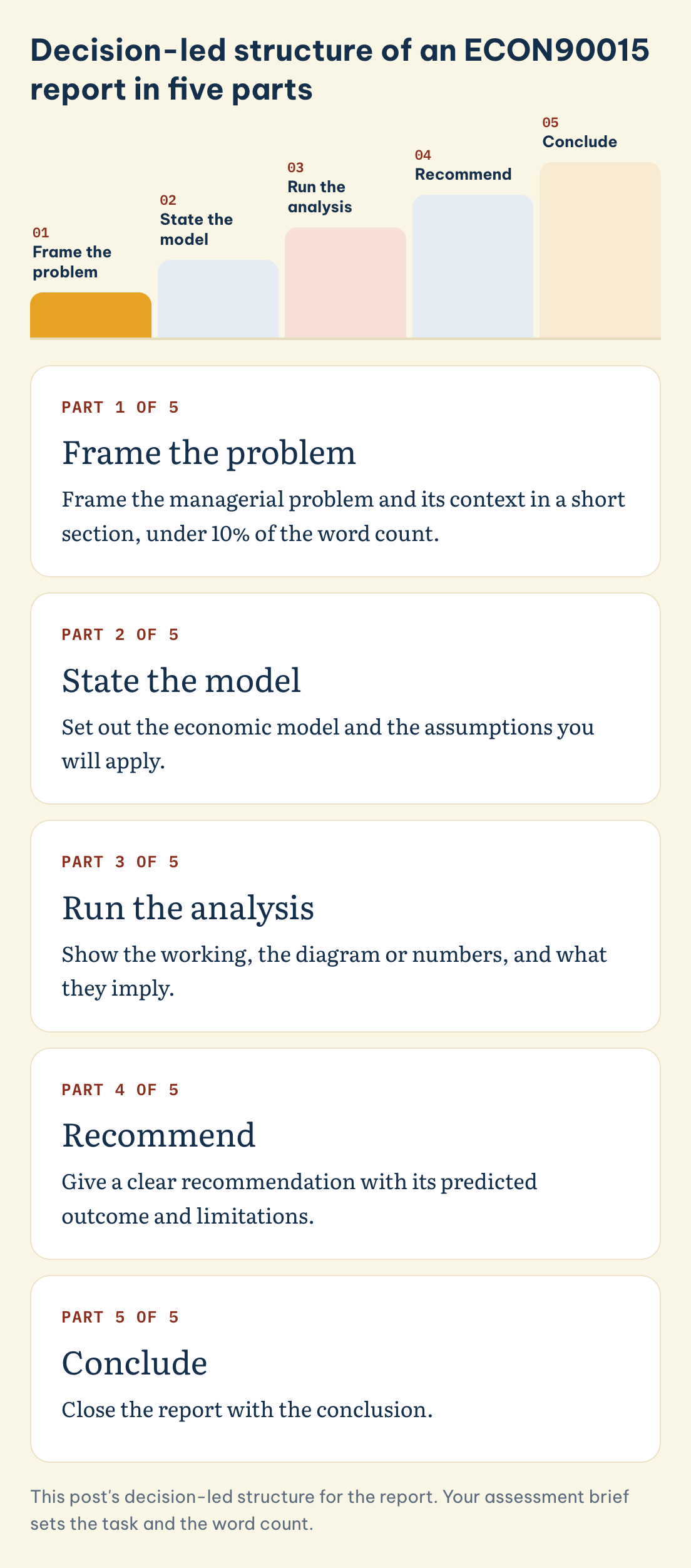
Direct answer: Use a decision-led structure: (1) a short framing of the managerial problem and its context (keep it under 10% of the word count), (2) the economic model and assumptions you will apply, (3) the analysis itself, the working, the diagram or numbers, and what they imply, (4) a clear recommendation with its predicted outcome and limitations, (5) conclusion. The single biggest structural fix is shrinking the background and expanding the analysis and recommendation, where the marks concentrate.
Decision-led structure of an ECON90015 report in five parts
The bar heights and colours only mark the order and carry no weight.
Part 1 of 5
Frame the problem
Frame the managerial problem and its context in a short section, under 10% of the word count.
Part 2 of 5
State the model
Set out the economic model and the assumptions you will apply.
Part 3 of 5
Run the analysis
Show the working, the diagram or numbers, and what they imply.
Part 4 of 5
Recommend
Give a clear recommendation with its predicted outcome and limitations.
Part 5 of 5
Conclude
Close the report with the conclusion.
Save this figure
Evidence: Criterion-referenced rubrics weight "application and analysis" and "recommendation and justification" far above "context and background". Matching your word budget to the rubric weighting is the most reliable way to lift a grade without new research.
Example: A Vietnamese student submitted a draft with a 500-word industry overview and a two-line recommendation. His MAAS mentor inverted the ratio so the recommendation carried the elasticity numbers and a sensitivity check. The final report, same case, same data, moved from a borderline Pass to a Distinction because the recommendation was finally developed enough to assess.
◆ Question 6 / 7 · Common mistakes
What are the most common mistakes that lose marks in ECON90015?
Direct answer: Three recurring mistakes show up across MAAS managerial-economics coaching. First, students explain models instead of using them, the theory is correct but never reaches a decision. Second, they treat assumptions as decoration rather than stating them and testing whether the result survives if an assumption changes. Third, recommendations are generic ("the firm should lower the price") rather than specific, quantified, and tied to the elasticity or game-theoretic result. Fixing these three lifts most drafts by at least one band.
Evidence: Across MAAS coaching, marker feedback before intervention clusters on "apply the model, don't just describe it" and "recommendation not justified by your analysis", the two phrases that most often separate a Pass from a Distinction in Monash economics rubrics.
Example: A Vietnamese student's recommendation read "the firm should cut prices to compete." His MAAS mentor pushed him to specify: a 10% cut, justified by an estimated price elasticity above one (so revenue rises), with a game-theory caveat that a matching rival cut would erase the gain. The specific, model-backed version earned full marks on the recommendation criterion.
◆ Question 7 / 7 · Length and referencing
How long is the ECON90015 assignment and what referencing style does it use?
Direct answer: Confirm the exact word count and style in your assessment brief, graduate managerial economics reports commonly sit between 2,000 and 3,000 words and use APA 7th, Monash Business School's standard style. Stay within the 10% tolerance, cite every model and data source, and make sure in-text citations and the reference list match exactly. Reference accuracy is a quick, reliable source of marks that many students leave on the table.
Evidence: Monash Business and Economics uses APA 7th referencing, documented in the Monash Library APA guide and the faculty Q Manual. Markers routinely deduct marks for inconsistent referencing even when the analysis is strong.
Example: A Vietnamese Monash student lost several marks across two units for mismatched in-text citations and reference entries. A MAAS pre-submission audit caught more than a dozen errors in an hour. On her next ECON90015 task, clean APA referencing recovered the marks she had been losing on a criterion that requires no extra research at all.
Frequently asked questions
Is ECON90015 a hard unit?
It is conceptually demanding rather than mathematically hard, the algebra is modest, but the unit expects you to choose the right model and reason to a decision under uncertainty. Students who treat it as "solve the equation" struggle; students who treat it as "advise the manager" do well.
Do I need strong maths for the Managerial Economics assignment?
You need comfort with basic algebra, percentages, and reading a graph, not advanced calculus. The marks reward economic reasoning and clear decisions far more than heavy computation, so explain what each number means for the firm.
How many economic models should I use in the assignment?
Two or three, applied deeply, beats five applied shallowly. Examiners reward using a model to reach a justified decision, not the number of models you can name.
What referencing style does ECON90015 use?
APA 7th is Monash Business School's default. Always confirm in your own brief, and use the Monash Library APA guide and Q Manual to format entries consistently.
Can MAAS help me with ECON90015?
Yes. MAAS Assignment & Essay Support coaches you through the assignment with the Outline, Draft, Final model, choosing the right model, building the decision logic, draft feedback, and a pre-submission referencing audit, all with discipline-matched experts. We coach your work; we do not write it for you.
Ready to approach ECON90015 with a clear decision in mind?
If you understand the models but cannot turn them into a defensible recommendation, that is exactly where a discipline-matched expert helps most. MAAS Assignment & Essay Support is an academic support partner; we work alongside you through Outline, Draft, Final so the analysis stays yours and the decision logic earns the marks.
Bring your ECON90015 brief and we will match you to an economics mentor, 23% of our 100+ experts hold a PhD, within 48 hours when our network already covers that field. If it does not, MAAS opens a dedicated recruitment round for your case, which usually takes about two weeks.
Book a free 20-minute ECON90015 consultation with MAAS Assignment & Essay Support →
Related guides
- How do you approach the ECON1269 Business in the Globalised Economy assignment?: sibling economics guide on reasoning from economic data and indicators
- ISYS90026 assignment: how do you approach Concepts in Information Systems?: sibling University of Melbourne postgraduate guide on analysing a business case and justifying a solution
- How do you approach Marketing Insights at Monash (MKF2801)?: sibling Monash Business School guide on turning data into a decision-ready insight
- How do you approach the MGF3621 Organisational Change assignment?: sibling Monash Business School guide on evidence-led recommendations
- BAFI3230 Corporate Finance assignment: how do you approach it?: sibling finance guide on investment, financing, and valuation decisions
- How do you approach the BAFI3182 Financial Markets assignment?: sibling finance guide on analysing markets, valuation, and risk
- How to write a methodology in an essay: for the assumptions-and-method half of any data-driven report
- MAAS Academic Mentoring service: 1:1 coaching with PhD-level mentors in your discipline
- Data & Coding Projects service: support with data analysis, charts, and quantitative tasks
- Tutoring service: 1:1 subject tutoring in 60- or 90-minute sessions with an expert matched on your course code, always inside your discipline
- Course-code assignment coaching: pillar guide on tackling any unit assignment with a MAAS mentor
References
- Baye, M. R., & Prince, J. T. (2025). Managerial economics and business strategy (2025 release). McGraw-Hill Education.
- Coase, R. H. (1937). The nature of the firm. Economica, 4(16), 386–405. https://doi.org/10.1111/j.1468-0335.1937.tb00002.x
- Marshall, A. (1920). Principles of economics (8th ed.). Macmillan.
- Porter, M. E. (1979). How competitive forces shape strategy. Harvard Business Review, 57(2), 137–145.
- Samuelson, W. F., Marks, S. G., & Zagorsky, J. L. (2021). Managerial economics (9th ed.). Wiley.
Tools & resources
- Monash University. (n.d.). Q Manual: Faculty of Business and Economics. Retrieved June 22, 2026, from https://www.monash.edu/business/current-students/study-resources/qmanual.pdf
- Monash University Library. (n.d.). APA 7th referencing guide. Retrieved June 22, 2026, from https://guides.lib.monash.edu/apa-7
This article is part of the MAAS Journal series for Vietnamese international students. MAAS Assignment & Essay Support is an academic support partner; we coach students through the Outline, Draft, Final delivery model with developmental feedback from discipline-matched experts. We do not write or submit work on a student's behalf.
A free 20-minute consultation is a conversation about where you are with ECON90015.
Book a free consultation ▸