
◆ Accounting & Finance
BAFI3230 Corporate Finance assignment: how do you approach it?
BAFI3230 Corporate Finance rewards a defensible financial decision, invest, fund, or value the firm, not a description of the company you chose. Most students who lose marks run the numbers correctly but never explain what the result means for shareholder value or why their assumptions hold. This guide answers the seven questions Vietnamese students at RMIT ask MAAS mentors most often before they start BAFI3230.

◆ Question 1 / 7 · The course
What is BAFI3230 Corporate Finance about?
Direct answer: BAFI3230 Corporate Finance is an RMIT finance course on three core decisions a firm makes: which projects to invest in (capital budgeting), how to fund them (capital structure and cost of capital), and how much cash to return to owners (dividend policy). The unifying goal is value creation, every decision is judged by whether it increases firm value to shareholders.
Evidence: This investment–financing–payout framing is the standard architecture of every major corporate finance text, including Berk and DeMarzo (2024) and Brealey et al. (2023). That structure and the principle that managers should maximise shareholder value, is the backbone the BAFI3230 assessments draw on.
Example: A Vietnamese student at RMIT opened her BAFI3230 report with three pages profiling the company's history and product range. Her MAAS mentor reframed the brief: the assignment is not about who the company is, it is about whether a specific investment or financing decision adds value and why. Once she centred the report on the decision and its effect on firm value, the draft moved from a descriptive Pass toward a Distinction.
◆ Question 2 / 7 · The assignment
What does the BAFI3230 assignment usually ask for?
Direct answer: A typical BAFI3230 assessment asks you to evaluate a corporate finance decision and make a recommendation, for example, appraising a capital project with NPV and IRR, estimating a firm's weighted average cost of capital (WACC), analysing an optimal capital structure, or valuing a company or proposed acquisition. "Evaluate", "appraise" and "recommend" are the operative words: you must apply a method, interpret the output, and reach a justified decision. Always confirm the exact task, word count, and weighting in your own Canvas shell, because the brief changes by semester.
Evidence: RMIT assessments are criterion-referenced, marks are awarded against published rubric criteria, not ranked against classmates. This is stated in RMIT's Assessment policy, which is why a corporate finance task rewards a correct, well-justified decision far more than the volume of company background you include.
Example: A Vietnamese RMIT student chose a capital-budgeting case. His first draft was a 1,000-word company profile followed by a single NPV figure. His MAAS mentor cut the profile to 200 words and redirected the rest to the cash-flow assumptions, the discount rate, a sensitivity check, and a clear accept-or-reject recommendation, the part the rubric actually assesses.
◆ Question 3 / 7 · The rubric
How is BAFI3230 graded, what does the rubric reward?
Direct answer: The rubric rewards four things, roughly in order: (1) correct application of the method and calculations, (2) the quality of assumptions and the justification of inputs such as the discount rate, (3) depth of interpretation, what the result means for the decision and for shareholder value, and (4) academic writing and Harvard referencing. Getting the number is necessary but not sufficient; the marks concentrate on the assumptions behind it and the decision it supports.
Evidence: RMIT business and finance rubrics use criterion bands (Pass / Credit / Distinction / High Distinction). The jump from Credit to Distinction is almost always defined by judgement, defending your inputs and explaining the implication of a calculation, rather than by adding more company description or more arithmetic.
Example: A MAAS mentor reviewed one Vietnamese student's draft and found a correct NPV table with no statement of where the discount rate came from. The number was right; the reasoning was invisible. After the student justified the WACC, ran a sensitivity analysis, and stated the decision, the same calculation lifted the mark two full bands.
◆ Question 4 / 7 · Concepts
Which concepts and frameworks should you use in BAFI3230?
Direct answer: Use the corporate finance tools that fit your decision, applied correctly, rather than listing every model you have met. For most BAFI3230 assessments the workhorses are discounted cash flow for investment appraisal, the WACC for the cost of capital, and a capital-structure lens (trade-off or pecking order) for the financing decision.
What each BAFI3230 corporate finance concept is used to analyse
Each row sets one corporate finance concept or model beside the thing it is used to analyse.
Concept or model
Use it to analyse
Net present value & IRR (discounted cash flow)
Whether a project or acquisition creates value
Weighted average cost of capital (WACC)
The discount rate and the cost of funding
Modigliani-Miller propositions
The baseline for how leverage affects firm value
Trade-off & pecking-order theory
The choice between debt and equity financing
Agency theory
Conflicts between managers, shareholders, and debtholders
Save this figure
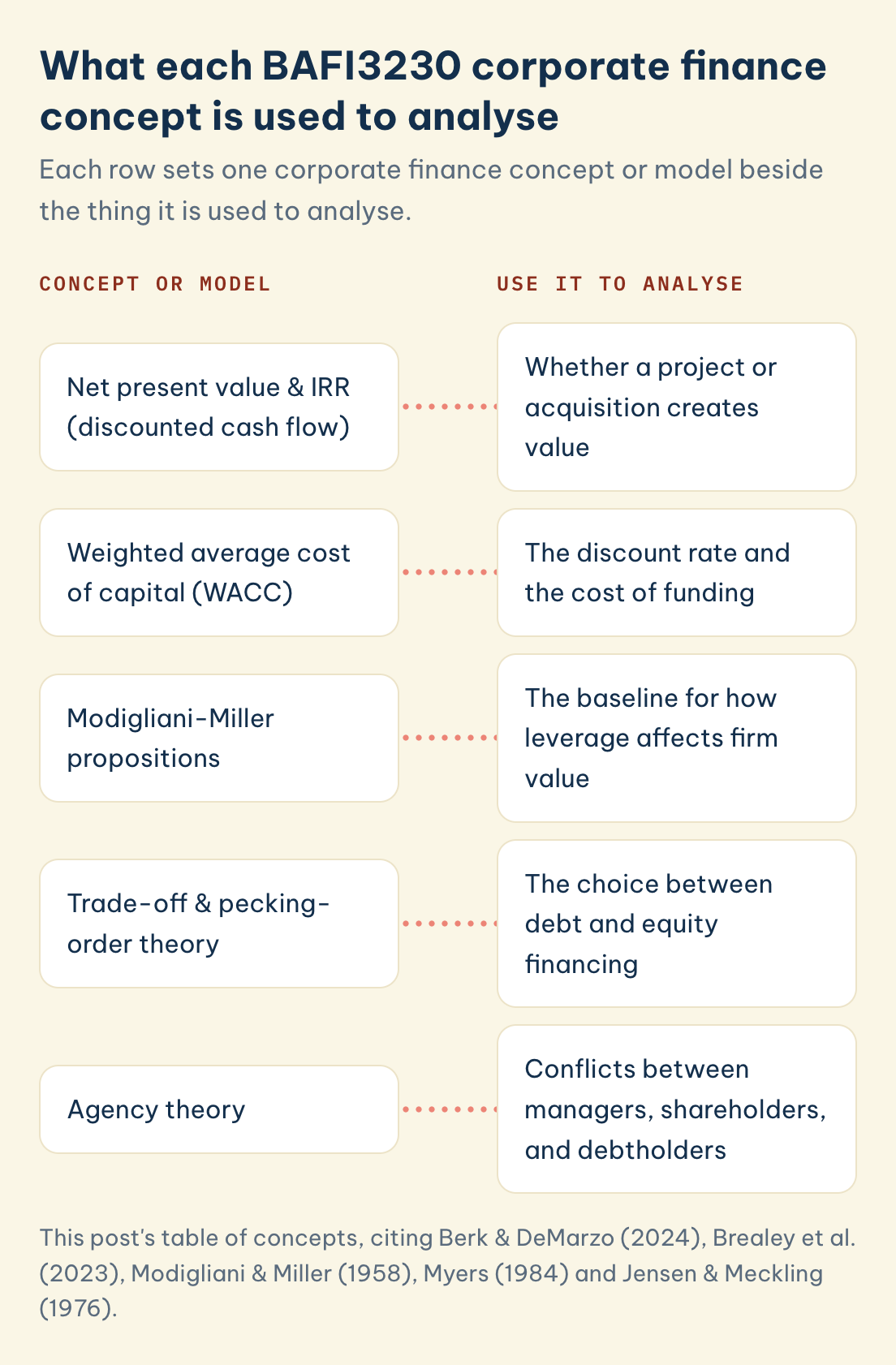
| Concept / model | Use it to analyse | Author / source |
|---|---|---|
| Net present value & IRR (discounted cash flow) | Whether a project or acquisition creates value | Berk & DeMarzo (2024) |
| Weighted average cost of capital (WACC) | The discount rate and the cost of funding | Brealey et al. (2023) |
| Modigliani–Miller propositions | The baseline for how leverage affects firm value | Modigliani & Miller (1958) |
| Trade-off & pecking-order theory | The choice between debt and equity financing | Myers (1984) |
| Agency theory | Conflicts between managers, shareholders, and debtholders | Jensen & Meckling (1976) |
Evidence: The Modigliani–Miller propositions (1958) remain the recognised starting point for any capital-structure argument, while the pecking-order view (Myers, 1984) and agency theory (Jensen & Meckling, 1976) are the lenses markers expect when you explain why a real firm deviates from the textbook benchmark. Survey evidence from financial managers confirms NPV and WACC are the dominant tools in practice (Graham & Harvey, 2001). Myers states the pecking-order logic directly in his own abstract: "the firm prefers internal to external financing, and debt to equity if it issues securities" (Myers, 1984), the benchmark your report should test the firm's actual financing choice against.
Example: A Vietnamese student analysing a financing decision used the trade-off theory to weigh the tax shield of debt against financial-distress costs, then pecking-order logic to explain why the firm issued debt before equity. Two frameworks, applied to one decision, cleared Distinction.
◆ Question 5 / 7 · Report structure
How should you structure the BAFI3230 analysis report?
Direct answer: Use a decision-led structure: (1) short introduction and context (under 10% of the word count), (2) the method and your assumptions, (3) the analysis itself, calculations, the discount rate, and a sensitivity check, (4) interpretation and the recommendation, (5) conclusion. The biggest structural fix is shrinking the company background and expanding the assumptions and interpretation, where the marks concentrate.
Evidence: Criterion-referenced rubrics weight "analysis", "justification" and "recommendation" far above "context". Matching your word budget to the rubric weighting is the most reliable way to lift a grade without new research.
Example: A Vietnamese RMIT student submitted a draft with an 800-word company overview and a two-line recommendation. His MAAS mentor inverted the ratio; the final report, same model, same data, moved from a borderline Credit to a Distinction because the assumptions were defended and the recommendation was finally developed enough to assess.
◆ Question 6 / 7 · Common mistakes
What mistakes most often lose marks in BAFI3230?
Direct answer: Three recurring mistakes show up across MAAS coaching. First, students describe the company instead of analysing the decision, the profile crowds out the finance. Second, they present a calculation without justifying the inputs, especially the discount rate, leaving the marker to guess where WACC came from. Third, they give no sensitivity analysis and no clear recommendation, so the report stops at a number instead of a decision. Fixing these three lifts most drafts by at least one rubric band.
Evidence: Across MAAS coaching on RMIT finance assessments, marker feedback before intervention clusters on "justify your assumptions" and "what is your recommendation", the two phrases that most often separate a Credit from a Distinction.
Example: A Vietnamese student's conclusion read "the project looks acceptable". His MAAS mentor pushed him to state the decision (accept), the basis (positive NPV at the firm's WACC), and the risk (the result turns negative if sales fall 15%, shown in a sensitivity table). The specific version earned full marks on the analysis criterion.
◆ Question 7 / 7 · Length and referencing
How long is the BAFI3230 assignment and what referencing style does it use?
Direct answer: Confirm the exact word count in your brief, BAFI3230 reports commonly sit between 2,000 and 2,500 words and use RMIT Harvard referencing, the default for RMIT business and finance courses. Stay within the 10% tolerance band, cite every model, formula source, and data input, and make sure in-text citations and the reference list match exactly. Clean referencing is a quick, reliable source of marks many students leave on the table.
Evidence: RMIT's business school uses RMIT Harvard, documented in RMIT's Easy Cite tool. Markers routinely deduct marks for inconsistent Harvard referencing and for data presented without a source, even when the finance is correct.
Example: A Vietnamese RMIT student lost several marks across two assignments for uncited inputs and mismatched citations. A MAAS pre-submission audit caught the gaps in an hour; on her next BAFI3230 task, sourced inputs and clean referencing recovered the marks she had been losing on criteria that need no extra analysis.
Frequently asked questions
Is BAFI3230 the same as Business Finance or Financial Management?
They are closely related corporate finance courses covering investment, financing, and payout decisions. The assessment approach is the same, confirm your exact course code and brief in Canvas, because input data and weightings differ by semester.
Do I need strong maths for BAFI3230?
You need to be comfortable with discounting, NPV, IRR, and basic statistics, but the marks reward justified assumptions and interpretation more than heavy calculation. Get the method right, defend your inputs, then explain what the result means for the decision.
How many frameworks should I use?
Two or three core tools, applied correctly to one decision, beats listing every model. Pair an appraisal method (NPV) with a cost-of-capital estimate (WACC) and, where relevant, a capital-structure lens.
How do I choose the discount rate?
Most BAFI3230 tasks expect the firm's WACC, or a rate adjusted for the project's risk. The marks are in justifying the choice and its components (cost of equity, cost of debt, weights), not just plugging in a number.
What referencing style does BAFI3230 use?
RMIT Harvard is the default. Confirm in your brief and use RMIT's Easy Cite tool to keep entries consistent, and cite every data input and formula source.
Can MAAS help me with BAFI3230?
Yes. MAAS Assignment & Essay Support coaches you through the assignment with the Outline, Draft, Final model, method selection, assumption review, draft feedback, and a referencing audit, with PhD-level mentors. We coach your work; we do not write it for you.
Ready to approach BAFI3230 with a clear strategy?
If you can run the NPV but your draft still reads like a company profile, that is exactly where a discipline-matched expert helps most. MAAS Assignment & Essay Support is an academic support partner; we work alongside you through Outline, Draft, Final so the analysis stays yours and the decision earns the marks.
Bring your BAFI3230 brief and we will match you to a finance mentor, 23% of our 100+ experts hold a PhD, within 48 hours when our network already covers that field. If it does not, MAAS opens a dedicated recruitment round for your case, which usually takes about two weeks.
Book a free 20-minute BAFI3230 consultation with MAAS Assignment & Essay Support →
Related guides
- BAFI3182 Financial Markets assignment: how do you approach the analysis?: sibling RMIT finance guide on analysis over market commentary
- How do you approach the ECON1269 Business in the Globalised Economy assignment?: sibling RMIT economics guide on analysing markets and economic forces
- How do you approach the BUSM4164 Business Consulting assignment?: sibling RMIT business guide on evidence-based analysis and recommendations
- FNCE 370 Overview of Corporate Finance at Athabasca University: the same investment and financing decisions tested as calculations in a self-paced course where the final carries 50%
- How to write a methodology in an essay: for the analytical-rigour half of any finance report
- MAAS Academic Mentoring service: 1:1 coaching with PhD-level mentors in your discipline
- Course-code assignment coaching: pillar guide on tackling any unit assignment with a MAAS mentor
References
- Berk, J., & DeMarzo, P. (2024). Corporate finance (6th ed.). Pearson.
- Brealey, R. A., Myers, S. C., Allen, F., & Edmans, A. (2023). Principles of corporate finance (14th ed.). McGraw-Hill Education.
- Graham, J. R., & Harvey, C. R. (2001). The theory and practice of corporate finance: Evidence from the field. Journal of Financial Economics, 60(2–3), 187–243. https://doi.org/10.1016/S0304-405X(01)00044-7
- Jensen, M. C., & Meckling, W. H. (1976). Theory of the firm: Managerial behavior, agency costs and ownership structure. Journal of Financial Economics, 3(4), 305–360. https://doi.org/10.1016/0304-405X(76)90026-X
- Modigliani, F., & Miller, M. H. (1958). The cost of capital, corporation finance and the theory of investment. The American Economic Review, 48(3), 261–297.
- Myers, S. C. (1984). The capital structure puzzle. The Journal of Finance, 39(3), 575–592. https://doi.org/10.1111/j.1540-6261.1984.tb03646.x
Tools & resources
- RMIT University. (n.d.). Assessment and exams. Retrieved June 21, 2026, from https://www.rmit.edu.au/students/student-essentials/assessment-and-exams
- RMIT University. (n.d.). Easy Cite referencing tool. Retrieved June 21, 2026, from https://www.rmit.edu.au/library/study/referencing
This article is part of the MAAS Journal series for Vietnamese international students. MAAS Assignment & Essay Support is an academic support partner; we coach students through the Outline, Draft, Final delivery model with developmental feedback from discipline-matched experts. We do not write or submit work on a student's behalf.
A free 20-minute consultation is a conversation about where you are with BAFI3230.
Book a free consultation ▸