
BUSM4164 Business Consulting asks you to diagnose a client's problem and recommend a justified fix, and the rubric rewards structure over generic advice. Most students who struggle with this RMIT course are not short on ideas; they jump straight to solutions before they have framed the problem, so their recommendations float free of any diagnosis. This guide answers the seven questions Vietnamese students at RMIT ask MAAS mentors most often before they start BUSM4164.
Author: MAAS Editorial Team · Reviewed by a MAAS subject mentor
Last updated: 2026-07-05
Category: business-management

What is BUSM4164 Business Consulting about?
Direct answer: BUSM4164 is an RMIT business course, offered at RMIT Melbourne and RMIT Vietnam, that teaches you to act as a consultant: enter a client situation, define the real problem, analyse it with recognised frameworks, and deliver recommendations a client could implement. The course wants you to think like an adviser, not a student writing an essay.
Evidence: Consulting is a disciplined process, not a single deliverable. Kubr (2002) describes the engagement as a sequence of phases, entry, diagnosis, action planning, implementation, and termination and most BUSM4164 assessments map onto the first three of those phases. Reading your brief through that process lens tells you what each assessment is really testing.
Example: A Vietnamese student at RMIT Vietnam came to MAAS treating BUSM4164 as "a long SWOT about a company". Her MAAS mentor reframed it: a consultant is hired to answer one sharp question, and everything in the report exists to answer it. Once she defined her client's question, "should this café chain expand or consolidate?", her draft stopped being a description and started being a recommendation, and her mark moved from a Pass-level draft to a Distinction.
What assessment does the BUSM4164 assignment usually involve?
Direct answer: Business consulting courses at this level are typically assessed through a staged consulting project, often an early task that frames a client problem and scopes the engagement (Assessment 1), followed by a full consulting report or client recommendation deck later in the semester (Assessment 3).
You are usually asked to work with a real or realistic client, identify the core business issue, analyse it, and recommend a justified course of action. Always confirm the exact brief, deliverables, and weighting in your own Canvas shell, the structure changes by semester and campus.
Evidence: RMIT business assessments are criterion-referenced, meaning marks are awarded against published rubric criteria rather than ranked against classmates. This is set out in RMIT's assessment policy, which is why decoding the rubric (next section) matters more than writing length.
Example: A Vietnamese RMIT student spent most of his Assessment 1 word count describing his client's industry and almost none defining the problem he was hired to solve. His MAAS mentor flipped the emphasis, a tight problem statement and a clear engagement scope up front and the same client, same research, earned a much stronger mark because the consulting logic was finally visible.
How is the BUSM4164 assignment graded, what does the rubric actually reward?
Direct answer: Consulting rubrics at this level reward four things, roughly in this order: (1) a clearly defined and well-scoped problem, (2) structured, evidence-based analysis using appropriate frameworks, (3) practical, justified, client-ready recommendations, and (4) professional communication and referencing. Generic advice that any company could receive earns almost no marks, marks live in analysis that is specific to this client and recommendations that follow from your diagnosis. If a sentence does not help frame, analyse, or solve the client's problem, cut it.
Evidence: Criterion bands (Pass / Credit / Distinction / High Distinction) in RMIT business rubrics usually separate Credit from Distinction with words like "critical", "integrated", and "justified". A report moves up not by adding content but by showing that its recommendations are logically derived from the analysis, the core discipline of consulting communication (Minto, 2009).
Example: A MAAS mentor mapped one Vietnamese student's draft and found the analysis section and the recommendations section did not connect, the recommendations could have been written without reading the analysis. After one restructuring pass that tied each recommendation back to a specific finding, the same evidence moved the mark up two full bands.
Which consulting frameworks should you use in BUSM4164?
Direct answer: Choose two or three frameworks that fit your client's actual situation rather than name-dropping many. The most useful for BUSM4164 are: a structured problem-definition method such as issue trees built on the MECE principle, an external-environment lens such as Porter's five forces, and an internal-alignment lens such as the McKinsey 7S model. Use a framework as a tool to reach a judgement, never as a checklist you fill in for its own sake.
| Framework | What it diagnoses | Best used for |
|---|---|---|
| Issue tree (MECE) | Breaks the client's problem into mutually exclusive, collectively exhaustive parts | Structuring the problem before analysis |
| Porter's five forces | Competitive pressure in the client's industry | External / market-side problems |
| McKinsey 7S | Alignment of strategy, structure, systems, staff, skills, style, shared values | Internal / organisational problems |
| Pyramid principle | Logical order of the recommendation itself | Structuring the report and the "answer first" |
Evidence: Porter (1980) provides the canonical tool for analysing industry competition; Waterman et al. (1980) introduced the 7S framework to explain why strategy fails when the "soft" organisational elements are misaligned; and Minto (2009) sets out the pyramid principle that consultants use to lead with the answer and support it with grouped, logically ordered arguments. These are foundational, examiner-recognised sources, not blog-level references. Waterman, Peters, and Phillips underline the payoff of getting that alignment right: "the real energy required to redirect an institution comes when all the variables in the model are aligned" (Waterman et al., 1980, p. 26).
Example: A Vietnamese RMIT student analysing a logistics client tried to apply five frameworks and explained each one shallowly. Her MAAS mentor cut it to two, five forces to show the margin pressure in the industry, and 7S to show why the client's structure could not respond. Fewer frameworks, deeper application, higher mark.
How should you structure the BUSM4164 consulting report?
Direct answer: Lead with the answer. Use a consultant's structure: (1) an executive summary that states your recommendation up front, (2) a short client and problem context, (3) a clearly framed problem statement, (4) analysis using your chosen frameworks, (5) recommendations that follow directly from the analysis, and (6) a brief implementation outline. The single biggest structural fix is the "answer-first" move, busy clients and busy markers should know your recommendation within the first page.
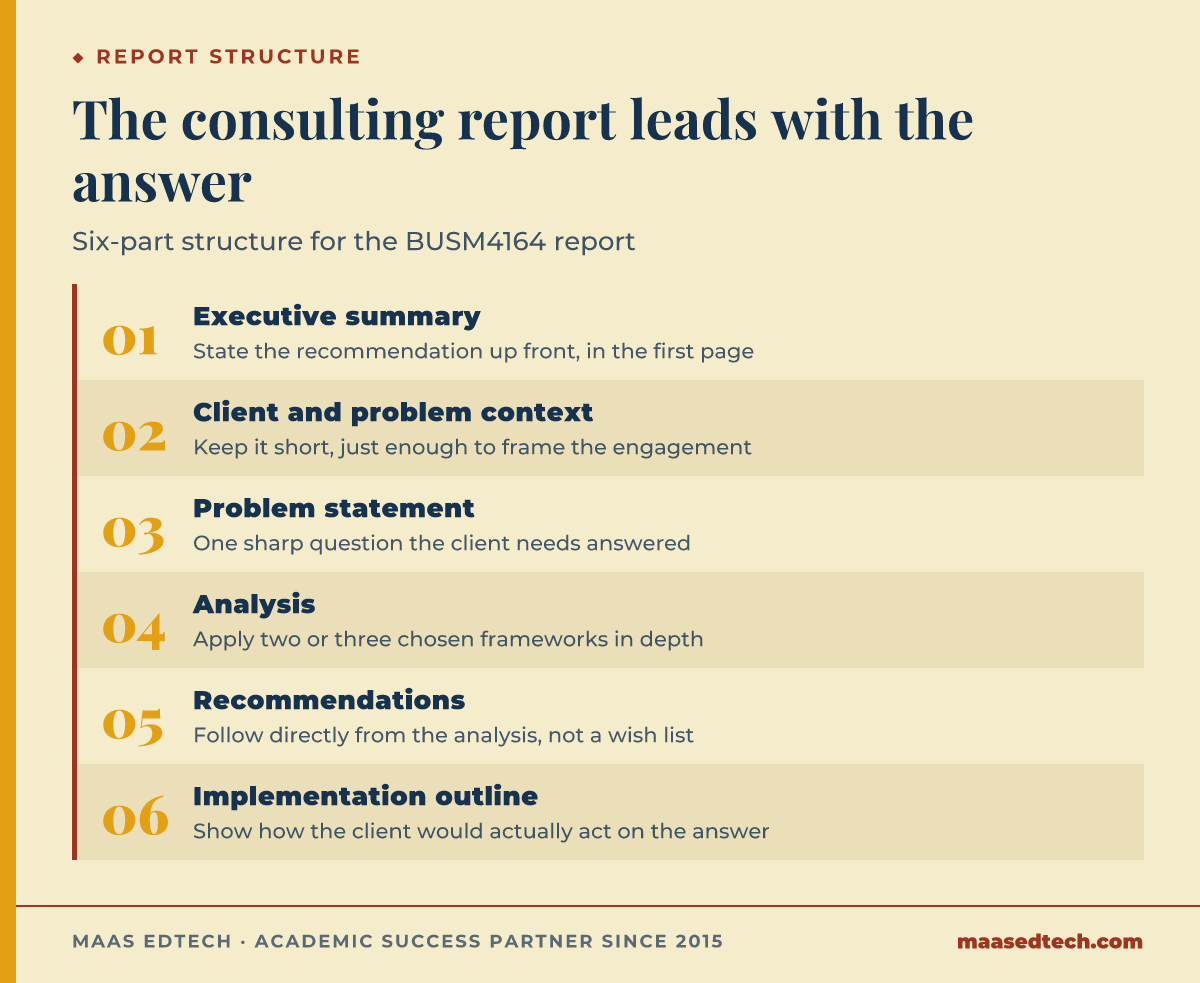
Evidence: The pyramid principle holds that effective business communication starts with the conclusion, then groups and orders the supporting arguments beneath it (Minto, 2009). Block (2011) adds that recommendations only get used when the client can see the reasoning and feels ownership of it, which is why an implementation outline, not just a list of ideas, separates strong consulting reports.
Example: A Vietnamese MBA-pathway student at RMIT buried his recommendation on the final page after twelve pages of analysis. His MAAS mentor moved it to an executive summary on page one and rebuilt the body to defend it. Same client, same findings, the answer-first version read like genuine consulting and earned a Distinction.
What are the most common mistakes that lose marks in BUSM4164?
Direct answer: Three recurring mistakes show up across MAAS consulting coaching. First, students skip problem definition and rush to solutions, so the analysis answers a question no one asked. Second, they treat frameworks as decoration, a SWOT or five forces sits in the report but never drives a conclusion. Third, recommendations are generic ("the company should improve marketing") rather than specific, sequenced, and costed. Fixing these three lifts most drafts by at least one rubric band.
Evidence: Effective consulting depends on the quality of the diagnosis, not the volume of analysis (Schein, 1999). When the problem is framed badly, every later section inherits the error, which is why marker feedback on weak consulting reports clusters on "unclear problem" and "recommendations not justified".
Example: A Vietnamese student's recommendation read "the client should use social media more." His MAAS mentor pushed him to specify: which segment (working professionals aged 25–35), which channel and why (LinkedIn, to match the client's B2B pivot), and in what sequence (pilot in one quarter, then scale). The specific, sequenced version earned full marks on the recommendations criterion.
How long is the BUSM4164 assignment and what referencing style does it use?
Direct answer: Confirm the exact word count and style in your assessment brief, consulting reports at this level commonly sit around 2,000 words for an individual task and use RMIT Harvard, the default business referencing style. Stay within the 10% tolerance band, cite every framework and data source, and make sure your reference list and in-text citations match exactly. Reference accuracy is a quick, reliable source of marks that many students leave on the table.
Evidence: RMIT's Business school uses RMIT Harvard as its standard referencing style, documented in RMIT's Easy Cite referencing tool. Markers routinely deduct marks for inconsistent or incomplete referencing even when the analysis is strong.
Example: A Vietnamese RMIT student lost several marks across two assignments for mismatched in-text citations and reference-list entries. A MAAS pre-submission audit caught a dozen referencing errors in an hour. On her next BUSM4164 task, clean Harvard referencing recovered the marks she had previously been losing on a criterion that requires no extra research at all.
Frequently asked questions
Is BUSM4164 a hard course?
It is conceptually demanding rather than technically hard; there is no heavy maths, but the course expects disciplined problem-structuring and client-focused judgement instead of memorisation. Students who treat it as "write about a company" struggle; students who treat it as "solve a client's problem" do well.
Do I need a real client for the assignment?
Often the brief provides a client or case, or asks you to choose a realistic one. Either way, treat it as a genuine engagement, define one sharp question the client needs answered and let that question discipline the whole report.
How many frameworks should I use in the report?
Two or three, applied deeply, beats five applied shallowly. Markers reward frameworks that drive a conclusion, not the number of models you can name.
What referencing style does BUSM4164 use?
RMIT Harvard is the default for business courses. Always confirm in your own brief, and use RMIT's Easy Cite tool to format entries consistently.
Can MAAS help me with BUSM4164?
Yes. MAAS Assignment & Essay Support coaches you through the assignment with the Outline, Draft, Final model, problem framing, framework selection, draft feedback, and a pre-submission referencing audit, all with discipline-matched experts. We coach your work; we do not write it for you.
Ready to approach BUSM4164 with a clear strategy?
If you have a client and the research but not a sharp problem and a defensible recommendation, that is exactly where a discipline-matched expert helps most. MAAS Assignment & Essay Support is an academic support partner; we work alongside you through Outline, Draft, Final so the analysis stays yours and the consulting logic earns the marks.
Bring your BUSM4164 brief and we will match you to a Business Consulting mentor, 23% of our 100+ experts hold a PhD, within 48 hours when our network already covers that field. If it does not, MAAS opens a dedicated recruitment round for your case, which usually takes about two weeks.
Book a free 15-minute BUSM4164 consultation with MAAS Assignment & Essay Support →
Related guides
- How do you approach the BAFI3182 Financial Markets assignment?: sibling RMIT finance guide on analysing markets, valuation, and risk
- BAFI3230 Corporate Finance assignment: how do you approach it?: sibling RMIT finance guide on investment, financing, and valuation decisions
- How do you approach the BUSM2617 Managing People for the Future assignment?: sibling RMIT business course guide on managing people through change
- How do you approach the BUSM4187 International HRM assignment?: sibling RMIT business course guide on managing people globally
- How do you approach the BUSM3299 Foundations of Entrepreneurship assignment?: sibling RMIT business course guide on building a venture case
- ISYS90026 assignment: how do you approach Concepts in Information Systems?: sibling University of Melbourne guide on the problem → analysis → recommendation structure of an IS case report
- How do you approach the ECON1269 Business in the Globalised Economy assignment?: for the market-and-industry analysis half of a consulting report
- How to write a methodology in an essay: for the analytical-rigour half of any business report
- How to write a theoretical framework: for applying consulting frameworks with academic depth
- MAAS Academic Mentoring service: 1:1 coaching with PhD-level mentors in your discipline
- Tutoring service: 1:1 subject tutoring in 60- or 90-minute sessions with an expert matched on your course code, always inside your discipline
- Course-code assignment coaching: pillar guide on tackling any unit assignment with a MAAS mentor
References
- Block, P. (2011). Flawless consulting: A guide to getting your expertise used (3rd ed.). Pfeiffer.
- Kubr, M. (Ed.). (2002). Management consulting: A guide to the profession (4th ed.). International Labour Office.
- Minto, B. (2009). The pyramid principle: Logic in writing and thinking (3rd ed.). Pearson Education.
- Porter, M. E. (1980). Competitive strategy: Techniques for analyzing industries and competitors. Free Press.
- Schein, E. H. (1999). Process consultation revisited: Building the helping relationship. Addison-Wesley.
- Waterman, R. H., Peters, T. J., & Phillips, J. R. (1980). Structure is not organization. Business Horizons, 23(3), 14–26. https://doi.org/10.1016/0007-6813(80)90027-0
Tools & resources
- RMIT University. (n.d.). Assessment and exams. Retrieved June 9, 2026, from https://www.rmit.edu.au/students/student-essentials/assessment-and-exams
- RMIT University. (n.d.). Easy Cite referencing tool. Retrieved June 9, 2026, from https://www.rmit.edu.au/library/study/referencing
This article is part of the MAAS Journal series for Vietnamese international students. MAAS Assignment & Essay Support is an academic support partner; we coach students through the Outline, Draft, Final delivery model with developmental feedback from discipline-matched experts. We do not write or submit work on a student's behalf.