
◆ IT & Data
ISYS90026 at Melbourne: how do you approach the IS assignment?
ISYS90026 Concepts in Information Systems asks you to analyse a real business case and argue an IS solution, the rubric rewards analysis, not description. Most students who struggle with this University of Melbourne subject are not weak on technology; they describe what a system does but never argue why it creates value for the organisation. This guide answers the seven questions Vietnamese students at Melbourne ask MAAS mentors most often before they start ISYS90026.

◆ Question 1 / 7 · The subject
What is ISYS90026 Concepts in Information Systems about?
Direct answer: ISYS90026 is a foundational subject in the University of Melbourne's Master of Information Systems that introduces information systems as sociotechnical systems, the interaction of people, processes, organisations, and technology, not technology alone. It asks you to reason about how systems support business processes and create value.
Evidence: The dominant framing for subjects of this type treats an information system as having three intertwined dimensions, organisation, management, and technology (Laudon & Laudon, 2021). This is why ISYS90026 rarely asks "how does this technology work?" and almost always asks "what business problem does it solve, and for whom?" The sociotechnical view, that system performance depends on jointly optimising the social and the technical (Bostrom & Heinen, 1977), is the lens the subject keeps returning to. The University of Melbourne's own subject aims state it directly: "Information Technology now impacts on people and processes within and beyond organisational boundaries" (University of Melbourne, n.d.-a).
Example: A Vietnamese student at Melbourne came to MAAS treating ISYS90026 as "an IT subject" and filled her draft with technical specifications of an ERP system. Her MAAS mentor reframed it: the marker does not care that the ERP has a particular database; the marker cares whether it fixes the firm's fragmented order-to-cash process. Once she analysed the process the system changed, her draft stopped reading like a product brochure and started reading like an IS analysis.
◆ Question 2 / 7 · Assessment
What assessment does the ISYS90026 assignment usually involve?
Direct answer: ISYS90026 is assessed mainly through case discussion and analysis delivered in a staged way that is integrated with the weekly tutorials, so the written assignment is usually a business-case analysis rather than a standalone essay. You are typically asked to read a real or realistic organisational case, identify a business problem or opportunity, analyse it with information-systems concepts, and recommend a credible solution. Always confirm the exact brief, staging, and weighting in your own LMS subject page, the structure changes by semester.
Evidence: The University of Melbourne handbook describes the assessment for ISYS90026 as predominantly case discussion and analysis, staged across the tutorial program, with some tasks completed or demonstrated during tutorials to keep the assessment authentic (University of Melbourne, n.d.). That design has a direct consequence for you: the markers have already seen how you reason in class, so your written analysis has to match and build on, the thinking you showed in the tutorial.
Example: A Vietnamese student assumed the written case report was independent of the tutorials and wrote it the weekend before the deadline. His MAAS mentor pointed out that the staged design rewards continuity, the strongest reports extend the in-class discussion rather than starting fresh. Reusing his own tutorial notes as the backbone of the report cut his drafting time and made the argument more coherent.
◆ Question 3 / 7 · Grading
How is the ISYS90026 assignment graded, what does the rubric actually reward?
Direct answer: IS case-analysis rubrics at this level reward four things, roughly in order: (1) depth of critical analysis of the business problem, (2) correct and explicit use of IS concepts and frameworks, (3) a credible, justified recommendation, and (4) academic writing and referencing. Describing the organisation or the technology earns almost no marks on its own, the marks live in why the problem matters and whether your solution will work. If you can replace a descriptive sentence with an analytical one, do it every time.
Evidence: The subject's stated aim is to train students to respond to business problems, highlight weaknesses and opportunities, and provide a credible solution and analysis (University of Melbourne, n.d.). That phrasing maps almost word-for-word onto a Distinction-band rubric: weakness/opportunity analysis, then a justified solution, description of the firm is the setup, not the answer.
Example: A MAAS mentor colour-coded one Vietnamese student's draft sentence by sentence as "describe" or "analyse". The draft was roughly 75% describe, pages on the company and the software, a paragraph on the actual decision. After one restructuring pass that flipped the ratio, the same case and the same evidence moved up two rubric bands because the recommendation was finally developed enough to assess.
◆ Question 4 / 7 · Frameworks
Which information systems frameworks should you use in ISYS90026?
Direct answer: Anchor your analysis in two or three established IS frameworks rather than name-dropping many. The most useful for ISYS90026 are the sociotechnical (people–process–technology) view for diagnosing where a system fails, Porter's value chain and competitive-forces logic for arguing strategic value, the Technology Acceptance Model for explaining user adoption, and the DeLone and McLean IS success model for evaluating whether a system actually delivers. Pick the frameworks that fit your case, do not force all of them in.
| Framework | What it helps you analyse | Best fit in a case |
|---|---|---|
| Sociotechnical systems (people–process–technology) | Why a technically sound system still fails in practice | Implementation problems, user resistance |
| Porter's value chain & competitive forces | How an IS creates strategic or competitive advantage | "Should the firm invest?" strategy questions |
| Technology Acceptance Model (TAM) | Whether users will actually adopt the system | Adoption, change-management, training issues |
| DeLone & McLean IS success model | Whether the system delivers measurable value | Post-implementation evaluation, ROI arguments |
Evidence: Each of these is examiner-recognised, not blog-level. Porter and Millar (1985) set out how information gives a firm competitive advantage; Davis (1989) introduced perceived usefulness and ease of use as the predictors of system adoption; DeLone and McLean (2003) defined the dimensions along which IS success is measured. Using a named framework to reach a judgement, not just to label a paragraph, is what separates a Credit from a Distinction.
Example: A Vietnamese student analysing a hospital's new patient-records system tried to apply four frameworks shallowly. Her MAAS mentor cut it to two, the sociotechnical view to diagnose why nurses bypassed the system, and TAM to explain that low perceived ease of use drove the workaround. Fewer frameworks, deeper application, a higher mark.
◆ Question 5 / 7 · Structure
How should you structure the ISYS90026 case analysis?
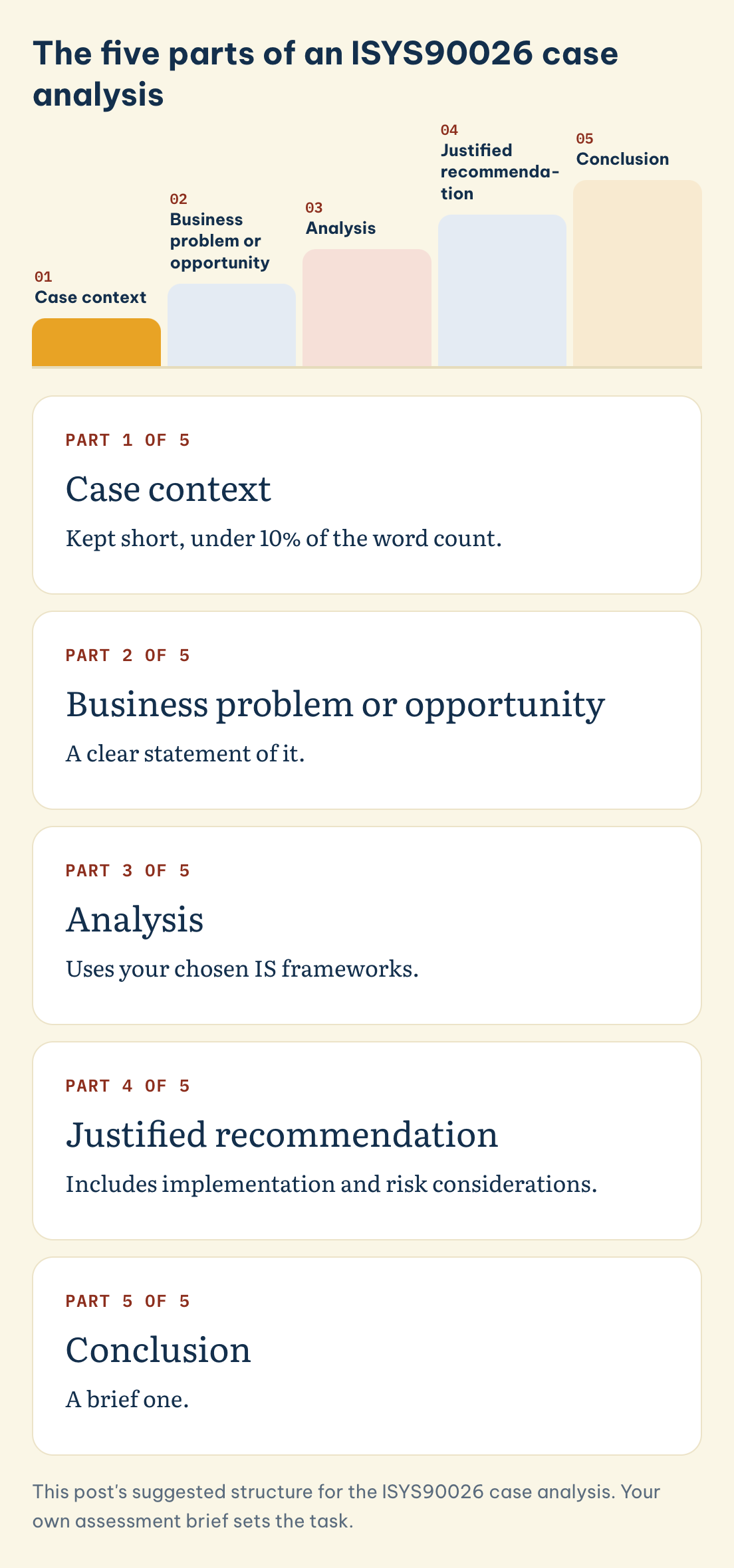
Direct answer: Use a problem-led structure: (1) a short case context (keep it under 10% of the word count), (2) a clear statement of the business problem or opportunity, (3) analysis of that problem using your chosen IS frameworks, (4) a justified recommendation with implementation and risk considerations, (5) a brief conclusion. The single biggest structural fix is shrinking the description sections and expanding the analysis and recommendation sections, where the marks concentrate.
The five parts of an ISYS90026 case analysis
This is the problem-led structure the post recommends. The bar heights and colours only mark the order and carry no weight.
Part 1 of 5
Case context
Kept short, under 10% of the word count.
Part 2 of 5
Business problem or opportunity
A clear statement of it.
Part 3 of 5
Analysis
Uses your chosen IS frameworks.
Part 4 of 5
Justified recommendation
Includes implementation and risk considerations.
Part 5 of 5
Conclusion
A brief one.
Save this figure
Evidence: Because the rubric weights problem analysis and justified solution far above background, structuring your word budget to match the rubric weighting is the most reliable way to lift a grade without doing new research. A recommendation that names the change, the affected stakeholders, and the implementation risk is assessable; a recommendation that says "the firm should adopt the system" is not.
Example: A Vietnamese student submitted a draft with a 500-word company history and a 200-word recommendation. His MAAS mentor inverted the ratio. The final report, same case, same sources, moved from a borderline Credit to a Distinction because the recommendation finally addressed how the system would be implemented and what could go wrong.
◆ Question 6 / 7 · Common mistakes
What are the most common mistakes that lose marks in ISYS90026?
Direct answer: Three recurring mistakes show up across MAAS IS coaching. First, students describe the technology instead of analysing the business problem, specs crowd out the argument. Second, students treat frameworks as labels rather than tools; they mention the value chain but never use it to reach a judgement. Third, recommendations are generic ("the company should digitise") rather than specific, sequenced, and tied to the analysis. Fixing these three lifts most drafts by at least one rubric band.
Evidence: Across MAAS IS coaching, marker feedback before intervention clusters on "more critical analysis needed" and "recommendation not sufficiently justified", the two phrases that most often separate a Credit from a Distinction. Both point at the same root cause: treating an information system as a technical artefact rather than a sociotechnical intervention in an organisation.
Example: A Vietnamese student's recommendation read "the retailer should adopt a CRM system." His MAAS mentor pushed him to specify which process the CRM would change (fragmented customer data across stores), which stakeholders it affected (in-store staff and the marketing team), and the main adoption risk (staff seeing it as surveillance). The specific version earned full marks on the recommendation criterion.
◆ Question 7 / 7 · Length and referencing
How long is the ISYS90026 assignment and what referencing style does it use?
Direct answer: Confirm the exact word count and style in your own assessment brief, IS case reports at this level commonly sit between 1,500 and 2,500 words and most University of Melbourne IS subjects use APA referencing, though some accept Harvard. Stay within the tolerance band, cite every conceptual claim, and make sure your reference list and in-text citations match exactly. Reference accuracy is a quick, reliable source of marks that many students leave on the table.
Evidence: Markers routinely deduct marks for inconsistent or incomplete referencing even when the analysis is strong, because referencing sits on its own rubric criterion. Getting it right requires no extra research, only care, which makes it the cheapest marks in the subject.
Example: A Vietnamese student lost several marks across two reports for mismatched in-text citations and reference-list entries. A MAAS pre-submission audit caught the errors in an hour. On her next ISYS90026 report, clean APA referencing recovered the marks she had previously been losing on a criterion that requires no new analysis at all.
Frequently asked questions
Is ISYS90026 a hard subject?
It is conceptually demanding rather than technically hard; there is little maths, but the subject expects you to reason about organisations, not just technology. Students who treat it as "an IT subject" struggle; students who treat it as "business problem-solving with IS concepts" do well.
Do I need a technical or coding background for ISYS90026?
No. The subject is about concepts, processes, and the business value of information systems, not programming. The thinking it rewards is analytical and strategic, which is why it sits in a foundational position in the Master of Information Systems.
How many frameworks should I use in the assignment?
Two or three, applied deeply, beats five applied shallowly. Markers reward critical application, using a framework to reach a judgement, not the number of models you can name.
What referencing style does ISYS90026 use?
Most University of Melbourne IS subjects use APA; always confirm in your own brief and use the University's referencing guides to format entries consistently.
Can MAAS help me with ISYS90026?
Yes. MAAS Assignment & Essay Support coaches you through the assignment with the Outline, Draft, Final model, case decoding, framework selection, draft feedback, and a pre-submission referencing audit, all with discipline-matched experts. We coach your work; we do not write it for you.
Ready to approach ISYS90026 with a clear strategy?
If you have the case but not the argument, that is exactly where a discipline-matched expert helps most. MAAS Assignment & Essay Support is an academic support partner; we work alongside you through Outline, Draft, Final so the analysis stays yours and the structure earns the marks.
Bring your ISYS90026 brief and we will match you to an Information Systems mentor, 23% of our 100+ experts hold a PhD, within 48 hours when our network already covers that field. If it does not, MAAS opens a dedicated recruitment round for your case, which usually takes about two weeks.
Book a free 20-minute ISYS90026 consultation with MAAS Assignment & Essay Support →
Related guides
- BUSM2519 assignment: how do you approach Leading in the Age of Digital Disruption?: sibling guide on leading organisations through digital and technology-driven change
- How do you approach the BUSM4164 Business Consulting assignment?: sibling guide on the problem → analysis → recommendation structure every consulting and case report shares
- ECON90015 assignment: how to approach Managerial Economics?: sibling postgraduate guide on using a model to justify a real business decision
- How to write a methodology in an essay: for the analytical-rigour half of any case report
- MAAS Academic Mentoring service: 1:1 coaching with PhD-level mentors in your discipline
- Data & Coding Projects service: support with data analysis, charts, and quantitative tasks
- Tutoring service: 1:1 subject tutoring in 60- or 90-minute sessions with an expert matched on your course code, always inside your discipline
- Course-code assignment coaching: pillar guide on tackling any unit assignment with a MAAS mentor
References
- Bostrom, R. P., & Heinen, J. S. (1977). MIS problems and failures: A socio-technical perspective. Part I: The causes. MIS Quarterly, 1(3), 17–32. https://doi.org/10.2307/248710
- Davis, F. D. (1989). Perceived usefulness, perceived ease of use, and user acceptance of information technology. MIS Quarterly, 13(3), 319–340. https://doi.org/10.2307/249008
- DeLone, W. H., & McLean, E. R. (2003). The DeLone and McLean model of information systems success: A ten-year update. Journal of Management Information Systems, 19(4), 9–30. https://doi.org/10.1080/07421222.2003.11045748
- Laudon, K. C., & Laudon, J. P. (2021). Management information systems: Managing the digital firm (17th ed.). Pearson.
- Porter, M. E., & Millar, V. E. (1985). How information gives you competitive advantage. Harvard Business Review, 63(4), 149–160.
- University of Melbourne. (n.d.-a). Concepts in information systems (ISYS90026). The University of Melbourne Handbook. Retrieved June 23, 2026, from https://handbook.unimelb.edu.au/subjects/isys90026
- University of Melbourne. (n.d.-b). Re:cite, referencing styles. Retrieved June 23, 2026, from https://library.unimelb.edu.au/recite
Tools & resources
- University of Melbourne. (n.d.). Concepts in information systems (ISYS90026). The University of Melbourne Handbook. Retrieved June 23, 2026, from https://handbook.unimelb.edu.au/subjects/isys90026
- University of Melbourne. (n.d.). Re:cite, referencing styles. Retrieved June 23, 2026, from https://library.unimelb.edu.au/recite
This article is part of the MAAS Journal series for Vietnamese international students. MAAS Assignment & Essay Support is an academic support partner; we coach students through the Outline, Draft, Final delivery model with developmental feedback from discipline-matched experts. We do not write or submit work on a student's behalf.
A free 20-minute consultation is a conversation about where you are with ISYS90026.
Book a free consultation ▸