
◆ Business & Management
BUSM2519 assignment: how do you approach Leading in the Age of Digital Disruption?
BUSM2519 Leading in the Age of Digital Disruption asks you to build a personal leadership development plan, not an essay about digital technology. Most students who lose marks describe Industry 4.0 trends in the abstract and forget that the assessment is about them as a leader, their profile, their honest self-reflection, and a concrete plan to grow. This guide answers the seven questions Vietnamese students at RMIT ask MAAS mentors most often before they start BUSM2519.

◆ Question 1 / 7 · The module
What is BUSM2519 Leading in the Age of Digital Disruption about?
Direct answer: BUSM2519 is an RMIT business course about leading people and yourself through digital disruption, the changes that automation, AI, remote work, and global virtual teams bring to organisations. It focuses less on technology and more on leadership capabilities: adaptive leadership, a global mindset, and the ability to lead distributed teams. The major assessment asks you to assess your own leadership.
Evidence: The course sits in RMIT's management and leadership stream and draws on future-of-work and digital-leadership scholarship. The World Economic Forum's Future of Jobs Report, a source assessments of this type frequently reference, ranks resilience, flexibility and agility fifth of nineteen skills employers say are rising in importance, with leadership and social influence also rising but further down at eleventh (World Economic Forum, 2023). The report is direct about why the latter counts: "leadership and social influence ranks five places higher than suggested by its current importance and is the highest ranked attitude" (World Economic Forum, 2023), which is exactly the capability set BUSM2519 asks you to build.
Example: A Vietnamese student at RMIT Vietnam opened her BUSM2519 draft with two pages on how AI is reshaping banking. Her MAAS mentor reframed the brief: the markers do not want a technology report, they want to know what kind of leader she intends to become in that environment. Once she centred the work on her own leadership profile and growth plan, the draft moved from a thin Pass toward a Distinction.
◆ Question 2 / 7 · Assessment 3
What does the BUSM2519 Assessment 3 (Personal Leadership Development Plan) ask for?
Direct answer: Assessment 3 is typically a Personal Leadership Development Plan of around 2,500 words. It asks you to profile your current leadership, reflect critically on your strengths and gaps using leadership theory, and then design a concrete action plan to develop the capabilities a digitally disrupted workplace demands. It is a reflective, applied, first-person task, not a literature review. Always confirm the exact wording, word count, and structure in your own Canvas shell, as the brief varies by semester and campus.
Evidence: RMIT assessments are criterion-referenced, marks are awarded against published rubric criteria, not ranked against classmates. This is stated in RMIT's Assessment policy, which is why a development-plan task rewards honest self-analysis and theory application far more than the volume of background reading you cite.
Example: A Vietnamese RMIT student treated the plan as a generic "become a better leader" essay with vague goals. His MAAS mentor pushed him to anchor every goal in a specific capability the course names, for instance leading a global virtual team and to attach a measurable milestone and timeline to each. The specific version read like a real plan, and the rubric rewarded it.
◆ Question 3 / 7 · Marking
How is BUSM2519 graded, what does the rubric reward?
Direct answer: The Personal Leadership Development Plan is usually marked across four linked components, each carrying a slice of the word count and the marks. Depth of honest critical reflection and the quality of a specific, theory-grounded action plan carry the most weight. Describing leadership concepts in general earns little; applying them to yourself with evidence earns the marks.
Indicative word weights for the BUSM2519 Personal Leadership Development Plan
Indicative weights from this post, approximately, across four components. The yellow components carry the most weight.
Personal & professional profile
600
words, approximately
Critical reflection & analysis (carries the most weight)
800
words, approximately
Action plan for leadership development (carries the most weight)
800
words, approximately
Implementation & effectiveness discussion
300
words, approximately
Save this figure
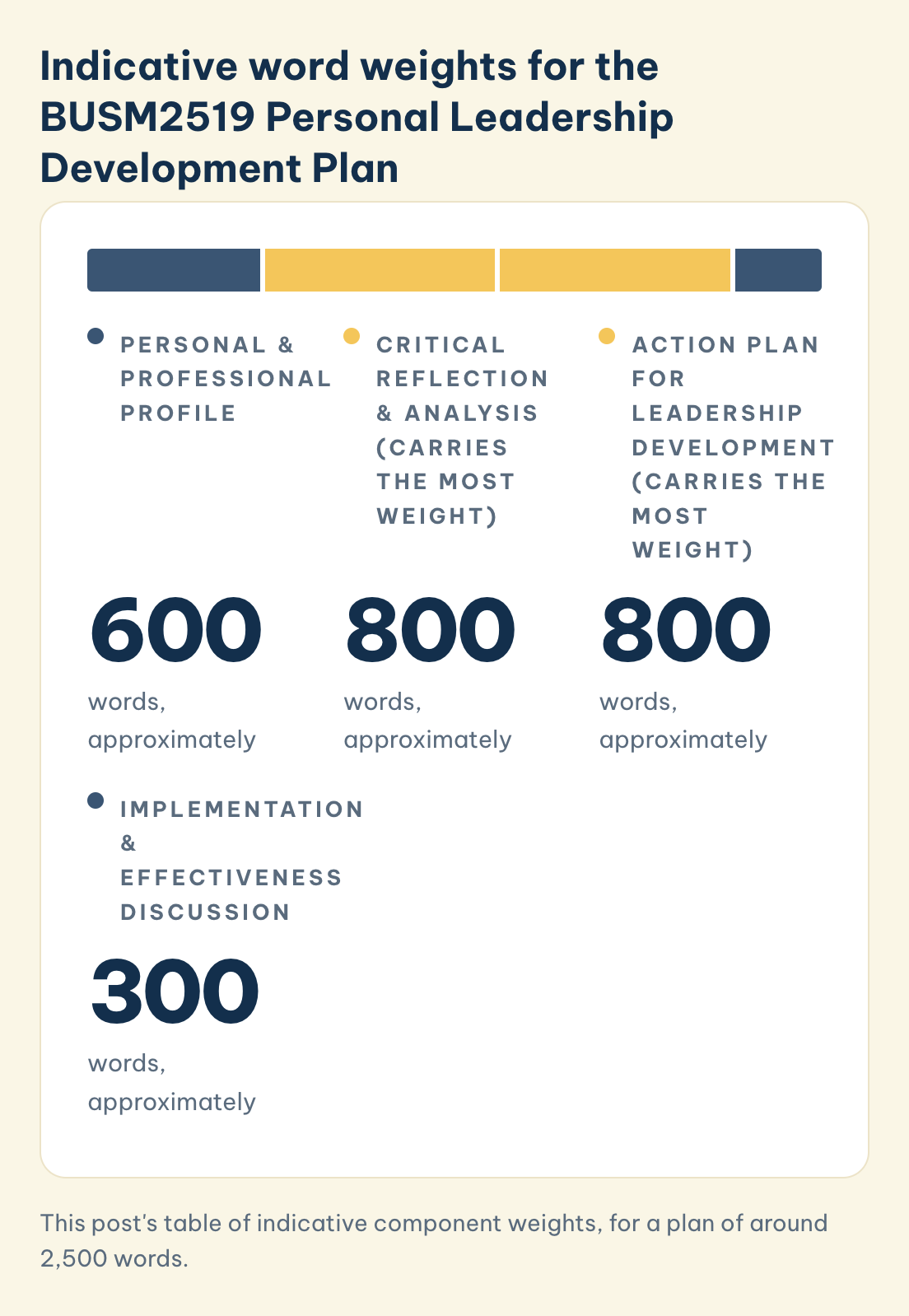
| Component | Indicative weight | What earns the marks |
|---|---|---|
| Personal & professional profile | ~600 words | A focused, evidence-based picture of your current leadership, not a CV |
| Critical reflection & analysis | ~800 words | Honest analysis of strengths and gaps, framed with leadership theory |
| Action plan for leadership development | ~800 words | Specific goals, milestones, and timelines tied to named capabilities |
| Implementation & effectiveness discussion | ~300 words | How you will enact the plan and measure whether it worked |
Evidence: RMIT business rubrics use criterion bands (Pass / Credit / Distinction / High Distinction). The jump from Credit to Distinction is almost always defined by the word "critical", critical, honest self-reflection and critical application of theory, rather than by adding more description or more references.
Example: A MAAS mentor colour-coded one Vietnamese student's reflection section into "describe" versus "reflect critically". It was 80% description of what leadership is. After one restructuring pass that turned the generic claims into honest, evidenced self-analysis, the same material lifted the mark two full bands.
◆ Question 4 / 7 · Frameworks
Which leadership frameworks should you use in BUSM2519?
Direct answer: Use two or three frameworks that genuinely fit your reflection and plan, applied deeply, rather than naming many. For a digital-disruption leadership plan, pair a self-development lens (a reflective model) with a leadership lens that suits a disrupted, distributed workplace. The course materials usually point to adaptive leadership, a global mindset, and leading global virtual teams.
| Framework | Use it to | Author / source |
|---|---|---|
| Adaptive Leadership | Analyse how you respond to ambiguous, disruptive challenges | Heifetz & Linsky (2002) |
| Global Mindset | Assess your readiness to lead across cultures and borders | Javidan & Walker (2013) |
| Global Virtual Teams | Plan how you will lead distributed, technology-mediated teams | Maznevski & Chudoba (2000) |
| Transformational Leadership | Frame how you inspire and develop others through change | Bass & Avolio (1994) |
| Gibbs' Reflective Cycle | Structure your critical reflection systematically | Gibbs (1988) |
Evidence: Heifetz's adaptive leadership and Bass and Avolio's transformational leadership remain two of the most examiner-recognised frameworks for analysing leadership in conditions of change, while Gibbs' Reflective Cycle gives ESL students a clear, defensible scaffold for the reflection component markers expect.
Example: A Vietnamese student used Gibbs to structure her reflection (description → feelings → evaluation → analysis → conclusion → action plan) and adaptive leadership to analyse a real disruption she had managed at work. Two frameworks, deeply applied, produced a coherent narrative that earned a clear Distinction.
◆ Question 5 / 7 · Plan structure
How should you structure the BUSM2519 leadership development plan?
Direct answer: Follow the four-part structure the rubric implies: (1) a concise personal and professional leadership profile, (2) a critical reflection on your strengths and development gaps, (3) a specific action plan with goals, milestones, and timelines, and (4) a short discussion of implementation and how you will evaluate effectiveness. The most common structural fix is shrinking the generic theory and expanding the personal reflection and the action plan, where the marks concentrate.
Evidence: Criterion-referenced rubrics weight "critical reflection" and "action plan" far above general background. Matching your word budget to the rubric weighting, roughly 600 / 800 / 800 / 300, is the most reliable way to lift a grade without new research.
Example: A Vietnamese RMIT student submitted a draft that spent 900 words defining leadership styles and only 200 words on his own plan. His MAAS mentor inverted the ratio; the final plan, same theory, same sources, moved from a borderline Credit to a Distinction because the action plan was finally specific enough to assess.
◆ Question 6 / 7 · Common mistakes
What mistakes most often lose marks in BUSM2519?
Direct answer: Three recurring mistakes show up across MAAS coaching. First, students write about digital disruption in the abstract instead of about their own leadership, the technology crowds out the person. Second, the reflection stays safe and generic ("I need better communication") rather than honest and specific. Third, the action plan lists vague intentions with no milestones, timelines, or measures. Fixing these three lifts most drafts by at least one rubric band.
Evidence: Across MAAS coaching on RMIT leadership assessments, marker feedback before intervention clusters on "needs deeper critical reflection" and "action plan not specific or measurable", the two phrases that most often separate a Credit from a Distinction.
Example: A Vietnamese student's goal read "improve my leadership skills". His MAAS mentor pushed him to specify the capability (leading a global virtual team), the action (a six-month rotation plus a virtual-collaboration course), the milestone (lead one cross-border project by month four), and the measure (a 360-degree feedback score). The specific version earned full marks on the action-plan criterion.
◆ Question 7 / 7 · Length and referencing
How long is the BUSM2519 assignment, what referencing style does it use, and what about RMIT version history?
Direct answer: Confirm the exact figure in your brief, the BUSM2519 development plan commonly runs to about 2,500 words (within a 10% tolerance, excluding the title page and reference list) and uses RMIT Harvard referencing, the default for RMIT business courses.
Write the assignment directly in your RMIT Microsoft Word online account so a natural version history builds over time, and develop the work in stages rather than pasting in a finished document at the end. Cite every framework and data claim, and make sure in-text citations and the reference list match exactly.
Evidence: RMIT's business school uses RMIT Harvard, documented in RMIT's Easy Cite tool, and RMIT's academic integrity guidance emphasises that work should be genuinely your own, written and developed by you. Markers routinely deduct marks for inconsistent Harvard referencing even when the analysis is strong.
Example: A Vietnamese RMIT student lost several marks for mismatched citations across two assignments. A MAAS pre-submission audit, working alongside her own draft, caught 11 referencing errors in an hour; on her next BUSM2519 task, clean referencing recovered the marks she had been losing on a criterion that needs no extra research.
Frequently asked questions
Is BUSM2519 an essay or a reflective plan?
It is a reflective, applied plan written largely in the first person. You analyse your own leadership and design a development plan; it is not a standard argumentative essay or a literature review.
Do I have to write about my own real experience?
Usually yes. The Personal Leadership Development Plan is built on honest self-assessment, so draw on real roles, projects, or study experiences. Generic, invented examples read as thin to markers.
How many frameworks should I use?
Two or three, applied deeply, beats five named shallowly. Pair a reflective model such as Gibbs with a leadership lens such as adaptive leadership or transformational leadership.
What referencing style does BUSM2519 use?
RMIT Harvard is the default. Confirm in your brief and use RMIT's Easy Cite tool to keep entries consistent.
Why does RMIT care about version history?
RMIT can review the edit history of work written in your student Microsoft account as part of academic integrity checks. Writing in stages in your own account creates a natural history and protects you.
Can MAAS help me with BUSM2519?
Yes. MAAS Assignment & Essay Support coaches you through the plan with the Outline, Draft, Final model, framework selection, reflection feedback, and a referencing audit, with PhD-level mentors. We coach your work; we do not write it for you.
Ready to approach BUSM2519 with a clear strategy?
If you understand digital disruption but your draft still reads like a technology report rather than your own leadership plan, that is exactly where a discipline-matched expert helps most. MAAS Assignment & Essay Support is an academic support partner; we work alongside you through Outline, Draft, Final so the reflection stays honestly yours and the structure earns the marks.
Bring your BUSM2519 brief and we will match you to a leadership-and-change mentor, 23% of our 100+ experts hold a PhD, within 48 hours when our network already covers that field. If it does not, MAAS opens a dedicated recruitment round for your case, which usually takes about two weeks.
Book a free 20-minute BUSM2519 consultation with MAAS Assignment & Essay Support →
Related guides
- How do you approach the MGF3621 Organisational Change assignment?: sibling Monash Business School guide on diagnosing and leading organisational change
- ISYS90026 assignment: how do you approach Concepts in Information Systems?: sibling University of Melbourne guide on analysing a business problem and arguing an information-systems solution
- MMH356 assignment: how do you approach Change Management at Deakin?: sibling Deakin guide on managing change through a sustainability lens
- How do you approach the BUSM7113 Leading for Social Impact assignment?: sibling postgraduate leadership guide on leading change for measurable social outcomes
- How do you approach the BUSM2617 Managing People for the Future assignment?: sibling RMIT business course guide on managing people through digital change
- How do you approach the BUSM2618 Managing People for the Future assignment?: paired-code sibling guide on planning the future workforce, skills, and people strategy
- How do you approach the BUSM4187 International HRM assignment?: sibling RMIT business course guide on leading people globally
- BUSM3299 assignment: how do you approach Foundations of Entrepreneurship?: sibling RMIT business guide on validating an opportunity under uncertainty
- How to write a reflection essay: for the critical-reflection half of any development plan
- MAAS Academic Mentoring service: 1:1 coaching with PhD-level mentors in your discipline
- Course-code assignment coaching: pillar guide on tackling any unit assignment with a MAAS mentor
References
- Bass, B. M., & Avolio, B. J. (1994). Improving organizational effectiveness through transformational leadership. SAGE.
- Gibbs, G. (1988). Learning by doing: A guide to teaching and learning methods. Further Education Unit, Oxford Polytechnic.
- Heifetz, R. A., & Linsky, M. (2002). Leadership on the line: Staying alive through the dangers of leading. Harvard Business School Press.
- Javidan, M., & Walker, J. L. (2013). Developing your global mindset: The handbook for successful global leaders. Beaver's Pond Press.
- Maznevski, M. L., & Chudoba, K. M. (2000). Bridging space over time: Global virtual team dynamics and effectiveness. Organization Science, 11(5), 473–492.
- World Economic Forum. (2023). The future of jobs report 2023. https://www.weforum.org/reports/the-future-of-jobs-report-2023/
Tools & resources
- RMIT University. (n.d.). Academic integrity. Retrieved June 8, 2026, from https://www.rmit.edu.au/students/my-course/assessment-results/academic-integrity
- RMIT University. (n.d.). Easy Cite referencing tool. Retrieved June 8, 2026, from https://www.rmit.edu.au/library/study/referencing
This article is part of the MAAS Journal series for Vietnamese international students. MAAS Assignment & Essay Support is an academic support partner; we coach students through the Outline, Draft, Final delivery model with developmental feedback from discipline-matched experts. We do not write or submit work on a student's behalf.
A free 20-minute consultation is a conversation about where you are with BUSM2519.
Book a free consultation ▸