
◆ Business & Management
MMH356 at Deakin: how do you approach Change Management?
MMH356 Change Management at Deakin asks you to analyse organisational change through a sustainability lens, not just describe a transformation. Most students who struggle with this Deakin unit are not short on effort; they narrate what a company changed but never argue why that change was managed well or badly. This guide answers the seven questions Vietnamese students at Deakin ask MAAS mentors most often before they start MMH356.

◆ Question 1 / 7 · About the unit
What is MMH356 Change Management about?
Direct answer: MMH356 is a Deakin Business School unit examining how organisations plan, lead, and sustain change, framed inside a sustainability context. It takes a critical view of the drivers of organisational change and asks you to manage that change while protecting the long-term economic, social, and environmental health of the business. It wants you to think like a change strategist.
Evidence: Deakin's published unit description for MMH356 positions it as an advanced study of change management models "within a sustainability framework", emphasising a critical approach to the drivers of change and the process of managing it sustainably. That sustainability angle is what separates MMH356 from a generic change unit and it is exactly where markers look for depth.
Example: A Vietnamese student at Deakin came to MAAS treating MMH356 as "Kotter's 8 steps with a case study". Her mentor reframed it: the unit is about managing change without sacrificing long-term sustainability. Once she ran every recommendation through Elkington's (1997) triple-bottom-line filter, her draft stopped listing change steps and started arguing trade-offs and her mark moved from a Pass-level draft to a Distinction.
◆ Question 2 / 7 · Assessment
What assessment does the MMH356 assignment usually involve?
Direct answer: MMH356 is typically assessed through a short progress or proposal piece, a substantial individual change report (often in the 3,000–3,500 word range and the largest written task), and an examination. The report usually asks you to analyse a real organisation undergoing change, diagnose the change using established models, and recommend a sustainable way to manage it. Always confirm the exact tasks, weightings, and word counts in your own CloudDeakin unit site, assessment structure changes by teaching period and campus.
Evidence: Deakin business units are criterion-referenced, meaning marks are awarded against published rubric criteria rather than ranked against classmates. This is why decoding the rubric (next section) matters far more than writing length, and why a 3,400-word report packed with description can still land a Pass.
Example: A Vietnamese Deakin student chose Patagonia as her change case but spent 900 of her 3,200 words describing the company's history and product line. Her MAAS mentor suggested she cut the background to 300 words and redirect the rest into analysing Patagonia's change using a sustainability-phase model. Same company, same word count, the analysis-heavy version earned a clear Distinction.
◆ Question 3 / 7 · Rubric
How is the MMH356 assignment graded, what does the rubric actually reward?
Direct answer: Change-management rubrics at this level reward four things, roughly in this order: (1) depth of critical analysis, (2) correct and explicit use of change and sustainability frameworks, (3) practical, justified recommendations, and (4) academic writing and Harvard referencing. Describing what an organisation did earns almost no marks on its own, the marks live in why it did it, how well the change was managed, and whether it was sustainable. If you can replace a descriptive sentence with an analytical one, do it every time.
Evidence: Deakin business rubrics use criterion bands (Pass / Credit / Distinction / High Distinction). The jump from Credit to Distinction is almost always defined by the word "critical", critical evaluation, critical application of theory, critical judgement, not by adding more content.
Example: A MAAS mentor colour-coded one Vietnamese student's draft sentence by sentence as "describe" or "analyse". The draft was 75% describe. After one restructuring pass that flipped the ratio to 60% analyse, the same evidence and the same case organisation moved the mark up two full bands.
◆ Question 4 / 7 · Frameworks
Which change-management frameworks should you use in MMH356?
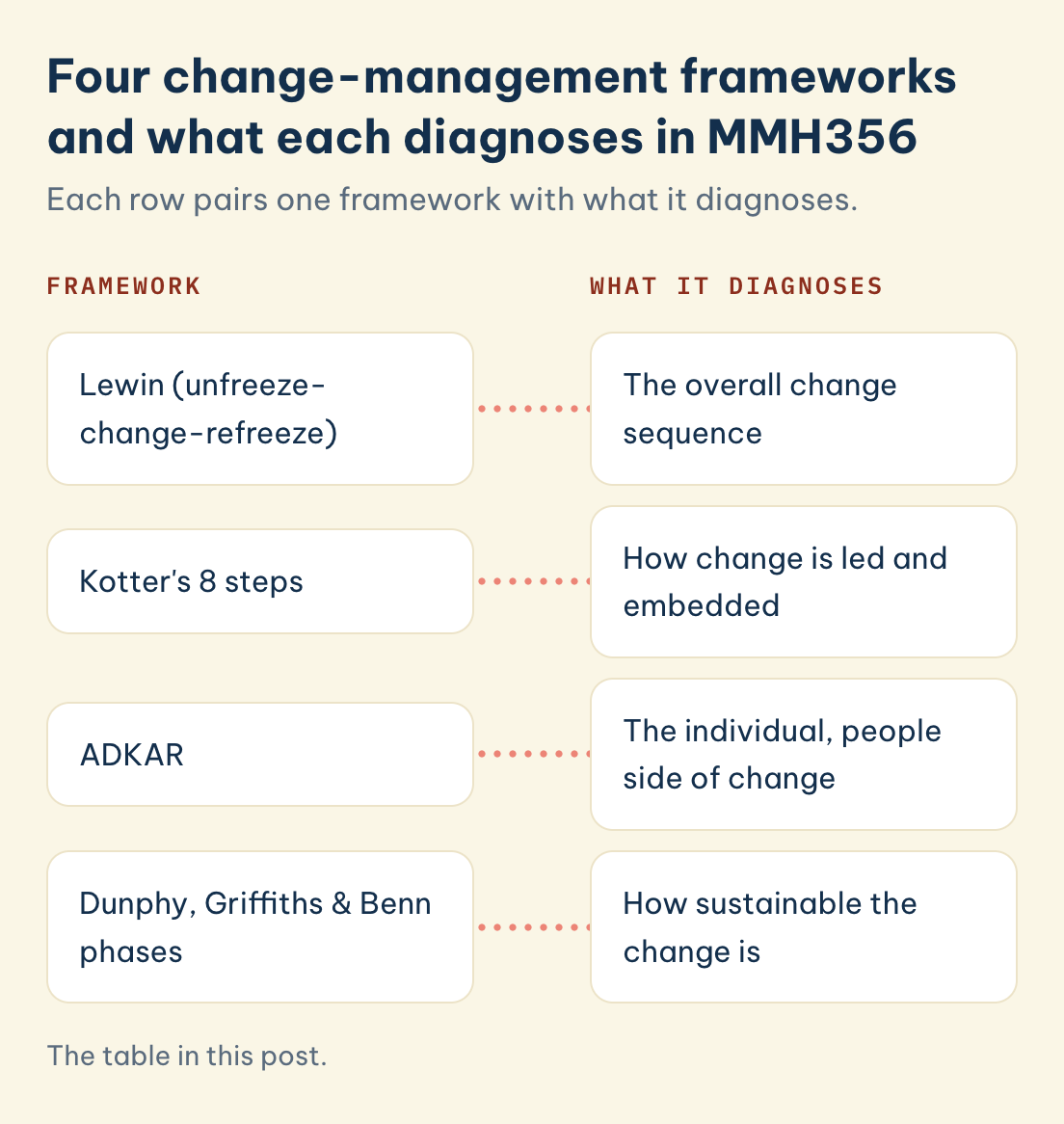
Direct answer: Anchor your analysis in two or three established models rather than name-dropping many and because MMH356 is sustainability-framed, pair a classic change model with a sustainability model. The most useful are Lewin's three-stage model (unfreeze–change–refreeze), Kotter's eight-step model for leading change, the ADKAR model for the people side of change, and Dunphy, Griffiths and Benn's sustainability phase model for the unit's defining angle. Pick models that fit your case organisation's actual situation, do not force all of them in.
Four change-management frameworks and what each diagnoses in MMH356
Each row pairs one framework with what it diagnoses.
Framework
What it diagnoses
Lewin (unfreeze-change-refreeze)
The overall change sequence
Kotter's 8 steps
How change is led and embedded
ADKAR
The individual, people side of change
Dunphy, Griffiths & Benn phases
How sustainable the change is
Save this figure
| Framework | What it diagnoses | Best use in MMH356 |
|---|---|---|
| Lewin (unfreeze–change–refreeze) | The overall change sequence | Framing the change journey simply |
| Kotter's 8 steps | How change is led and embedded | Evaluating leadership and momentum |
| ADKAR | The individual, people side of change | Analysing resistance and adoption |
| Dunphy, Griffiths & Benn phases | How sustainable the change is | The unit's core sustainability lens |
Evidence: Lewin (1947) introduced the foundational change sequence still taught today; Kotter (1996) formalised the eight-step leadership model in Leading Change; Hiatt (2006) developed ADKAR for individual change adoption; and Dunphy, Griffiths and Benn (2014) provide the sustainability-phase model that maps directly onto MMH356's framing. Hayes's (2018) textbook remains the standard synthesis of these models for practitioners, while By (2005) is blunt about the state of the field: "theories and approaches to change management currently available to academics and practitioners are often contradictory, mostly lacking empirical evidence and supported by unchallenged hypotheses concerning the nature of contemporary organisational change management" (By, 2005, p. 369), which is exactly why MMH356 rewards critical application over description. These are examiner-recognised sources, not blog-level references.
Example: A Vietnamese Deakin student analysing a manufacturer's shift to renewable energy tried to apply five models and explained each shallowly. Her MAAS mentor suggested she keep two, Kotter to evaluate how the change was led, and the Dunphy–Griffiths–Benn phases to judge whether the firm had moved from "compliance" toward genuine "sustaining corporation". Fewer frameworks, deeper application, higher mark.
◆ Question 5 / 7 · Report structure
How should you structure the MMH356 change report?
Direct answer: Use a diagnosis-led structure: (1) brief introduction and organisation context (keep it under 10% of the word count), (2) identification of the specific change and its drivers, (3) analysis of how the change was or should be, managed, using your chosen models, (4) a sustainability assessment of the change, (5) evidence-based recommendations, and (6) conclusion. The single biggest structural fix is shrinking the description sections and expanding the analysis, sustainability, and recommendation sections, where the marks concentrate.
Evidence: Criterion-referenced rubrics weight "analysis and application of theory" and "recommendations and justification" far above "context and background". Structuring your word budget to match the rubric weighting is the most reliable way to lift a grade without new research.
Example: A Vietnamese Deakin student submitted a draft with a 700-word company history and a 350-word recommendations section. His MAAS mentor inverted the ratio and added a dedicated sustainability-assessment section. The final report, same case, same sources, moved from a borderline Credit to a Distinction because the recommendations were finally developed enough to be assessed against the rubric.
◆ Question 6 / 7 · Common mistakes
What are the most common mistakes that lose marks in MMH356?
Direct answer: Three recurring mistakes show up across MAAS change-management coaching. First, students describe instead of analyse, the organisation's history crowds out the argument. Second, they treat sustainability as a one-line add-on rather than the unit's central lens, so the "sustainability framework" the rubric expects never appears. Third, recommendations are generic ("the company should communicate better") rather than specific, sequenced, and tied to the analysis. Fixing these three lifts most drafts by at least one rubric band.
Evidence: Across MAAS change-management coaching, marker feedback before intervention clusters heavily on "needs more critical analysis" and "sustainability dimension underdeveloped", the two phrases that most often separate a Credit from a Distinction in Deakin business rubrics.
Example: A Vietnamese student's recommendation read "the company should manage resistance better." His MAAS mentor pushed him to specify: which stakeholder group (frontline plant staff), which intervention (ADKAR-based awareness and reinforcement steps), and why it was sustainable (embedding the change so it survives leadership turnover). The specific version earned full marks on the recommendations criterion.
◆ Question 7 / 7 · Length and referencing
How long is the MMH356 assignment and what referencing style does it use?
Direct answer: Confirm the exact word count and style in your assessment brief, the main MMH356 report commonly sits in the 3,000–3,500 word range and uses Harvard referencing, Deakin's standard business style. Stay within the 10% tolerance band, cite every theoretical claim, and make sure your reference list and in-text citations match exactly. Reference accuracy is a quick, reliable source of marks that many students leave on the table.
Evidence: Deakin's Business School uses Harvard as its standard referencing style, documented in the Deakin guide to referencing. Markers routinely deduct marks for inconsistent or incomplete Harvard referencing even when the analysis is strong.
Example: A Vietnamese Deakin student lost several marks across two assignments for mismatched in-text citations and reference-list entries. A MAAS pre-submission audit caught 12 referencing errors in an hour. On her next MMH356 task, clean Harvard referencing recovered the marks she had previously been losing on a criterion that requires no extra research at all.
Frequently asked questions
Is MMH356 a hard unit?
It is conceptually demanding rather than technically hard; there is no maths, but the unit expects critical thinking and a genuine sustainability lens instead of memorised change steps. Students who treat it as "describe a company's change" struggle; students who treat it as "argue how to manage change sustainably" do well.
Can I use a well-known company as my change case?
Yes, large, well-documented organisations work well because there is enough public information to analyse. The risk is spending too long on company background. Pick a firm with a clear change and a real sustainability angle you can analyse, not just a famous name.
How many frameworks should I use in the assignment?
Two or three, applied deeply, beats five applied shallowly. Pair one change model with one sustainability model so you cover both halves of what MMH356 rewards.
What referencing style does MMH356 use?
Harvard is the default for Deakin business units. Always confirm in your own brief, and use the Deakin guide to referencing to format entries consistently.
Does the sustainability angle really matter for the grade?
Yes. Sustainability is the unit's defining frame, not decoration. Reports that treat it as a central analytical lens consistently outperform reports that mention it once in the conclusion.
Can MAAS help me with MMH356?
Yes. MAAS Assignment & Essay Support coaches you through the assignment with the Outline, Draft, Final model, rubric decoding, framework selection, sustainability-lens structuring, draft feedback, and a pre-submission referencing audit, all with discipline-matched experts. We coach your work; we do not write it for you.
Ready to approach MMH356 with a clear strategy?
If you have the change case but not the argument, that is exactly where a discipline-matched expert helps most. MAAS Assignment & Essay Support is an academic support partner; we work alongside you through Outline, Draft, Final so the analysis stays yours and the structure earns the marks.
Bring your MMH356 brief and we will match you to an organisational-change mentor, 23% of our 100+ experts hold a PhD, within 48 hours when our network already covers that field. If it does not, MAAS opens a dedicated recruitment round for your case, which usually takes about two weeks.
Book a free 20-minute MMH356 consultation with MAAS Assignment & Essay Support →
Related guides
- How do you approach the BUSM3312 Managing Change assignment?: sibling RMIT guide on diagnosing and leading the change process
- How do you approach the MGF3621 Organisational Change assignment?: sibling Monash Business School guide on diagnosing and leading organisational change
- How do you approach the BUSM2519 Leading in the Age of Digital Disruption assignment?: sibling guide on leading change through disruption
- How do you approach the BUSM2617 Managing People for the Future assignment?: sibling guide on the people impact of transformation
- How to write a methodology in an essay: for the analytical-rigour half of any change report
- How to write a reflection essay: useful if your MMH356 task includes a reflective component
- MAAS Academic Mentoring service: 1:1 coaching with postgraduate-qualified mentors in your discipline
- Tutoring service: 1:1 subject tutoring in 60- or 90-minute sessions with an expert matched on your course code, always inside your discipline
- Course-code assignment coaching: pillar guide on tackling any unit assignment with a MAAS mentor
References
- By, R. T. (2005). Organisational change management: A critical review. Journal of Change Management, 5(4), 369–380.
- Dunphy, D., Griffiths, A., & Benn, S. (2014). Organizational change for corporate sustainability (3rd ed.). Routledge.
- Elkington, J. (1997). Cannibals with forks: The triple bottom line of 21st century business. Capstone.
- Hayes, J. (2018). The theory and practice of change management (5th ed.). Palgrave Macmillan.
- Hiatt, J. (2006). ADKAR: A model for change in business, government and our community. Prosci Learning Center.
- Kotter, J. P. (1996). Leading change. Harvard Business School Press.
- Lewin, K. (1947). Frontiers in group dynamics. Human Relations, 1(1), 5–41.
Tools & resources
- Deakin University. (n.d.). Deakin guide to referencing. Retrieved June 17, 2026, from https://www.deakin.edu.au/students/study-support/referencing
- Deakin University. (n.d.). MMH356 Change Management unit. Retrieved June 17, 2026, from https://www.deakin.edu.au/courses/unit?unit=MMH356
This article is part of the MAAS Journal series for Vietnamese international students. MAAS Assignment & Essay Support is an academic support partner; we coach students through the Outline, Draft, Final delivery model with developmental feedback from discipline-matched experts. We do not write or submit work on a student's behalf.
A free 20-minute consultation is a conversation about where you are with MMH356.
Book a free consultation ▸