
◆ Business & Management
BUSM3312 (RMIT) assignment: how do you approach Managing Change?
BUSM3312 Managing Change asks you to diagnose a real change and argue how it should be led; the rubric rewards analysis over description. Most students who struggle with this RMIT course are not short on effort. They narrate what a company did during a change but rarely evaluate why it worked, where it failed, and what a change leader should have done differently, which is what the seven questions below work through.

◆ Question 1 / 7 · The module
What is BUSM3312 Managing Change about?
Direct answer: BUSM3312 is an RMIT management course (offered at RMIT Melbourne and RMIT Vietnam) examining how organisations plan, lead, and survive change, restructures, digital transformation, mergers, and the human resistance that comes with them. The course wants you to think like a change agent who diagnoses the situation and chooses an intervention, not a reporter summarising what happened.
Evidence: Change-management courses at this level draw heavily on the established canon, Lewin's force-field and three-stage model, Kotter's eight-step process, Hayes' (2018) The Theory and Practice of Change Management, and the ADKAR individual-change model. The recurring exam-and-assignment question across these texts is the same: not "what changed?" but "how well was the change led, and on what evidence do you judge that?"
Example: A Vietnamese student at RMIT Vietnam arrived at MAAS certain BUSM3312 was "just describing a company reorganisation." Her mentor reframed it: the course is about the gap between how leaders rolled out a change and how employees actually absorbed it. Once she analysed that gap with a single diagnostic model, her draft stopped narrating a timeline and started making an argument and her mark moved from a Pass-level draft toward a Distinction.
◆ Question 2 / 7 · Assessment
What assessment does the BUSM3312 assignment usually involve?
Direct answer: Managing Change courses at this level are typically assessed through a mix of an individual analytical report built around a real change case and a reflective or interview-based task. At RMIT, BUSM3312 has commonly used an "interview about change at work" task, where you interview someone who has lived through an organisational change and analyse their experience, alongside a longer report that diagnoses a change and recommends how it should be led. Always confirm the exact assessments, weighting, and word counts in your own Canvas shell, because the structure changes by semester and campus.
Evidence: RMIT business and management assessments are criterion-referenced, meaning marks are awarded against published rubric criteria rather than ranked against classmates. This is set out in RMIT's Assessment and Assessment Flexibility policy, which is why decoding the rubric (next section) matters far more than writing length.
Example: A Vietnamese RMIT student treated the interview task as a transcript exercise, three pages of quotes, almost no analysis. His MAAS mentor showed him that the marks lived in connecting the interviewee's lived experience to change theory: mapping their resistance onto the change curve and their "unfreezing" onto Lewin. Same interview, same word count, the analysis-led version earned a clear Distinction.
◆ Question 3 / 7 · Marking
How is the BUSM3312 assignment graded, what does the rubric actually reward?
Direct answer: Change-management rubrics at this level reward four things, roughly in this order: (1) depth of critical analysis and judgement, (2) correct and explicit application of change theory and frameworks, (3) practical, justified recommendations for leading the change, and (4) academic writing and Harvard referencing. Describing the sequence of events earns almost no marks on its own, marks live in why the change succeeded or stalled and what a leader should do about it. If you can replace a narrating sentence with an evaluating one, do it every time.
Evidence: RMIT business and management rubrics use criterion bands (Pass / Credit / Distinction / High Distinction). The jump from Credit to Distinction is almost always defined by the word "critical", critical evaluation, critical application of theory, critical reflection, not by adding more description or more length.
Example: A MAAS mentor colour-coded one Vietnamese student's draft sentence by sentence as "describe" or "analyse". The draft was roughly 75% describe. After one restructuring pass that flipped the ratio toward analyse, same case, same sources, the mark moved up two full rubric bands, driven entirely by the criterion that asks for critical evaluation.
◆ Question 4 / 7 · Frameworks
Which change-management frameworks should you use in BUSM3312?
Direct answer: Anchor your analysis in two or three established frameworks rather than name-dropping many. The most useful for BUSM3312 are: Lewin's three-stage model (unfreeze – change – refreeze) and force-field analysis for diagnosing the drivers and resistors of change; Kotter's eight-step model for evaluating how the change was led; and the ADKAR model (Awareness, Desire, Knowledge, Ability, Reinforcement) for analysing change at the individual level, which fits the interview task especially well. Pick frameworks that match your case; do not force all of them in.
Five change-management frameworks for BUSM3312 and what each is best used for
Each row sets one framework beside what it is best used for.
Framework
Best used for
Lewin (unfreeze-change-refreeze)
Diagnosing the overall change process
Lewin force-field analysis
Mapping drivers vs. resistors
Kotter's 8 steps
Evaluating leadership of the change
ADKAR
Individual-level change (interview task)
Kübler-Ross change curve
Emotional response to change
Save this figure
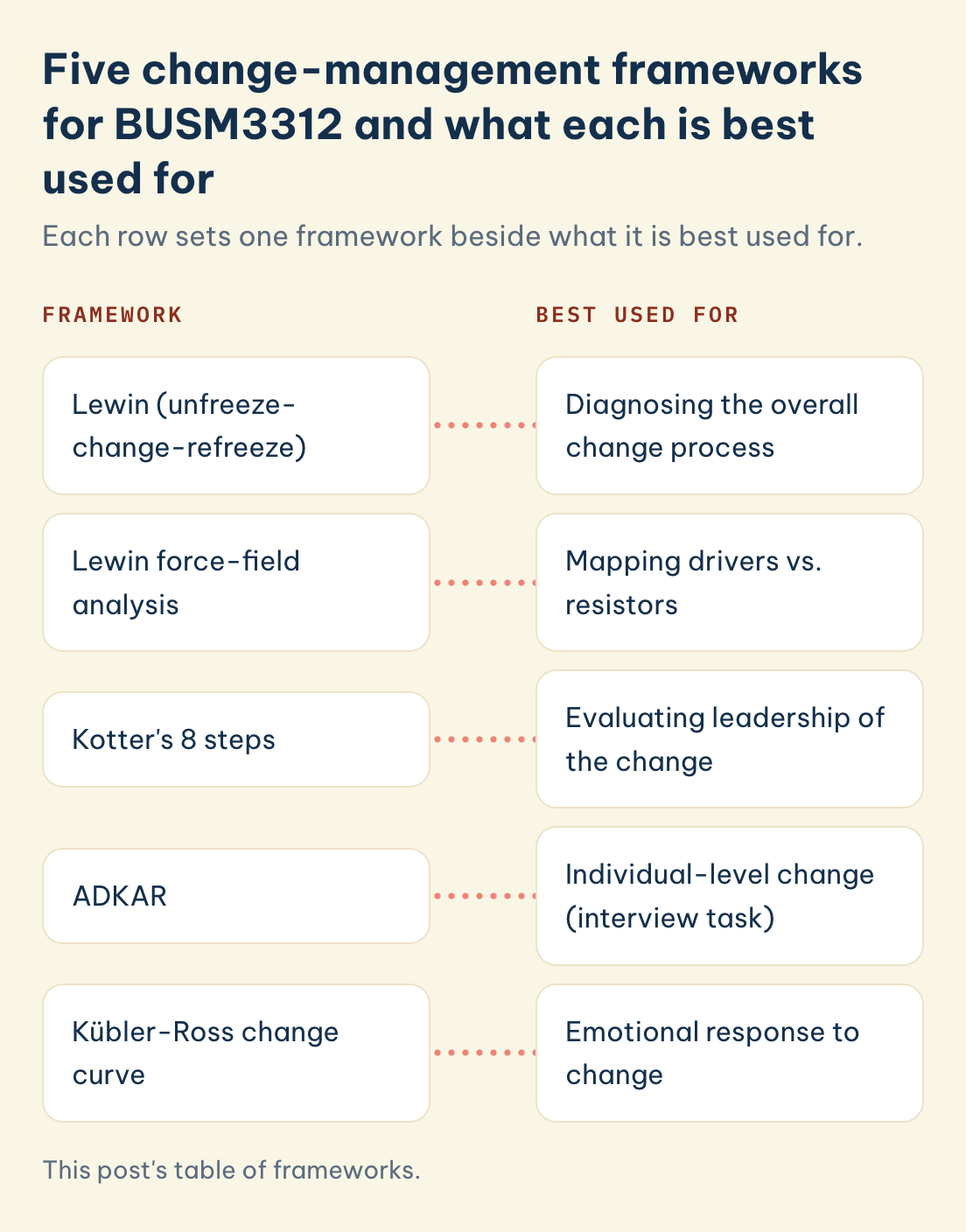
| Framework | Best used for | What it helps you argue |
|---|---|---|
| Lewin (unfreeze–change–refreeze) | Diagnosing the overall change process | Whether the change was properly prepared and embedded, or refroze too soon |
| Lewin force-field analysis | Mapping drivers vs. resistors | Which forces leaders should have strengthened or weakened |
| Kotter's 8 steps | Evaluating leadership of the change | Where the change effort skipped a step (e.g. no urgency, no short-term wins) |
| ADKAR | Individual-level change (interview task) | At which stage a person got stuck and why |
| Kübler-Ross change curve | Emotional response to change | How resistance and acceptance evolved over time |
Evidence: Lewin (1947) introduced the unfreeze–change–refreeze logic and force-field analysis that still underpin change diagnosis, and he was explicit that reaching a new level is not the same as keeping it: "Permanency of the new level, or permanency for a desired period, should be included in the objective" (Lewin, 1947, pp. 34–35). Kotter (1996) formalised the eight-step process that examiners recognise immediately; the ADKAR model (Hiatt, 2006) remains the standard for analysing change at the individual level. These are foundational, marker-recognised sources, not blog-level references.
Example: A Vietnamese RMIT student analysing a bank's digital rollout tried to apply five models and explained each one shallowly. Her MAAS mentor cut it to two, Kotter to evaluate how leadership ran the rollout, and ADKAR to explain why frontline staff stalled at "Desire." Fewer frameworks, deeper application, a higher mark on the theory-application criterion.
◆ Question 5 / 7 · Report structure
How should you structure the BUSM3312 report?
Direct answer: Use a diagnosis-led structure: (1) brief introduction and change context, keep it under 10% of the word count; (2) clear statement of the specific change and the problem or tension it created; (3) analysis of that change using your chosen frameworks; (4) evidence-based recommendations for how the change should be led; (5) conclusion.
The single biggest structural fix is shrinking the description sections and expanding the analysis and recommendation sections, where the marks concentrate. For the interview task, structure around themes (resistance, communication, leadership) rather than a question-by-question replay of the conversation.
Evidence: Criterion-referenced rubrics weight "analysis and application of theory" and "recommendations and justification" far above "context and background." Structuring your word budget to match the rubric weighting is the most reliable way to lift a grade without doing new research.
Example: A Vietnamese RMIT student submitted a draft with a 600-word company-and-change history and a 250-word recommendations section. His MAAS mentor inverted the ratio. The final report, same case, same sources, moved from a borderline Credit to a Distinction because the recommendations were finally developed enough to be assessed against the rubric.
◆ Question 6 / 7 · Common mistakes
What are the most common mistakes that lose marks in BUSM3312?
Direct answer: Three recurring mistakes show up across MAAS change-management coaching. First, students narrate instead of analyse, the change timeline crowds out the argument and judgement. Second, students apply frameworks as labels rather than tools; they name Kotter or Lewin but never use the model to reach a conclusion about whether the change was well led. Third, recommendations are generic ("the company should communicate better") rather than specific, staged, and tied to the analysis. Fixing these three lifts most drafts by at least one rubric band.
Evidence: Across MAAS change-management coaching, marker feedback before intervention clusters heavily on "needs more critical analysis" and "recommendations not sufficiently justified", the two phrases that most often separate a Credit from a Distinction in RMIT management rubrics.
Example: A Vietnamese student's recommendation read "the company should manage resistance better." His MAAS mentor pushed for specifics: which group (mid-level managers losing authority in the restructure), which intervention (involve them as change champions in the unfreeze stage, with a communication cadence), and why (to convert force-field resistors into drivers). The specific version earned full marks on the recommendations criterion.
◆ Question 7 / 7 · Length and referencing
How long is the BUSM3312 assignment and what referencing style does it use?
Direct answer: Confirm the exact word count and style in your own assessment brief, change-management individual reports at this level commonly sit between 2,000 and 3,000 words and use Harvard referencing, which is RMIT's default business and management style. The interview task is often shorter. Stay within the 10% tolerance band, cite every theoretical claim, and make sure your in-text citations and reference list match exactly. Reference accuracy is a quick, reliable source of marks that many students leave on the table.
Evidence: RMIT's business and management programs use RMIT Harvard as their standard referencing style, documented in RMIT's Easy Cite referencing tool. Markers routinely deduct marks for inconsistent or incomplete Harvard referencing even when the analysis is strong.
Example: A Vietnamese RMIT student lost several marks across two assignments for mismatched in-text citations and reference-list entries. A MAAS pre-submission audit caught 14 referencing errors in an hour. On her next BUSM3312 task, clean Harvard referencing recovered marks she had previously been losing on a criterion that requires no extra research at all.
Frequently asked questions
Is BUSM3312 a hard course?
It is conceptually demanding rather than technically hard; there is no maths, but the course expects critical, theory-driven analysis instead of storytelling. Students who treat it as "describe a change" struggle; students who treat it as "diagnose and judge how a change was led" do well.
Can I use my own workplace or a part-time job for the change case?
Yes, and it often works well, a change you witnessed firsthand gives you rich detail for the interview and report tasks. The risk is slipping into pure narration. Anchor your firsthand experience to a framework so it becomes analysis, not anecdote.
How many frameworks should I use in the assignment?
Two or three, applied deeply, beats five applied shallowly. Examiners reward critical application, using a model to reach a judgement, not the number of theories you can name.
What's the difference between BUSM3312 and BUSM2617?
BUSM3312 Managing Change centres on the change process and how it is led; BUSM2617 Managing People for the Future centres on the people impact of transformation and the future of work. They overlap on change frameworks, so the analytical habits transfer between them.
What referencing style does BUSM3312 use?
RMIT Harvard is the default for business and management courses. Always confirm in your own brief, and use RMIT's Easy Cite tool to format entries consistently.
Can MAAS help me with BUSM3312?
Yes. MAAS Assignment & Essay Support coaches you through the assignment with the Outline, Draft, Final model, rubric decoding, framework selection, interview-analysis structure, draft feedback, and a pre-submission referencing audit, all with discipline-matched experts. We coach your work; we do not write it for you.
Ready to approach BUSM3312 with a clear strategy?
If you have the change case but not the argument, that is exactly where a discipline-matched expert helps most. MAAS Assignment & Essay Support is an academic support partner; we work alongside you through Outline, Draft, Final so the analysis stays yours and the structure earns the marks.
Bring your BUSM3312 brief and we will match you to an organisational-change mentor, 23% of our 100+ experts hold a PhD, within 48 hours when our network already covers that field. If it does not, MAAS opens a dedicated recruitment round for your case, which usually takes about two weeks.
Book a free 20-minute BUSM3312 consultation with MAAS Assignment & Essay Support →
Related guides
- BUSM4692 assignment: how do you approach Global Corporate Responsibility?: sibling RMIT guide on CSR, ESG, and evaluating whether corporate responsibility is strategic
- BUSM2575 assignment: how do you approach Business in Society?: sibling RMIT business guide on CSR, stakeholder theory, and the role of business in society
- How do you approach the MGF3621 Organisational Change assignment?: sibling Monash Business School guide on diagnosing and leading organisational change
- MMH356 assignment: how do you approach Change Management at Deakin?: sibling Deakin guide on managing change through a sustainability lens
- How do you approach the BUSM7113 Leading for Social Impact assignment?: sibling postgraduate leadership guide on leading change for measurable social outcomes
- How do you approach the BUSM4187 International HRM assignment?: sibling RMIT business course guide on managing people globally
- How do you approach the BUSM2617 Managing People for the Future assignment?: sibling RMIT management course guide on the people impact of change
- How do you approach the BUSM2618 Managing People for the Future assignment?: paired-code sibling guide on planning the future workforce, skills, and people strategy
- How do you approach the BUSM2519 Leading in the Age of Digital Disruption assignment?: sibling RMIT guide on leadership through disruption
- How do you approach the BUSM3299 The Foundations of Entrepreneurship assignment?: sibling RMIT business course guide on evaluating venture opportunities
- BUSM4164 assignment: how do you approach Business Consulting?: sibling RMIT business guide on diagnosing a client problem and recommending a justified fix
- How to write a methodology in an essay: for the analytical-rigour half of any change report
- How to write a reflection essay: directly useful for the BUSM3312 interview-and-reflection task
- MAAS Academic Mentoring service: 1:1 coaching with PhD-level mentors in your discipline
- Course-code assignment coaching: pillar guide on tackling any unit assignment with a MAAS mentor
References
- Hayes, J. (2018). The theory and practice of change management (5th ed.). Palgrave Macmillan.
- Hiatt, J. (2006). ADKAR: A model for change in business, government and our community. Prosci Learning Center.
- Kotter, J. P. (1996). Leading change. Harvard Business School Press.
- Lewin, K. (1947). Frontiers in group dynamics. Human Relations, 1(1), 5–41.
Tools & resources
- RMIT University. (n.d.). Assessment and exams. Retrieved June 8, 2026, from https://www.rmit.edu.au/students/student-essentials/assessment-and-exams
- RMIT University. (n.d.). Easy Cite referencing tool. Retrieved June 8, 2026, from https://www.rmit.edu.au/library/study/referencing
This article is part of the MAAS Journal series for Vietnamese international students. MAAS Assignment & Essay Support is an academic support partner; we coach students through the Outline, Draft, Final delivery model with developmental feedback from discipline-matched experts. We do not write or submit work on a student's behalf.
A free 20-minute consultation is a conversation about where you are with BUSM3312.
Book a free consultation ▸