
◆ Business & Management
BUSM2618 assignment: how do you approach Managing People for the Future?
BUSM2618 Managing People for the Future rewards a forward-looking analysis of how work, skills, and the workforce must change, not the technology. Most students who lose marks describe the system a company installed but never argue what it means for the people who will do the work next. This guide answers the seven questions Vietnamese students at RMIT ask MAAS mentors most often before they start BUSM2618.

◆ Question 1 / 7 · The module
What is BUSM2618 Managing People for the Future about?
Direct answer: BUSM2618 is the paired course code for RMIT's Managing People for the Future, also coded BUSM2617, offered to different cohorts and campuses, including RMIT Vietnam. It examines how digital transformation, automation, and the future of work reshape jobs, skills, and workforce planning. The course wants you to lead with people, not technology.
Evidence: The course sits in RMIT's management and HRM stream and draws on future-of-work scholarship. The World Economic Forum's Future of Jobs Report 2023, a source assessments of this type frequently cite, estimates that 23% of jobs will change within five years (World Economic Forum, 2023), which is exactly the "managing people through disruption" problem BUSM2618 trains you to analyse. Announcing the report, the World Economic Forum's Managing Director Saadia Zahidi said governments and businesses must invest in supporting "the shift to the jobs of the future through the education, reskilling and social support structures that can ensure individuals are at the heart of the future of work" (World Economic Forum, 2023).
Example: A Vietnamese student at RMIT Vietnam opened her BUSM2618 draft with three paragraphs on a bank's new mobile platform. Her MAAS mentor reframed the brief: the assignment is not about the app, it is about the tellers whose roles, skills, and career paths the app changed. Once she centred the analysis on people, the draft moved from a descriptive Pass to a Distinction.
◆ Question 2 / 7 · Assignment
What does the BUSM2618 assignment ask you to do?
Direct answer: BUSM2618 assessments typically ask you to take a real organisation facing technological or workforce change and analyse the people consequences, how roles and skills must shift, where capability gaps will open, how employees may resist, and what management should do to prepare the workforce for the future. "Critically analyse" and "recommend" are the operative verbs: you evaluate and propose, you do not narrate a timeline. Always confirm the exact wording, word count, and weighting in your own Canvas shell, because the brief and assessment number vary by semester and campus.
Evidence: RMIT assessments are criterion-referenced, marks are awarded against published rubric criteria, not ranked against classmates (RMIT University, n.d.). That is why a future-of-work task rewards judgement, workforce-planning logic, and framework use far more than the volume of company background you include.
Example: A Vietnamese RMIT student chose a retailer's automation of its warehouses as his case. His first draft was a 1,000-word history of the rollout. His MAAS mentor cut it to 250 words of context and redirected the rest to mapping which roles would disappear, which new skills the remaining roles demanded, and how the company should reskill, the forward-looking analysis the rubric actually assesses.
◆ Question 3 / 7 · Marking
How is BUSM2618 graded, what does the rubric reward?
Direct answer: The rubric rewards four things, roughly in order: (1) depth of critical analysis of the people and skills impact, (2) correct application of future-of-work and change-management frameworks, (3) evidence-based, practical workforce recommendations, and (4) academic writing and RMIT Harvard referencing. Describing what a company did earns little; analysing what it means for tomorrow's workforce and what management should do now, earns the marks.
Evidence: RMIT business rubrics use criterion bands (Pass / Credit / Distinction / High Distinction). The jump from Credit to Distinction is almost always defined by the word "critical", critical evaluation, critical application of theory, critical judgement, rather than by adding more description.
Example: A MAAS mentor colour-coded one Vietnamese student's draft sentence by sentence into "describe" versus "analyse". It was 78% description. After a single restructuring pass that flipped the ratio, the same case and the same sources lifted the mark two full bands, without one extra source.
◆ Question 4 / 7 · Frameworks
Which future-of-work frameworks should you use in BUSM2618?
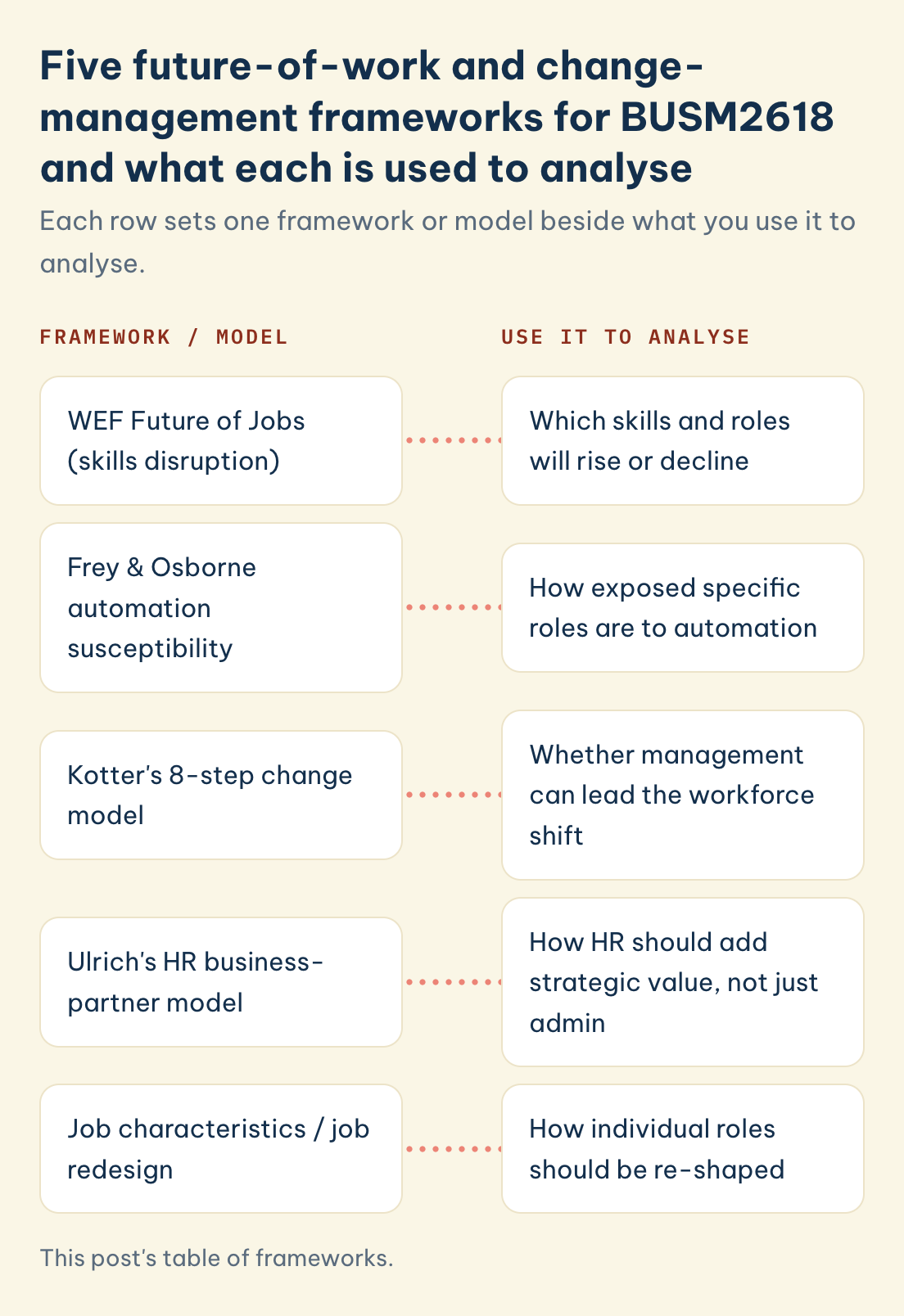
Direct answer: Use two or three frameworks that fit your case, applied deeply, rather than naming many. For BUSM2618, pair a future-of-work lens (to analyse how skills and roles will change) with a change-management or HR-strategy lens (to judge how management should respond). Pick the models that match your organisation's actual situation, do not force all of them in.
Five future-of-work and change-management frameworks for BUSM2618 and what each is used to analyse
Each row sets one framework or model beside what you use it to analyse.
Framework / model
Use it to analyse
WEF Future of Jobs (skills disruption)
Which skills and roles will rise or decline
Frey & Osborne automation susceptibility
How exposed specific roles are to automation
Kotter's 8-step change model
Whether management can lead the workforce shift
Ulrich's HR business-partner model
How HR should add strategic value, not just admin
Job characteristics / job redesign
How individual roles should be re-shaped
Save this figure
| Framework / model | Use it to analyse | Source |
|---|---|---|
| WEF Future of Jobs (skills disruption) | Which skills and roles will rise or decline | World Economic Forum (2023) |
| Frey & Osborne automation susceptibility | How exposed specific roles are to automation | Frey & Osborne (2017) |
| Kotter's 8-step change model | Whether management can lead the workforce shift | Kotter (1996) |
| Ulrich's HR business-partner model | How HR should add strategic value, not just admin | Ulrich (1997) |
| Job characteristics / job redesign | How individual roles should be re-shaped | Hackman & Oldham (1976) |
Evidence: Frey and Osborne (2017) provide a citable estimate of how susceptible different occupations are to computerisation, while the WEF Future of Jobs Report supplies current data on skills disruption (World Economic Forum, 2023). Pairing one of these with Kotter's Leading Change (1996) gives markers the combination they expect in a future-of-work analysis: evidence of what is changing plus a judgement on how management should lead it.
Example: A Vietnamese student analysing a logistics firm's automation used Frey and Osborne to show which roles were most exposed, the WEF skills lens to map the reskilling needed, and Kotter to judge the rollout (management skipped "create urgency", causing resistance). Three frameworks, deep application, a clear Distinction.
◆ Question 5 / 7 · Report structure
How should you structure the BUSM2618 report?
Direct answer: Use an analysis-led structure: (1) short introduction and case context (under 10% of the word count), (2) the change and its current and future people impact, (3) critical analysis using your chosen frameworks, (4) evidence-based workforce recommendations, (5) conclusion. The biggest structural fix is shrinking the description and expanding the analysis and recommendation sections, where the marks concentrate.
Evidence: Criterion-referenced rubrics weight "critical analysis" and "recommendations" far above "context" (RMIT University, n.d.). Matching your word budget to the rubric weighting is the most reliable way to lift a grade without new research.
Example: A Vietnamese RMIT student submitted a BUSM2618 draft with a 600-word company history and a 200-word recommendations section. His MAAS mentor inverted the ratio; the final report, same case, same sources, moved from a borderline Credit to a Distinction because the workforce recommendations were finally developed enough to assess.
◆ Question 6 / 7 · Common mistakes
What mistakes most often lose marks in BUSM2618?
Direct answer: Three recurring mistakes show up across MAAS coaching. First, students write a technology case study instead of a people-and-skills analysis, the system crowds out the workforce. Second, they apply frameworks as labels (naming Kotter or the WEF report but never using them to reach a judgement). Third, recommendations are generic ("upskill the staff") rather than specific, justified, and tied to the analysis. Fixing these three lifts most drafts by at least one rubric band.
Evidence: Across MAAS coaching on RMIT management assessments, marker feedback before intervention clusters on "needs more critical analysis" and "recommendations not sufficiently justified", the two phrases that most often separate a Credit from a Distinction.
Example: A Vietnamese student's recommendation read "the company should train people for the future." His MAAS mentor pushed him to specify which group (warehouse supervisors), which intervention (a structured reskilling pathway into inventory-analytics roles plus a change-champion network), and why (to close the skills gap Frey and Osborne's analysis had surfaced). The specific version earned full marks on the recommendations criterion.
◆ Question 7 / 7 · Length and referencing
How long is the BUSM2618 assignment and what referencing style does it use?
Direct answer: Confirm the exact word count in your brief, BUSM2618 individual reports at this level commonly sit between 1,500 and 2,500 words and use RMIT Harvard referencing, the default for RMIT business courses. Stay within the 10% tolerance band, cite every framework and data claim, and make sure in-text citations and the reference list match exactly. Clean referencing is a quick, reliable source of marks many students leave on the table.
Evidence: RMIT's business school uses RMIT Harvard, documented in RMIT's Easy Cite tool (RMIT University, n.d.). Markers routinely deduct marks for inconsistent Harvard referencing even when the analysis is strong.
Example: A Vietnamese RMIT student lost several marks across two assignments for mismatched in-text citations and reference-list entries. A MAAS pre-submission audit caught 13 referencing errors in an hour; on her next BUSM2618 task, clean referencing recovered the marks she had been losing on a criterion that needs no extra research at all.
Frequently asked questions
Is BUSM2618 the same as BUSM2617?
Yes; they are paired codes for the same RMIT course, "Managing People for the Future", offered to different cohorts or campuses. The frameworks and the analyse-not-describe expectation are the same; confirm your exact assessment brief in Canvas, as the assessment number and task can differ between offerings.
Do I have to use a real organisation for the assignment?
Usually yes, a real organisation with a documented technological or workforce change gives you enough public evidence to analyse. Pick one with a clear people impact you can argue, not just a famous name.
How many frameworks should I use in BUSM2618?
Two or three, applied deeply, beats five named shallowly. Pair one future-of-work lens (WEF skills or Frey and Osborne) with one change-management or HR-strategy lens (Kotter or Ulrich).
What referencing style does BUSM2618 use?
RMIT Harvard is the default for RMIT business courses. Always confirm in your own brief and use RMIT's Easy Cite tool to keep entries consistent.
Can MAAS help me with BUSM2618?
Yes. MAAS Assignment & Essay Support coaches you through the assignment with the Outline, Draft, Final model, framework selection, draft feedback, and a pre-submission referencing audit, with PhD-level mentors. We coach your work; we do not write it for you.
Ready to approach BUSM2618 with a clear strategy?
If you have the case organisation but your draft still reads like a technology story, that is exactly where a discipline-matched expert helps most. MAAS Assignment & Essay Support is an academic support partner; we work alongside you through Outline, Draft, Final so the analysis stays yours and the structure earns the marks.
Bring your BUSM2618 brief and we will match you to a people-and-change mentor, 23% of our 100+ experts hold a PhD, within 48 hours when our network already covers that field. If it does not, MAAS opens a dedicated recruitment round for your case, which usually takes about two weeks.
Book a free 20-minute BUSM2618 consultation with MAAS Assignment & Essay Support →
Related guides
- How do you approach the BUSM2617 Managing People for the Future assignment?: the paired-code sibling guide, focused on critically analysing a digital transformation that has already happened
- How do you approach the BUSM2519 Leading in the Age of Digital Disruption assignment?: sibling RMIT leadership guide on building a personal development plan for a digitally disrupted workplace
- How do you approach the BUSM3312 Managing Change assignment?: sibling RMIT guide on diagnosing and leading organisational change
- How do you approach the BUSM4187 International HRM assignment?: sibling RMIT business guide on managing people across borders
- How do you approach the MGF3621 Organisational Change assignment?: sibling Monash Business School guide on diagnosing and leading organisational change
- How do you approach the MMH356 Change Management assignment?: sibling Deakin guide on applying change models to a real organisational change
- How to write a methodology in an essay: for the analytical-rigour half of any business report
- How to write a theoretical framework: for applying future-of-work frameworks with academic depth
- MAAS Academic Mentoring service: 1:1 coaching with PhD-level mentors in your discipline
- Course-code assignment coaching: pillar guide on tackling any unit assignment with a MAAS mentor
References
- Frey, C. B., & Osborne, M. A. (2017). The future of employment: How susceptible are jobs to computerisation? Technological Forecasting and Social Change, 114, 254–280. https://doi.org/10.1016/j.techfore.2016.08.019
- Hackman, J. R., & Oldham, G. R. (1976). Motivation through the design of work: Test of a theory. Organizational Behavior and Human Performance, 16(2), 250–279. https://doi.org/10.1016/0030-5073(76)90016-7
- Kotter, J. P. (1996). Leading change. Harvard Business School Press.
- RMIT University. (n.d.-a). Assessment and exams. Retrieved June 15, 2026, from https://www.rmit.edu.au/students/student-essentials/assessment-and-exams
- RMIT University. (n.d.-b). Easy Cite referencing tool. Retrieved June 15, 2026, from https://www.rmit.edu.au/library/study/referencing
- Ulrich, D. (1997). Human resource champions: The next agenda for adding value and delivering results. Harvard Business School Press.
- World Economic Forum. (2023). The future of jobs report 2023. https://www.weforum.org/reports/the-future-of-jobs-report-2023/
Tools & resources
- RMIT University. (n.d.). Assessment and exams. Retrieved June 15, 2026, from https://www.rmit.edu.au/students/student-essentials/assessment-and-exams
- RMIT University. (n.d.). Easy Cite referencing tool. Retrieved June 15, 2026, from https://www.rmit.edu.au/library/study/referencing
This article is part of the MAAS Journal series for Vietnamese international students. MAAS Assignment & Essay Support is an academic support partner; we coach students through the Outline, Draft, Final delivery model with developmental feedback from discipline-matched experts. We do not write or submit work on a student's behalf.
A free 20-minute consultation is a conversation about where you are with BUSM2618.
Book a free consultation ▸