
◆ Business & Management
BUSM3299 assignment: how do you approach Foundations of Entrepreneurship?
BUSM3299 The Foundations of Entrepreneurship asks you to test a real venture idea, and the rubric rewards feasibility analysis over a clever concept. Most students who lose marks in this RMIT course are not short on enthusiasm; they fall in love with their idea and forget to prove it could survive contact with a customer and a market. This guide answers the seven questions Vietnamese students at RMIT ask MAAS mentors most often before they start BUSM3299.

◆ Question 1 / 7 · The module
What is BUSM3299 The Foundations of Entrepreneurship about?
Direct answer: BUSM3299 is an RMIT business course (RMIT Melbourne and RMIT Vietnam) that introduces how entrepreneurs recognise, evaluate, and act on opportunities under uncertainty. It is not about writing a polished business plan, but testing whether an opportunity is real before committing resources. The course wants you to think like a founder validating assumptions, not defending a pre-decided idea.
Evidence: Foundational entrepreneurship courses of this type draw heavily on the opportunity-centred view of entrepreneurship associated with Shane and Venkataraman (2000), and on practitioner methods such as Osterwalder's Business Model Canvas and Ries's Lean Startup. The common thread across these sources is that an idea only becomes an opportunity once it has been tested against a market.
Example: A Vietnamese student at RMIT Vietnam came to MAAS certain her food-delivery concept was "obviously" a winner and wanted help writing it up. Her MAAS mentor reframed the task: the assessment does not reward how good the idea sounds, it rewards how honestly you test it. Once she ran her assumptions through a Business Model Canvas and a few customer conversations, she found a flaw, pivoted the model, and her revised submission moved from a Pass-level draft to a Distinction.
◆ Question 2 / 7 · Assessment
What assessment does the BUSM3299 assignment usually involve?
Direct answer: Entrepreneurship foundation courses at this level are typically assessed through an opportunity-evaluation or feasibility report built around a single venture idea, often paired with a shorter reflective piece or a pitch component. You are usually asked to identify an opportunity, analyse its market and customer, model how the venture would create and capture value, and assess its feasibility with evidence. Always confirm the exact brief, components, and weighting in your own Canvas shell, assessment structure changes by semester and campus.
Evidence: RMIT business assessments are criterion-referenced, meaning marks are awarded against published rubric criteria rather than ranked against classmates. This is set out in RMIT's Assessment policy, which is why decoding the rubric (next section) matters far more than producing a glossy idea.
Example: A Vietnamese RMIT student built his feasibility report around a campus laundry-pickup service but spent two-thirds of his words describing the app features he imagined. His MAAS mentor cut the feature wish-list to a paragraph and redirected the word budget to market sizing and customer validation. Same idea, same word count, the evidence-led version earned a clear Distinction.
◆ Question 3 / 7 · Marking
How is the BUSM3299 assignment graded, what does the rubric actually reward?
Direct answer: Entrepreneurship rubrics at this level reward four things, roughly in this order: (1) the quality of opportunity evaluation and critical reasoning, (2) correct and explicit application of entrepreneurship frameworks, (3) evidence of customer and market validation, and (4) academic writing and Harvard referencing. Describing your idea earns almost no marks on its own, marks live in whether you can show the opportunity is real and the model is viable. If you can replace an assertion with evidence, do it every time.
Evidence: RMIT business rubrics use criterion bands (Pass / Credit / Distinction / High Distinction). The jump from Credit to Distinction is almost always defined by the word "critical", critical evaluation of the opportunity, critical application of frameworks, critical judgement about feasibility, not by adding a more exciting idea.
Example: A MAAS mentor mapped one Vietnamese student's draft and colour-coded each sentence as "assert" or "evidence". The draft was 75% assertion. After one restructuring pass that replaced unsupported claims with market data and customer quotes, the same venture idea moved up two full rubric bands.
◆ Question 4 / 7 · Frameworks
Which entrepreneurship frameworks should you use in BUSM3299?
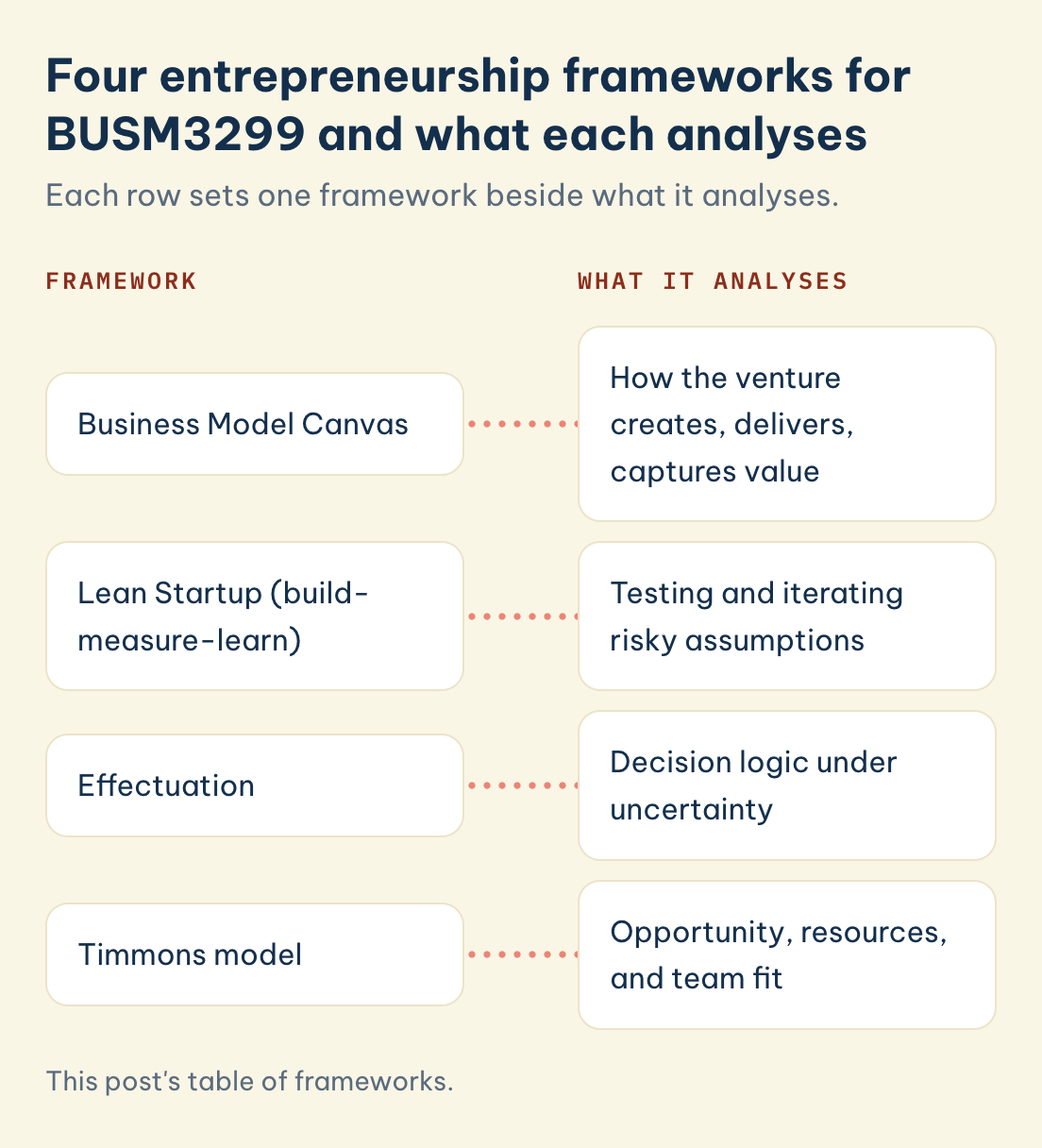
Direct answer: Anchor your analysis in two or three established frameworks rather than name-dropping many. The most useful for BUSM3299 are: Osterwalder's Business Model Canvas (to map how the venture creates, delivers, and captures value), Ries's Lean Startup build-measure-learn loop (to show validation and iteration), Sarasvathy's effectuation logic (to reason about decisions under uncertainty), and the Timmons model (to weigh opportunity, resources, and team). Pick frameworks that fit your venture's actual stage, do not force all of them in.
Four entrepreneurship frameworks for BUSM3299 and what each analyses
Each row sets one framework beside what it analyses.
Framework
What it analyses
Business Model Canvas
How the venture creates, delivers, captures value
Lean Startup (build-measure-learn)
Testing and iterating risky assumptions
Effectuation
Decision logic under uncertainty
Timmons model
Opportunity, resources, and team fit
Save this figure
| Framework | What it analyses | Best fit in your report |
|---|---|---|
| Business Model Canvas | How the venture creates, delivers, captures value | Mapping the whole model on one page |
| Lean Startup (build-measure-learn) | Testing and iterating risky assumptions | Showing customer validation and pivots |
| Effectuation | Decision logic under uncertainty | Justifying founder choices with limited data |
| Timmons model | Opportunity, resources, and team fit | Assessing overall venture feasibility |
Evidence: Osterwalder and Pigneur (2010) formalised the canvas, set out in Business Model Generation, now standard in entrepreneurship teaching; Ries (2011) popularised validated learning in The Lean Startup; Sarasvathy (2001) introduced effectuation as the reasoning of expert entrepreneurs, drawing the line between the two logics directly: "Causation rests on a logic of prediction, effectuation on the logic of control" (Sarasvathy, 2001, p. 243). These are foundational, examiner-recognised sources, not blog-level references.
Example: A Vietnamese RMIT student analysing an eco-packaging venture tried to apply five frameworks and explained each shallowly. Her MAAS mentor cut it to two, the Business Model Canvas to map value creation, and the Lean Startup loop to show how she tested willingness to pay. Fewer frameworks, deeper application, higher mark.
◆ Question 5 / 7 · Report structure
How should you structure the BUSM3299 report?
Direct answer: Use an evidence-led structure: (1) a brief introduction to the opportunity and the problem it solves (keep it under 10% of the word count), (2) market and customer analysis, (3) the business model mapped through your chosen framework, (4) a feasibility assessment with risks and assumptions tested, (5) a conclusion or recommendation. The single biggest structural fix is shrinking the idea-description sections and expanding the validation and feasibility sections, where the marks concentrate.
Evidence: Criterion-referenced rubrics weight "opportunity evaluation" and "feasibility and analysis" far above "idea and background". Structuring your word budget to match the rubric weighting is the most reliable way to lift a grade without changing your venture.
Example: A Vietnamese student at RMIT submitted a draft with a 700-word origin story for her idea and a 200-word feasibility section. Her MAAS mentor inverted the ratio. The final report, same venture, same sources, moved from a borderline Credit to a Distinction because the feasibility analysis was finally developed enough to be assessed.
◆ Question 6 / 7 · Common mistakes
What are the most common mistakes that lose marks in BUSM3299?
Direct answer: Three recurring mistakes show up across MAAS entrepreneurship coaching. First, students advocate instead of evaluate; they sell the idea rather than test it, so weaknesses are hidden instead of analysed. Second, students apply frameworks as decoration rather than tools; they draw a Business Model Canvas but never use it to reach a judgement. Third, feasibility claims are generic ("there is a big market for this") rather than specific, sourced, and tied to real customer evidence. Fixing these three lifts most drafts by at least one rubric band.
Evidence: Across MAAS entrepreneurship coaching, marker feedback before intervention clusters heavily on "needs more critical evaluation" and "claims not supported by evidence", the two phrases that most often separate a Credit from a Distinction in RMIT business rubrics.
Example: A Vietnamese student's feasibility claim read "young Vietnamese consumers love this kind of product." His MAAS mentor pushed him to specify: which segment (urban students aged 18–24), what evidence (a small survey plus two interviews), and what it implied (a narrower but reachable beachhead market). The specific, evidenced version earned full marks on the feasibility criterion.
◆ Question 7 / 7 · Length and referencing
How long is the BUSM3299 assignment and what referencing style does it use?
Direct answer: Confirm the exact word count and style in your assessment brief, entrepreneurship reports at this level commonly sit between 1,500 and 3,000 words and use Harvard referencing, which is RMIT's default business style. Stay within the 10% tolerance band, cite every framework and market claim, and make sure your reference list and in-text citations match exactly. Reference accuracy is a quick, reliable source of marks that many students leave on the table.
Evidence: RMIT's Business school uses RMIT Harvard as its standard referencing style, documented in RMIT's Easy Cite referencing tool. Markers routinely deduct marks for inconsistent or incomplete Harvard referencing even when the venture analysis is strong.
Example: A Vietnamese RMIT student lost several marks across two assignments for mismatched in-text citations and reference-list entries. A MAAS pre-submission audit caught 12 referencing errors in an hour. On her next BUSM3299 task, clean Harvard referencing recovered the marks she had previously been losing on a criterion that requires no extra research at all.
Frequently asked questions
Is BUSM3299 a hard course?
It is conceptually demanding rather than technically hard; there is no maths, but the course expects honest, evidence-based evaluation instead of idea advocacy. Students who treat it as "pitch my idea" struggle; students who treat it as "test whether this opportunity is real" do well.
Do I need a completely original startup idea to score well?
No. Markers reward the quality of your evaluation, not the novelty of the idea. A familiar concept analysed rigorously beats a flashy idea defended with assumptions.
How many frameworks should I use in the assignment?
Two or three, applied deeply, beats five applied shallowly. Examiners reward using a framework to reach a judgement, not the number of models you can name.
How do I show validation if I cannot build a real product?
You do not need a finished product. A small customer survey, two or three interviews, competitor analysis, or a simple landing-page test are all valid evidence of demand at this level.
What referencing style does BUSM3299 use?
RMIT Harvard is the default for business courses. Always confirm in your own brief, and use RMIT's Easy Cite tool to format entries consistently.
Can MAAS help me with BUSM3299?
Yes. MAAS Assignment & Essay Support coaches you through the assignment with the Outline, Draft, Final model, opportunity framing, framework selection, draft feedback, and a pre-submission referencing audit, all with discipline-matched experts. We coach your work; we do not write it for you.
Ready to approach BUSM3299 with a clear strategy?
If you have the idea but not the evidence, that is exactly where a discipline-matched expert helps most. MAAS Assignment & Essay Support is an academic support partner; we work alongside you through Outline, Draft, Final so the venture analysis stays yours and the structure earns the marks.
Bring your BUSM3299 brief and we will match you to an Entrepreneurship and Innovation mentor, 23% of our 100+ experts hold a PhD, within 48 hours when our network already covers that field. If it does not, MAAS opens a dedicated recruitment round for your case, which usually takes about two weeks.
Book a free 20-minute BUSM3299 consultation with MAAS Assignment & Essay Support →
Related guides
- How do you approach the BUSM4187 International HRM assignment?: sibling RMIT business course guide on managing people globally
- How do you approach the BUSM2617 Managing People for the Future assignment?: sibling RMIT business course guide on people, skills, and change
- How do you approach the BUSM3312 Managing Change assignment?: sibling RMIT business course guide on leading and analysing change
- How do you approach the BUSM2412 Marketing for Managers assignment?: sibling RMIT business course guide on turning analysis into marketing decisions
- How do you approach the BUSM4164 Business Consulting assignment?: sibling RMIT business course guide on diagnosing a client problem and recommending a fix
- How to write a methodology in an essay: for the analytical-rigour half of any business report
- How to write a theoretical framework: for applying entrepreneurship frameworks with academic depth
- MAAS Academic Mentoring service: 1:1 coaching with PhD-level mentors in your discipline
- Course-code assignment coaching: pillar guide on tackling any unit assignment with a MAAS mentor
References
- Osterwalder, A., & Pigneur, Y. (2010). Business model generation. John Wiley & Sons.
- Ries, E. (2011). The lean startup. Crown Business.
- Sarasvathy, S. D. (2001). Causation and effectuation: Toward a theoretical shift from economic inevitability to entrepreneurial contingency. Academy of Management Review, 26(2), 243–263.
- Shane, S., & Venkataraman, S. (2000). The promise of entrepreneurship as a field of research. Academy of Management Review, 25(1), 217–226.
Tools & resources
- RMIT University. (n.d.). Assessment and exams. Retrieved June 8, 2026, from https://www.rmit.edu.au/students/student-essentials/assessment-and-exams
- RMIT University. (n.d.). Easy Cite referencing tool. Retrieved June 8, 2026, from https://www.rmit.edu.au/library/study/referencing
This article is part of the MAAS Journal series for Vietnamese international students. MAAS Assignment & Essay Support is an academic support partner; we coach students through the Outline, Draft, Final delivery model with developmental feedback from discipline-matched experts. We do not write or submit work on a student's behalf.
A free 20-minute consultation is a conversation about where you are with BUSM3299.
Book a free consultation ▸