
◆ Accounting & Finance
BAFI3182 Financial Markets assignment: how do you approach the analysis?
BAFI3182 Financial Markets rewards analysis of how markets price risk and channel capital, not a recap of what the financial news reported this week. Most students who lose marks treat the assignment as a current-affairs summary; they describe a rate move or a market sell-off, but never analyse why it happened or what it means for an investor. This guide answers the seven questions Vietnamese students at RMIT ask MAAS mentors most often before they start BAFI3182.

◆ Question 1 / 7 · The course
What is BAFI3182 Financial Markets about?
Direct answer: BAFI3182 (also taught as Financial Markets and Institutions) is an RMIT finance course on how the financial system works: money and capital markets, interest rates, bonds, equities, foreign exchange, derivatives, and the institutions and regulators that hold it together. The course wants you to explain how prices and risk flow through the system, then apply that to real markets.
Evidence: The course sits in RMIT's finance stream and builds on the standard money-and-markets curriculum set out in widely used texts such as Mishkin (2019). That framing, financial system, institutions, instruments, and the price of money, is the backbone the assessments draw on.
Example: A Vietnamese student at RMIT opened her BAFI3182 report with two pages narrating a week of headlines about the Reserve Bank of Australia. Her MAAS mentor reframed the brief: the assignment is not about what the RBA did, it is about why the rate decision moved bond yields and what that implied for the instrument she was analysing. Once she centred the analysis on cause and effect, the draft moved from a descriptive Pass to a Distinction.
The RBA's own account of how a rate decision flows through the market makes the same point: "The size of the effects will depend on factors such as whether financial markets expected the change and where they expect interest rates will be in future." (Atkin & La Cava, 2017, p. 2)
◆ Question 2 / 7 · The assignment
What does the BAFI3182 assignment usually ask for?
Direct answer: A typical BAFI3182 assessment asks you to analyse a financial market, instrument, or institution, for example, valuing a bond or equity, explaining how a central-bank decision transmits through the yield curve, or evaluating a market event using finance theory. "Analyse" and "evaluate" are the operative words: you must apply concepts and reach a judgement, not narrate the timeline. Always confirm the exact task, word count, and weighting in your own Canvas shell, because the brief changes by semester.
Evidence: RMIT assessments are criterion-referenced, marks are awarded against published rubric criteria, not ranked against classmates. This is stated in RMIT's Assessment policy, which is why a market-analysis task rewards correct application of theory and clear reasoning far more than the volume of market background you include.
Example: A Vietnamese RMIT student chose a corporate bond as his case. His first draft was a 900-word history of the issuer. His MAAS mentor cut it to 200 words of context and redirected the rest to calculating the bond's price and yield and explaining how an interest-rate change would move both, the part the rubric actually assesses.
◆ Question 3 / 7 · The rubric
How is BAFI3182 graded, what does the rubric reward?
Direct answer: The rubric rewards four things, roughly in order: (1) correct application of finance concepts and calculations, (2) depth of analysis and interpretation of the result, (3) use of evidence and data to support the argument, and (4) academic writing and Harvard referencing. Getting the number is necessary but not sufficient, the marks concentrate on what the number means and why it matters for an investor or institution.
Evidence: RMIT business and finance rubrics use criterion bands (Pass / Credit / Distinction / High Distinction). The jump from Credit to Distinction is almost always defined by interpretation, explaining the implication of a calculation or a market move, rather than by adding more description or more arithmetic.
Example: A MAAS mentor reviewed one Vietnamese student's draft and found a correct bond-valuation table with no sentence explaining it. The numbers were right; the analysis was missing. After the student added two paragraphs interpreting the yield and its sensitivity to rates, the same calculation lifted the mark two full bands.
◆ Question 4 / 7 · Concepts
Which concepts and frameworks should you use in BAFI3182?
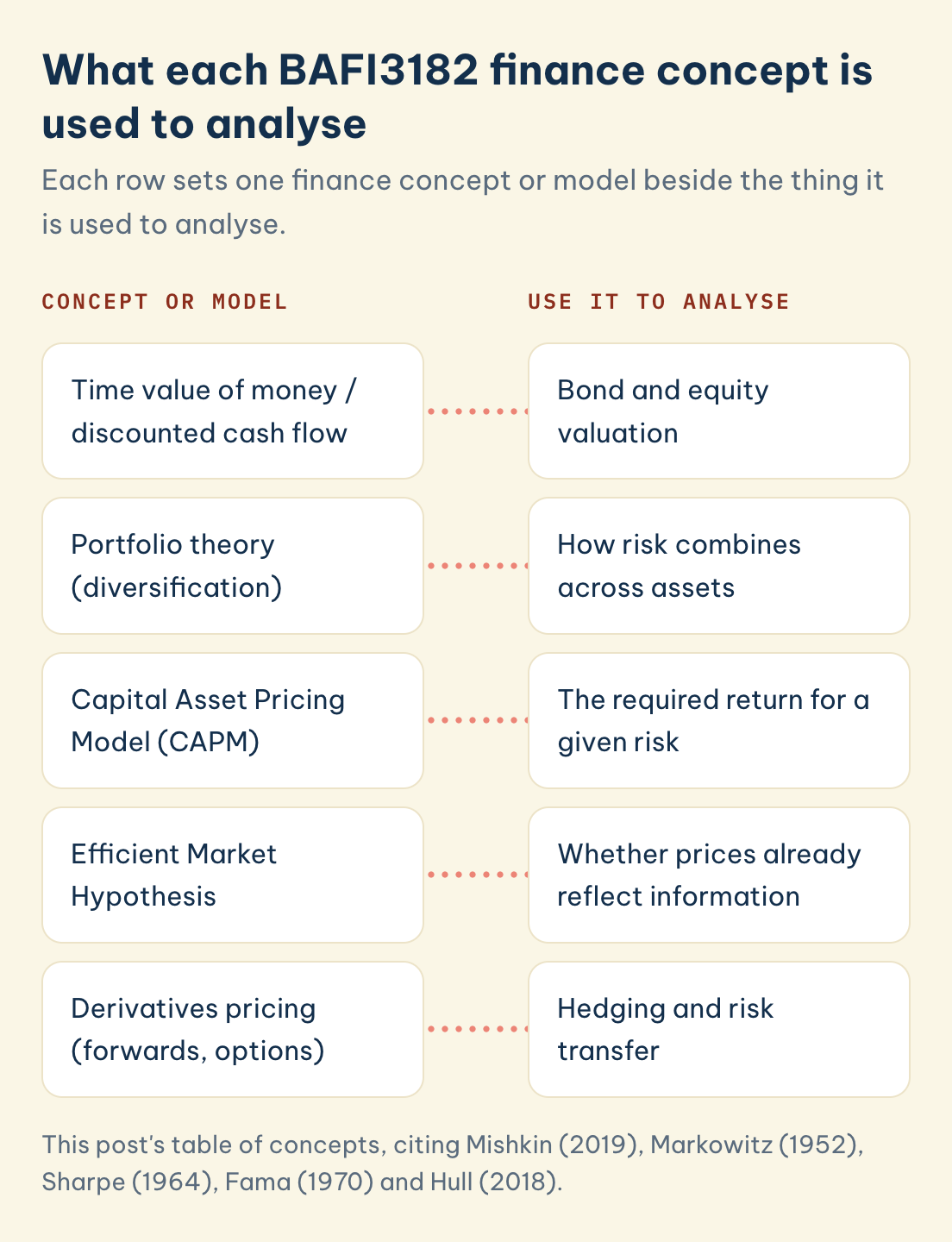
Direct answer: Use the core finance concepts that fit your task, applied correctly, rather than listing every model you have met. For most BAFI3182 assessments the workhorses are time value of money and discounting for valuation, the risk-return relationship for any asset, and a market-efficiency lens for interpreting price behaviour.
What each BAFI3182 finance concept is used to analyse
Each row sets one finance concept or model beside the thing it is used to analyse.
Concept or model
Use it to analyse
Time value of money / discounted cash flow
Bond and equity valuation
Portfolio theory (diversification)
How risk combines across assets
Capital Asset Pricing Model (CAPM)
The required return for a given risk
Efficient Market Hypothesis
Whether prices already reflect information
Derivatives pricing (forwards, options)
Hedging and risk transfer
Save this figure
| Concept / model | Use it to analyse | Author / source |
|---|---|---|
| Time value of money / discounted cash flow | Bond and equity valuation | Mishkin (2019) |
| Portfolio theory (diversification) | How risk combines across assets | Markowitz (1952) |
| Capital Asset Pricing Model (CAPM) | The required return for a given risk | Sharpe (1964) |
| Efficient Market Hypothesis | Whether prices already reflect information | Fama (1970) |
| Derivatives pricing (forwards, options) | Hedging and risk transfer | Hull (2018) |
Evidence: Portfolio theory (Markowitz, 1952) and CAPM (Sharpe, 1964) remain the two most examiner-recognised frameworks for linking risk and return, while the Efficient Market Hypothesis (Fama, 1970) gives you the standard lens for judging whether a price move was predictable, the combination markers expect in a markets analysis. These three ideas also anchor the standard investments curriculum taught across university finance courses (Bodie et al., 2021), which is why examiners expect to see them applied correctly rather than merely named.
Example: A Vietnamese student analysing an equity used CAPM to estimate the required return and the efficient-market lens to argue that the stock's reaction to an earnings surprise was consistent with a semi-strong market. Two concepts, applied correctly, clear Distinction.
◆ Question 5 / 7 · Report structure
How should you structure the BAFI3182 analysis report?
Direct answer: Use an analysis-led structure: (1) short introduction and context (under 10% of the word count), (2) the relevant theory or method, (3) the analysis itself, calculations, data, and interpretation, (4) implications for the investor or institution, (5) conclusion. The biggest structural fix is shrinking the market background and expanding the interpretation, where the marks concentrate.
Evidence: Criterion-referenced rubrics weight "analysis" and "interpretation" far above "context". Matching your word budget to the rubric weighting is the most reliable way to lift a grade without new research.
Example: A Vietnamese RMIT student submitted a draft with a 700-word market overview and a 150-word interpretation section. His MAAS mentor inverted the ratio; the final report, same data, same calculations, moved from a borderline Credit to a Distinction because the implications were finally developed enough to assess.
◆ Question 6 / 7 · Common mistakes
What mistakes most often lose marks in BAFI3182?
Direct answer: Three recurring mistakes show up across MAAS coaching. First, students write market commentary instead of financial analysis, the headlines crowd out the theory. Second, they present a calculation without interpreting it, leaving the marker to guess what it means. Third, data and sources are vague, a claim about yields or volatility with no figure and no citation. Fixing these three lifts most drafts by at least one rubric band.
Evidence: Across MAAS coaching on RMIT finance assessments, marker feedback before intervention clusters on "needs deeper analysis" and "interpretation not developed", the two phrases that most often separate a Credit from a Distinction.
Example: A Vietnamese student's recommendation read "the investor should be cautious". His MAAS mentor pushed him to specify the risk (duration risk on a long-dated bond), the evidence (the bond's sensitivity to a 1% rate rise), and the action (shorten duration or hedge). The specific version earned full marks on the analysis criterion.
◆ Question 7 / 7 · Length and referencing
How long is the BAFI3182 assignment and what referencing style does it use?
Direct answer: Confirm the exact word count in your brief, BAFI3182 reports commonly sit between 2,000 and 2,500 words and use RMIT Harvard referencing, the default for RMIT business and finance courses. Stay within the 10% tolerance band, cite every model, data point, and market claim, and make sure in-text citations and the reference list match exactly. Clean referencing is a quick, reliable source of marks many students leave on the table.
Evidence: RMIT's business school uses RMIT Harvard, documented in RMIT's Easy Cite tool. Markers routinely deduct marks for inconsistent Harvard referencing and for data presented without a source, even when the finance is correct.
Example: A Vietnamese RMIT student lost several marks across two assignments for uncited data and mismatched citations. A MAAS pre-submission audit caught the gaps in an hour; on her next BAFI3182 task, sourced data and clean referencing recovered the marks she had been losing on criteria that need no extra analysis.
Frequently asked questions
Is BAFI3182 the same as Financial Markets and Institutions?
They are closely related labels for the same finance course at RMIT, covering the financial system, instruments, and institutions. The assessment approach is the same, confirm your exact brief in Canvas.
Do I need strong maths for BAFI3182?
You need to be comfortable with discounting, yields, and basic statistics, but the marks reward interpretation more than heavy calculation. Get the method right, then explain what the result means.
How many frameworks should I use?
Two or three core concepts, applied correctly, beats listing every model. Pair a valuation method with a risk-return or market-efficiency lens that fits your case.
What referencing style does BAFI3182 use?
RMIT Harvard is the default. Confirm in your brief and use RMIT's Easy Cite tool to keep entries consistent, and cite every data point.
Can MAAS help me with BAFI3182?
Yes. MAAS Assignment & Essay Support coaches you through the assignment with the Outline, Draft, Final model, concept selection, draft feedback, and a referencing audit, with PhD-level mentors. We coach your work; we do not write it for you.
Ready to approach BAFI3182 with a clear strategy?
If you can run the calculation but your draft still reads like market news, that is exactly where a discipline-matched expert helps most. MAAS Assignment & Essay Support is an academic support partner; we work alongside you through Outline, Draft, Final so the analysis stays yours and the interpretation earns the marks.
Bring your BAFI3182 brief and we will match you to a finance mentor, 23% of our 100+ experts hold a PhD, within 48 hours when our network already covers that field. If it does not, MAAS opens a dedicated recruitment round for your case, which usually takes about two weeks.
Book a free 20-minute BAFI3182 consultation with MAAS Assignment & Essay Support →
Related guides
- BAFI3230 Corporate Finance assignment: how do you approach it?: sibling RMIT finance guide on investment, financing, and valuation decisions
- How do you approach the ECON1269 Business in the Globalised Economy assignment?: sibling RMIT economics guide on analysing markets and global economic forces
- How do you approach the BUSM4164 Business Consulting assignment?: sibling RMIT business guide on evidence-based analysis and recommendations
- How do you approach the BUSM2617 Managing People for the Future assignment?: sibling RMIT business course guide on critical analysis over description
- How do you approach the BUSM4187 International HRM assignment?: sibling RMIT business guide on analysis versus narration
- How to write a methodology in an essay: for the analytical-rigour half of any finance report
- MAAS Academic Mentoring service: 1:1 coaching with PhD-level mentors in your discipline
- Course-code assignment coaching: pillar guide on tackling any unit assignment with a MAAS mentor
References
- Atkin, T., & La Cava, G. (2017, September 15). The transmission of monetary policy: How does it work? Reserve Bank of Australia. https://www.rba.gov.au/publications/bulletin/2017/sep/1.html
- Bodie, Z., Kane, A., & Marcus, A. J. (2021). Investments (12th ed.). McGraw-Hill Education.
- Fama, E. F. (1970). Efficient capital markets: A review of theory and empirical work. The Journal of Finance, 25(2), 383–417. https://doi.org/10.2307/2325486
- Hull, J. C. (2018). Options, futures, and other derivatives (10th ed.). Pearson.
- Markowitz, H. (1952). Portfolio selection. The Journal of Finance, 7(1), 77–91. https://doi.org/10.1111/j.1540-6261.1952.tb01525.x
- Mishkin, F. S. (2019). The economics of money, banking, and financial markets (12th ed.). Pearson.
- Sharpe, W. F. (1964). Capital asset prices: A theory of market equilibrium under conditions of risk. The Journal of Finance, 19(3), 425–442. https://doi.org/10.1111/j.1540-6261.1964.tb02865.x
Tools & resources
- RMIT University. (n.d.). Assessment and exams. Retrieved June 15, 2026, from https://www.rmit.edu.au/students/student-essentials/assessment-and-exams
- RMIT University. (n.d.). Easy Cite referencing tool. Retrieved June 15, 2026, from https://www.rmit.edu.au/library/study/referencing
- Reserve Bank of Australia. (n.d.). Education. Retrieved June 15, 2026, from https://www.rba.gov.au/education/
This article is part of the MAAS Journal series for Vietnamese international students. MAAS Assignment & Essay Support is an academic support partner; we coach students through the Outline, Draft, Final delivery model with developmental feedback from discipline-matched experts. We do not write or submit work on a student's behalf.
A free 20-minute consultation is a conversation about where you are with BAFI3182.
Book a free consultation ▸