
◆ Marketing
MKT3020 Omnichannel Marketing assignment: how do you approach it?
MKT3020 Omnichannel Marketing rewards an integrated customer-experience strategy across channels, not a list of the channels a brand happens to use. Most students who lose marks describe a company's website, app, and stores in turn but never analyse how the channels work together as one experience, which is the whole point of "omnichannel". This guide answers the seven questions Vietnamese students at RMIT ask MAAS mentors most often before they start MKT3020.

◆ Question 1 / 7 · The course
What is MKT3020 Omnichannel Marketing about?
Direct answer: MKT3020 is an RMIT marketing course on designing a seamless customer experience across every channel a brand uses, stores, website, app, social media, and email, so they behave as one connected system rather than separate silos. The course wants you to analyse how customers move between channels and recommend an integrated strategy that is frictionless, not just channel description.
Evidence: The course sits in RMIT's marketing stream and draws on the omnichannel literature that distinguishes "multichannel" (separate channels) from "omnichannel" (integrated channels managed as one experience), as set out by Verhoef, Kannan, and Inman (2015). Rigby (2011) first popularised the term for a broader business audience, and Brynjolfsson, Hu, and Rahman (2013) set out what integrating channels actually costs and returns for a retailer. That distinction, integration, not just presence, is the backbone the assessments are built on.
Example: A Vietnamese student at RMIT opened her MKT3020 report by describing a retailer's app, then its stores, then its website, as three separate sections. Her MAAS mentor reframed the brief: the assignment is not about what channels the brand has, it is about how a customer's journey flows across them and where the experience breaks. Once she centred the analysis on the connected journey, the draft moved from a descriptive Pass to a Distinction.
◆ Question 2 / 7 · The assignment
What does the MKT3020 assignment usually ask for?
Direct answer: A typical MKT3020 assessment asks you to analyse a real brand's omnichannel customer experience and recommend an integrated strategy, mapping the customer journey across touchpoints, diagnosing where channels fail to connect, and proposing how to close the gaps. "Analyse" and "recommend" are the operative words: you apply omnichannel concepts to a real case and reach actionable conclusions, not narrate each channel. Always confirm the exact task, word count, and weighting in your own Canvas shell, because the brief changes by semester.
Evidence: RMIT assessments are criterion-referenced, marks are awarded against published rubric criteria, not ranked against classmates. This is stated in RMIT's Assessment policy, which is why an omnichannel task rewards integrated analysis and justified recommendations far more than the volume of channel background you include.
Example: A Vietnamese RMIT student chose a well-known fashion retailer as his case. His first draft spent 800 words listing every channel the brand operated. His MAAS mentor cut it to 200 words of context and redirected the rest to a customer-journey map that showed where the in-store and online experiences contradicted each other, the part the rubric actually assesses.
◆ Question 3 / 7 · Rubric
How is MKT3020 graded, what does the rubric reward?
Direct answer: The rubric rewards four things, roughly in order: (1) depth of analysis of the omnichannel customer experience and journey, (2) correct and explicit use of omnichannel and customer-experience frameworks, (3) practical, justified recommendations that integrate channels, and (4) academic writing and Harvard referencing. Describing channels earns almost no marks on its own, the marks concentrate on how the channels connect and what the brand should do to make the experience seamless.
Evidence: RMIT marketing rubrics use criterion bands (Pass / Credit / Distinction / High Distinction). The jump from Credit to Distinction is almost always defined by integration and judgement, analysing the journey as one connected experience and justifying recommendations, rather than by adding more channel description.
Example: A MAAS mentor reviewed one Vietnamese student's draft and found a thorough channel inventory with no journey analysis. The detail was there; the integration was missing. After the student added a journey map and two paragraphs on where channels failed to hand off to each other, the same case lifted the mark two full bands.
◆ Question 4 / 7 · Frameworks
Which frameworks should you use in MKT3020?
Direct answer: Anchor your analysis in three or four established frameworks rather than name-dropping many, and make sure each one feeds the next. For most MKT3020 assessments the workhorses are customer journey mapping to trace the experience across touchpoints, the customer-experience lens to judge quality at each stage, STP to keep recommendations targeted, and an omnichannel-integration view to diagnose where channels fail to connect. Pick the tools that fit your brand's actual situation rather than forcing all of them in.
| Framework | Use it to analyse | Author / source |
|---|---|---|
| Customer journey mapping | How a customer moves across touchpoints over time | Lemon & Verhoef (2016) |
| Customer experience (CX) lens | The quality of experience at each stage and channel | Lemon & Verhoef (2016) |
| Multichannel vs omnichannel integration | Whether channels are siloed or managed as one system | Verhoef, Kannan & Inman (2015) |
| STP (segmentation, targeting, positioning) | Which customers the experience should serve and how | Kotler & Armstrong (2021) |
| Channel-management challenges | Where data, attribution, and consistency break down | Neslin et al. (2006) |
Evidence: Customer journey mapping and the customer-experience lens (Lemon & Verhoef, 2016) are the two most examiner-recognised tools for analysing experience across channels, while the multichannel-to-omnichannel distinction (Verhoef, Kannan, & Inman, 2015) gives you the standard frame for judging whether a brand is truly integrated, the combination markers expect in an omnichannel analysis. Neslin and colleagues, the source behind the channel-management-challenges row above, set out the discipline this way: "We define multichannel customer management as the design, deployment, coordination, and evaluation of channels to enhance customer value through effective customer acquisition, retention, and development" (Neslin et al., 2006, p. 96). That is why the table rewards diagnosing data, attribution and consistency gaps, not describing which channels the brand happens to use.
Example: A Vietnamese student analysing a supermarket chain used journey mapping to trace a "research online, buy in store" path and the integration view to argue that the app and the loyalty card held disconnected data. Two frameworks, applied to one real journey, cleared Distinction.
◆ Question 5 / 7 · Report structure
How should you structure the MKT3020 omnichannel report?
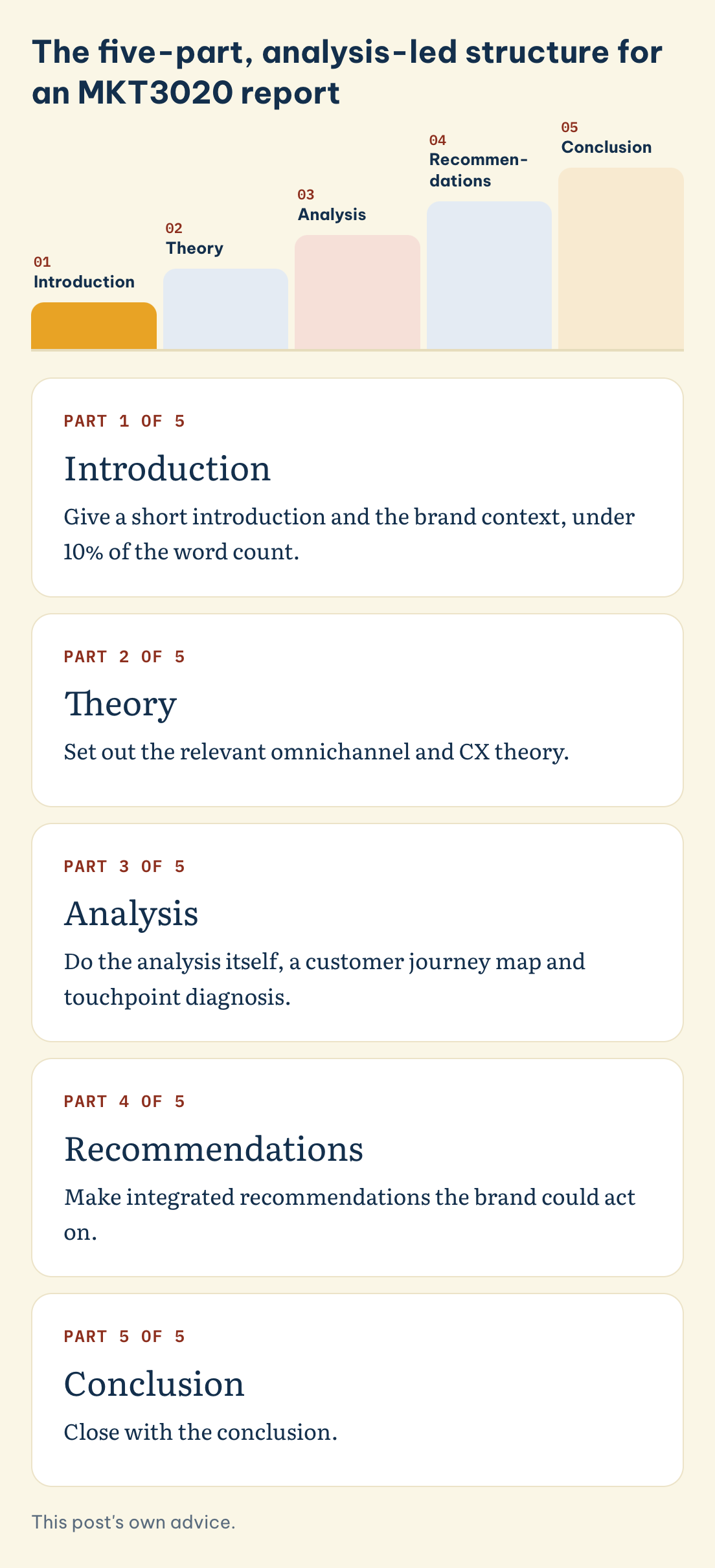
Direct answer: Use an analysis-led structure: (1) short introduction and brand context (under 10% of the word count), (2) the relevant omnichannel and CX theory, (3) the analysis itself, a customer journey map and touchpoint diagnosis, (4) integrated recommendations the brand could act on, (5) conclusion. The biggest structural fix is shrinking the channel description and expanding the journey analysis and recommendations, where the marks concentrate.
The five-part, analysis-led structure for an MKT3020 report
Select a part to read what it asks for. The post advises this analysis-led structure for the report. The bar heights and colours only mark the order and carry no weight.
Part 1 of 5
Introduction
Give a short introduction and the brand context, under 10% of the word count.
Part 2 of 5
Theory
Set out the relevant omnichannel and CX theory.
Part 3 of 5
Analysis
Do the analysis itself, a customer journey map and touchpoint diagnosis.
Part 4 of 5
Recommendations
Make integrated recommendations the brand could act on.
Part 5 of 5
Conclusion
Close with the conclusion.
Save this figure
Evidence: Criterion-referenced rubrics weight "analysis" and "recommendations" far above "context". Matching your word budget to the rubric weighting is the most reliable way to lift a grade without new research.
Example: A Vietnamese RMIT student submitted a draft with a 700-word brand overview and a 150-word recommendations section. His MAAS mentor inverted the ratio; the final report, same brand, same journey map, moved from a borderline Credit to a Distinction because the integrated recommendations were finally developed enough to assess.
◆ Question 6 / 7 · Common mistakes
What mistakes most often lose marks in MKT3020?
Direct answer: Three recurring mistakes show up across MAAS marketing coaching. First, students describe channels instead of analysing the connected journey, the inventory crowds out the integration. Second, they present a journey map without interpreting it, leaving the marker to guess what the friction means. Third, recommendations are generic ("the brand should improve its app") rather than specific, segment-targeted, and tied to a diagnosed gap. Fixing these three lifts most drafts by at least one rubric band.
Evidence: Across MAAS marketing coaching on RMIT assessments, marker feedback before intervention clusters on "needs deeper analysis" and "recommendations not sufficiently integrated", the two phrases that most often separate a Credit from a Distinction.
Example: A Vietnamese student's recommendation read "the brand should improve its omnichannel experience". His MAAS mentor pushed him to specify the gap (loyalty points earned online were invisible in store), the segment (app-first young shoppers), and the action (a single unified customer profile across channels). The specific version earned full marks on the recommendations criterion.
◆ Question 7 / 7 · Length and referencing
How long is the MKT3020 assignment and what referencing style does it use?
Direct answer: Confirm the exact word count in your brief, MKT3020 reports commonly sit between 1,500 and 2,500 words and use RMIT Harvard referencing, the default for RMIT business and marketing courses. Stay within the 10% tolerance band, cite every framework, market claim, and data point, and make sure in-text citations and the reference list match exactly. Clean referencing is a quick, reliable source of marks many students leave on the table.
Evidence: RMIT's business school uses RMIT Harvard, documented in RMIT's Easy Cite tool. Markers routinely deduct marks for inconsistent Harvard referencing and for claims presented without a source, even when the marketing analysis is strong.
Example: A Vietnamese RMIT student lost several marks across two assignments for uncited claims and mismatched citations. A MAAS pre-submission audit caught the gaps in an hour; on her next MKT3020 task, sourced claims and clean referencing recovered the marks she had been losing on criteria that need no extra analysis.
Frequently asked questions
What is the difference between multichannel and omnichannel marketing?
Multichannel means a brand uses several channels that operate separately; omnichannel means those channels are integrated and managed as one connected experience. MKT3020 marks reward the integration, so always frame your analysis around how channels work together, not just that they exist.
Do I need a real brand for the MKT3020 assignment?
Usually yes, pick a brand with enough public information about its online and offline presence to map a real customer journey. Large retailers and well-documented service brands work well because you can trace an actual cross-channel path.
How many frameworks should I use?
Two or three core tools, applied to one real journey, beats listing every model. Pair customer journey mapping with an integration or CX lens that fits your case.
What referencing style does MKT3020 use?
RMIT Harvard is the default. Confirm in your brief and use RMIT's Easy Cite tool to keep entries consistent, and cite every framework and data point.
Can MAAS help me with MKT3020?
Yes. MAAS Assignment & Essay Support coaches you through the assignment with the Outline, Draft, Final model, framework selection, journey-map feedback, and a referencing audit, with PhD-level mentors. We coach your work; we do not write it for you.
Ready to approach MKT3020 with a clear strategy?
If you can list the channels but your draft still reads like an inventory instead of an integrated journey, that is exactly where a discipline-matched expert helps most. MAAS Assignment & Essay Support is an academic support partner; we work alongside you through Outline, Draft, Final so the analysis stays yours and the integrated recommendations earn the marks.
Bring your MKT3020 brief and we will match you to a marketing mentor, 23% of our 100+ experts hold a PhD, within 48 hours when our network already covers that field. If it does not, MAAS opens a dedicated recruitment round for your case, which usually takes about two weeks.
Book a free 20-minute MKT3020 consultation with MAAS Assignment & Essay Support →
Related guides
- MKTG1294 Introduction to Advertising assignment: how do you analyse a campaign?: sibling RMIT marketing guide on analysing one advertising campaign against theory
- How do you approach the BUSM2412 Marketing for Managers assignment?: sibling RMIT marketing guide on turning analysis into justified recommendations
- How do you approach the MKTG1419 Social Media and Mobile Marketing assignment?: sibling RMIT marketing guide on building a measurable digital campaign
- How do you approach Marketing Insights at Monash (MKF2801)?: sibling marketing guide on turning market data into a decision-ready insight
- BUSM2519 assignment: how do you approach Leading in the Age of Digital Disruption?: sibling RMIT guide on responding to digital change
- MAAS Academic Mentoring service: 1:1 coaching with PhD-level mentors in your discipline
- Course-code assignment coaching: pillar guide on tackling any unit assignment with a MAAS mentor
References
- Brynjolfsson, E., Hu, Y. J., & Rahman, M. S. (2013). Competing in the age of omnichannel retailing. MIT Sloan Management Review, 54(4), 23–29.
- Kotler, P., & Armstrong, G. (2021). Principles of marketing. Pearson.
- Lemon, K. N., & Verhoef, P. C. (2016). Understanding customer experience throughout the customer journey. Journal of Marketing, 80(6), 69–96. https://doi.org/10.1509/jm.15.0420
- Neslin, S. A., Grewal, D., Leghorn, R., Shankar, V., Teerling, M. L., Thomas, J. S., & Verhoef, P. C. (2006). Challenges and opportunities in multichannel customer management. Journal of Service Research, 9(2), 95–112. https://doi.org/10.1177/1094670506293559
- Rigby, D. (2011). The future of shopping. Harvard Business Review, 89(12), 65–76.
- Verhoef, P. C., Kannan, P. K., & Inman, J. J. (2015). From multi-channel retailing to omni-channel retailing. Journal of Retailing, 91(2), 174–181. https://doi.org/10.1016/j.jretai.2015.02.005
Tools & resources
- RMIT University. (n.d.). Easy Cite referencing tool. Retrieved June 19, 2026, from https://www.rmit.edu.au/library/study/referencing
- RMIT University. (n.d.). Assessment and exams. Retrieved June 19, 2026, from https://www.rmit.edu.au/students/student-essentials/assessment-and-exams
This article is part of the MAAS Journal series for Vietnamese international students. MAAS Assignment & Essay Support is an academic support partner; we coach students through the Outline, Draft, Final delivery model with developmental feedback from discipline-matched experts. We do not write or submit work on a student's behalf.
A free 20-minute consultation is a conversation about where you are with MKT3020.
Book a free consultation ▸