
BUSM4771 Managing Performance in Organisations rewards students who diagnose why performance is falling short before designing a system to manage it, not those who describe the appraisal cycle. Students often explain goal setting, ratings, and feedback accurately, then recommend "implement a performance management system" for a problem that is really about workload or unclear expectations. This guide answers the seven questions Vietnamese students at RMIT ask MAAS mentors most often before they start BUSM4771.
Author: MAAS Editorial Team
Last updated: 2026-07-20
Category: business-management

What is BUSM4771 Managing Performance in Organisations about?
Direct answer: BUSM4771 is an RMIT management course about how organisations define, measure, support, and reward performance. It covers the performance cycle from planning to review, goal setting, performance measurement, feedback, motivation theory, reward systems, and managing underperformance. The course treats performance management as a system with intended and unintended effects.
Evidence: The teaching frame rests on the established literature: Locke and Latham's goal-setting theory for why specific, difficult goals raise performance, Adams' equity theory and the broader organisational-justice research for why perceived fairness drives acceptance of a rating, Deci and Ryan's self-determination theory for the limits of extrinsic reward, and the DeNisi and Murphy review of a century of appraisal research, which concludes the evidence that appraisal alone improves performance is far weaker than practice assumes. Aguinis (2019) frames the wider system these pieces sit inside, planning, monitoring, developing, rating, and rewarding, as one connected cycle rather than an annual event.
Example: A Vietnamese student at RMIT Vietnam arrived at MAAS with a draft recommending quarterly reviews for a team missing targets. Her mentor asked one question first: is this a can't problem or a won't problem, capability, clarity, resourcing, or motivation? The case evidence pointed to conflicting priorities from two managers. Once the diagnosis came before the system design, her mark moved from a Pass-level draft to a Distinction.
What assessment does the BUSM4771 assignment usually involve?
Direct answer: Performance management courses at this level are commonly assessed through an individual report or case analysis of a performance problem in a real or set organisation, often with a group component, a role-play or simulated performance conversation, and sometimes a reflective piece.
You are typically asked to diagnose the causes of the performance gap, apply motivation and performance theory, and design or critique a performance management approach including how it would be evaluated. Always confirm the exact task, word count, and weighting in your own Canvas shell, because assessment structure changes by semester and campus.
Evidence: RMIT business assessments are criterion-referenced, meaning marks are awarded against published rubric criteria rather than ranked against classmates. This is set out in RMIT's Assessment policy, which is why decoding the rubric matters far more than how many models you name.
Example: A Vietnamese RMIT student spent half of a 2,000-word report describing the standard performance management cycle before reaching the case problem. His MAAS mentor cut the textbook section to a short paragraph and reallocated the words to the evidence about why targets were being missed. Same case, same word count, the diagnosis-led version earned a clear Distinction.
How is the BUSM4771 assignment graded, what does the rubric actually reward?
Direct answer: Performance management rubrics at this level reward four things, roughly in this order: (1) a diagnosis grounded in case evidence; you show why performance is short rather than assuming low motivation, (2) correct application of motivation, goal-setting, and justice theory to that specific cause, (3) critical evaluation including unintended consequences, fairness, and manager capability to deliver the system, and (4) a practical design with evaluation measures, plus academic writing and Harvard referencing. Recommending a generic performance management system without a diagnosis is the classic Credit-level submission.
Evidence: RMIT business rubrics use criterion bands (Pass / Credit / Distinction / High Distinction). The jump from Credit to Distinction is almost always defined by the words "critical" and "justified", a justified diagnosis and a critically evaluated design, not by covering more theory.
Example: A MAAS mentor marked one Vietnamese student's draft sentence by sentence, labelling each as "describe", "diagnose", or "evaluate". The draft was 65% describe and its recommendation named no risks at all. After one restructuring pass that tied the design to an evidenced cause and named two ways the new metric could be gamed, the same case moved up two full rubric bands.
Which frameworks should you use in BUSM4771?
Direct answer: Anchor your analysis in two or three frameworks that match the cause you diagnosed, rather than listing the syllabus. A workable spine is: a can't-versus-won't diagnosis to separate capability and clarity problems from motivation problems; goal-setting theory to test whether objectives are specific, difficult, and accepted; organisational justice to check whether the process, the outcome, and the explanation are seen as fair; self-determination theory to weigh intrinsic against extrinsic motivators; and a measurement-distortion lens to ask what behaviour the metric will actually produce. Pick the ones your case evidence can support.
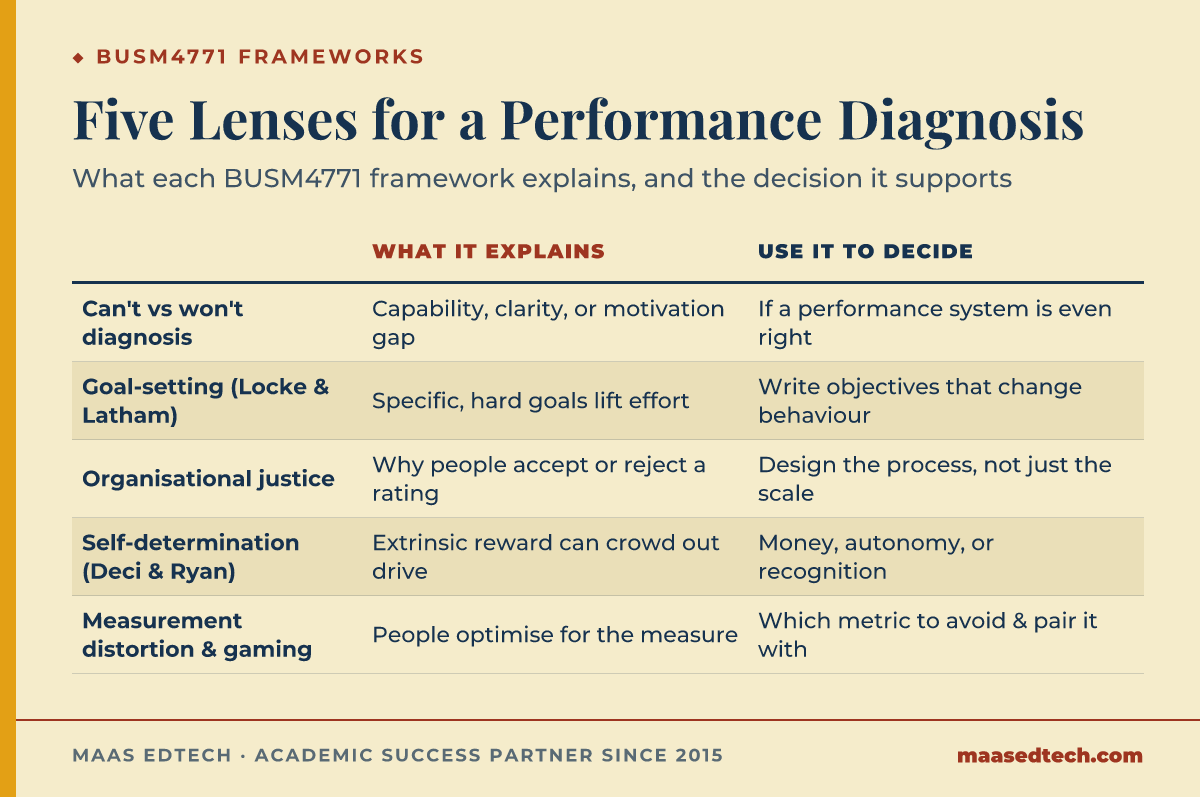
| Framework | What it explains | Use it to decide |
|---|---|---|
| Can't versus won't diagnosis | Whether the gap is capability, clarity, resourcing, or motivation | Whether a performance system is even the right intervention |
| Goal-setting theory (Locke & Latham) | Why specific, difficult, accepted goals lift effort and persistence | How to write objectives that actually change behaviour |
| Organisational justice (distributive, procedural, interactional) | Why employees accept or reject a rating and its consequences | How to design the process and the conversation, not just the scale |
| Self-determination theory (Deci & Ryan) | When extrinsic rewards support motivation and when they crowd it out | Whether to reward with money, autonomy, or recognition |
| Measurement distortion and gaming | How people optimise for the measure rather than the goal | Which metric to avoid, and what to pair it with |
Evidence: These frameworks rest on examiner-recognised, textbook-level foundations: Locke and Latham (2002) for goal setting, Colquitt et al. (2001) for the organisational-justice evidence base, and Deci and Ryan (2000) for self-determination theory, which opens with a direct claim about motivation: "Self-determination theory (SDT) maintains that an understanding of human motivation requires a consideration of innate psychological needs for competence, autonomy, and relatedness" (Deci & Ryan, 2000). DeNisi and Murphy (2017) supply the critical review of whether appraisal improves performance. Citing DeNisi and Murphy against your own proposal and then defending it under stated conditions, is exactly the critical move that earns Distinction-level marks.
Example: A Vietnamese RMIT student analysing a call centre proposed a stricter handling-time target. Her MAAS mentor applied the distortion lens: staff would hit the time by ending calls early, moving the cost to repeat contacts. The revised design paired the efficiency measure with a first-contact-resolution measure and the analysis of the trade-off earned the marks.
How should you structure the BUSM4771 report?
Direct answer: Use a diagnosis-led structure: (1) an introduction stating the performance problem and your position, with organisational context under 10% of the word count, (2) the diagnosis, showing evidence for the cause rather than assuming it, (3) the proposed approach with each element justified by theory, (4) a critical evaluation of fairness, unintended consequences, manager capability, and implementation cost, and (5) how the approach would be evaluated, with measures and a review point. Any table, a diagnosis summary, an objective-setting example, an evaluation plan, must be referred to and interpreted in the text.
Evidence: Criterion-referenced rubrics weight "analysis", "application of theory", and "critical evaluation" far above "description of the performance cycle". Matching your word budget to the rubric weighting is the most reliable way to lift a grade without finding new material.
Example: A Vietnamese RMIT student submitted a report with a full description of a rating scale and a two-line evaluation section. His MAAS mentor inverted the balance, giving the evaluation room to weigh rater bias, manager workload, and the risk that forced ranking would damage the team's collaboration. Same case, same sources, the report moved from a borderline Credit to a Distinction because the trade-offs were finally argued.
What are the most common mistakes that lose marks in BUSM4771?
Direct answer: Three recurring mistakes show up across MAAS management coaching. First, students assume the cause is low motivation and design incentives for what is actually a clarity or resourcing problem. Second, the design ignores fairness and manager capability, a sophisticated system is proposed for supervisors who have had no training in giving feedback, which is where most systems fail in practice.
Third, no unintended consequences are named, so the critical-evaluation criterion cannot be met: every metric changes behaviour, sometimes in the wrong direction. Fixing these three lifts most drafts by at least one rubric band.
Evidence: Across MAAS management coaching, marker feedback before intervention clusters heavily on "needs deeper analysis" and "risks not considered", the two phrases that most often separate a Credit from a Distinction in RMIT management rubrics.
Example: A Vietnamese student recommended individual sales bonuses for a team whose case material described shared accounts and heavy cross-selling. His MAAS mentor asked what an individual bonus does to information sharing in that setting. The revised proposal used a team component with an individual quality gate, and explained the trade-off explicitly, earning full marks on the criterion the bonus-only answer had failed.
How long is the BUSM4771 assignment and what referencing style does it use?
Direct answer: Confirm the exact word count and style in your assessment brief, individual management reports at this level commonly sit between 1,500 and 2,500 words, with tables, appendices, and reference lists often excluded from the count, and use Harvard referencing, which is RMIT's default business style. Stay within the 10% tolerance band, and cite theory from the source or a current edition rather than a website summary, Locke and Latham, Deci and Ryan, and the justice literature are all frequently cited second-hand, and markers notice.
Evidence: RMIT's Business school uses RMIT Harvard as its standard referencing style, documented in RMIT's Easy Cite referencing tool. Markers routinely deduct marks for secondary citations of classic theorists, uncited claims about the organisation, or inconsistent Harvard formatting even when the analysis is strong.
Example: A Vietnamese RMIT student lost several marks because he cited goal-setting theory through a management blog and his in-text citations did not match his reference list. A MAAS pre-submission audit closed the gaps in under an hour, primary sources restored and Harvard entries aligned. On his next BUSM4771 task, clean sourcing recovered marks on a criterion that requires no extra analysis at all.
Frequently asked questions
Is BUSM4771 a hard course?
It is judgement-heavy rather than technically hard. The theory is accessible, but the course marks whether you diagnose before you design and whether you can see a system's side effects. Students who treat it as "describe the appraisal cycle" struggle; students who treat it as "solve a performance problem" do well.
How is BUSM4771 different from BUSM4777 Human Resource Development?
Performance management asks how an organisation sets expectations, measures results, and responds to shortfalls; human resource development asks how it builds capability over time. They overlap when the diagnosis shows a genuine skills gap, that is exactly the point where a performance report hands over to a development intervention.
Can I use my own workplace as the case?
Usually yes, and it often produces a stronger report because you can evidence the gap concretely. Two cautions: check whether your brief requires a set case, and anonymise anything confidential, performance data about identifiable individuals must never appear in a student report.
Should I recommend scrapping performance ratings altogether?
You can, if the evidence supports it and you engage with both sides. The literature on removing ratings is genuinely contested, so a well-argued case that names what is lost, comparability, a defensible record for managing underperformance, is stronger than either blanket position.
What referencing style does BUSM4771 use?
RMIT Harvard is the default for business courses. Cite classic theorists from the source or a current edition rather than a website summary, and use RMIT's Easy Cite tool to format entries consistently.
Can MAAS help me with BUSM4771?
Yes. MAAS Assignment & Essay Support coaches you through the assignment with the Outline, Draft, Final model, sharpening the diagnosis, choosing the right theory, stress-testing the design for unintended consequences, and a pre-submission referencing audit, all with discipline-matched experts. We coach your work; we do not write it for you.
Ready to approach BUSM4771 with a clear strategy?
If you have the case but not the diagnosis, that is exactly where a discipline-matched expert helps most. MAAS Assignment & Essay Support is an academic support partner; we work alongside you through Outline, Draft, Final so the analysis stays yours and the structure earns the marks.
Bring your BUSM4771 brief and we will match you to an organisational behaviour mentor, 23% of our 100+ experts hold a PhD, within 48 hours when our network already covers that field. If it does not, MAAS opens a dedicated recruitment round for your case, which usually takes about two weeks.
Book a free 15-minute BUSM4771 consultation with MAAS Assignment & Essay Support →
Related guides
- How to approach the BUSM4777 Human Resource Development assignment?: the capability-building companion to this course
- BUSM2617 assignment: how do you approach Managing People for the Future?: for the strategic-HR view of people management
- BUSM3312 assignment: how do you approach Managing Change?: for implementing a new performance system
- MAAS Academic Mentoring service: 1:1 coaching with PhD-level mentors in your discipline
- Course-code assignment coaching: pillar guide on tackling any unit assignment with a MAAS mentor
References
- Colquitt, J. A., Conlon, D. E., Wesson, M. J., Porter, C. O. L. H., & Ng, K. Y. (2001). Justice at the millennium: A meta-analytic review of 25 years of organizational justice research. Journal of Applied Psychology, 86(3), 425–445. https://doi.org/10.1037/0021-9010.86.3.425
- Deci, E. L., & Ryan, R. M. (2000). The "what" and "why" of goal pursuits: Human needs and the self-determination of behavior. Psychological Inquiry, 11(4), 227–268. https://doi.org/10.1207/S15327965PLI1104_01
- DeNisi, A. S., & Murphy, K. R. (2017). Performance appraisal and performance management: 100 years of progress? Journal of Applied Psychology, 102(3), 421–433. https://doi.org/10.1037/apl0000085
- Locke, E. A., & Latham, G. P. (2002). Building a practically useful theory of goal setting and task motivation. American Psychologist, 57(9), 705–717. https://doi.org/10.1037/0003-066X.57.9.705
- Aguinis, H. (2019). Performance management (4th ed.). Chicago Business Press.
Tools & resources
- RMIT University. (n.d.). Assessment and exams. Retrieved July 20, 2026, from https://www.rmit.edu.au/students/student-essentials/assessment-and-exams
- RMIT University. (n.d.). Easy Cite referencing tool. Retrieved July 20, 2026, from https://www.rmit.edu.au/library/study/referencing
This article is part of the MAAS Journal series for Vietnamese international students. MAAS Assignment & Essay Support is an academic support partner; we coach students through the Outline, Draft, Final delivery model with developmental feedback from discipline-matched experts. We do not write or submit work on a student's behalf.