
◆ Accounting & Finance
FNCE 370 Athabasca: how do you pass when the final must hit 50%?
FNCE 370 Overview of Corporate Finance is a 3-credit, self-paced Athabasca University course in which the final exam carries 50% and must itself reach 50%. Five assignments and fifteen quizzes make up the other half, and the university expects nine or more hours of work per week for 26 weeks. This guide sets out how MAAS mentors read that structure and where, in their experience, marks tend to slip.
Note on the code: this guide describes the Athabasca University course, written "FNCE 370" in its syllabus. Concordia University in Montreal codes its finance courses FINA and COMM, so search results that attach this code to Concordia point to the wrong school. The University of Findlay in the United States runs an unrelated FNCE 370 on money and banking. MAAS is an independent academic support provider with no affiliation to Athabasca University.
◆ Question 1 / 8 · Course and who takes it
What is FNCE 370 Overview of Corporate Finance, and who takes it?
Direct answer: FNCE 370 is a 3-credit undergraduate course from the Faculty of Business at Athabasca University, delivered as individualized online study through Brightspace. Students start on the first of any month, work alone through 15 lessons, and are expected to arrive already comfortable with statistics and financial accounting.
Evidence: The syllabus for Revision 13, opened on 7 April 2026 and updated on 10 April 2026, lists the prerequisites as MATH 215 or MGSC 301, together with ACCT 250 or ACCT 253. Self-funded students register by the 10th of a month to start on the 1st of the next. The course text is the 12th Canadian edition of Fundamentals of Corporate Finance by Ross, Westerfield, Jordan, Pandes and Holloway, published by McGraw Hill in 2025. The syllabus also warns that students transferring the course to a professional accounting designation such as CPA may need a grade above the minimum pass.
Example: Two very different students end up in the same course. One is a full-time BComm student in Alberta taking FNCE 370 as a core requirement, and the other is a working accountant in Ontario collecting credits toward a CPA pathway. Both study without classmates, set their own weekly pace, and sit the same invigilated final, so neither has a lecture timetable that forces the work to happen.
◆ Question 2 / 8 · Assessment
How is FNCE 370 assessed in Revision 13?
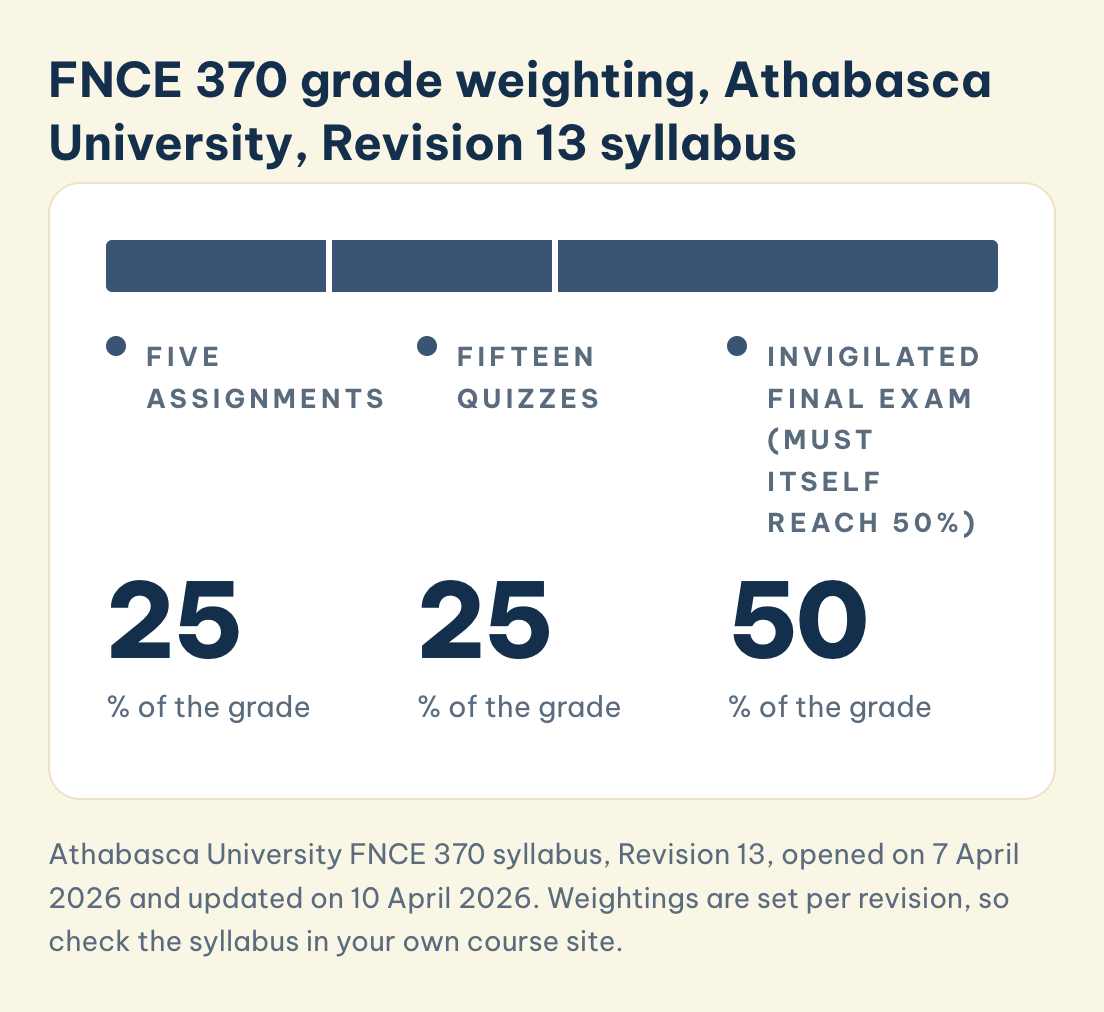
Direct answer: Half the grade comes from coursework and half from one exam. Five assignments carry 5% each, fifteen quizzes share 25%, and the final exam carries 50%. The final is written under supervision, either through ProctorU or at an approved invigilation centre, and the student pays any invigilation fee.
FNCE 370 grade weighting, Athabasca University, Revision 13 syllabus
The bars show the FNCE 370 grade weighting in the Athabasca University Revision 13 syllabus.
Five assignments
25
% of the grade
Fifteen quizzes
25
% of the grade
Invigilated final exam (must itself reach 50%)
50
% of the grade
Save this figure
Evidence: The weightings below come from the Revision 13 syllabus. Some answer engines quote a different split: on 25 September 2026 Perplexity described the course as 30% quizzes, 30% assignments and 40% final, which does not match the official page. Treat the syllabus in your own course site as the final word, because Athabasca revises its courses and older revisions carried different documents.
| Component | Weight | What it rewards |
|---|---|---|
| Assignment 1 to Assignment 5 | 5% each, 25% in total | Accurate multi-step calculations with the working shown |
| 15 quizzes | 25% in total | Steady recall of each lesson's concepts and formulas |
| Final exam, invigilated | 50% | Choosing and applying the right tool under invigilated conditions |
| Pass rule | At least 50% on the final and at least 50% overall | Both conditions, not one |
Example: The five assignments together are worth half as much as the final, and each one is worth only one fifth of the quiz total. A student who spends three weekends polishing Assignment 1 while skipping the quizzes has put effort where the grade is thinnest. Lesson 1 reviews prerequisite concepts, so the early assignment is also the cheapest place to find out whether financial accounting and calculator habits from ACCT 250 or ACCT 253 are still in place.
◆ Question 3 / 8 · The 50% final rule
What does the 50% final exam rule mean for your study plan?
Direct answer: The rule means strong coursework cannot rescue a weak final. You must score at least 50% on the exam itself and at least 50% overall, so a student who averages 90% on assignments and quizzes but writes 48% on the final still fails. Study time should be planned around the exam from the first week.
Evidence: The syllabus states the rule directly: credit requires a minimum grade of D, or 50 percent, on the final examination and an overall course grade of D. The arithmetic shows why the first condition matters most. Coursework worth 50% of the grade, completed at 90%, contributes 45 points. A final of 48% adds 24 points, for an overall grade of 69%, yet the course is not passed because the exam condition fails. Google's AI Overview for this course, read on 25 September 2026, also stressed that exam answers need every calculation step shown.
Example: A student who treats the assignments as the "real" course often works through them with the textbook open, checks each answer against worked examples, and scores well. The first time the same student solves a bond pricing question without a worked example beside it, and with no chapter heading to hint at the method, may be the exam itself. MAAS mentors suggest closing the book for at least one full problem set every fortnight, so the exam is not the first test of that skill.
◆ Question 4 / 8 · Calculation load
Which FNCE 370 lessons carry the heaviest calculation load?
Direct answer: Lessons 3 to 9 carry most of the arithmetic: time value of money, bond valuation, stock valuation, NPV and other investment criteria, and project cash flows. Later lessons on risk, cost of capital and capital structure build on those tools, so an error learned early repeats in every later topic.
Evidence: The 15 lessons in Revision 13 run in four blocks. Lessons 1 and 2 review prerequisites and cover forecasting and external financing needed. Lessons 3 to 6 cover time value of money in two parts and then bond and stock valuation. Lessons 7 to 9 move to NPV, operating cash flows and project analysis. Lessons 10 to 15 cover historical returns, portfolio risk and the security market line, cost of capital, raising capital, capital structure with the Modigliani and Miller propositions, and dividend policy.
Example: Take a bond with a face value of $1,000, an annual coupon of 5%, ten years to maturity and a market yield of 6%. The coupons are worth $50 multiplied by an annuity factor of 7.3601, or $368.00, and the face value is worth $1,000 multiplied by 0.5584, or $558.39, so the price is about $926.40. The same two-part logic, an annuity plus a single sum, prices a project, values a loan and sets up a cost of capital calculation. A student who sees this pattern once needs fewer formulas than one who memorises each chapter separately.
◆ Question 5 / 8 · Capital budgeting
How do you solve capital budgeting problems in FNCE 370?
Direct answer: Start from cash flows, not accounting profit, then discount them at a rate that matches the project's risk. Write the timeline first, label each cash flow by year, and only then reach for the calculator. In MAAS mentors' experience, a wrong cash flow costs more marks than a wrong discount formula.
Evidence: Graham and Harvey (2001) surveyed 392 chief financial officers, a 9% response from about 4,440 firms, and reported that 74.9% always or almost always use net present value and 75.7% always or almost always use internal rate of return. They also found that small firms were relatively more likely to use the payback period. The authors add a caution that belongs in any written answer: "the responses represent beliefs" (Graham & Harvey, 2001, p. 197), so a survey shows what managers say they do, not proof that the method was applied well.
Example: A machine costs $100,000 and produces after-tax cash flows of $30,000 a year for five years, with a 10% required return. The five-year annuity factor at 10% is 3.7908, so the cash flows are worth about $113,724 today and the NPV is about $13,724. A common error is to subtract depreciation from those cash flows a second time, after the tax effect of depreciation has already been included. Another is to add the machine's financing cost as a cash outflow, which counts the cost of capital twice because the 10% rate already covers it.
◆ Question 6 / 8 · Using the quizzes
How should you use the 15 quizzes over 26 weeks?
Direct answer: Use each quiz as retrieval practice, not only as a score. Attempt it without notes once the lesson is finished, record every question you missed, and return to those questions a week or two later. Fifteen spaced checks over 26 weeks are the course's built-in revision system.
Evidence: Roediger and Karpicke (2006) had students either restudy prose passages or take recall tests on them. After one week, students in the repeated-testing condition recalled 61% of the material against 40% in the repeated-study condition, even though they had read the passage 3.4 times on average against 14.2 times. The authors conclude that "testing is a powerful means of improving learning, not just assessing it" (Roediger & Karpicke, 2006, p. 249). They also report that repeated studying made students more confident while leaving them with poorer retention, which is the trap of rereading a chapter until it feels familiar.
Example: A student finishes Lesson 5 on bonds, misses three questions on the quiz that covers it, and moves straight to Lesson 6. A better use of the same quiz is to rework those three questions from a blank page the next day, then again two weeks later while studying stock valuation. By the time the final arrives, the bond questions have been retrieved three times rather than read once, and the gaps that remain are known rather than guessed.
◆ Question 7 / 8 · Capital structure
What does the capital structure lesson ask you to explain?
Direct answer: Lesson 14 asks you to explain why, under strict assumptions, the mix of debt and equity does not change a firm's value, and then why it does once taxes and financial distress enter. Good answers state the assumption being relaxed before stating the result, rather than listing propositions from memory.
Evidence: Modigliani and Miller (1958) showed that in a market without taxes, transaction costs or bankruptcy costs, the value of a firm does not depend on how it is financed. The textbook then adds corporate taxes, which make debt valuable through the interest tax shield, and financial distress costs, which limit how much debt is worth adding. Graham and Harvey (2001) found some support for the trade-off and pecking-order views among their respondents, and reported that CFOs named financial flexibility and credit ratings as concerns when issuing debt.
Example: A question may ask whether a firm with steady cash flows and high taxable income should borrow more. An answer that only writes "M&M Proposition II says the cost of equity rises with leverage" is incomplete. A stronger answer names the tax shield as the reason to borrow, names distress costs as the limit, and says what the firm's stable cash flows imply for that balance.
◆ Question 8 / 8 · Getting help
Can you get help with FNCE 370 assignments?
Direct answer: You can get help understanding methods, but every assignment and exam answer must be your own work. Because the assignments are completed through individualized online study rather than in a supervised room, the line matters more here than in a campus course. Copying from a solution manual, a shared file or another student counts as plagiarism under Athabasca policy.
Evidence: Athabasca University's Student Academic Misconduct Policy defines plagiarism as submitting or presenting coursework as if it is the student's own when it is not. Its list includes work done in whole or in part by someone else, and coursework copied from "a textbook, a solution manual, the internet and/or any other source". The policy lists penalties that range from a reduction in grade for a course to revocation of an awarded credential, and it separately treats sharing examination content as cheating.
Example: Search results for this course are crowded with sites offering marked assignments and sample exams from earlier revisions. Using them to produce a submission falls inside the policy's definition, and it also leaves the student unpractised for an invigilated final that decides half the grade. The legitimate use of a tutor looks different: a student brings a textbook problem they got wrong, reworks it aloud, and is asked why the cash flow in year zero was treated as positive.
Frequently asked questions
Is FNCE 370 a hard course?
The syllabus itself calls it a challenging, high-volume course and asks for nine or more hours of work per week across 26 weeks. The difficulty is breadth and precision rather than advanced mathematics, since 15 lessons build on one another and the final decides half the grade.
What happens if I score below 50% on the FNCE 370 final?
You do not receive credit for the course, even if your overall grade is above 50%. The syllabus requires at least 50% on the final examination and at least 50% overall, so both conditions have to be met.
Which calculator can I use in the FNCE 370 exam?
The syllabus lists approved financial calculators, including the Texas Instruments BA II Plus, the Sharp EL-738 family, the HP 10bII+ and the Casio FC-200V. Any other model needs approval from the course coordinator in advance through the AU Service Centre.
Can I challenge FNCE 370 instead of taking it?
Yes. The syllabus offers a challenge for credit option, assessed by a single challenge examination worth 100%, with at least 50% needed to receive credit.
Which textbook does FNCE 370 use?
Revision 13 uses Ross, Westerfield, Jordan, Pandes and Holloway, Fundamentals of Corporate Finance, 12th Canadian edition, published by McGraw Hill in 2025, supplied digitally through the course.
Does MAAS complete FNCE 370 assignments or exams?
No. MAAS mentors explain methods and review practice problems you have already attempted. Every assignment, quiz and exam answer must be your own, in line with Athabasca University's academic misconduct policy.
Related reading
- BAFI3230 Corporate Finance: how RMIT frames the same investment, financing and payout decisions as a written report
- FINA1149 Finance for Non-Finance Managers: the core finance toolkit explained for students without a finance background
- How to revise for final exams effectively: a longer look at spaced and retrieval practice before a final that carries most of the grade
Where MAAS fits
- Subject tutoring, one to one: 60 or 90 minute sessions with a tutor matched to finance, working through practice problems you have already attempted. Tutoring is advisory, so it carries no grade target; if the tutor is not the right fit, you can ask to change expert
- Exam coaching resources: how MAAS mentors approach preparation for timed, invigilated exams
References
- Graham, J. R., & Harvey, C. R. (2001). The theory and practice of corporate finance: Evidence from the field. Journal of Financial Economics, 60(2–3), 187–243. https://doi.org/10.1016/S0304-405X(01)00044-7
- Modigliani, F., & Miller, M. H. (1958). The cost of capital, corporation finance and the theory of investment. American Economic Review, 48(3), 261–297.
- Roediger, H. L., & Karpicke, J. D. (2006). Test-enhanced learning: Taking memory tests improves long-term retention. Psychological Science, 17(3), 249–255. https://doi.org/10.1111/j.1467-9280.2006.01693.x
Tools & resources
- Athabasca University. (2026). FNCE 370: Overview of corporate finance (Revision 13) [Course syllabus]. Retrieved September 25, 2026, from https://www.athabascau.ca/syllabi/fnce/fnce370.html
- Athabasca University. (n.d.). Student academic misconduct policy. Retrieved September 25, 2026, from https://www.athabascau.ca/university-secretariat/_documents/policy/student-academic-misconduct-policy.pdf
- Ross, S. A., Westerfield, R. W., Jordan, B. D., Pandes, J. A., & Holloway, T. A. (2025). Fundamentals of corporate finance (12th Canadian ed.). McGraw Hill.
This article is part of the MAAS Journal series for Vietnamese international students. MAAS is an independent academic support provider. For courses assessed by exams and individual online work, we offer one-to-one tutoring on methods only; we do not write, complete or submit any assessed work.
A free 20-minute consultation is a conversation about where you are with FNCE 370.
Book a free consultation ▸