
◆ Accounting & Finance
FINA1149 Finance for Non-Finance Managers: what do the reports need?
FINA1149 is assessed by two short reports totalling 2,000 words, and that constraint is the whole difficulty. Students arrive braced for a maths problem and instead face a compression problem: a 500-word report and a 1,500-word report in which every sentence has to earn its place. The module tests whether you can read a set of accounts and say what it means, not whether you can produce one. Everything below assumes you are starting from zero in accounting.

◆ Question 1 / 7 · About the unit
What is FINA1149 Finance for Non-Finance Managers about?
Direct answer: FINA1149 is a Level 4 module taught by the Accounting, Finance and Economics department at Greenwich Business School. It introduces basic concepts in accounting, banking and finance used in modern organisations, builds competence in reading the data and statements organisations use to communicate with stakeholders, and raises your numeracy and confidence handling financial information from a non-finance role.
Evidence: The module's published aims name employability directly, describing the goal as enhancing transferable skills for working with financial information in non-finance roles. That framing tells you what kind of answer the assessment wants: not the technically deepest treatment, but the one a manager without a finance background could act on.
Example: A Vietnamese student at Greenwich spent her first 3 weeks trying to memorise double-entry bookkeeping rules she had found online, convinced the module would test them. Her MAAS mentor read the learning outcomes with her. None of the three asked her to prepare accounts; all three asked her to understand, use and interpret them. She had been revising for a different module.
◆ Question 2 / 7 · Assessment
What assessment does FINA1149 involve?
Direct answer: Two reports. Report 1 is worth 30%, runs to 500 words, addresses one case study scenario, and covers the material from the first 5 weeks against learning outcome 1. Report 2 is worth 70%, runs to 1,500 words in three sections, works from case study scenarios covering the whole module, and is assessed against all three learning outcomes.
Both carry a 40% pass mark. There is also formative work that does not count towards your mark: weekly multiple-choice, true or false and matching questions after each topic, plus in-class case discussions. Confirm the exact briefs and deadlines in your own module handbook.
Evidence: These figures come from the assessment section published in Greenwich's public module catalogue. Note the structure the brief gives you for Report 2: it is explicitly a three-section report. That is not a stylistic suggestion, it is the shape the marker expects, and it maps naturally onto the three learning outcomes.
Example: A student wrote Report 2 as one continuous 1,500-word discussion with no headings. The content was sound. His mentor pointed out that the brief specified three sections and the module has exactly three learning outcomes, so an unsectioned report forces the marker to hunt for evidence against each one. Adding three clear headings, with no change to the words underneath, made the same work far easier to credit.
◆ Question 3 / 7 · Marking
How is FINA1149 graded, what does the marking reward?
Direct answer: Interpretation, not computation, the same reading Atrill and McLaney (2025) train non-specialists to do. The learning outcomes ask you to understand the role of the finance function, to understand the role, use and messages communicated by the key financial statements, and to understand the use and importance of management accounting including budgeting and ratios. The recurring verb is "understand", and in a case-based report that means explaining what a number tells a manager and what decision it should influence. A ratio calculated correctly and left unexplained earns very little.
Evidence: Learning outcome 2 uses the phrase "messages communicated by" the financial statements. Statements do not merely contain figures in this framing; they carry a message to stakeholders. Atrill and McLaney (2025) make the same point for non-specialists: the value of a financial statement lies in what it tells a decision-maker, not in the arithmetic that produced it. An answer that reports a current ratio of 1.4 has extracted a figure. An answer that explains what a current ratio of 1.4 signals about this firm's ability to meet short-term obligations, and what a manager should watch next, has read the message.
Example: A MAAS mentor asked a student to cover the numbers in her draft with her hand and read what remained. Almost nothing did; her report was a table with connecting words. She rewrote so that each figure was followed by a sentence beginning "which means that…". The calculations never changed, but the report moved from a bare pass to a strong mark.
◆ Question 4 / 7 · Concepts and tools
Which concepts and tools should you use in FINA1149?
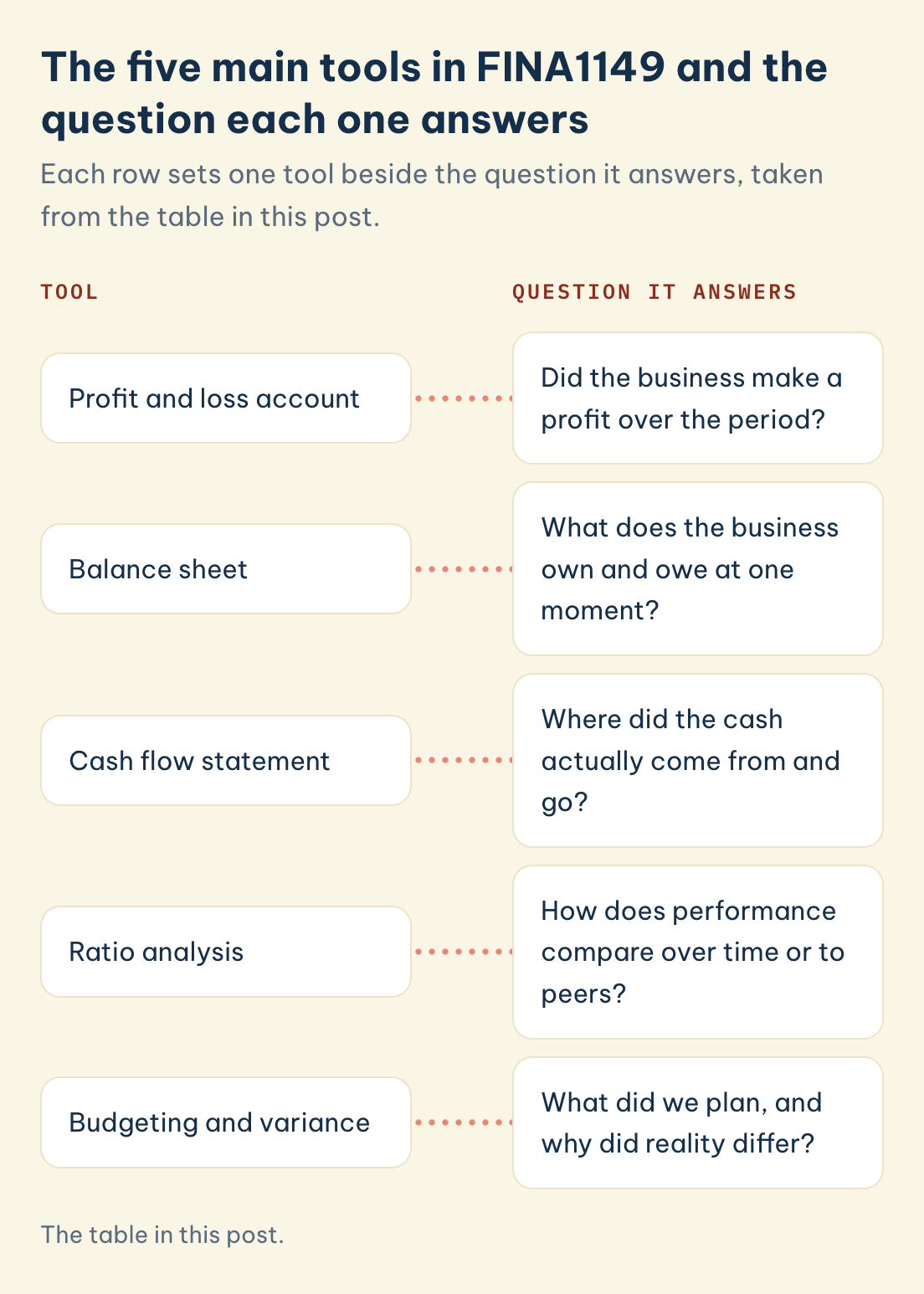
Direct answer: The module covers a defined set, and you should use them in the order a manager actually would, the same sequence Weetman (2019) builds her introduction around: understand what the statements are, then read them, then look forward with budgets. The table below maps the main tools to the question each one answers.
The five main tools in FINA1149 and the question each one answers
Each row sets one tool beside the question it answers, taken from the table in this post.
Tool
Question it answers
Profit and loss account
Did the business make a profit over the period?
Balance sheet
What does the business own and owe at one moment?
Cash flow statement
Where did the cash actually come from and go?
Ratio analysis
How does performance compare over time or to peers?
Budgeting and variance
What did we plan, and why did reality differ?
Save this figure
| Tool | Question it answers | Where students go wrong |
|---|---|---|
| Profit and loss account | Did the business make a profit over the period? | Confusing profit with cash |
| Balance sheet | What does the business own and owe at one moment? | Reading it as a period, not a snapshot |
| Cash flow statement | Where did the cash actually come from and go? | Skipping it because P&L looks healthy |
| Ratio analysis | How does performance compare over time or to peers? | Calculating many ratios, interpreting none |
| Budgeting and variance | What did we plan, and why did reality differ? | Describing the budget process instead of using it |
Evidence: The indicative content published for this module lists the main financial statements, how they relate to one another, and how they can be used as management data, alongside banking, investments, taxation and VAT, and the company annual report. Note the phrase "how they relate to one another". A profit figure with no cash context, or a balance sheet read without the P&L, misses the relationship the module is built around; Weetman (2019) treats those inter-statement links as the foundation of financial literacy rather than as an advanced topic. OpenStax's Principles of Accounting puts it plainly: "the information resulting from ratio analysis can be used to examine trends in performance, establish benchmarks for success, set budget expectations, and compare industry competitors" (Franklin et al., 2019), exactly the "which means that…" move a strong Report 2 needs.
Example: A student concluded that a case company was performing well because its profit had risen year on year. Her mentor asked her to look at the cash flow statement. Operating cash flow had fallen, because the profit rise came from sales made on credit that had not yet been collected. One additional statement reversed her conclusion entirely, and that reversal was exactly what the case was designed to teach.
◆ Question 5 / 7 · Report 2 structure
How should you structure the 1,500-word Report 2?
Direct answer: Follow the three-section instruction and align each section with a learning outcome. A workable allocation: section one, the finance function and the key concepts at work in this scenario, roughly 350 words; section two, what the financial statements say about this business, roughly 600 words; section three, the management accounting view, budgeting, control and ratios, and what the business should do, roughly 500 words. Keep the introduction to two or three sentences. At 1,500 words you cannot afford a warm-up.
Evidence: The published brief describes Report 2 as a three-section report assessed against all three learning outcomes. When a brief names both a section count and an outcome count and they match, that alignment is the safest structural decision available to you.
Example: A student spent 300 of his 1,500 words introducing the case company and explaining what accounting is. His mentor cut both to a total of 60 words. The 240 words freed up went into the ratio interpretation section, which had previously been two sentences long, and that section was where two of the three outcomes were actually demonstrated.
◆ Question 6 / 7 · Common mistakes
What are the most common mistakes that lose marks in FINA1149?
Direct answer: Non-specialist finance reports go wrong in a small and predictable set of ways.
| Mistake | Why it costs marks | The fix |
|---|---|---|
| Numbers with no interpretation | Outcomes ask you to understand, not to compute | Follow every figure with "which means that…" |
| Calculating every ratio you know | Breadth without depth in a 1,500-word limit | Choose three or four ratios that fit the scenario |
| Ignoring the cash flow statement | Misses the relationship between the statements | Always read profit against cash |
| Long company background | At 2,000 words total, context is expensive | Two or three sentences maximum |
| No sections in Report 2 | The brief names three; the marker looks for three | Head each section and align it to an outcome |
| Textbook definitions padding the word count | Definitions are assumed, not credited | Apply the concept to the scenario instead |
Evidence: The word limits here are unusually tight, 500 and 1,500 words, and tight limits change what good writing looks like. In a 3,000-word essay a paragraph of background costs you little. In a 500-word report it costs a fifth of your submission.
Example: A student's 500-word Report 1 opened with 120 words defining what a balance sheet is. Her mentor asked who she imagined was reading it. She had been writing to prove she knew the definition; the brief asked her to apply it to a scenario. Deleting the definition and using the space to analyse the scenario doubled the substance of the same submission.
◆ Question 7 / 7 · Handling numbers
How do you handle the numbers if you are not confident with maths?
Direct answer: The arithmetic in this module is deliberately accessible, and the module aims say so, describing the goal as enhancing numeracy and confidence for people in non-finance roles. Two habits help more than revision, and both follow Drury's (2021) framing of a figure as evidence for a decision rather than an end in itself: always write the unit and the period next to any figure you use, and always state the comparison. Drury (2021) frames management accounting information as existing to support a decision, which is why a figure with no comparator does no work. A number alone carries no meaning; a number next to last year's, or next to an industry norm, carries an argument.
Evidence: The module's aims explicitly frame numeracy as a confidence and employability issue rather than a technical hurdle, which is consistent with an assessment design built on short case-based reports rather than on calculation-heavy examinations.
Example: A student told her mentor she was "bad at numbers" and had been avoiding the ratio topic. He asked her to compare two figures from the case and say which was better and why. She did it immediately and correctly. Her difficulty was never arithmetic; it was that nobody had told her the comparison was the answer, and the calculation merely the step before it.
Frequently asked questions
Is FINA1149 hard if I have never studied accounting?
The module is designed for exactly that starting point, the same non-specialist reader Atrill and McLaney (2025) write for. The difficulty most students meet is not technical, it is the discipline of writing something useful inside 500 and 1,500 words.
Do I need to prepare financial statements myself?
The learning outcomes ask you to understand their role, use and messages, not to produce them, the same message-over-mechanics reading Weetman (2019) teaches. Reading and interpreting is the assessed skill.
How many ratios should I include in Report 2?
Three or four, chosen because they suit the scenario, each properly interpreted, the same interpretation-over-breadth standard Atrill and McLaney (2025) write their whole textbook around. A long list of correctly calculated ratios with no interpretation demonstrates none of the outcomes.
Does the formative quiz count towards my mark?
No. The weekly multiple-choice, true or false and matching questions are formative, meaning they exist to show you where your understanding is thin while you can still fix it. They are worth doing precisely because they carry no risk.
Can MAAS help me with FINA1149?
MAAS mentors work with you on reading a case scenario, choosing which ratios and statements matter for it, and turning figures into interpretation that a marker can credit. You remain the author of your reports; the mentor helps you hear what your own figures are saying.
When you can do the sums but not the sentence
Comfort with arithmetic matters less here than most students expect. What pays is treating every figure as the start of a sentence rather than the end of one, and respecting how little room 2,000 words really gives you. If you can do the calculations but cannot see what to say about them, a MAAS mentor can work through a scenario with you before you write.
Talk to a MAAS mentor about your module
Related guides
References
- Atrill, P., & McLaney, E. (2025). Accounting and finance for non-specialists (13th ed.). Pearson.
- Drury, C. (2021). Management and cost accounting (11th ed.). Cengage Learning.
- Franklin, M., Graybeal, P., & Cooper, D. (2019). Principles of accounting, volume 1: Financial accounting. OpenStax. https://openstax.org/books/principles-financial-accounting/pages/a-financial-statement-analysis
- Weetman, P. (2019). Financial and management accounting: An introduction (8th ed.). Pearson.
Tools & resources
- University of Greenwich. (n.d.). Module information [Module catalogue entry]. Retrieved July 29, 2026, from https://www.gre.ac.uk/modules/modules?crse=1149&subj=FINA&term=205000
- University of Greenwich. (n.d.). Academic skills. Retrieved July 29, 2026, from https://www.gre.ac.uk/students/support/academic-skills
This article is part of the MAAS Journal series for Vietnamese international students. MAAS Assignment & Essay Support is an academic support partner; we coach students through the Outline, Draft, Final delivery model with developmental feedback from discipline-matched experts. We do not write or submit work on a student's behalf.
A free 20-minute consultation is a conversation about where you are with FINA1149.
Book a free consultation ▸