
◆ Marketing
MARK1107 Marketing: how do you write the 3,000-word report?
MARK1107 Principles and Practice of Marketing is a 30-credit module at the University of Greenwich, making it one of the largest blocks of credit in a first-year marketing degree. It is assessed twice, through a group presentation and an individual report, and the two halves reward different things. Students who treat the report as a longer version of the presentation usually lose marks. The guide below works through what Vietnamese students at Greenwich often need clarified.

◆ Question 1 / 7 · The module
What is MARK1107 Principles and Practice of Marketing about?
Direct answer: MARK1107 is a Level 4 module worth 30 credits, taught by the Management and Marketing department at Greenwich Business School. It is the cornerstone of your marketing knowledge for the degree, introducing the philosophy underlying marketing, ethical and societal issues, what "customer focused" means, and marketing practice at regional, national, and global scale.
Evidence: The module's published learning outcomes run in six steps: describe the role of marketing in a business context; describe the environmental forces; understand strategy and stakeholders; describe the marketing mix; understand market research and target market analysis; and appreciate competition and marketing. Read those verbs carefully. Four of the six are "describe" or "appreciate", which is appropriate for a first-year foundation module, but it also means the students who lift into the higher bands are the ones who go beyond the verb they were given.
Example: A Vietnamese student at Greenwich assumed a 30-credit module meant twice the reading of a 15-credit one. Her MAAS mentor pointed out the more useful implication: it carries twice the weight in her year average, and it is the module every later marketing module will assume she absorbed. Treating it as foundational rather than as one module among many changed how she prioritised her term.
◆ Question 2 / 7 · Assessment
What assessment does MARK1107 involve?
Direct answer: Two components. A group presentation worth 30% with a 20-minute time limit, and an individual report of 3,000 words worth 70%. Both carry a 40% pass mark and both are assessed against all six learning outcomes. There is also formative assessment that does not count towards your mark: 2 online multiple-choice quizzes, placed midway through each term, covering the lecture material to that point. Confirm the exact brief, deadline and topic constraints in your own module handbook, since these are reissued each academic year.
Evidence: These figures come from the assessment section Greenwich publishes openly in its module catalogue, where the module is coordinated by Ian Whitten and taught through lectures that run 1 hour, paired with tutorials of roughly 50 minutes that follow each lecture's pre-reading list. Note the design logic: the presentation is the smaller component and comes with a hard time limit, while the report carries the majority of the mark and gives you room to develop an argument. Those are different tasks, and the mistake is preparing once and delivering twice.
Example: A student built an excellent 20-minute presentation on a beverage brand, then expanded the same slide content into 3,000 words for the report. The report scored well below the presentation. His mentor showed him why: the presentation rewarded selection, cutting to the few points that would land in 20 minutes, while the report rewarded development, following one line of reasoning with evidence. Expanded slides give you neither.
◆ Question 3 / 7 · Marking
How is MARK1107 graded, what does the marking reward?
Direct answer: Both components are marked against all six learning outcomes, so coverage matters more here than in a narrow module. But within that coverage, the marks separate on application. Describing the marketing mix earns you the outcome; showing why a specific firm's mix is coherent, or incoherent, with its chosen target segment is what earns the band. The most reliable lift at Level 4 is to attach every concept you introduce to a decision a real firm made.
Evidence: The learning outcomes explicitly pair descriptive knowledge (the mix, environmental forces) with analytical framing (strategy and stakeholders, market research and target market analysis, competition). A report that handles the first group well and the second group thinly has covered the syllabus without demonstrating the reasoning the second group implies.
Example: A MAAS mentor asked a student to draw a line between her segmentation section and her marketing mix section. She could not, because they had been written as two separate topics about the same company. Rewriting so the mix decisions followed from the segment she had identified, same length, same brand, produced a report that finally read as one argument.
◆ Question 4 / 7 · Frameworks
Which marketing frameworks should you use in MARK1107?
Direct answer: Use the core set properly rather than reaching for advanced models you have not been taught yet. For this module the essential four are below, and the sequence matters, segmentation and targeting should come before mix decisions, not after.
| Framework | What it decides | Where students go wrong |
|---|---|---|
| STP (segmentation, targeting, positioning) | Who you are selling to and how you want to be seen | Choosing a segment, then designing a mix that ignores it |
| The marketing mix (4Ps, or 7Ps for services) | Product, price, place, promotion decisions | Describing each P in turn with no link between them |
| PESTEL and competitor analysis | The external forces and rivals shaping your options | Treating this as background rather than as constraint |
| Market research (primary vs secondary) | What you actually know versus what you are assuming | Presenting assumptions as findings |
Evidence: Smith (1956), in the Journal of Marketing volume 21, issue 1, pages 3 to 8, introduced market segmentation as a strategy distinct from product differentiation, establishing the logic that you can serve a defined sub-market rather than the whole market. Borden (1964), in the Journal of Advertising Research volume 4, issue 2, pages 2 to 7, coined the term "marketing mix" to capture the interrelated decisions a marketing manager controls, and McCarthy's (1960) textbook then compressed those ingredients into the four Ps still used today. Booms and Bitner (1981), pages 47 to 51, extended the mix to seven Ps for services, adding people, process and physical evidence, which matters if your chosen organisation sells a service rather than a product.
Kotler and Armstrong (2020), now in its 18th edition from Pearson, is the textbook most Greenwich reading lists point to for a fuller treatment of each framework once the module has introduced it, and it is worth citing the framework's originator, Smith, Borden, McCarthy, Booms and Bitner, rather than only the textbook that summarises them, since MARK1107's outcomes reward tracing an idea to where it came from. Smith put the payoff of the two strategies in a single image: "The differentiator seeks to secure a layer of the market cake, whereas one who employs market segmentation strives to secure one or more wedge-shaped pieces" (Smith, 1956, p. 4).
Example: A student analysing a coffee chain wrote a strong 4Ps section and never mentioned staff or store atmosphere. Her mentor asked whether a coffee chain sells a product or an experience. Switching to the 7Ps let her discuss service delivery and physical environment, and those turned out to be exactly where the brand's positioning was actually built.
◆ Question 5 / 7 · Report structure
How should you structure the MARK1107 individual report?
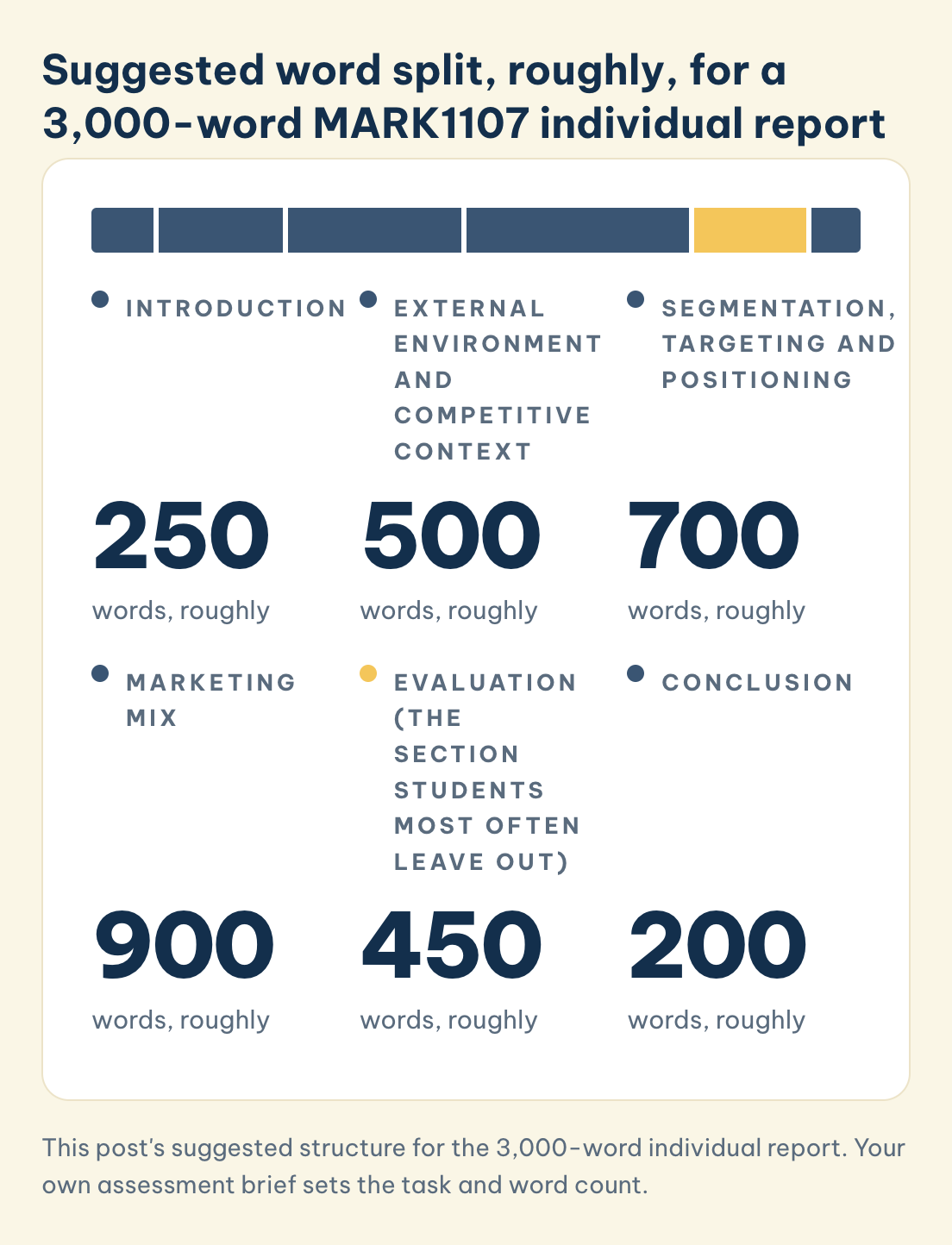
Direct answer: Structure it as a chain of decisions rather than a tour of topics. A structure that works at 3,000 words: (1) introduction naming the organisation and the marketing question you are examining, around 250 words; (2) the external environment and competitive context, around 500 words; (3) segmentation, targeting and positioning for this organisation, around 700 words; (4) the marketing mix that follows from that positioning, around 900 words; (5) evaluation, is the mix coherent with the positioning, and where is it weak, around 450 words; (6) conclusion, around 200 words. Section five is what separates a competent report from a strong one, and it is the one students most often leave out.
Suggested word split, roughly, for a 3,000-word MARK1107 individual report
The section word counts are roughly the amounts this post suggests, and the yellow section is the one students most often leave out.
Introduction
250
words, roughly
External environment and competitive context
500
words, roughly
Segmentation, targeting and positioning
700
words, roughly
Marketing mix
900
words, roughly
Evaluation (the section students most often leave out)
450
words, roughly
Conclusion
200
words, roughly
Save this figure
Evidence: The module's outcomes ask you to understand strategy and stakeholders and to appreciate competition, not merely to describe the mix. A report that ends after describing four Ps has stopped at outcome four and never demonstrated outcomes three, five and six, even though it may run to the full word count.
Example: A student's report described a fashion retailer's pricing, product, place and promotion accurately across 2,600 words and then concluded that the marketing was "effective". His mentor asked what evidence supported that judgement. There was none, because the report had never set up a standard against which effectiveness could be judged. Adding a short evaluation against the positioning statement gave the whole report a conclusion it had earned.
◆ Question 6 / 7 · Common mistakes
What are the most common mistakes that lose marks in MARK1107?
Direct answer: First-year marketing reports tend to fail in the same handful of places.
| Mistake | Why it costs marks | The fix |
|---|---|---|
| The four Ps as four unconnected sections | Shows description, not strategy | Derive each P from the positioning you chose |
| Segment defined as "young people aged 18-35" | Too broad to guide any decision | Segment on behaviour or need, not just demographics |
| Company history as the opening 600 words | Context is not analysis | Cap background at roughly 250 words |
| Using 4Ps for a service business | Misses the three Ps where the value sits | Use 7Ps when the offer is a service |
| No evaluation section | Leaves the higher outcomes undemonstrated | Judge the mix against the positioning explicitly |
| Sources are brand websites and blogs | Weak evidence base for a marks-bearing claim | Anchor concepts in the original scholarly sources |
Evidence: At Level 4 the gap between bands is rarely knowledge of the frameworks, since the frameworks are taught directly and are easy to reproduce. The gap is whether the frameworks are used to reach a conclusion about a specific organisation, or simply reported in sequence.
Example: One student defined her target segment as "students in London". Her mentor asked what those students had in common that would change a pricing decision. She refined it to students living away from home for the first year who buy convenience over value, and suddenly the price and place sections had something to be consistent with.
◆ Question 7 / 7 · Presentation and report
How do the presentation and the report fit together in MARK1107?
Direct answer: Treat the presentation as a rehearsal of your thinking, not a draft of your report. The 20-minute limit forces you to decide what your central claim actually is, which is genuinely useful preparation. But then write the report from the argument, not from the slides. Where the presentation had to cut nuance to fit the clock, the report is where that nuance belongs.
Evidence: The presentation carries 30% and the report 70%, and the report is 3,000 words with no comparable time constraint. That weighting signals that developed reasoning is worth more than compressed delivery, which means the report needs material the presentation did not have room for.
Example: A group's presentation argued a brand should reposition upmarket, and they defended it well in 20 minutes. Two of them then wrote individual reports repeating the same three supporting points at greater length. Their mentor pointed out that the report's extra space was an invitation to address the counter-case, what the repositioning would cost the brand in its existing segment, which neither report had touched.
Frequently asked questions
Is MARK1107 hard?
The concepts are introductory. The demand is breadth, since both assessments are marked against all six outcomes, and the weight, since 30 credits means it moves your year average more than most modules. Underestimating it is the common error, not finding it difficult.
Can I choose any organisation for the report?
Usually within the brief, and choosing well matters more than students expect. Pick an organisation whose marketing decisions are visible and documented. A brand you can only describe from its own website will push you into description.
Should I use the 4Ps or the 7Ps?
Use 7Ps if the organisation's offer is substantially a service, since people, process and physical evidence are where a service's value is delivered. Use 4Ps for a straightforward product business. Say which you have chosen and why.
How many sources do I need?
Follow the number given in your brief, but the quality question matters more. One correctly used original source for a framework is worth more than five blog summaries of the same idea.
Can MAAS help me with MARK1107?
MAAS mentors work with you on choosing an organisation, defining a segment that can actually guide decisions, and testing whether your mix follows from your positioning. You remain the author of your report; the mentor's job is to find the weak joint before the marker does.
If your sections feel disconnected
The reports that do well in this module rarely stand out for covering the most frameworks. What they share is that they where the segment leads to the positioning, the positioning leads to the mix, and the evaluation says honestly where that chain holds and where it breaks. If you have the research done but the sections feel disconnected, a MAAS mentor can work through the chain with you before you write.
Talk to a MAAS mentor about your module
Related guides
References
- Booms, B. H., & Bitner, M. J. (1981). Marketing strategies and organization structures for service firms. In J. H. Donnelly & W. R. George (Eds.), Marketing of services (pp. 47–51). American Marketing Association.
- Borden, N. H. (1964). The concept of the marketing mix. Journal of Advertising Research, 4(2), 2–7.
- Kotler, P., & Armstrong, G. (2020). Principles of marketing (18th ed.). Pearson.
- McCarthy, E. J. (1960). Basic marketing: A managerial approach. Irwin.
- Smith, W. R. (1956). Product differentiation and market segmentation as alternative marketing strategies. Journal of Marketing, 21(1), 3–8.
Tools & resources
- University of Greenwich. (n.d.). Module information [Module catalogue entry]. Retrieved July 29, 2026, from https://www.gre.ac.uk/modules/modules?crse=1107&subj=MARK&term=205000
- University of Greenwich. (n.d.). Academic skills. Retrieved July 29, 2026, from https://www.gre.ac.uk/students/support/academic-skills
This article is part of the MAAS Journal series for Vietnamese international students. MAAS Assignment & Essay Support is an academic support partner; we coach students through the Outline, Draft, Final delivery model with developmental feedback from discipline-matched experts. We do not write or submit work on a student's behalf.
A free 20-minute consultation is a conversation about where you are with MARK1107.
Book a free consultation ▸