
◆ Business & Management
BUSI1695 International Business Environment: how do you analyse it?
BUSI1695 International Business Environment is a first-year Greenwich module that catches students out for a reason few expect. Even though 80% of the mark sits in a 1,500-word individual essay, the unfamiliar 20% component, a 10-minute team presentation, is what derails otherwise solid students. A defensible analysis of external forces carries the essay, but it still has to be delivered clearly by a team inside a fixed slot, which is where the questions below begin.

◆ Question 1 / 7 · The module
What is BUSI1695 International Business Environment about?
Direct answer: BUSI1695 is a Level 4 module in Greenwich Business School, in the Business, Operations and Strategy department. Level 4 sits at the entry point of the UK's Framework for Higher Education Qualifications (Quality Assurance Agency for Higher Education, 2024). The module develops your understanding of the political, economic, market, socio-cultural, ecological, demographic and technological forces shaping organisations.
Evidence: The Level 4 descriptor sets the bar this module marks against, expecting a graduate to show "an ability to present, evaluate and interpret qualitative and quantitative data, in order to develop lines of argument and make sound judgements in accordance with basic theories and concepts of their subject(s) of study" (Quality Assurance Agency for Higher Education, 2024). The module aims published in Greenwich's public module catalogue describe business as operating "within a complex external environment that impacts organisational operations and decision-making", and the indicative content introduces business as a societal construct placed inside a wider environmental context. That framing matters: the module is not asking you to list external factors, it is asking you to explain how a firm's decisions change because of them.
Example: A Vietnamese student at Greenwich prepared for BUSI1695 by memorising what each letter of PESTEL stood for. In her first seminar she was asked what a specific regulatory change meant for a specific airline's route planning, and she had nothing to say. Her MAAS mentor reframed her preparation: for every factor she could name, she now had to finish the sentence "…and so this firm has to change ___". The definitions were never the problem; the "and so" was.
◆ Question 2 / 7 · Assessment
What assessment does BUSI1695 involve?
Direct answer: Two components carry the mark, according to Greenwich's published module catalogue. An individual essay of 1,500 words, worth 80% of the module, is assessed against learning outcomes LO1 and LO2. A team presentation of around 10 minutes, worth the remaining 20%, is assessed against LO3, the collaborative outcome. Each component needs 40% to count as a pass. Confirm the exact deadlines and any brief changes in your own module handbook, since these are reissued each academic year even when the weighting stays the same.
Evidence: The learning outcomes published in the module catalogue rise in demand across three steps: LO1 demonstrate an appreciation of the external environment; LO2 analyse the opportunities and challenges of that environment for specific businesses, industries or sectors; LO3 collaborate to produce a visually effective presentation. Note that LO2 uses the verb "analyse" and names specificity, and LO3 assesses collaboration and communication design, not just content.
Example: A group of four students split BUSI1695 by letter, one took political, one economic, one social, one technological. The result was four unconnected mini-talks about the same company. Their MAAS mentor had them re-split by argument instead: one person framed the decision the firm faced, two analysed the forces that pushed for and against it, one handled implications. Same slides count, same research, but the talk finally had a spine.
◆ Question 3 / 7 · Marking
How is BUSI1695 graded, what does the marking reward?
Direct answer: Inside the 80% essay, marks concentrate on LO2, not LO1. LO1, showing you appreciate that an external environment exists and can name its components, is entry-level and earns comparatively little on its own; LO2, analysing opportunities and challenges for a named business or sector, is where the essay's 1,500 words should actually go.
The 20% presentation is judged separately against LO3, so a strong essay cannot compensate for a weak team delivery, or the reverse. At Level 4 the examiners are checking whether you can move from a general framework to a specific consequence, which is the exact skill Level 5 and 6 modules will assume you already have.
Evidence: The module explicitly names "specific businesses, industries, or commercial sectors" in its learning outcome, which is a deliberate constraint. General statements about how technology is changing business cannot satisfy an outcome that requires specificity, no matter how accurate they are.
Example: A MAAS mentor asked a student to read her draft slide aloud: "Political factors such as government regulation can affect businesses." He asked which government, which regulation, which business, and by how much. She replaced the sentence with one naming a specific import tariff and its effect on one company's sourcing costs. That single change is the difference between LO1 and LO2 territory.
◆ Question 4 / 7 · Frameworks
Which frameworks should you use in BUSI1695?
Direct answer: PESTEL, the standard macro-environment checklist covering political, economic, social, technological, environmental and legal factors (Johnson et al., 2020), is your organising scaffold, not your analysis. Use it to make sure you have scanned widely, then pick the two or three forces that genuinely matter for your chosen firm and go deep on those. Pair PESTEL with one framework that explains competitive pressure and, if your case crosses borders, one that explains distance.
| Framework | What it gives you | Watch out for |
|---|---|---|
| PESTEL | A checklist so you do not miss a whole category of force | It is a scanning tool; listing all six shallowly is the classic Level 4 mistake |
| Porter's five forces | Why an industry is profitable or brutal | Do not confuse industry structure with the general macro environment |
| Ghemawat's CAGE | Cultural, administrative, geographic and economic distance between two countries | Only relevant when the firm is actually crossing a border |
| Hofstede's dimensions | Why the same practice lands differently in different national cultures | Treat as a starting hypothesis about a country, not a verdict about a person |
Evidence: Porter (1980) established the five-forces logic that separates industry-level competitive structure from the wider macro environment, a distinction students routinely blur. Ghemawat (2001) argued that firms systematically overestimate foreign market attractiveness because standard country analysis counts potential sales while ignoring the costs created by distance, and his CAGE framework splits that distance into cultural, administrative, geographic and economic components. Hofstede (2001) remains the most cited comparative model of national work cultures.
Example: A student analysing a European retailer's entry into Vietnam ran a full six-letter PESTEL and concluded the market was attractive. Her mentor asked her to apply CAGE instead. Administrative distance, licensing and local partner requirements, turned out to be the binding constraint her PESTEL had spread thinly across "political" and "legal" without ever weighing it. Her recommendation reversed.
◆ Question 5 / 7 · Presentation
How should you structure the BUSI1695 presentation?
Direct answer: Build it around one decision, not around a framework. A structure that works inside a short seminar slot: (1) the firm and the specific decision or challenge it faces, one slide; (2) the two or three external forces that actually bear on that decision, with evidence, one slide each; (3) what those forces mean for the decision, the analysis slide, which is the one that earns the marks; (4) a clear conclusion or recommendation; (5) sources. Resist the urge to open with three slides of company history.
Evidence: LO3 assesses whether the presentation is visually effective and communicates an aspect of the external environment, which means design and selection are being marked, not only research. A slide carrying six bullet points of definitions communicates less than a slide carrying one chart and one sentence of interpretation, even though it contains more words.
Example: One group's deck ran to 19 slides for a slot of 10 minutes, and they overran badly, cutting their analysis section to save time. Their mentor had them cut to 9 slides and move every definition into the spoken commentary. They finished inside the slot with the analysis intact, and it was the analysis that the marking criteria rewarded.
◆ Question 6 / 7 · Common mistakes
What are the most common mistakes that lose marks in BUSI1695?
Direct answer: First-year external-environment work slips in a predictable handful of places.
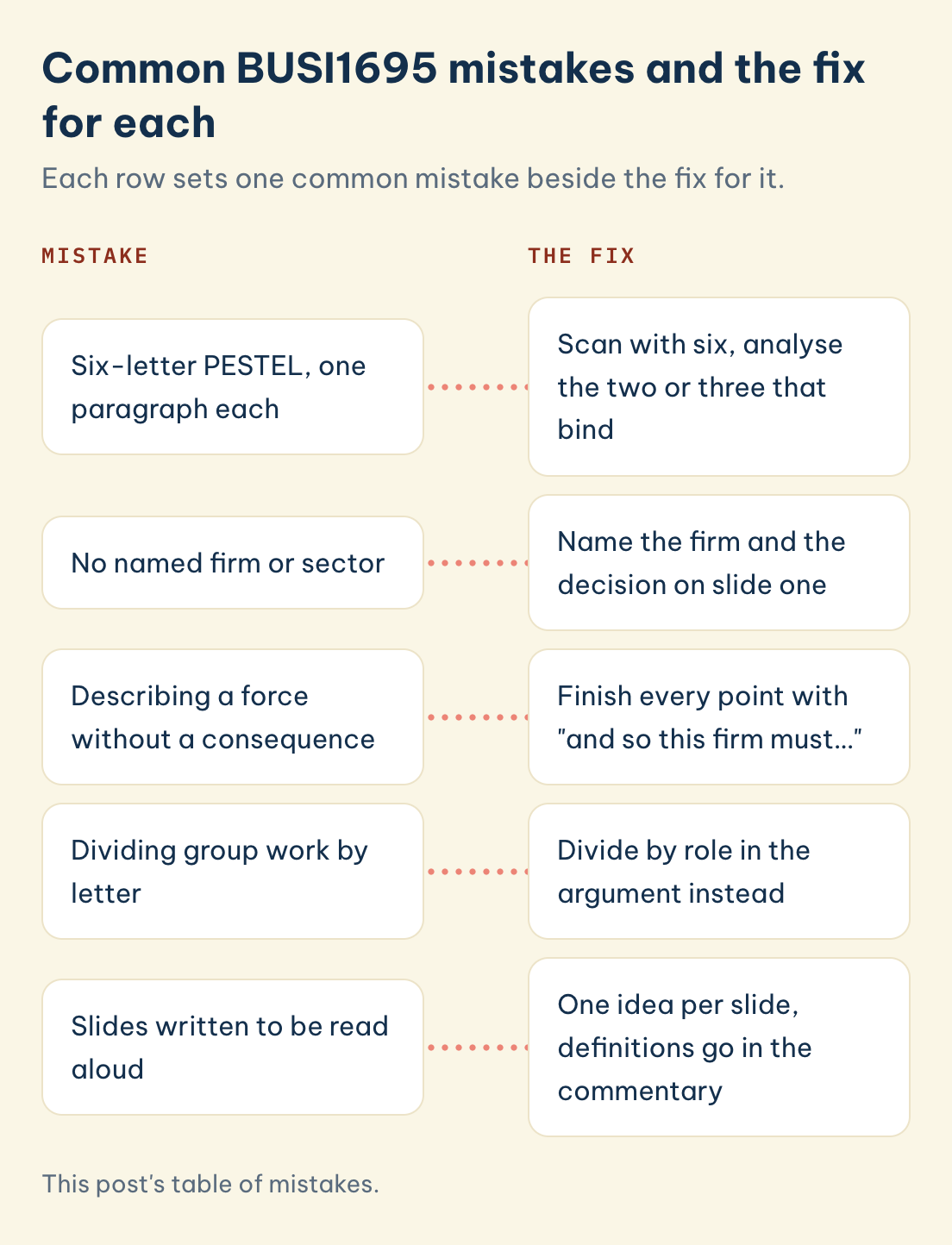
Common BUSI1695 mistakes and the fix for each
Each row sets one common mistake beside the fix for it.
Mistake
The fix
Six-letter PESTEL, one paragraph each
Scan with six, analyse the two or three that bind
No named firm or sector
Name the firm and the decision on slide one
Describing a force without a consequence
Finish every point with "and so this firm must…"
Dividing group work by letter
Divide by role in the argument instead
Slides written to be read aloud
One idea per slide, definitions go in the commentary
Save this figure
| Mistake | Why it costs marks | The fix |
|---|---|---|
| Six-letter PESTEL, one paragraph each | Satisfies LO1 only; never reaches analysis | Scan with six, analyse the two or three that bind |
| No named firm or sector | The learning outcome requires specificity | Name the firm and the decision on slide one |
| Describing a force without a consequence | Description is not analysis | Finish every point with "and so this firm must…" |
| Dividing group work by letter | Produces four talks, not one argument | Divide by role in the argument instead |
| Slides written to be read aloud | Undermines "visually effective" | One idea per slide; definitions go in the commentary |
Evidence: At Level 4, assessment is calibrated to test whether you can bridge from a taught framework to a specific real situation. Students rarely fail this module on knowledge; they lose marks by staying at the level of the framework itself.
Example: A student's slide read "Economic factors: inflation, exchange rates, interest rates, unemployment." Her mentor asked which of those four her company's board had actually discussed in its latest annual report. Only exchange rates appeared. Cutting the other three and spending the slide on currency exposure turned a definition slide into an analysis slide.
◆ Question 7 / 7 · Group work
How do you handle the group work fairly in BUSI1695?
Direct answer: Agree three things in your first meeting: who owns which part of the argument, a shared deadline that sits several days before the real one, and one person responsible for the deck's visual consistency. Most group presentations lose marks not because someone did nothing, but because four people made four sets of design choices and nobody rehearsed the joins between sections.
Evidence: Greenwich's published teaching plan states that students are tutored in the foundations of working as a team to deliver a common objective within a relatively short timescale, which signals that the collaboration itself is treated as a taught, assessed skill rather than a logistical inconvenience.
Example: A group of Vietnamese and British students in one MAAS session had divided the work perfectly but had never run the presentation end to end. In rehearsal they discovered two members had analysed different subsidiaries of the same parent company. 20 minutes of rehearsal a week earlier would have caught it; the day before, it cost them a rushed rewrite.
Frequently asked questions
Is BUSI1695 hard for a first-year module?
The content is accessible. The demand is that you apply it to something specific and present it as a team, which is a different kind of difficulty from an exam and one that rewards early planning far more than late effort.
Do I have to use PESTEL?
It is the natural scanning tool for this module and most students use it. What you should avoid is treating PESTEL as the structure of your whole analysis rather than as the first pass that tells you where to look closely.
Can our group choose any company?
Usually yes within the brief, but pick one where the external environment genuinely bit recently. A firm facing a live regulatory change or currency shock gives you something to analyse; a stable, comfortable firm gives you a description exercise.
How much detail should go on the slides?
Enough that a slide is legible from the back of the room and carries one idea. Everything else belongs in what you say. The outcome being marked is visual effectiveness, and dense slides work against it directly.
Can MAAS help me with BUSI1695?
MAAS mentors work with you on framing the decision, choosing which forces to analyse, and stress-testing the argument before you build the deck. You and your group remain the authors of the work; the mentor works on the argument, not on the slides.
Before your group opens PowerPoint
The groups that do well in this module rarely stand out for that research the most widely. What they share is that they that pick one firm, one decision and two or three forces that genuinely bear on it, and then spend their time making that argument land. If your group has the research but cannot see the spine yet, a MAAS mentor can work through the framing with you before you start building slides.
Talk to a MAAS mentor about your module
Related guides
References
- Ghemawat, P. (2001). Distance still matters: The hard reality of global expansion. Harvard Business Review, 79(8), 137–147.
- Hofstede, G. (2001). Culture's consequences: Comparing values, behaviors, institutions and organizations across nations (2nd ed.). SAGE.
- Johnson, G., Whittington, R., Regnér, P., Angwin, D., & Scholes, K. (2020). Exploring strategy: Text and cases (12th ed.). Pearson.
- Porter, M. E. (1980). Competitive strategy: Techniques for analyzing industries and competitors. Free Press.
- Quality Assurance Agency for Higher Education. (2024). The frameworks for higher education qualifications of UK degree-awarding bodies. https://www.qaa.ac.uk/docs/qaa/quality-code/the-frameworks-for-higher-education-qualifications-of-uk-degree-awarding-bodies-2024.pdf
Tools & resources
- University of Greenwich. (n.d.). Module information [Module catalogue entry]. Retrieved July 29, 2026, from https://www.gre.ac.uk/modules/modules?crse=1695&subj=BUSI&term=205000
- University of Greenwich. (n.d.). Academic skills. Retrieved July 29, 2026, from https://www.gre.ac.uk/students/support/academic-skills
This article is part of the MAAS Journal series for Vietnamese international students. MAAS Assignment & Essay Support is an academic support partner; we coach students through the Outline, Draft, Final delivery model with developmental feedback from discipline-matched experts. We do not write or submit work on a student's behalf.
A free 20-minute consultation is a conversation about where you are with BUSI1695.
Book a free consultation ▸