
◆ Business & Management
BUSI1314 Business Ethics: how do you write the essay that argues?
BUSI1314 Business Ethics at the University of Greenwich is assessed by a single individual essay, and that design punishes one habit above all others: summarising what ethical theories say instead of using them to reach a defensible judgement. Most students who lose marks here have read the material carefully. What they have not done is take a position and defend it against the strongest objection. Below are the questions MAAS mentors field most often from Vietnamese students taking it.

◆ Question 1 / 7 · The module
What is BUSI1314 Business Ethics about?
Direct answer: BUSI1314 is a Level 5 module in Greenwich Business School worth 15 credits, sitting in the Business, Operations and Strategy department. It gets you to reflect critically on the responsibility of a business organisation, its stakeholders, and your own potential role inside it. The module works through theories of ethical reasoning, covering Corporate Social Responsibility, Responsible Innovation, and surveillance capitalism.
Evidence: The module summary published in Greenwich's public module catalogue lists four learning outcomes: identify ethical issues and dilemmas in an organisational context; understand fundamental concepts and theories in business ethics; apply different positions of ethical reasoning to real-life problems; and discuss controversies surrounding the social responsibility of business. Notice the verbs escalate, identify, then understand, then apply, then discuss controversies. The final outcome is the one that carries the higher marks, and it is the one students most often skip. The Responsible Innovation strand draws on Von Schomberg (2013), and the surveillance-capitalism strand draws on Zuboff (2019), so both are worth reading before you pick a case for the essay.
Example: A Vietnamese student at Greenwich told her MAAS mentor that BUSI1314 was "the easy module because there is no maths". Her first draft explained utilitarianism, deontology and virtue ethics accurately across 900 words and then declared a company "unethical" in two sentences. Her mentor pointed at the fourth learning outcome: nothing in the draft discussed a controversy, it only reported theories. Reframing the essay around one contested question changed the draft's shape entirely.
◆ Question 2 / 7 · Assessment
What assessment does the BUSI1314 essay involve?
Direct answer: The module is assessed by one individual essay of 3,000 words carrying 100% of the module mark, with a 40% pass mark. The task requires you to apply theory to the practice of business ethics. There is also a formative element, a group drama performance on an ethical dilemma in an organisational context, which does not carry marks but is designed to surface how differently reasonable people read the same dilemma. Always confirm the exact task, deadline and weighting in your own module handbook and Moodle shell, since briefs are reissued each academic year.
Evidence: These figures come from the module summary Greenwich publishes openly in its course-modules catalogue, not from a third-party site. This matters. Assessment briefs circulating on assignment-selling websites are frequently out of date, attached to the wrong academic year, or attributed to the wrong university altogether, and building your plan on one of them is a real risk.
Example: A student came to a MAAS session with a "BUSI1314 brief" he had found through a search engine that asked for a 2,000-word report on a named company. His actual module handbook asked for a 3,000-word essay with a free choice of context. He had already written 1,400 words against the wrong task. Ten minutes of checking the official source at the start would have saved a week.
◆ Question 3 / 7 · Marking
How is BUSI1314 graded, what does the marking actually reward?
Direct answer: The essay is marked against the module's four learning outcomes, and the marks concentrate in the upper two. Identifying an ethical issue and explaining a theory correctly establishes competence, roughly the Pass to low Merit territory. The higher bands come from applying competing ethical positions to one concrete problem and then discussing the controversy honestly, including the objections to your own view. The single most reliable way to move up a band is to stop treating the theories as a list to be introduced and start treating them as rival answers to one question you have posed.
Evidence: UK Level 5 assessment criteria across business schools are criterion-referenced, meaning your work is judged against published descriptors rather than ranked against classmates, and the descriptors separating bands at this level turn on the words "critical" and "evaluate" rather than on coverage or length. This is why a longer essay that explains more theories routinely scores below a shorter essay that argues one case well.
Example: A MAAS mentor asked a Vietnamese student to highlight in her draft every sentence that contained a judgement rather than a description. She found four, out of roughly ninety. The evidence, the reading and the case were all sound; the essay simply never committed. Rewriting around a single arguable claim, with the same sources, moved the work up two bands.
◆ Question 4 / 7 · Frameworks
Which frameworks should you use in the BUSI1314 essay?
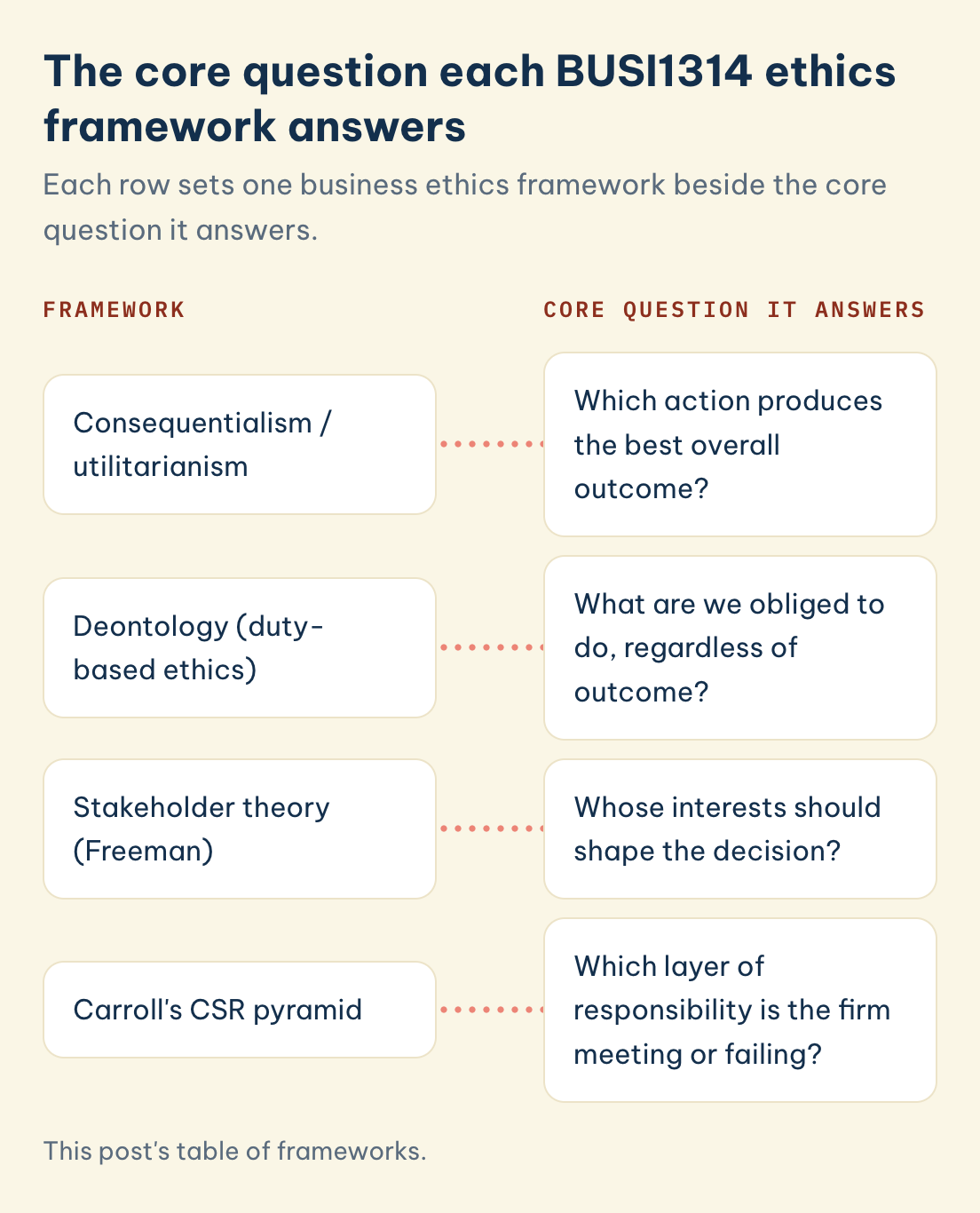
Direct answer: Use two or three frameworks properly rather than six superficially. For this module the most productive pairing is a normative lens (how should we decide?) combined with a stakeholder or CSR lens (whose interests count, and how far?). The table below sets out the four that map most directly onto the module's stated content.
The core question each BUSI1314 ethics framework answers
Each row sets one business ethics framework beside the core question it answers.
Framework
Core question it answers
Consequentialism / utilitarianism
Which action produces the best overall outcome?
Deontology (duty-based ethics)
What are we obliged to do, regardless of outcome?
Stakeholder theory (Freeman)
Whose interests should shape the decision?
Carroll's CSR pyramid
Which layer of responsibility is the firm meeting or failing?
Save this figure
| Framework | Core question it answers | Best used when |
|---|---|---|
| Consequentialism / utilitarianism | Which action produces the best overall outcome? | The harms and benefits are measurable and spread across many people |
| Deontology (duty-based ethics) | What are we obliged to do, regardless of outcome? | Rights, consent or transparency are at stake |
| Stakeholder theory (Freeman) | Whose interests should shape the decision? | The case involves competing legitimate claims on the firm |
| Carroll's CSR pyramid | Which layer of responsibility is the firm meeting or failing? | You need to separate legal compliance from ethical and philanthropic duty |
Evidence: Freeman (1984) defined a stakeholder as any group or individual who can affect, or is affected by, the achievement of an organisation's purpose, which reframed the firm's obligations away from shareholders alone. Carroll (1991) then arranged corporate responsibilities into economic, legal, ethical and philanthropic layers, giving you a vocabulary for saying precisely where a firm's conduct sits, and he draws the philanthropic line precisely: "Communities desire firms to contribute their money, facilities, and employee time to humanitarian programs or purposes, but they do not regard the firms as unethical if they do not provide the desired level" (Carroll, 1991). Friedman (1970) is the standing counter-position, that the social responsibility of business is to increase its profits within the rules of the game, and an essay that never engages him has not really discussed the controversy. Crane et al. (2019) is the standard textbook survey of this whole field if you need a single source that walks through each framework in turn.
Example: A Vietnamese student analysing a fast-fashion supply chain applied five frameworks in 3,000 words, giving each about 300 words of explanation and almost none of application. Her mentor cut it to two, stakeholder theory to establish which claims on the firm were legitimate, and Carroll to show the firm satisfied the legal layer while failing the ethical one. The word count freed up went into the objection she had previously ignored.
◆ Question 5 / 7 · Essay structure
How should you structure the BUSI1314 essay?
Direct answer: Structure it as an argument, not as a tour of the syllabus. A structure that consistently works at 3,000 words: (1) introduction that names one contested question and states your position, around 300 words; (2) the case or context, kept tight at roughly 400 words; (3) analysis through your first framework, around 700 words; (4) analysis through your second framework, around 700 words; (5) the strongest objection to your position and your response to it, around 600 words; (6) conclusion that answers the question you posed, around 300 words. The section most students omit is number five, and it is where the higher bands live.
Evidence: The module's fourth learning outcome asks you to discuss controversies surrounding the social responsibility of business. A controversy is by definition two-sided. An essay with no section devoted to the opposing view has structurally excluded the outcome that carries the most credit, no matter how well the rest is written.
Example: A student argued that a technology firm's data practices were ethically indefensible and wrote 2,400 strong words to that effect. His mentor asked what the firm's own best defence would be. He had never considered it. Adding 600 words that stated the commercial and consent-based counter-argument, and then explained why he still found it insufficient, made the whole essay read as judgement rather than assertion.
◆ Question 6 / 7 · Common mistakes
What are the most common mistakes that lose marks in BUSI1314?
Direct answer: These common mistakes are the patterns MAAS mentors see in almost every draft for modules of this type.
| Mistake | Why it costs marks | The fix |
|---|---|---|
| Theory tour: explaining every ethical theory in turn | Meets outcome 2, ignores outcomes 3 and 4 | Pose one question; treat theories as rival answers to it |
| Describing the company at length | Context is not analysis | Cap the case section at around 400 words |
| Asserting a verdict without argument | "This is unethical" is a claim, not a judgement | Show the reasoning that gets you there |
| No counter-argument | Structurally excludes the highest-credit outcome | Reserve a full section for the strongest objection |
| Treating CSR and ethics as synonyms | They answer different questions | Use Carroll to separate the layers explicitly |
| Sources that are all websites | Weakens academic credibility | Anchor each framework in its original scholarly source |
Evidence: The gap between a competent and a strong essay at Level 5 is rarely a knowledge gap. Students who can name and define four ethical theories accurately already possess the content; what separates the bands is whether that content is deployed to settle a question or merely displayed.
Example: One student's draft opened with "Business ethics is very important in today's globalised world." Her mentor asked what the sentence ruled out, since no reader would disagree with it. She replaced it with a specific contested claim about whether a firm's compliance with the law discharged its ethical duty. The rest of the essay tightened around that claim on its own.
◆ Question 7 / 7 · Length and referencing
How long is the BUSI1314 essay and what referencing style does it use?
Direct answer: The essay is 3,000 words and carries the whole module mark. Greenwich Business School work is normally submitted in Harvard style, but referencing conventions vary by school and by module, so confirm the required style in your module handbook rather than assuming. Whichever style applies, every in-text citation must appear in the reference list and every reference-list entry must be cited in the text.
Evidence: Referencing at this level is assessed as part of academic writing quality, and it also functions as a credibility signal for the argument itself. Citing Freeman (1984) directly for stakeholder theory reads very differently from citing a summary blog that paraphrases him, particularly in a module about integrity.
Example: A Vietnamese student had cited a lecture slide deck for Carroll's pyramid throughout her essay. Her MAAS mentor asked her to find and read the original 1991 article. She discovered that the philanthropic layer was framed as "desired" rather than "expected", a distinction her argument had been getting wrong for eight paragraphs.
Frequently asked questions
Is BUSI1314 a hard module?
It is not difficult in the sense of technical content, and that is exactly why students underestimate it. The difficulty is that the whole mark rests on one 3,000-word essay, and that essay rewards a skill, sustained ethical argument, which is rarely assessed elsewhere on a business degree.
Can I write about a well-known company like Amazon or Shein?
Yes, and many strong essays do. The risk with a very familiar company is that abundant material tempts you into description. If you choose one, discipline yourself to the word cap on the case section and spend the space on the argument instead.
How many ethical theories should I include?
Two or three, applied properly. An essay that applies two frameworks to one problem in depth consistently outperforms one that introduces five and applies none.
Do I need to agree with one theory and reject the others?
No. You need to reach a defensible position and show that you understood what the strongest opposing view would say. A conclusion that acknowledges genuine tension is stronger than one that pretends the answer was obvious.
Can MAAS help me with BUSI1314?
MAAS mentors work with you on planning, framework selection and developmental feedback across the Outline, Draft and Final stages. You remain the author of your essay; the mentor's role is to test your reasoning and show you where an examiner would push back.
Where to start if the reading is done but the argument is not
Reading widely is not what separates the strong essays here. What separates them is deciding early what you are arguing, then spending 3,000 words earning that claim against a serious objection. If you have the reading done but cannot see the argument yet, a MAAS mentor can work through the framing with you before you commit words to the page.
Talk to a MAAS mentor about your module
Related guides
References
- Carroll, A. B. (1991). The pyramid of corporate social responsibility: Toward the moral management of organizational stakeholders. Business Horizons, 34(4), 39–48. https://doi.org/10.1016/0007-6813(91)90005-G
- Crane, A., Matten, D., Glozer, S., & Spence, L. (2019). Business ethics: Managing corporate citizenship and sustainability in the age of globalization (5th ed.). Oxford University Press.
- Freeman, R. E. (1984). Strategic management: A stakeholder approach. Pitman.
- Friedman, M. (1970). The social responsibility of business is to increase its profits. The New York Times Magazine.
- Von Schomberg, R. (2013). A vision of responsible research and innovation. In R. Owen, J. Bessant, & M. Heintz (Eds.), Responsible innovation: Managing the responsible emergence of science and innovation in society (pp. 51–74). Wiley. https://doi.org/10.1002/9781118551424.ch3
- Zuboff, S. (2019). The age of surveillance capitalism: The fight for a human future at the new frontier of power. PublicAffairs.
Tools & resources
- University of Greenwich. (n.d.). Module information [Module catalogue entry]. Retrieved July 29, 2026, from https://www.gre.ac.uk/modules/modules?crse=1314&subj=BUSI&term=205000
- University of Greenwich. (n.d.). Academic skills. Retrieved July 29, 2026, from https://www.gre.ac.uk/students/support/academic-skills
This article is part of the MAAS Journal series for Vietnamese international students. MAAS Assignment & Essay Support is an academic support partner; we coach students through the Outline, Draft, Final delivery model with developmental feedback from discipline-matched experts. We do not write or submit work on a student's behalf.
A free 20-minute consultation is a conversation about where you are with BUSI1314.
Book a free consultation ▸