
◆ Engineering
MECH371: how do you approach Analysis and Design of Control Systems?
MECH 371 Analysis and Design of Control Systems is a 3.75-credit course in the Mechanical Engineering core at Concordia University, and it is the gateway to at least seven later courses that list it as a prerequisite. Its prerequisites and its place in the degree changed in the 2026-2027 calendar, so older notes can mislead. This guide sets out how MAAS mentors read the course, for Vietnamese engineering students in Montreal who need a clear method before the first lab report.
◆ Question 1 / 8 · What it covers
What does MECH 371 cover, and who has to take it?
Direct answer: MECH 371 teaches how to model a dynamic system, predict how it responds, and design a feedback controller that makes it behave well. It sits in the Mechanical Engineering core of the BEng, so mechanical students take it, and it also feeds several aerospace and mechatronics courses.
Evidence: The 2026-2027 Undergraduate Calendar lists the course at 3.75 credits, with 3 hours of lecture and 1 hour of tutorial every week, plus a laboratory of 3 hours on alternate weeks. The prerequisites are PHYS 205, ENGR 243 and ENGR 311. The calendar says the lab "presents the opportunity to experiment with actual control systems hardware", and the topic list runs from modelling of mechanical and electrical elements through block diagrams, time domain analysis, linearization, transfer functions and stability, to the root-locus method, frequency response, PID-controller design and computer-aided design in Matlab and Simulink. A February 2026 curriculum letter from the department added a note on timing: MECH 371 now carries the prerequisites above, MECH 370 was removed from the Mechanical core, and MIAE 383 (3.50 credits) was added.
Example: Åström and Murray (2021) describe their field as the study of how feedback lets a system be insensitive both to external disturbances and to variations in its own parts, while also warning that feedback can cause oscillations or runaway behaviour. That tension, benefit against instability, is the single idea the whole course builds on.
◆ Question 2 / 8 · Grading
How is MECH 371 graded, and what pass rule applies?
Direct answer: Check your own section's outline in the first week, because the weights are not published in one stable place. The sources we found disagree with each other, and none of them is the current outline for your term, so do not plan around any single percentage you read online.
Evidence: An undated instructor page for the course still lists a 2001-era textbook and gives a final exam of 60%, a midterm of 25%, laboratory work of 10% and assignments of 5%. A Google AI summary gathered on 7 October 2026 gave a different split, with a midterm of about 30%, a final of about 50%, assignments of about 10% and lab reports of about 10%, and Perplexity gave no split at all. Two of the three give the final exam at least half the grade, which is plausible for a course taught this way, but plausible is not verified. We also found no public statement of a "pass the final to pass the course" rule for MECH 371; that rule is documented for other Concordia courses, such as ENGR 391, and should not be assumed here.
| Source | Final | Midterm | Lab | Assignments | Status |
|---|---|---|---|---|---|
| Undated instructor page | 60% | 25% | 10% | 5% | Old, textbook from 2001 |
| Google AI summary, 7 Oct 2026 | about 50% | about 30% | about 10% | about 10% | Unverified |
| Concordia calendar | Not stated | Not stated | 3 h on alternate weeks | Not stated | Official, no weights |
Example: A student who reads "final 60%" on an old page and skips the lab reports can be surprised, because the lab is a separate component that exists in every version of the outline we saw. Treat the outline you receive in week one as the only authority.
◆ Question 3 / 8 · Exam topics
Which topics carry the exam, and how should you study them?
Direct answer: Stability and the two design methods that follow from it, root locus and frequency response, are the spine of the course. Learn the order in which the tools build on one another, because each later method assumes you can already find the closed-loop poles of the one before.
Evidence: The older instructor outline orders the content in eight blocks: introduction, systems modelling with Laplace transforms and block diagrams, performance and steady-state error, stability with the Routh-Hurwitz criterion, the root-locus method, frequency response with Nyquist plots, gain and phase margins with the Nichols chart, and feedback system design with phase-lag, phase-lead and PID compensators. That sequence still matches the calendar's current topic list. ChatGPT, asked the same question on 7 October 2026, named the same pillars in its own headings, and Google AI Mode's heading for the study plan was "Master the Core Topics (The Exam Pillars)".
| Block | What you must be able to do | Typical slip |
|---|---|---|
| Modelling | Turn a mechanical or electrical system into a transfer function | Wrong sign in the Laplace transform of a derivative |
| Time response | Read overshoot, settling time and steady-state error from a model | Applying a second-order formula to a higher-order system |
| Stability | Build a Routh array and count right-half-plane poles | Dropping a row after a zero in the first column |
| Root locus | Sketch the branches as gain K rises from 0 | Forgetting the real-axis segments rule |
| Frequency response | Read gain and phase margin from a Bode plot | Quoting margin at the wrong crossover frequency |
| Design | Choose lead, lag or PID to meet a specification | Designing before writing the specification down |
Example: A useful self-test is to take one plant and solve it three ways, with a Routh array, a root locus and a Bode plot, then check that all three agree on the stable range of gain. Disagreement points to an arithmetic slip, and finding it yourself is faster than finding it in an exam.
◆ Question 4 / 8 · Choosing a method
How do you choose between root locus, Bode and PID?
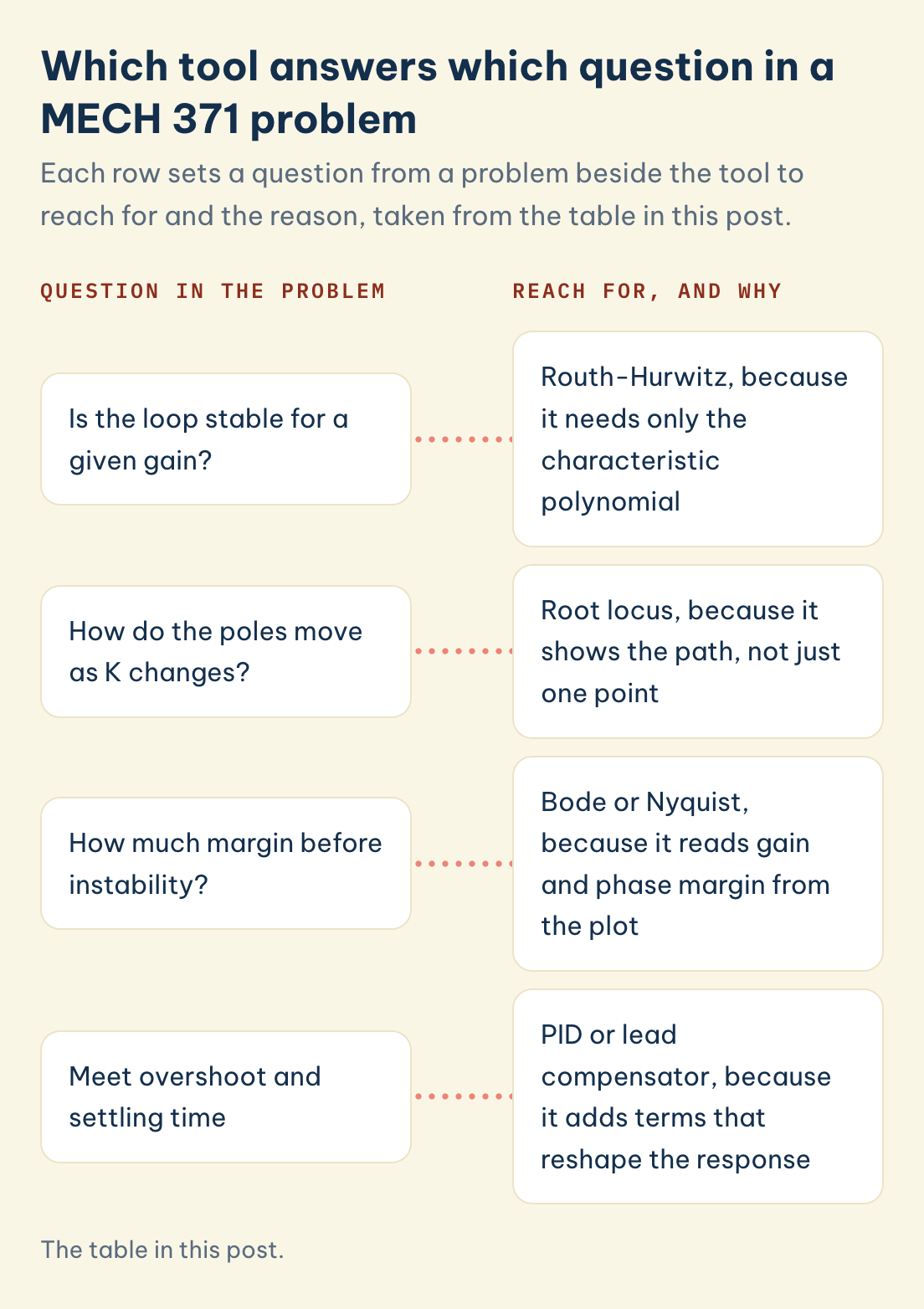
Direct answer: Ask what you know and what you can change. Root locus shows how closed-loop poles move as one gain changes, Bode plots show stability margins from frequency data, and PID is the controller structure you will most often tune with either. Pick the tool that answers the specific question in the problem.
Which tool answers which question in a MECH 371 problem
Each row sets a question from a problem beside the tool to reach for and the reason, taken from the table in this post.
Question in the problem
Reach for, and why
Is the loop stable for a given gain?
Routh-Hurwitz, because it needs only the characteristic polynomial
How do the poles move as K changes?
Root locus, because it shows the path, not just one point
How much margin before instability?
Bode or Nyquist, because it reads gain and phase margin from the plot
Meet overshoot and settling time
PID or lead compensator, because it adds terms that reshape the response
Save this figure
Evidence: Åström and Murray state that "Proportional-integral-derivative (PID) control is by far the most common way of using feedback in engineering systems" (Åström & Murray, 2021, p. 11-1). Chapter 1 of the same book adds that more than 95% of industrial control problems are solved by PID, although many of those controllers are actually PI (p. 1-19). Page labels here follow the free electronic edition of the book, whose pagination differs from the print edition. They also cite a Desborough and Miller survey of more than eleven thousand controllers in refining, chemicals and pulp and paper, in which 97% of regulatory controllers used a PID algorithm. Åström and Hägglund (2001) reviewed the state of the art of PID control, covering specifications, stability, design and performance. For a student, the point is practical: PID design is the part of the course you can expect to meet again in industry.
| Question in the problem | Reach for | Why |
|---|---|---|
| Is the loop stable for a given gain? | Routh-Hurwitz | Needs only the characteristic polynomial |
| How do the poles move as K changes? | Root locus | Shows the path, not just one point |
| How much margin before instability? | Bode or Nyquist | Reads gain and phase margin from the plot |
| Meet overshoot and settling time | PID or lead compensator | Adds terms that reshape the response |
Example: A PID controller adds three terms: the proportional term depends on the present error, the integral term on past errors and the derivative term on anticipated future errors (Åström & Murray, 2021). Naming which term fixes which defect, for instance integral action removing steady-state error, is the kind of reasoning that earns marks beyond a correct gain.
◆ Question 5 / 8 · MATLAB and Simulink lab
How do you handle the MATLAB and Simulink lab work?
Direct answer: Prepare the simulation before the lab session, not after it. The calendar places the lab on alternate weeks, so each session is scarce, and a model you have already run lets you spend the hardware time comparing prediction with measurement.
Evidence: The calendar names computer-aided controller design in Matlab and Simulink as part of the course content. The AI engines we queried cited a Concordia lab manual with five experiments on a DC motor servo trainer, but we did not open that manual and cannot confirm its contents, so check the version your section uses. Dormido (2004) reviews how simulation, virtual laboratories and remote laboratories are used in control education, and the debate it reflects, between hardware and simulated labs, explains why your lab report is expected to discuss the gap between the two.
Example: When a measured step response overshoots more than the simulation predicted, the gap is the finding. A strong discussion section names a plausible cause, such as friction, actuator saturation or sensor noise, then says how you would test it, rather than reporting that the results "differ slightly".
◆ Question 6 / 8 · Midterm and final
How should you prepare for the midterm and final?
Direct answer: Build one page per method, with the setup, the formula, the common error and one worked case, then practise under time pressure without notes. The engines we checked agree on one point, that problem practice beats rereading, and our own advice is to time yourself by method rather than by topic.
Evidence: Perplexity's summary advised redoing each worked example within 24 hours and doing 5 to 10 problems per topic, and ChatGPT's section on exam strategy and its warning about "the biggest mistake to avoid" point the same way. These are AI summaries, not Concordia policy, so use them as study technique only. Google's related searches for the course, "Mech 371 midterm" and "Mech 371 final", show that students look for past tests; ask your instructor which past material is allowed, since some courses restrict it.
Example: Spend the first five minutes of any control question writing the closed-loop transfer function and the characteristic equation. Almost every later step, whether Routh, root locus or margins, starts from that equation, and writing it first also shows the marker your method even if a later arithmetic step goes wrong.
◆ Question 7 / 8 · What it unlocks
What does passing MECH 371 unlock?
Direct answer: It opens the control and mechatronics half of the Mechanical program. At least seven later courses list MECH 371, sometimes as an alternative to another control course, among their prerequisites, so a weak result here narrows your options in the senior years.
Evidence: The department's course sequence, compiled in April 2026, lists MECH 373 Instrumentation and Measurements (3.50 credits), MECH 375 Mechanical Vibrations (3.50) and MECH 463 Fluid Power Control (3.50, with ENGR 361) as accepting it (alone or with an alternative such as MECH 370 or AERO 371) as a prerequisite, alongside MECH 472 Mechatronics and Automation (3.50), MECH 473 Control System Design (3.50), MECH 474 Mechatronics (3.75) and AERO 480 Flight Control Systems (3.50). The department's sequence page adds a transition rule for the curriculum change: a student who completed MECH 370 by Winter 2026 takes MECH 371 and does not need MIAE 383, while one who did not takes both MECH 371 and MIAE 383.
Example: A student planning a mechatronics elective in third year should map the prerequisite chain in second year, because MECH 371 itself needs ENGR 311 and ENGR 243 first. Missing one link can delay the whole sequence by a term, which is a scheduling cost that has nothing to do with ability.
◆ Question 8 / 8 · Common errors
What do students most often get wrong?
Direct answer: Three errors recur: designing before specifying, trusting a single method without a cross-check, and treating the lab report as a results list. Each is a reasoning error rather than an arithmetic slip, so each costs marks even when every calculation in the answer is correct.
Evidence: The calendar's own wording explains the pattern. It frames the course as "the basic understanding of control system theory and its role in engineering design", and it lists design in Matlab and Simulink as a topic, so the work is judged on whether your design meets a stated specification, not only on whether your algebra is clean. A specification written first, for example "overshoot under 10% and settling time under 2 seconds", gives you a test your answer must pass.
Example: A student who finds a gain by trial and error in Simulink has a number but not a justification. Adding the root-locus or Bode argument that predicts the gain range turns a lucky result into a defensible design, and that argument is exactly what the marker is looking for.
Frequently asked questions
Which university offers MECH 371 Analysis and Design of Control Systems?
Concordia University in Montreal, in the Gina Cody School of Engineering and Computer Science. Other institutions reuse the code MECH 371 for unrelated courses, so confirm the title before using study material.
How many credits is MECH 371?
It is worth 3.75 credits, with 3 hours of lecture and 1 hour of tutorial each week and a 3-hour lab on alternate weeks, according to the 2026-2027 Undergraduate Calendar.
What are the prerequisites?
PHYS 205, ENGR 243 and ENGR 311, per the 2026-2027 calendar and the department's February 2026 curriculum letter.
Is the grading the same in every section?
Not necessarily, and we could not find a current public outline with weights. An older instructor page and an AI summary gave different splits, so use the outline your instructor publishes.
What software does the course use?
Matlab and Simulink, according to the calendar description.
Related reading
- ENGR391 Numerical Methods in Engineering: another Concordia engineering course where the method choice has to be justified
- ENGR301 Engineering Management Principles and Economics: the engineering core course taught by a different department
- MECH343 Heat Transfer and Aerodynamics: a mechanical course where the numerical check matters as much as the number
- How to revise for final exams effectively: timed practice before a heavily weighted final
Where MAAS fits
- Subject tutoring, one to one: 60 or 90 minute sessions with a tutor matched to your subject area, useful for working through a method you cannot yet explain. Tutoring is advisory, so it carries no grade target; if the tutor is not the right fit, you can ask to change expert
- Coursework and assignment support: developmental feedback on your own draft through the Outline, Draft, Final model with a discipline-matched expert
- Course-code assignment coaching: how MAAS mentors approach any unit assignment
References
- Åström, K. J., & Hägglund, T. (2001). The future of PID control. Control Engineering Practice, 9(11), 1163–1175. https://doi.org/10.1016/S0967-0661(01)00062-4
- Åström, K. J., & Murray, R. M. (2021). Feedback systems: An introduction for scientists and engineers (2nd ed.). Princeton University Press. https://fbsbook.org
- Dormido, S. (2004). Control learning: Present and future. Annual Reviews in Control, 28(1), 115–136. https://doi.org/10.1016/j.arcontrol.2003.12.002
Tools & resources
- Concordia University. (2026). Mechanical engineering courses. In Undergraduate calendar 2026-2027. https://www.concordia.ca/academics/undergraduate/calendar/current/section-71-gina-cody-school-of-engineering-and-computer-science/section-71-60-engineering-course-descriptions/mechanical-engineering-courses.html
- Concordia University. (2026). Course sequences for Mechanical Engineering (BEng). https://www.concordia.ca/ginacody/mechanical-industrial-aerospace-eng/programs/mechanical-eng/bachelor-course-sequences.html
- Concordia University. (2026). Important notes and curriculum changes in the 2026-2027 UG calendar: Mechanical [Curriculum letter]. https://www.concordia.ca/content/dam/ginacody/miae/docs/undergraduate/Curriculum%20letters/2026-02-Curriculum_Letter_MECH.pdf
This article is part of the MAAS Journal series for Vietnamese international students. MAAS Assignment & Essay Support is an academic support partner; we coach students through the Outline, Draft, Final delivery model with developmental feedback from discipline-matched experts. We do not write or submit work on a student's behalf.
A free 20-minute consultation is a conversation about where you are with MECH371.
Book a free consultation ▸