
MECH343 Heat Transfer and Aerodynamics at the University of Wollongong is assessed partly through two separate group assignments, and it covers two physically distinct bodies of theory under one subject code. Students who treat it as a single topic tend to prepare for half of it. This guide sets out how MAAS mentors read a MECH343 task.
Author: MAAS Editorial Team
Last updated: 2026-09-22
Category: engineering
What is MECH343 Heat Transfer and Aerodynamics about?
Direct answer: MECH343 is a 300-level, 6 credit point subject in UOW's School of Engineering, inside the Faculty of Engineering and Information Sciences. It combines conduction, convection, heat exchangers and radiation with boundary layer flow, flow around immersed bodies and one-dimensional compressible flow, and it carries the Embedded WIL designation.
Evidence: The 2026 UOW Course Handbook lists the coverage as one and two dimensional heat conduction, forced convection, heat exchangers, radiation, boundary layer flows, flow around immersed bodies, one dimensional compressible flow with and without heat transfer, normal shock waves, and compressible flow in pipes. The prescribed text is Bergman et al., Fundamentals of Heat and Mass Transfer, eighth edition, John Wiley, 2017.
Example: A MAAS mentor once asked a student to list the subject's topics from memory before an assignment briefing. He named six, and all six were heat transfer. The compressible flow half of the subject, which carries its own learning outcomes, had not registered as part of the same course at all.
Is this the same MECH343 taught at Concordia?
Direct answer: No, and this is the single most expensive mistake available in this subject. Concordia University in Montreal uses the code MECH 343 for Theory of Machines, a mechanisms and kinematics subject with no overlap with heat transfer or aerodynamics. Confirm the subject title, not just the code, before using any study material.
Evidence: Search results for the bare code are dominated by Concordia material, including lab manuals and assignment overview documents for Theory of Machines. Note-sharing sites index by code rather than by institution, so a search that looks like it found your subject can return a different subject entirely. The UOW subject is identified by the title Heat Transfer and Aerodynamics, School of Engineering, subject level 300.
Example: A student once worked through most of a downloaded lab manual before noticing that nothing in it mentioned heat. The manual was competent and complete. It was also for kinematics of mechanisms at a university on another continent.
What do the learning outcomes actually ask for?
Direct answer: They ask for four different verbs, and only one of them is calculation. The published outcomes move from understanding processes, to analysing problems, to designing equipment, to predicting rates across varied industrial contexts. A submission that only computes is answering one outcome out of five.
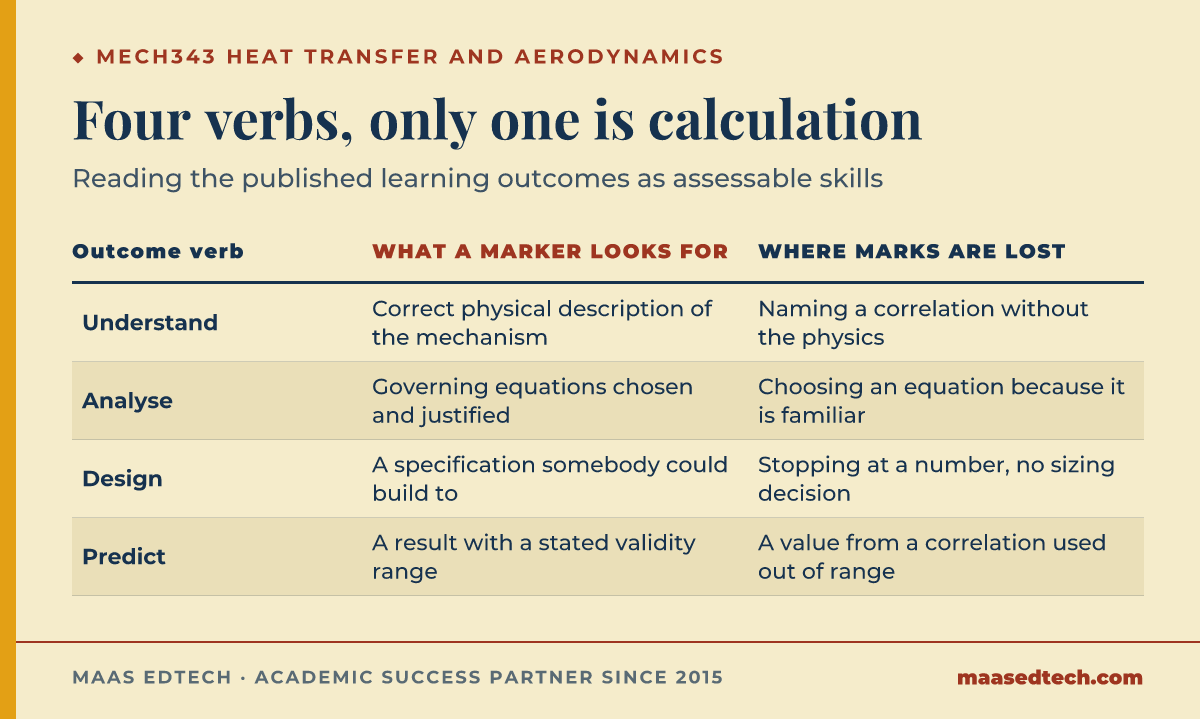
Evidence: UOW's 2026 handbook states that on completion students will be able to "Design simple thermal devices and equipment such as heat exchangers and furnace wall insulation" and to "Predict heat transfer rates in a wide variety of industrial equipment and processes". Two further outcomes cover compressible gas flow in pipes and nozzles and fluid flow in materials processing applications. Design and prediction are assessable skills distinct from solving a set problem.
| Outcome verb | What a marker looks for | Where students lose marks |
|---|---|---|
| Understand | Correct physical description of the mechanism | Naming a correlation without saying what physically happens |
| Analyse | Governing equations chosen and justified | Choosing an equation because it is familiar |
| Design | A specification somebody could build to | Stopping at a number with no sizing decision |
| Predict | A result with a stated validity range | A value quoted to five figures from a correlation used outside its range |
Example: A group produced a correct heat exchanger calculation and lost most of the design marks because they never specified anything. Their mentor asked one question: what would a workshop build from this page? The numbers stayed the same and the submission gained an area, a configuration and a material.
How should a group split two assignments?
Direct answer: Split by sub-problem with deliberate overlap, never by handing one person the whole thermal half and another the whole flow half. Each member should be able to explain the full solution, because the two halves of this subject meet inside single problems such as compressible flow with heat transfer.
Evidence: The handbook lists Group Assignment 1 and Group Assignment 2 as separate assessment components alongside quizzes and a final exam, so group work is not incidental to this subject. The coverage itself includes one dimensional compressible flow with and without heat transfer, which means a clean split along the two topic halves cuts directly through a problem class the subject explicitly teaches.
Wright (2018) documented a themed collaborative project in mechanical engineering thermodynamics where the group work was structured around a shared problem rather than parcelled out, and reported improved final exam performance alongside limited student enthusiasm for the software involved. The structure of the collaboration, not the fact of it, is what did the work.
Example: One group divided the work so cleanly that nobody could answer a question about the interface between the two analyses. Their mentor made them swap sections and re-derive each other's key step. The redraft took an afternoon and caught a units error that had survived three internal reviews.
How do you state assumptions so they earn marks?
Direct answer: State each assumption where it is used, say what it buys you, and say when it would break. Steady state, incompressible flow, constant properties and negligible radiation are the common four, and listing them without conditions reads as a template rather than as engineering judgement.
Evidence: Open-ended engineering problems are precisely where assumption-making becomes assessable. Douglas et al. (2012) studied how students tackle problems with no single correct answer and framed the difficulty as moving beyond formulas and fixations, a phrase that names the failure mode directly: reaching for a remembered equation instead of reasoning about the physical situation in front of you.
Example: A student wrote "assume constant properties" at the top of a solution where the temperature range was wide enough to change viscosity substantially. The assumption was not wrong so much as unexamined. Adding one sentence on the property evaluation temperature turned a flagged line into a credited one.
How do you check a correlation before you trust it?
Direct answer: Check three things every time: the geometry the correlation was derived for, the Reynolds number range it covers, and the Prandtl number range it covers. A correlation applied outside its validity range produces a confident number that is simply wrong, and markers look for the check rather than the number.
Evidence: Bergman et al. publish validity conditions alongside each correlation for exactly this reason. The same discipline applies to numerical work, where mesh independence and convergence criteria play the role that a validity range plays for a correlation. Verifying a method on a simpler case with a known solution, such as flow over a flat plate, is the cheapest check available and the one most often skipped.
Example: A group reported a convection coefficient to four significant figures from a correlation whose stated range stopped well below their Reynolds number. Their mentor did not correct the arithmetic, because the arithmetic was fine. The fix was a sentence acknowledging the extrapolation and a second estimate from a correlation that did cover the range.
Why does the report matter as much as the analysis?
Direct answer: Because a group submission is read as one document by one marker, and four stitched-together writing styles signal four uncoordinated analyses even when the engineering is sound. Number your equations, reference them in the text, label every axis with units, and have one person edit the whole thing last.
Evidence: Research on thermal-fluids teaching points to how students engage with problems, not only whether they solve them. Studying small-group conversations in thermal fluid transport courses, Melsky and colleagues reported that "students exhibited more instances of positive engagement and drew more connections between thermal fluid concepts and the world around them when discussing personalized problems as compared to when discussing non-personalized problems" (Melsky et al., 2023, p. 457). Connection-making is the part a report either makes visible or hides.
Example: A group's report had three different symbols for the same heat transfer coefficient across four sections. The analysis was consistent. The document was not, and the marker's comments spent more words on the confusion than on the engineering.
A practical order of work
Direct answer: Define and sketch the system, list knowns and boundary conditions, identify the governing principles, state assumptions, split into sub-problems, calculate, verify against a known case, then write. Writing last is deliberate, because the discussion section is where the marks concentrate and it cannot be drafted before results exist.
Evidence: Reversing this order produces the most common failure at 300 level, a report whose introduction promises an analysis the body never performs. The mismatch is easy for a marker to spot because the introduction reads as generic while the analysis is specific.
Example: One group kept a shared running list of every modelling choice with one line on why. By the time they reached the discussion section, it was already half written, and it was the strongest part of their submission.
Frequently asked questions
Which institution offers this MECH343?
The University of Wollongong, where the 2026 handbook records it as Heat Transfer and Aerodynamics, a 300-level subject worth 6 credit points in the School of Engineering. Concordia University uses the same code for Theory of Machines, an unrelated subject, so check the title.
What is the prescribed textbook?
Bergman et al., Fundamentals of Heat and Mass Transfer, eighth edition, published by John Wiley in 2017, as listed in the 2026 handbook. The handbook also directs students to the Subject Outline for current textbook information.
How is MECH343 assessed?
The 2026 handbook lists quizzes, Group Assignment 1, Group Assignment 2, and a final exam. Weightings depend on campus, delivery mode and session, so take them from your own Subject Outline rather than from any guide.
Does the subject include practical elements?
It carries the Embedded WIL designation, meaning it contains activities that relate to or simulate professional practice. That is one reason the design and prediction outcomes matter as much as the calculation ones.
How much compressible flow is there?
Enough that two of the five learning outcomes concern it, covering gas flow in pipes and nozzles, normal shock waves, and fluid flow in materials processing. Preparing only the heat transfer half leaves a substantial part of the subject unaddressed.
Where does this subject sit in the degree?
It is a 300-level subject in the mechanical engineering sequence at UOW. Enrolment rules are restated each academic year, so check the prerequisites published for your year rather than an older handbook version.
Related reading
- ACCY201 Advanced Financial Accounting: a different discipline, same habit of recording judgements as you make them
- How to write a reflection essay: useful if your subject includes a reflective component
- ENGR391 Numerical Methods in Engineering: the convergence and error checks that sit behind any numerical result in a thermal-fluids report
Where MAAS fits
- Coursework and assignment support: developmental feedback on your own draft through the Outline, Draft, Final model with a discipline-matched expert
- Subject tutoring, one to one: 60 or 90 minute sessions with a tutor matched to your subject area. Tutoring is advisory, so it carries no grade target; if the tutor is not the right fit, you can ask to change expert
- Course-code assignment coaching: how MAAS mentors approach any unit assignment
References
- Douglas, E. P., Koro-Ljungberg, M., McNeill, N. J., Malcolm, Z. T., & Therriault, D. J. (2012). Moving beyond formulas and fixations: Solving open-ended engineering problems. European Journal of Engineering Education, 37(6), 627–651. https://doi.org/10.1080/03043797.2012.738358
- Melsky, K., Stuopis, I., Wendell, K., & Kemmerling, E. C. (2023). Personalized problems and student discourse in thermal fluid transport courses. International Journal of Mechanical Engineering Education, 52(4), 457–478. https://doi.org/10.1177/03064190231195609
- Wright, K. (2018). Collaborative projects with simulation assignments in mechanical engineering thermodynamics courses. International Journal of Mechanical Engineering Education, 48(2), 140–161. https://doi.org/10.1177/0306419018803624
Tools & resources
- Bergman, T. L., Lavine, A. S., Incropera, F. P., & DeWitt, D. P. (2017). Fundamentals of heat and mass transfer (8th ed.). John Wiley & Sons.
- University of Wollongong. (2026). Course handbook: MECH343 Heat Transfer and Aerodynamics. Retrieved September 22, 2026, from https://courses.uow.edu.au/subjects/2026/MECH343
This article is part of the MAAS Journal series for Vietnamese international students. MAAS Assignment & Essay Support is an academic support partner; we coach students through the Outline, Draft, Final delivery model with developmental feedback from discipline-matched experts. We do not write or submit work on a student's behalf.