
ENGR 201 Professional Practice and Responsibility at Concordia University is a course many students describe as easy, and that reputation is exactly what makes it risky. It is worth only 1.5 credits and it is mostly assessed through quizzes and a team tutorial, yet it examines something that a calculation cannot rescue: your ability to reason about a professional duty and write that reasoning down. This guide explains how MAAS mentors read the course description and what that means for how you prepare.
Author: MAAS Editorial Team
Last updated: 2026-10-11
Category: engineering
What does ENGR 201 cover, and who has to take it?
Direct answer: ENGR 201 teaches the legal and ethical framework that governs engineers in Quebec and Canada. The Concordia calendar lists health and safety legislation, safe work practices, laboratory safety, the Professional Code, the Engineers Act and professional ethics, across 1.5 hours of lecture a week and a 1-hour tutorial every second week.
The course is worth 1.5 credits and sits in the Engineering Core of the Bachelor of Engineering at the Gina Cody School of Engineering and Computer Science (listed in section 71.20.5 of the 2026-2027 Undergraduate Calendar). The eConcordia course page lists a Fall 2026 session running from 8 September to 7 December and a Winter 2027 session running from 11 January to 12 April, and it adds that the tutorials for Section EC are not online. Students attend them in a classroom, and attendance is mandatory.
The outlines of earlier sessions describe four topics: professional systems, the ethics of engineering, the professional duties of an engineer and the legal dimensions of professional practice. They also list four learning outcomes: describe the main features of the Professional Order of Engineers in Quebec and Canada, analyse ethical dilemmas with ethical reasoning, identify the duties and obligations of an engineer and recognise the legal dimensions of professional practice. The course is open to students from other faculties because it has no prerequisite.
How is ENGR 201 graded?
Direct answer: The two outlines MAAS could read gave tutorials 20%, two online quizzes 20% each and a final quiz 40%, with an optional Knowledge Quest worth up to 5 extra points. Both outlines are from summer sessions (2022 and 2024), not Fall 2026, so your own section outline decides.
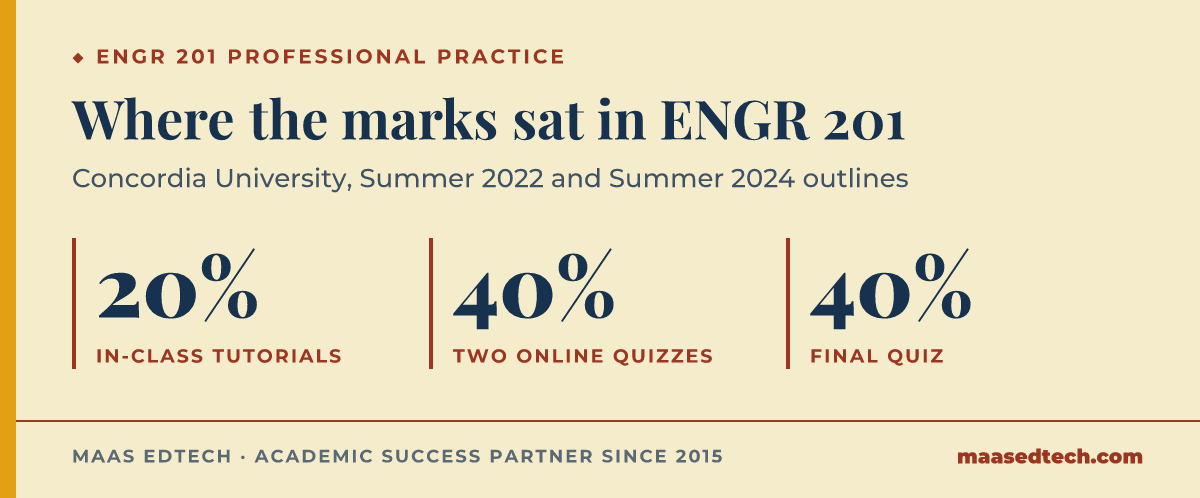
| Component | Weight in the Summer 2022 and Summer 2024 outlines | What it tests |
|---|---|---|
| In-class tutorials | 20% | A problem analysed as a team and submitted to the tutor |
| Two online quizzes | 40% (2 × 20%) | Key concepts, analysis and familiarity with the readings |
| Final quiz | 40% | All 11 online lessons |
| Knowledge Quest | Up to 5% (bonus) | About 5 questions per lesson, one attempt each |
A few details in those outlines change how you should plan. The Knowledge Quest gives you a single attempt at about 5 knowledge questions for each of the 11 lessons, and the outline states that five or fewer correct answers across the 11 lessons earns a score of 0 for the bonus. The quizzes are described as a mix of short answer, fill in the blank, true or false and an essay question, so the written reasoning counts alongside recall. The Summer 2022 outline lists a grading scale in which A+ starts at 90% and a pass at the D- level starts at 50%.
Weights, dates and the format of the final can change between sections and semesters, and the Fall 2026 outline was not available to MAAS at the time of writing. Read the outline for your own section in the first week, and treat any grade split on a note-sharing site as unverified.
What do the Professional Code, the Engineers Act and the OIQ actually require?
Direct answer: Engineers in Quebec belong to the Ordre des ingénieurs du Québec (OIQ), which regulates them under the Professional Code and the Engineers Act. Section 2.01 of the Code of ethics of engineers is the anchor for most ethics answers because it puts the public ahead of the client.
The section reads: "In all aspects of his work, the engineer must respect his obligations towards man and take into account the consequences of the performance of his work on the environment and on the life, health and property of every person" (Gouvernement du Québec, n.d.). That single sentence carries a lot of exam value, because each part of it can be turned into a test of a scenario: the phrase "in all aspects of his work" removes the idea that ethics applies only at certain moments, and "every person" extends the duty beyond the client who pays.
Pinsonnault (n.d.), a lawyer writing for the OIQ, describes section 2.01 as one of the most important sections of the Code and notes that the Ordre's Disciplinary Council and higher courts have repeatedly reiterated its importance. She also states that when the public interest in health, security or the environment conflicts with a client's interest, the engineer must favour the public interest. A scenario answer that reaches that conclusion and names the section is stronger than one that only says the engineer "should be ethical".
Section 3.02.04 of the same Code adds a precision duty. It says an engineer must refrain from giving contradictory or incomplete opinions and from using plans or documents the engineer knows to be ambiguous or insufficiently explicit (Ordre des ingénieurs du Québec [OIQ], 2016). The practical lesson is that a vague report is not a neutral choice under the Code; it can itself be a breach.
How do you answer an ethics case study or scenario question?
Direct answer: State the facts that matter, name the duty at stake, apply the duty to those facts and reach a decision you can defend. Marks usually come from naming the correct provision and showing why it applies, not from a long list of general virtues.
Davis (1991), writing in Philosophy & Public Affairs, argues that a code of ethics is central to advising engineers how to conduct themselves and to judging their conduct. His opening case is the night of 27 January 1986, when Robert Lund, vice-president for engineering at Morton Thiokol, had to decide whether to maintain an engineering recommendation against a shuttle launch scheduled for the next morning. Davis asks whether Lund should think like a manager or like an engineer. For a scenario question in ENGR 201, that framing is useful because it tells you what the examiner wants: the answer a member of the profession is obliged to give, not the answer that is commercially convenient.
A four-step structure keeps a written answer organised. First, identify who is affected and what is at risk. Second, name the legal or ethical provision, for example section 2.01 for the public and the environment. Third, apply it to the specific facts in two or three sentences. Fourth, state the action you recommend and the evidence that would change your mind. This structure is a study technique, not an official marking scheme, so test it on a past tutorial case before you rely on it.
Brocato (2009) argues that professional ethics is "best taught through synthesis and application" (p. 1), which is why cases of this kind are set as writing and decision tasks rather than lectures to memorise. Herkert (2000) surveyed the content, pedagogy and curriculum of engineering ethics education in the USA, which is a reminder that the case method is a common teaching approach but that the legal framework differs by jurisdiction. Do not import American examples into a Quebec answer: your examiner is looking for the Quebec Professional Code and Engineers Act, not a US licensing rule.
How do the tutorials work, and why do they count for 20%?
Direct answer: The tutorials are in-class sessions where a tutor sets a problem, your team analyses it and you submit the work. Attendance is mandatory for Section EC, and the 20% weight in earlier outlines makes the tutorial the one component you cannot reproduce with last-minute revision.
The outlines describe the tutorial as team analysis of a problem assigned by the tutor, with the work submitted to the tutor. That means the grade rewards what you do in the room: agreeing on the facts, dividing the analysis and writing a clear submission before the session ends. A student who attends but contributes nothing leaves with little to defend if the work is marked individually, so decide at the start who writes which part and read the final text together.
Because tutorials run every second week in the calendar description, there are fewer of them than a typical weekly tutorial course, which raises the cost of missing one. If you are an online student in Section EC, plan your timetable around the in-person requirement from the first week rather than the week before the first tutorial.
How should you prepare for the quizzes and the final?
Direct answer: Work through each of the 11 lessons once, attempt the Knowledge Quest carefully because you get one attempt, and then practise writing short scenario answers under time. Prepare the essay question separately, because the outlines describe it as part of the quizzes.
Start with the Knowledge Quest. Because the outline gives only one chance per lesson, treat each set as a closed-book check on the day you finish the reading rather than an open exploration. Then build a one-page sheet for the four topics: who regulates engineers, the main duties in the Code of ethics, the legal liability concepts from the lessons on responsibility and liability, and the typical issues that appear in professional practice. The lessons in the earlier outlines move from "What is a Profession?" and professional systems in Quebec through ethical reasoning, ethics and organisations, professional loyalty and trust, duties to the profession and the public, legal issues, and responsibility and liability, to issues in professional practice. Use that order for revision.
Since a final quiz covers all the online lessons, the 40% weight rewards steady coverage over cramming. A short weekly session that reviews one lesson and writes one scenario answer will serve you better than reading all 11 lessons the night before.
Frequently asked questions
Which university offers ENGR 201 Professional Practice and Responsibility?
Concordia University in Montreal, through the Gina Cody School of Engineering and Computer Science. Other institutions use ENGR 201 for unrelated courses, including Victoria University of Wellington (Engineering in Context) and several US universities, so confirm the title before using any study material.
How many credits is ENGR 201, and does it have prerequisites?
It is worth 1.5 credits. The Summer 2022 outline states that there are no prerequisites and that students from any faculty may enrol.
Is attendance mandatory?
For Section EC, the eConcordia course page states that the tutorials are not online and that they are regular in-class tutorials with mandatory attendance.
How is ENGR 201 graded?
Two earlier outlines, from Summer 2022 and Summer 2024, split the grade between tutorials, quizzes and a final quiz, with a small Knowledge Quest bonus on top. Weights can change, so the outline for your own section is the only reliable source.
Is the course really easy?
Student comments online describe it as easy, but those comments are unverified and say nothing about your section. The course is short, yet it asks for written ethical reasoning and knowledge of Quebec legislation, which are not skills you can pick up from a calculator.
Related reading
- ENGR301 Engineering Management Principles and Economics: another Engineering Core course at Concordia, where reasoning about method choice earns the marks
- ENGR391 Numerical Methods in Engineering: the Engineering Core course at the opposite end of the calculation spectrum
- COMM214 Business Analytics: how another Concordia course combines quiz marks with a heavy final
Where MAAS fits
- Subject tutoring, one to one: 60 or 90 minute sessions with a tutor matched to your subject area, useful for practising scenario answers aloud. Tutoring is advisory, so it carries no grade target; if the tutor is not the right fit, you can ask to change expert
- Coursework and assignment support: developmental feedback on your own draft through the Outline, Draft, Final model with a discipline-matched expert
- Course-code assignment coaching: how MAAS mentors approach any unit assignment
References
- Brocato, J. (2009). Two ways of using case studies to teach ethics [Paper presentation]. 2009 ASEE Annual Conference & Exposition, Austin, TX, United States. https://doi.org/10.18260/1-2--5419
- Davis, M. (1991). Thinking like an engineer: The place of a code of ethics in the practice of a profession. Philosophy & Public Affairs, 20(2), 150-167. https://www.jstor.org/stable/2265175
- Gouvernement du Québec. (n.d.). Code of ethics of engineers (CQLR, c. I-9, r. 6). Légis Québec. https://www.legisquebec.gouv.qc.ca/fr/document/rc/I-9,%20r.%206%20/?langCont=en
- Herkert, J. R. (2000). Engineering ethics education in the USA: Content, pedagogy and curriculum. European Journal of Engineering Education, 25(4), 303-313. https://doi.org/10.1080/03043790050200340
- Ordre des ingénieurs du Québec. (2016). Should not be taken lightly [Plan magazine article]. https://www.oiq.qc.ca/wp-content/uploads/documents/2016_11-12_PLAN_Enc-pro1_ENG1.pdf
- Pinsonnault, J. (n.d.). Respecting one's obligations towards man. Ordre des ingénieurs du Québec. https://www.oiq.qc.ca/wp-content/uploads/documents/DCAP/chroniques_PLAN/ethique_deontologie/ObligationsTowardsMan.pdf
Tools & resources
- Concordia University. (2026). ENGR 201 Professional Practice & Responsibility [Course page]. eConcordia. https://www.econcordia.com/home/coursedetails.aspx?id=5956
- Concordia University. (2026). Section 71.20.5 Degree requirements. In Undergraduate calendar 2026-2027. https://www.concordia.ca/academics/undergraduate/calendar/current/section-71-gina-cody-school-of-engineering-and-computer-science/section-71-20-beng/section-71-20-5-degree-requirements.html
- Concordia University. (n.d.). Undergraduate courses. Centre for Engineering in Society. https://www.concordia.ca/ginacody/engineering-in-society/programs/undergraduate-courses.html
- Canadian Engineering Accreditation Board. (2025). 2025 accreditation criteria and procedures. Engineers Canada. https://engineerscanada.ca/sites/default/files/2025-12/2025-Accreditation_Criteria_Procedures-EN.pdf
This article is part of the MAAS Journal series for Vietnamese international students. MAAS Assignment & Essay Support is an academic support partner; we coach students through the Outline, Draft, Final delivery model with developmental feedback from discipline-matched experts. We do not write or submit work on a student's behalf.