
◆ Accounting & Finance
COMM 305 Concordia: how do you prepare for exams worth 80%?
COMM 305 Managerial Accounting is a 3-credit course in the John Molson School of Business (JMSB) core at Concordia University in Montreal, and it is marked almost entirely under exam conditions. In the eConcordia Section EC outline for Fall 2026, 80% of the grade sits in a midterm and a final written in person on paper, and only 10% comes from two data analytics tasks. This guide sets out how MAAS mentors read that structure.
Note on the code: this guide describes the Concordia course, written "COMM 305" in the Concordia calendar. Other institutions use COMM305 or COMM 305 for unrelated subjects, so check the title on your own enrolment. MAAS is an independent academic support provider with no affiliation to Concordia University.
◆ Question 1 / 8 · The course
What is COMM 305 Managerial Accounting, and who takes it?
Direct answer: COMM 305 is one of four 300-level courses in the JMSB core, alongside COMM 309 Business Finance, COMM 316 Business Law and Ethics and COMM 320 Entrepreneurship. Students in JMSB programmes that include the core take it whatever their major, and it teaches how accounting information supports planning, control and decisions inside a firm.
Evidence: Section 61.22 of the Concordia Undergraduate Calendar lists COMM 305 at 3.00 credits in the core's 10.5 credits of 300-level courses, next to COMM 309 Business Finance at 3.00 credits, COMM 316 Business Law and Ethics at 1.50 and COMM 320 Entrepreneurship at 3.00. The Section EC outline for Fall 2026 names COMM 217 Financial Accounting as a prerequisite, together with COMM 213 or COMM 215, and states that the course "has been designed to accommodate both accounting and non-accounting majors." It divides the content into two modules, a Decision-Making Module and a Strategy Execution Module, across 12 weekly meetings from 8 September to 1 December 2026.
Example: A marketing major who passed COMM 217 by learning journal entries often expects more of the same. COMM 305 asks a different question. Financial accounting records what happened for outside readers, while managerial accounting prepares numbers a manager uses before deciding, so the working habit shifts from recording to choosing.
◆ Question 2 / 8 · Assessment
How is COMM 305 assessed in Section EC, Fall 2026?
Direct answer: Five components make up the grade: ten online assignments worth 10%, two data analytics assignments worth 5% each, a midterm worth 30% and a final worth 50%. Both exams are written on campus, in person and on paper, so four fifths of the mark depends on answering questions by hand under time pressure.
How the COMM 305 grade is weighted at Concordia University, eConcordia Section EC, Fall 2026
These are the official weightings for one offering, and the two exams, in yellow, carry 80% between them.
10 online assignments (WileyPLUS, pass or fail)
10
% of the grade
Data Analytics Assignment 1 (Power BI)
5
% of the grade
Data Analytics Assignment 2 (master budget in Excel)
5
% of the grade
Midterm exam, 1 November 2026 (in person, on paper)
30
% of the grade
Final exam (in person, on paper, comprehensive)
50
% of the grade
Save this figure
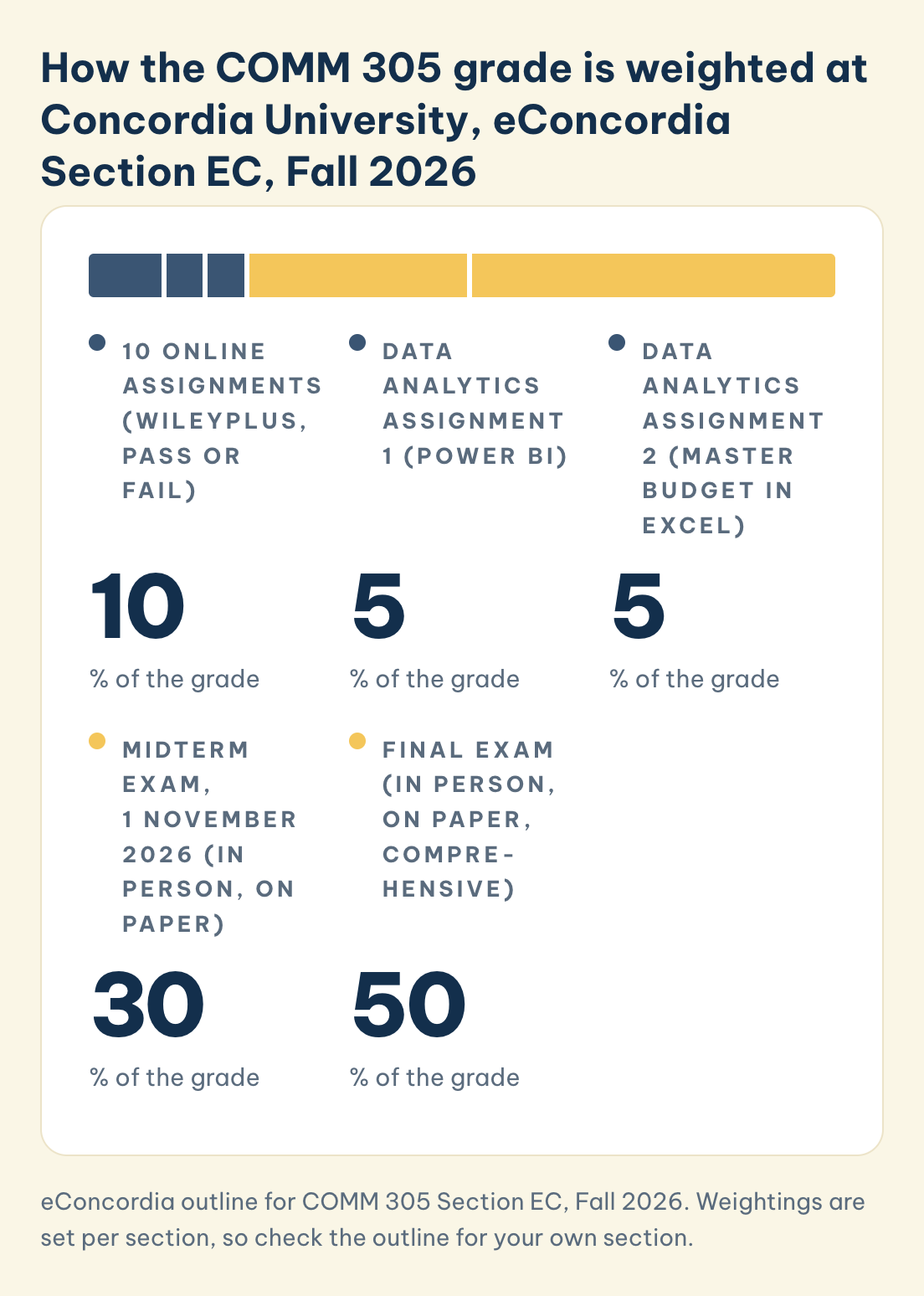
Evidence: The weightings below come from the eConcordia outline for Section EC, Fall 2026. Other sections of COMM 305 publish their own outlines, and the same outline warns that "the content and/or evaluation scheme in this course is subject to change", so treat the course site for your own section as the final word.
| Component | Weight | Format stated in the outline | What it rewards |
|---|---|---|---|
| 10 online assignments (WileyPLUS) | 10% | Pass or fail, 60% threshold, 2 attempts per question | Steady weekly practice |
| Data Analytics Assignment 1 | 5% | Power BI charts and quiz questions on a data set | Profitability and performance analysis |
| Data Analytics Assignment 2 | 5% | Master budget in Excel and quiz questions | Planning and budgeting |
| Midterm exam, 1 November 2026, 2 p.m. to 5 p.m. | 30% | In person, on paper, meetings 1 to 5 | Costing systems and CVP |
| Final exam | 50% | In person, on paper, comprehensive | Every topic (comprehensive) |
Example: Three hours for the midterm sounds generous until you count the material. Meetings 1 to 5 cover chapters 1 to 6 of the textbook: cost behaviour, job-order costing, process costing, activity-based costing and cost-volume-profit analysis. A student who can solve each of those only when the chapter heading tells them which method to use is not yet ready for an exam that does not say which chapter a question comes from.
◆ Question 3 / 8 · Online assignments
How do the pass-or-fail online assignments actually count?
Direct answer: Each of the ten WileyPLUS assignments is graded pass or fail, and a pass needs 60% of that assignment's total marks. Your 10% component is simply the number of passes multiplied by ten, so nine passes out of ten gives 90% on the component, and a narrow miss on one assignment costs a full tenth of it.
Evidence: Note 1 of the outline spells out the arithmetic with the same example, 9 passes multiplied by 10 giving 90% on the component, and confirms two attempts per question. Assignment zero is an introduction to WileyPLUS and counts for nothing. The first three graded assignments share one due date, Sunday 27 September 2026 at 11 p.m., which means a student who falls behind in week 1 faces three submissions at once.
Example: The trap is treating 60% as the goal. The assignments are the course's own rehearsal for the exams, and after each due date the correct answer and the solution approach become visible. A student who passes with 62% and never opens the solution has earned the point and skipped the lesson that the point was meant to buy.
◆ Question 4 / 8 · Power BI and Excel
Why does a mostly exam-based course still include Power BI and Excel?
Direct answer: Because five of the six accounting-level learning objectives are checked through the data analytics tasks as well as through the exams. The tasks carry only 10% of the grade, but they train the same skills the exams test: producing performance reports, building budgets and running profitability analysis on real-looking data.
Evidence: The outline's table of learning objectives maps Data Analytics Assignment 1, built in Power BI and open from 19 October to 8 November 2026, to three objectives, including a "profitability analysis regarding strategic options". It maps Assignment 2, a master budget in Excel open from 9 November to 22 November 2026, to budgeting and to assessing plans and forecasts. Only one objective, explaining management control and corporate governance, sits outside both tasks.
Example: Building the master budget in Excel for Assignment 2 feels like a spreadsheet exercise. Its real value may appear in the final, where the outline maps budgeting to application-based exam questions, and such a question can ask for the same chain of schedules, from sales to production to cash, with no formulas to drag down. In MAAS mentors' view, building the Excel version step by step, rather than filling in a template, is the better rehearsal for that.
◆ Question 5 / 8 · Exam topics
Which topics does each exam cover, and how should revision be split?
Direct answer: The midterm covers meetings 1 to 5, which means costing systems plus cost-volume-profit analysis. The final is comprehensive, so it adds incremental analysis, sustainability managerial accounting, inventory costing methods, pricing and transfer pricing, budgets, variance analysis and the balanced scorecard. Revision for the final should weight the second half, which the midterm never tested.
Evidence: The outline states that the midterm draws on chapters 1 to 6 and that the final "will be comprehensive and will include all topics covered in the course." It also states there is no make-up midterm: with a valid reason for missing it, the midterm grade is determined from the final, which would then carry 80% of the course on its own.
Example: A useful revision audit after the midterm is to list the fifteen topics in the outline and mark each one as "examined once" or "never examined". Counted against the outline, eight of the fifteen topics fall after meeting 5 and never appear on the midterm, so they deserve at least half of the revision time for the final.
◆ Question 6 / 8 · Practising
How do you practise for a final that covers every topic?
Direct answer: Stop practising one chapter at a time once you know the basics. Shuffle problems from different chapters into one set, so each question starts with a decision a comprehensive exam will not make for you: which method applies here. Mixed practice feels slower than blocked practice, yet in controlled studies it produced better results a week later.
Evidence: Rohrer and Taylor (2007) ran two experiments with college students on mathematics problems. In the second, practice problems of several types were either blocked by type or randomly mixed, and the result a week later was clear: "When tested 1 week later, performance was vastly superior after mixed practice" (Rohrer & Taylor, 2007, p. 481). Dunlosky et al. (2013), reviewing 10 learning techniques, rated practice testing and distributed practice as the two with high utility, rated interleaved practice as moderate with the strongest evidence from mathematics, and rated rereading and highlighting, among others, as low. The outline's own advice is blunter: managerial accounting is a system, and the one safe method is "PRACTICE, PRACTICE, AND PRACTICE."
Example: Take three short problems: a company choosing between making a part or buying it, a department whose applied overhead fell short of the overhead it actually incurred, and a product line priced below its full cost. Each looks like "a costing question". The first is incremental analysis, the second is job-order costing, and the third may be a transfer pricing or special order decision. Naming the method before calculating is where many answers go wrong.
◆ Question 7 / 8 · Strategy Execution
What do the Strategy Execution topics ask you to explain?
Direct answer: They ask you to link numbers to strategy. The balanced scorecard, responsibility accounting and budgets are taught as one chain, from a firm's strategy to the measures that track it and the budgets that fund it. Answers that calculate a variance but never say what it means for a manager miss the link these topics are built around.
Evidence: Meeting 9 in the outline is titled "From Strategy to Balanced Scorecard to Responsibility Accounting to Budgets". Kaplan and Norton (1992) proposed the balanced scorecard as a set of measures from four perspectives, financial, customer, internal business, and innovation and learning, so that managers could see beyond financial results alone. The outline also assigns a reading from the Institute of Management Accountants on reducing a carbon footprint in meeting 7, alongside the ChampSite carbon footprint decision-making case.
Example: A direct materials price variance of $4,000 unfavourable is a number. An answer that adds who is responsible for it (usually purchasing, not production), whether it may be caused by a deliberate switch to a higher-grade supplier, and which scorecard measure it touches turns that number into the evaluation the learning objectives describe.
◆ Question 8 / 8 · AI and outside help
Can you use AI tools or outside help in COMM 305?
Direct answer: Not for assessed work. The Section EC outline states that generative AI is "strictly prohibited in all course assignments unless explicitly stated otherwise by the instructor", and that using it for any assessment may be treated as academic misconduct. Outside help stays within the Academic Code only when it teaches you methods and leaves every submission your own.
Evidence: The outline cites Concordia's Academic Code of Conduct, which defines plagiarism as "the presentation of the work of another person as one's own or without proper acknowledgment." It also points students to free support: tutorial sessions for all sections, and peer tutoring, study strategy videos and learning specialists at the Student Success Centre, some of it designed specifically for COMM 305. The outline also notes that private tutoring companies are not authorized by Concordia and have no affiliation with the University; MAAS is one such independent provider.
Example: The legitimate use of a tutor in this course looks like a student bringing a textbook practice problem they got wrong, working it again aloud, and being asked why they chose absorption costing instead of variable costing. Anything that produces an answer for a WileyPLUS or data analytics submission crosses the line the outline draws.
Frequently asked questions
Is COMM 305 a hard course?
The outline itself calls it demanding and says it covers a lot of material. The difficulty is volume and pace rather than advanced mathematics: fifteen topics in twelve meetings, with 80% of the grade in two exams written on paper.
When is the COMM 305 midterm in Fall 2026?
For Section EC, the outline sets it for Sunday 1 November 2026, from 2 p.m. to 5 p.m., in person and on paper, covering meetings 1 to 5. The final date is set by the University's Examinations Office. Other sections may differ.
What happens if I miss the midterm?
There is no make-up midterm in Section EC. With a valid reason, the outline states that the midterm grade is determined from the final exam instead, which raises the stakes of the final considerably.
What grade counts as an A in COMM 305?
The outline converts scores without rounding up: A+ is 90 to 100%, A is 85 to 89.99%, A- is 80 to 84.99%, and anything below 50% is a failing grade.
Which textbook does COMM 305 use?
Section EC uses Weygandt, Kimmel and Aly, Managerial Accounting: Tools for Business Decision-Making, in the Seventh Canadian Edition published by Wiley in 2026, with WileyPLUS access required for the online assignments.
Does MAAS complete COMM 305 assignments or exams?
No. MAAS mentors explain methods and review your own worked practice problems. Every WileyPLUS submission, data analytics task and exam answer must be yours, in line with the outline's rules on academic integrity and generative AI.
Related reading
- COMM 214 Business Analytics: the JMSB statistics course where a cumulative in-person final carries 55% of the grade
- ACCT2522 Management Accounting for Decision Analysis: how incremental analysis earns marks for qualitative factors, not only for the arithmetic
- ACCT20001 Accounting for Management Decisions: the same toolkit at the University of Melbourne, including the assumptions behind the high-low method
- How to revise for final exams effectively: a longer look at spaced and mixed practice before a comprehensive final
Where MAAS fits
- Subject tutoring, one to one: 60 or 90 minute sessions with a tutor matched to accounting, working through your own practice problems. Tutoring is advisory, so it carries no grade target; if the tutor is not the right fit, you can ask to change expert
- Exam coaching resources: how MAAS mentors approach preparation for timed, closed-book exams
References
- Dunlosky, J., Rawson, K. A., Marsh, E. J., Nathan, M. J., & Willingham, D. T. (2013). Improving students' learning with effective learning techniques: Promising directions from cognitive and educational psychology. Psychological Science in the Public Interest, 14(1), 4–58. https://doi.org/10.1177/1529100612453266
- Kaplan, R. S., & Norton, D. P. (1992). The balanced scorecard: Measures that drive performance. Harvard Business Review, 70(1), 71–79.
- Rohrer, D., & Taylor, K. (2007). The shuffling of mathematics problems improves learning. Instructional Science, 35(6), 481–498. https://doi.org/10.1007/s11251-007-9015-8
Tools & resources
- Concordia University. (n.d.). Section 61.22 The JMSB core. Undergraduate Calendar. Retrieved September 24, 2026, from https://www.concordia.ca/academics/undergraduate/calendar/current/section-61-john-molson-school-of-business/section-61-22-the-jmsb-core.html
- eConcordia. (2026). COMM 305: Managerial accounting, Section EC, Fall 2026 [Course outline]. Concordia University. https://www.econcordia.com/outlines/managerial_accounting.pdf
This article is part of the MAAS Journal series for Vietnamese international students. MAAS is an independent academic support provider. For courses assessed by exams and individual online work, we offer one-to-one tutoring on methods only; we do not write, complete or submit any assessed work.
A free 20-minute consultation is a conversation about where you are with COMM 305.
Book a free consultation ▸