
◆ Accounting & Finance
ACCT2522 Management Accounting for Decision Analysis: the key theme
UNSW renamed this course. The 2015 handbook called it Management Accounting 1; the 2026 handbook calls it Management Accounting for Decision Analysis. The syllabus behind the rename still carries three themes, and two of them can be revised with a calculator. The third one, which the handbook describes as the way management accounting practices "affect and are affected by human processes within organisations," is where most of the marks that separate a credit from a distinction actually sit.
◆ Question 1 / 7 · Which ACCT2522
Which ACCT2522 is this, and where does it sit in the degree?
Direct answer: ACCT2522 Management Accounting for Decision Analysis is a UNSW Sydney course worth 6 units of credit, taught by the School of Accounting, Auditing and Taxation inside UNSW Business School. It runs in Term 1 and Term 3 on the Kensington campus, in person, with roughly 3 contact hours a week. No other Australian university teaches under this code.
Evidence: The 2026 handbook entry is unusually clean on the administrative facts. The course is undergraduate, sits under Field of Education 080101 Accounting, follows the UNSW 3+ academic calendar, and carries an indicative 2026 fee of $7,080 for both domestic and international students, against $2,175 for a Commonwealth Supported place. Offering terms are Term 1 and Term 3, which means a student who fails or defers waits two thirds of a year rather than one term.
The code itself is stable in a way many course codes are not. Searches for ACCT2522 outside UNSW return only UNSW material, so the collision problem that wrecks study notes for codes like ECON1101 or ACC203 does not apply here. What does move is the title. The legacy 2015 handbook lists the same code as Management Accounting 1, a sequence label, while the current entry names the analytical purpose instead. Reading old notes is therefore safe on content and unsafe on emphasis.
◆ Question 2 / 7 · Two ways in
What are the two ways into this course, and why does it matter?
Direct answer: The 2026 handbook sets the prerequisite as (COMM1170 AND COMM1180) OR ACCT1511, so two paths lead into the same second-year room. One is 6 units of financial accounting, the other 12 units of business core, and the two cohorts arrive short in opposite places.
Evidence: ACCT1511 Accounting and Financial Management 1B is a 6-unit financial accounting course. COMM1170 Organisational Resources and COMM1180 Value Creation are 6-unit courses from the UNSW Business School integrated first-year core, and neither is an accounting course in the traditional sense. A student who arrives via ACCT1511 has spent a year in double-entry mechanics and can usually build a cost schedule without hesitating, but has rarely been asked to argue about what a number should be used for. A student who arrives via COMM1170 and COMM1180 has spent a year on organisational resources and value creation and is comfortable with the argument, but often has not drilled the arithmetic.
| Entry path | Units | What the path drills | The usual gap in ACCT2522 |
|---|---|---|---|
| ACCT1511 Accounting and Financial Management 1B | 6 | Recording, classifying, preparing statements | Interpreting a variance rather than computing it |
| COMM1170 Organisational Resources + COMM1180 Value Creation | 12 | Framing business problems, value logic | Building a clean cost schedule under time pressure |
Neither gap is fatal, and both are diagnosable in week 1 rather than week 9. The point of naming them is that the two cohorts should revise differently, and a generic study plan bought online is written for neither.
◆ Question 3 / 7 · Third theme
Why does the third theme decide the grade?
Direct answer: Because the first two themes have right answers and the third one does not. Designing a costing system and improving a process both terminate in a defensible number. How that number is then used to judge a person does not, and that is the part the marking criteria reward.
Evidence: The UNSW description of ACCT2522 lists three interrelated themes: the design and operation of management accounting systems for planning and control; the role of these practices in supporting resource management and process improvement; and the way those practices affect and are affected by human processes within organisations. The UNSW Handbook entry for 2026 states that students will "learn to apply them critically and creatively in a variety of business contexts," which is the course restating the same ambition in the language of the overview rather than the syllabus.
The third theme is not decoration, and the discipline has a long argument to prove it. Hopwood (1972) surveyed supervisors in a manufacturing division and distinguished a budget-constrained evaluation style, in which a manager is judged on meeting the budget line, from a profit-conscious style, in which the same accounting data informs a longer-run judgement about efficient operation. He reported that the rigid style was associated with more job-related tension and more manipulation of the accounting data itself. Otley (1978) then ran a comparable study in a different setting, on coal mining units, and did not find the same association. The two studies use the same variance reports and reach different conclusions about what those reports do to people.
That six-year disagreement is the shape of the answer ACCT2522 wants. A student who writes that an adverse labour efficiency variance means the supervisor underperformed has answered the first theme and skipped the third. A student who writes that the variance is consistent with several causes, that the evaluation style in place determines whether the supervisor reports it honestly, and that the reporting behaviour then contaminates the next period's data, has understood why the course is not called Management Accounting 1 any more.
What to do about it: for every variance you calculate in this course, write one sentence naming who is accountable for it and one sentence naming what that person is likely to do when the number appears. If you cannot write the second sentence, you have computed rather than analysed.
◆ Question 4 / 7 · Incremental analysis
What does an incremental analysis actually have to show?
Direct answer: Three tests applied to every line, and a table whose columns are alternatives rather than periods. A cost belongs in the analysis only if it is future, incremental, and a cash flow. Anything failing one of the three is excluded, and the exclusion is worth saying out loud.
Evidence: The structure is stable across special order, make-or-buy, drop-or-retain and further-processing decisions, which is why the technique survives so well in exam conditions. Set the alternatives as columns, put each relevant revenue and cost in its own labelled row, and compute a net relevant benefit per column. Allocated head-office overhead that continues regardless of the decision does not appear. Depreciation on an asset already owned does not appear. The opportunity cost of capacity diverted from an existing customer does appear, even though no invoice will ever record it, and it is the line most often missing from a weak submission.
The reason markers weight this so heavily is historical. Kaplan (1984) traced the development of management accounting practice and argued that the systems in wide use had been shaped by external financial reporting requirements rather than by the internal decisions they were meant to serve. Full absorption costing, which spreads fixed overhead across units to value inventory, is correct for the financial statements and misleading for a special order. A student who unthinkingly imports the unit cost from a financial accounting course into a decision table has reproduced exactly the failure Kaplan described.
What to do about it: build the table before writing any prose, in a spreadsheet with assumptions in labelled input cells rather than typed inside formulas. Then change one assumption and see whether the recommendation flips. If it does, that sensitivity is a finding, not an embarrassment.
◆ Question 5 / 7 · Qualitative factors
How do qualitative factors get marks instead of losing them?
Direct answer: By being attached to a number. A paragraph of general concern about staff morale earns little. A sentence stating that the recommended option is profitable by a margin smaller than the plausible error in one input, and naming the non-financial risk that would tip it, earns a great deal.
Evidence: Ittner and Larcker (2003) examined how firms actually used non-financial performance measures and reported that most did not establish any link between the measures they tracked and the outcomes they wanted, which meant the measures were collected and then ignored. Kaplan and Norton (1992) put it in seven words: "What you measure is what you get" (p. 71), the opening line of the article that introduced the balanced scorecard. They had proposed the scorecard a decade before the Ittner and Larcker survey precisely to force that link, arranging financial, customer, internal process and learning measures so that each was meant to explain the next.
Chenhall (2003) reviewed two decades of contingency-based research on management control systems and concluded that no single design is best across settings, because appropriateness depends on the environment, the technology, the structure and the strategy of the organisation. For an ACCT2522 case, that means the honest answer to "which control system should this firm use" is never a name; it is a name plus the conditions under which that name stops being correct.
What to do about it: write each qualitative point in the same paragraph as the number it modifies, never in a separate section at the end. A separated qualitative section reads as an afterthought and is marked as one.
◆ Question 6 / 7 · Report structure
How should the report be structured?
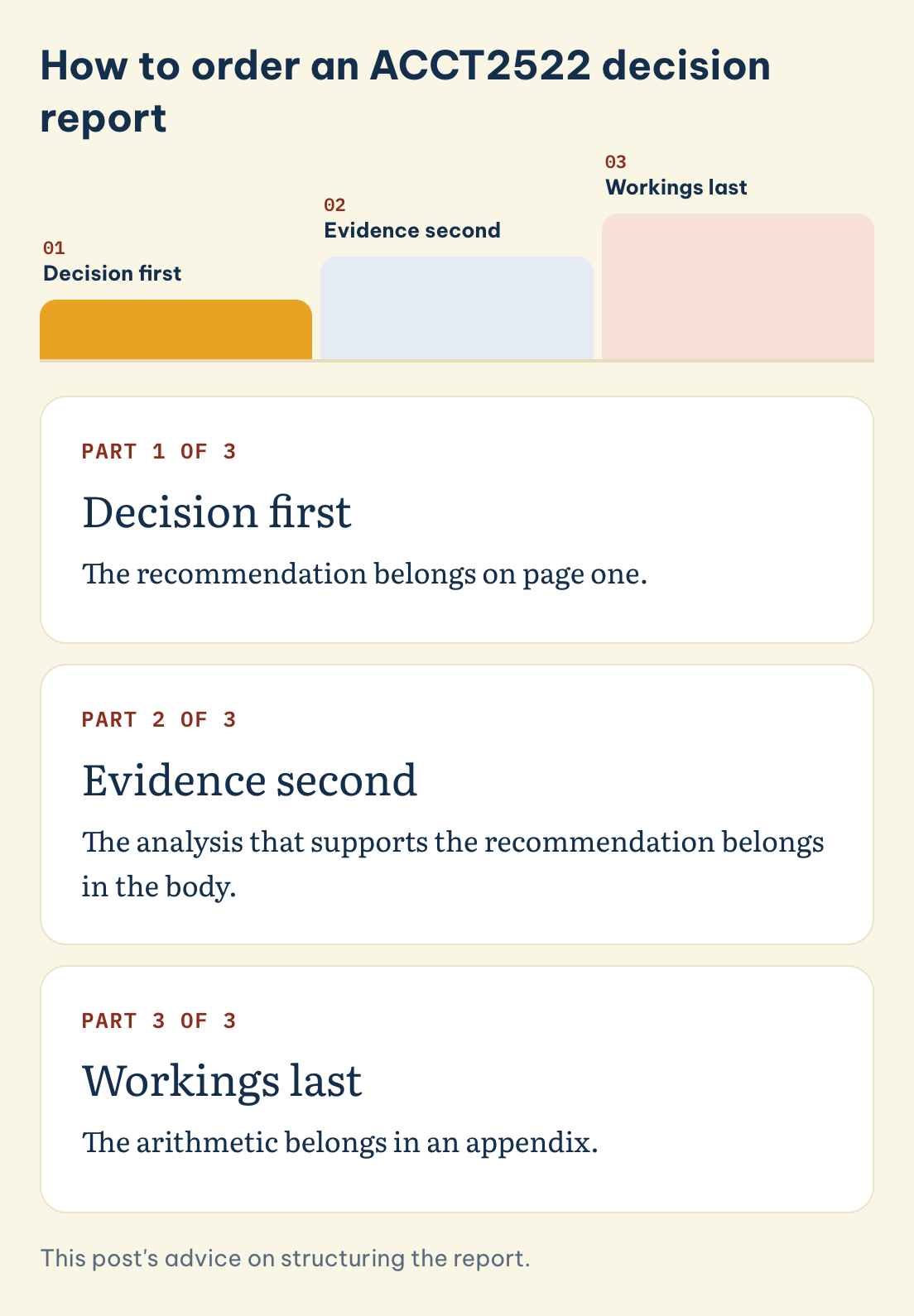
Direct answer: Decision first, evidence second, workings last. The recommendation belongs on page one, the analysis that supports it in the body, and the arithmetic in an appendix. Writing in the order you did the work produces a report that buries its own conclusion.
How to order an ACCT2522 decision report
The recommendation comes first, the supporting analysis second and the arithmetic last. The bar heights and colours only mark the order and carry no weight.
Part 1 of 3
Decision first
The recommendation belongs on page one.
Part 2 of 3
Evidence second
The analysis that supports the recommendation belongs in the body.
Part 3 of 3
Workings last
The arithmetic belongs in an appendix.
Save this figure
Evidence: The convention is not arbitrary. A management accounting report is written for a manager who will read the first half page and delegate the rest, so the executive summary carries the decision, the headline figure, the main assumption and the main risk. The body then earns each of those four items in turn. Detailed schedules go to appendices where a reader can check them without being made to walk through them.
Two structural habits separate high marks from average ones in this course specifically. The first is stating the decision as a question in one sentence before any analysis begins, which forces you to notice when a case actually contains three decisions rather than one. The second is naming the technique and why it fits, rather than deploying it silently. Writing that contribution per machine hour is the ranking basis because machine hours are the binding constraint tells the marker you chose the tool; producing the same table without that sentence looks like you followed a template.
What to do about it: draft the executive summary last and put it first. If you cannot write it in four sentences, the analysis underneath has not resolved yet.
◆ Question 7 / 7 · Common errors
What do students most often get wrong here?
Direct answer: They revise ACCT2522 as though it were a calculation course, because the tutorial questions look like calculation questions. The computations are the entry ticket, not the assessment, and the gap between a correct number and a defensible recommendation is where the mark range opens up.
Evidence: Consider two answers to the same product mix case. Both correctly rank three products by contribution per machine hour and both reach the same optimal mix. The first stops there. The second adds that the ranking depends on machine hours remaining the binding constraint, notes that the constraint shifts to skilled labour if demand rises by roughly a fifth, and flags that the dropped product is bought by the firm's two largest customers alongside the retained ones. The numbers are identical. The second answer is worth substantially more, and nothing in it required a further calculation.
The second recurring error is treating the two entry paths as interchangeable when forming study groups. A group of four students who all came through ACCT1511 will produce immaculate schedules with thin interpretation. A group of four from the COMM1170 and COMM1180 path will produce sharp framing on top of arithmetic nobody checked. Mixed groups catch both failure modes, and the prerequisite line is public, so the composition is knowable in week 1.
What to do about it: each week, take one tutorial question you have already answered correctly and write 150 words on what a manager should do differently because of the answer. That is the skill the course name is pointing at.
Frequently asked questions
Is ACCT2522 harder than ACCT1511?
It is different rather than harder. ACCT1511 rewards accuracy in preparing statements under rules; ACCT2522 rewards judgement about internal decisions where no rule settles the answer. Students who found the rule-following comfortable often find the judgement uncomfortable, and the reverse is equally common.
Do I need COMM1170 and COMM1180 if I have already done ACCT1511?
No. The 2026 handbook lists the prerequisite as (COMM1170 AND COMM1180) OR ACCT1511, so either path satisfies it on its own. Check your own enrolment record rather than a study forum, because program rules change and the handbook is versioned by year.
When is ACCT2522 offered?
The 2026 handbook lists Term 1 and Term 3 at the Sydney campus, delivered in person on a standard weekly or fortnightly pattern. Availability in any given year is confirmed on the UNSW class timetable rather than the handbook.
Where do I find the assessment weightings?
From the course outline released for your own term, not from a study-notes site. Weightings in this course have changed between terms, and a PDF uploaded from an earlier year is a reliable way to prepare for an assessment that no longer exists.
Does MAAS complete my ACCT2522 assignment?
No. MAAS works as an academic advisor. A mentor can review whether your incremental table has excluded the right costs, test whether your recommendation survives a change in one assumption, or work through a variance interpretation with you until you can explain it unaided. The submission stays your own work.
Related reading
If you want a mentor to review your decision analysis before you submit, our coursework and assignment support team works with students on structure and argument rather than on producing answers. For the financial reporting side of the same degree, see our guides to ACCT2542 Corporate Financial Reporting and Analysis and ACCT3563 Issues in Financial Reporting and Analysis, and for the alternative entry path into this course, our guide to COMM1170 Organisational Resources. UNSW students taking the financial accounting stream alongside this course can read our guide to ACCT2511 Financial Accounting Fundamentals, whose Term 3 2026 assessment differs from Term 1. For the same toolkit taught as a core course where two paper exams carry 80% of the grade, see our guide to COMM 305 Managerial Accounting at Concordia University. If the pressure is on a timed assessment rather than a report, online exam support is the closer fit.
References
Chenhall, R. H. (2003). Management control systems design within its organizational context: Findings from contingency-based research and directions for the future. Accounting, Organizations and Society, 28(2–3), 127–168. https://doi.org/10.1016/S0361-3682(01)00027-7
Hopwood, A. G. (1972). An empirical study of the role of accounting data in performance evaluation. Journal of Accounting Research, 10, 156–182. https://doi.org/10.2307/2489870
Ittner, C. D., & Larcker, D. F. (2003). Coming up short on nonfinancial performance measurement. Harvard Business Review, 81(11), 88–95.
Kaplan, R. S. (1984). The evolution of management accounting. The Accounting Review, 59(3), 390–418.
Kaplan, R. S., & Norton, D. P. (1992). The balanced scorecard: Measures that drive performance. Harvard Business Review, 70(1), 71–79.
Otley, D. T. (1978). Budget use and managerial performance. Journal of Accounting Research, 16(1), 122–149. https://doi.org/10.2307/2490414
Tools & resources
- UNSW Handbook entry for ACCT2522 for the prerequisite line and offering terms of your own year
- UNSW class timetable to confirm whether the course runs in the term you are planning
- ACCA technical article on relevant costs for the future, incremental, cash-flow test
A free 20-minute consultation is a conversation about where you are with ACCT2522.
Book a free consultation ▸