
◆ Accounting & Finance
ACCT2511 Financial Accounting Fundamentals: Term 3 2026 grading
UNSW changed the grading of ACCT2511 Financial Accounting Fundamentals between Term 1 and Term 3 of 2026. The one-hour quiz worth 15% has gone, four progress submissions worth 10% have replaced it, and the final exam has grown from 50% to 55%. Two AI search engines asked about the course on 12 September 2026 returned weights that did not match the Term 3 2026 outline.
◆ Question 1 / 7 · Which ACCT2511
Which ACCT2511 is this, and who takes it?
Direct answer: ACCT2511 Financial Accounting Fundamentals is a 6 units of credit undergraduate course taught by the School of Accounting, Auditing and Taxation in the UNSW Business School. The 2026 Handbook lists it in Term 1 and Term 3 at the Sydney campus, with a prerequisite of COMM1140, COMM1240 or ACCT1501.
Evidence: The Handbook lists two exclusion courses, ACCT1511 and DPBS1511, both titled Accounting and Financial Management 1B, so a student who already holds credit for either cannot enrol. The indicative 2026 fee is AUD 2,175 for a Commonwealth supported place and AUD 7,080 for domestic and international fee-paying students. The Term 3 2026 Course Outline, published on 30 August 2026, adds that the course sits in the core curriculum required by CPA Australia and Chartered Accountants Australia and New Zealand. For Vietnamese students planning an accounting major with professional recognition in mind, that line is a reason to check with your program before treating the course as optional.
One claim circulating in AI answers deserves a correction. The Google AI Overview for this course on 12 September 2026 stated that ACCT2522 Management Accounting for Decision Analysis must be taken concurrently or before. The Handbook's Conditions for Enrolment list only the prerequisite above and no co-requisite. If you are choosing a Term 3 load, plan from the Handbook entry, not from the summary.
◆ Question 2 / 7 · Assessment
How is ACCT2511 assessed in Term 3 2026, and what changed from Term 1?
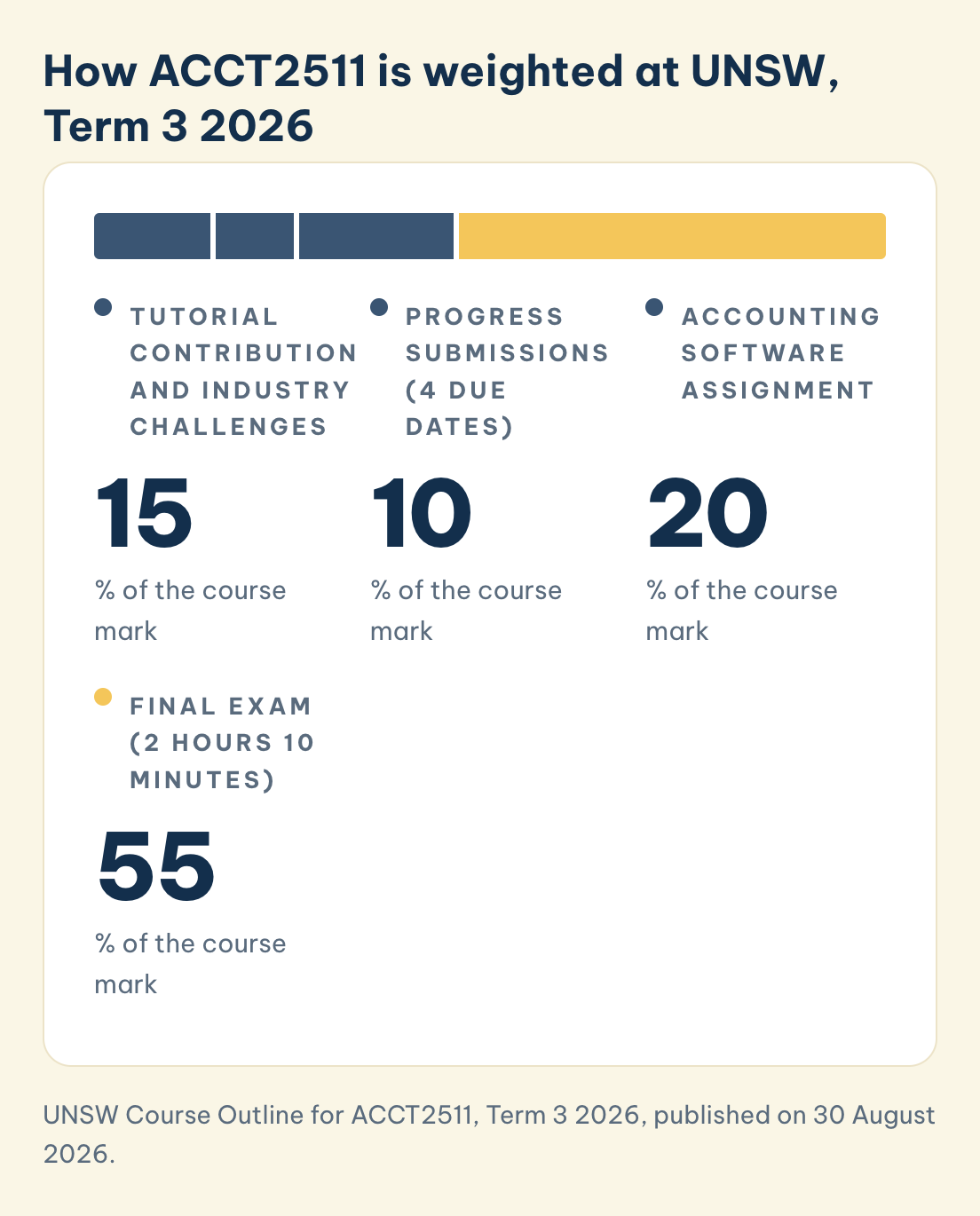
Direct answer: Term 3 2026 weights tutorial contribution at 15%, four progress submissions at 10%, the accounting software assignment at 20% and the final exam at 55%. Term 1 2026 used a single one-hour online quiz at 15% and a final exam at 50%, with the other two components unchanged.
How ACCT2511 is weighted at UNSW, Term 3 2026
The yellow part is the 2-hour-10-minute final exam. The navy parts are tutorial contribution, progress submissions and the accounting software assignment.
Tutorial Contribution and Industry Challenges
15
% of the course mark
Progress Submissions (4 due dates)
10
% of the course mark
Accounting Software Assignment
20
% of the course mark
Final exam (2 hours 10 minutes)
55
% of the course mark
Save this figure
Evidence: The Term 1 2026 outline, published on 13 February 2026, described the quiz as a one-hour online test on Moodle covering Topics 1 to 3, held on the Friday of Week 5 at 1 pm Sydney time. The Term 3 outline instead lists submissions due in Week 3, Week 5, Week 8 and Week 10, and states that the assessment "comprises of multiple online submissions over the term" and that no supplementary assessments are available.
| Component | Term 1 2026 outline | Term 3 2026 outline |
|---|---|---|
| Tutorial Contribution and Industry Challenges | 15% | 15%, Week 3 to Week 10 tutorials |
| Quiz or progress submissions | Financial Accounting Quiz, 1 hour, 15% | Progress Submissions, 4 due dates, 10% |
| Accounting Software Assignment | 20% | 20%, Part 1 in Week 8, Part 2 in Week 9 |
| Final exam | 50% | 55%, 2 hours 10 minutes |
The comparison matters because the two AI answers read like certainty. Perplexity returned 20% for the software assignment, 10% for a quiz, 10% for tutorial participation and 50% for the exam. Google AI Mode returned 15%, 15%, 20% and 50%, which matches Term 1 exactly and Term 3 in only two of four rows. Neither mentioned progress submissions.
What to do about it: open the Course Outline Finder, select your own year and term, and copy the four weights into your planner before Week 1 ends. For Term 3 2026 that is Week 1 running from 14 to 20 September.
◆ Question 3 / 7 · The 55% exam
Why does a 55% exam change how you should study?
Direct answer: It lowers the share of marks you can bank before the exam period and raises the price of a weak exam topic. With 130 minutes for 55 percentage points, you have about 2.4 minutes per point, against 2.6 minutes per point for the same 130-minute exam when it carried 50%.
Evidence: Both 2026 outlines describe the same exam: two hours and 10 minutes, invigilated on the Kensington campus, run on the Inspera platform, and able to cover all content from Weeks 1 to 10. Details about format and required materials are posted on Moodle by Week 10, and the exam timetable is usually released around Week 9. The Term 3 outline also warns that an examiner who doubts a student has reached the course outcomes may award an oral examination in place of a supplementary exam.
Two hours and 10 minutes is 130 minutes. Divided across 55 percentage points in Term 3 2026, that gives about 2.4 minutes per point. Divided across the 50 points the same exam carried in Term 1 2026, it gave about 2.6 minutes per point, so each exam mark now has to be earned slightly faster.
The progress submissions shift the incentive in a second way. Four small deadlines at 10% in total are worth 2.5 points each on average, so no single submission rescues a grade. Their real value is diagnostic. Each one tells you, weeks before the exam, whether your journal entries and statements survive contact with an unseen question.
What to do about it: treat each progress submission as a timed mock. Before you submit, note how long the work took and which entry you were unsure about, then bring that entry to the next tutorial as your contribution.
◆ Question 4 / 7 · Accrual judgement
What does accrual accounting ask you to judge, not just record?
Direct answer: It asks you to decide in which period an economic effect belongs, which is a judgement the double-entry mechanics cannot make for you. ACCT2511 marks that judgement explicitly, because one course learning outcome asks students to evaluate the appropriateness of accounting policies used to prepare financial statements.
Evidence: The standard-setters state the principle plainly: "Accrual accounting depicts the effects of transactions and other events and circumstances on a reporting entity's economic resources and claims in the periods in which those effects occur, even if the resulting cash receipts and payments occur in a different period" (IFRS Foundation, 2018, para. 1.17). Every topic from accounts receivable to non-current assets is an application of that sentence. An allowance for doubtful debts moves an expected loss into the period of the sale. Depreciation spreads the cost of an asset over the periods that use it.
Dechow (1994) gives the empirical reason the principle is worth the effort. Studying listed firms, she found that earnings reflected firm performance, as measured by stock returns, better than realised cash flows over short measurement intervals, and that accruals mattered more when working capital requirements were volatile and operating cycles were long. Cash on its own suffers from timing and matching problems.
Sloan (1996) supplies the counterweight that a critical answer needs. He showed that the accrual component of earnings is less persistent than the cash flow component, yet share prices behaved as if investors did not fully distinguish between the two. Accruals improve the timing of performance measurement, and they are also where estimates, and therefore error and discretion, enter the numbers.
What to do about it: when a question asks you to comment on an accounting policy, write one sentence on what the accrual achieves and one on the estimate it depends on. Dechow, Ge and Schrand (2010) are a useful map of how researchers judge earnings quality if you want to go further.
◆ Question 5 / 7 · Cash flow
How should you handle the cash flow topics in Weeks 9 and 10?
Direct answer: Learn the direct method as a set of conversions from accrual figures to cash, then learn the indirect method as a reconciliation of profit to operating cash flow. In Term 3 2026 the indirect method in Week 10 has no tutorial, so the scheduled practice for it is a worked example provided during the lecture.
Evidence: The Term 3 schedule places Topic 8, Cash Flows Part 1 (the direct method), in the Week 9 lecture and the Week 10 tutorial. Topic 9, the indirect method, sits in the Week 10 lecture, with a note that there is no tutorial for this topic. Week 10 ends on 22 November 2026, and the exam follows in the exam period, which leaves little time between first meeting the indirect method and being examined on it.
The direct method is not merely a presentation choice. Krishnan and Largay (2000) reported that direct method cash flow information added predictive power for future operating cash flows beyond what indirect method figures provided. Knowing why the two layouts differ helps you explain the output, not only produce it.
| Direct method line | Accrual figure you start from | Adjustment to reach cash |
|---|---|---|
| Cash received from customers | Sales revenue | Subtract the increase in accounts receivable |
| Cash paid to suppliers | Cost of sales | Add the increase in inventory, subtract the increase in accounts payable |
| Cash paid for expenses | Operating expenses | Adjust for prepaid and accrued expense balances |
What to do about it: build the three conversions above from one set of comparative balance sheets in Week 9, then use the same data to produce the indirect reconciliation yourself in Week 10. If both methods reach the same net operating cash flow, you have your own tutorial for the topic that has none.
◆ Question 6 / 7 · Software and tutorials
How do you earn marks in the software assignment and tutorials?
Direct answer: Plan the software assignment around its two due weeks, not around a single deadline, and prepare one specific point for every tutorial from Week 3. Together these two components carry 35% of the Term 3 grade, which is more than half of the non-exam marks.
Evidence: The Term 3 outline describes the software assignment as recording transactions and generating financial statements in industry accounting software, followed by an analysis, starting in Week 5 with Part 1 due in Week 8 and Part 2 due in Week 9. Tutorial Contribution and Industry Challenges begins in Week 3 tutorials and runs to Week 10. Week 6 is a flexibility week with no lectures or tutorials, which removes one contribution opportunity from the calendar. Tutorial contribution at 15% and the software assignment at 20% add up to 35% of the grade, out of the 45% that sits outside the final exam.
Two course learning outcomes explain what the tutorial mark is rewarding. One asks students to communicate accounting concepts confidently to stakeholders, and another asks them to discuss the potential impacts of business decisions on internal and external stakeholders. Getting the journal entry right in the tutorial is the entry ticket. Explaining who is affected by the choice is the contribution.
What to do about it: start Part 1 of the software assignment in Week 5, the week it opens, and schedule Part 2 before the Week 9 cash flow lecture takes your attention. For tutorials, write one sentence per week on who would care about that week's accounting choice and why.
◆ Question 7 / 7 · Common errors
What do students most often get wrong in ACCT2511?
Direct answer: They prepare for the course that study notes describe instead of the one their own outline describes, and they revise the mechanics without the evaluation. The first error costs planning, the second costs marks in a 55% exam whose listed learning outcomes include expressing professional judgment.
Evidence: The shared notes that Google indexes for this course carry dates from 2021 to 2025. One describes a Term 1 2024 research assignment analysing Cochlear, and others describe a mid-term quiz. A student in Term 3 2026 who revises for a Week 5 quiz will find four smaller submissions instead, and the first falls in Week 3. The second error is a habit worth checking in yourself, whether you are a Vietnamese student or a local one, because nothing in a calculation drill corrects it: reading a ratio or a cash balance as the answer, rather than as the output of accounting policies that someone chose.
Ball and Brown (1968) are a reminder of why the choices matter outside the classroom. Their study associated the direction of unexpected accounting earnings with the direction of abnormal share returns, which suggests that the policy behind a reported number is rarely a mere technicality.
What to do about it: in the first week, compare your outline against any notes you plan to use and cross out every assessment that no longer exists. Then, for each topic, keep a list of the estimates the numbers depend on.
Frequently asked questions
What is the ACCT2511 assessment breakdown in Term 3 2026?
Tutorial Contribution and Industry Challenges 15%, Progress Submissions 10%, Accounting Software Assignment 20% and Final Exam 55%, according to the UNSW Course Outline published on 30 August 2026. Always check the outline for your own term.
Does ACCT2511 need ACCT2522 at the same time?
No co-requisite appears in the 2026 or 2027 Handbook entries. The Conditions for Enrolment list a prerequisite of COMM1140, COMM1240 or ACCT1501, and exclusions of ACCT1511 and DPBS1511.
How long is the ACCT2511 final exam?
Both 2026 outlines list two hours and 10 minutes, invigilated on the Kensington campus and delivered on Inspera. The exam can cover all content from Weeks 1 to 10.
When is ACCT2511 offered?
The 2026 Handbook lists Term 1 and Term 3 at the Sydney campus. Confirm the term in the class timetable before enrolling, because the Handbook states that availability is best checked there.
Does MAAS complete ACCT2511 work for students?
No. MAAS works as an academic advisor. A mentor can time you through a practice statement of cash flows, check your reasoning on an accrual, or rehearse how to explain an accounting policy in a tutorial. The submissions, the software assignment and the exam remain your own work.
Related reading
For the course that comes before this one, see our guide to COMM1140 Financial Management. For the next course in the financial accounting stream, read ACCT2542 Corporate Financial Reporting and Analysis, and for the management accounting side at UNSW, ACCT2522 Management Accounting for Decision Analysis. If you want structured practice before the exam, our 1-on-1 university subject tutoring pairs you with a mentor for timed problem sets.
References
Ball, R., & Brown, P. (1968). An empirical evaluation of accounting income numbers. Journal of Accounting Research, 6(2), 159–178. https://doi.org/10.2307/2490232
Dechow, P. M. (1994). Accounting earnings and cash flows as measures of firm performance: The role of accounting accruals. Journal of Accounting and Economics, 18(1), 3–42. https://doi.org/10.1016/0165-4101(94)90016-7
Dechow, P., Ge, W., & Schrand, C. (2010). Understanding earnings quality: A review of the proxies, their determinants and their consequences. Journal of Accounting and Economics, 50(2–3), 344–401. https://doi.org/10.1016/j.jacceco.2010.09.001
IFRS Foundation. (2018). Conceptual framework for financial reporting. IFRS Foundation.
Krishnan, G. V., & Largay, J. A., III. (2000). The predictive ability of direct method cash flow information. Journal of Business Finance & Accounting, 27(1–2), 215–245. https://doi.org/10.1111/1468-5957.00311
Sloan, R. G. (1996). Do stock prices fully reflect information in accruals and cash flows about future earnings? The Accounting Review, 71(3), 289–315. https://doi.org/10.2308/tar-9608042309
Tools & resources
- UNSW Handbook entry for ACCT2511, 2026 for the prerequisite, exclusions and offering terms
- UNSW Course Outline Finder to confirm the assessment weights for your own term
- IFRS Conceptual Framework for Financial Reporting for paragraph 1.17 on accrual accounting
A free 20-minute consultation is a conversation about where you are with ACCT2511.
Book a free consultation ▸