
A common study pattern in Financial Management is to work through past questions until the mechanics are automatic: the journal entries, the adjustments, the ratio formulas. The pattern feels productive, and it produces students who can compute a current ratio and still lose marks on the question that asks what the ratio means for the company in front of them. The gap is not effort or arithmetic. It is that the course is built around interpreting financial information.
Author: MAAS Editorial Team
Last updated: 2026-08-11
Category: business-management

What is the course, and where does it sit in the degree?
Direct answer: COMM1140 Financial Management is worth 6 Units of Credit (UOC) at UNSW, one of the eight courses that make up the integrated first year of the Bachelor of Commerce, which totals 48 units of credit across those eight courses under the Business School's progression structure.
Evidence: The UNSW handbook lists the course at 6 units of credit (UOC). The Business School's published progression material sets the integrated first year at 48 units of credit (UOC) across eight courses, with COMM1140 among them, alongside the myBCom portfolio requirements that run across the degree. The word integrated is doing real work in that structure: the courses are designed to connect rather than to sit as eight separate silos, which is why a purely procedural grasp of this one tends to show up as a weakness later, in courses that assume you can read a set of financial statements and say something about the business.
Example: A student who treated first year as eight unrelated hurdles found second-year finance harder than expected, because those courses opened by assuming students could look at a statement and form a view, not merely locate a figure on it.
What is the course actually assessing?
Direct answer: Whether you can comprehend, interpret and analyse the financial information organisations report, and say what it means. Computation is the entry ticket rather than the destination.
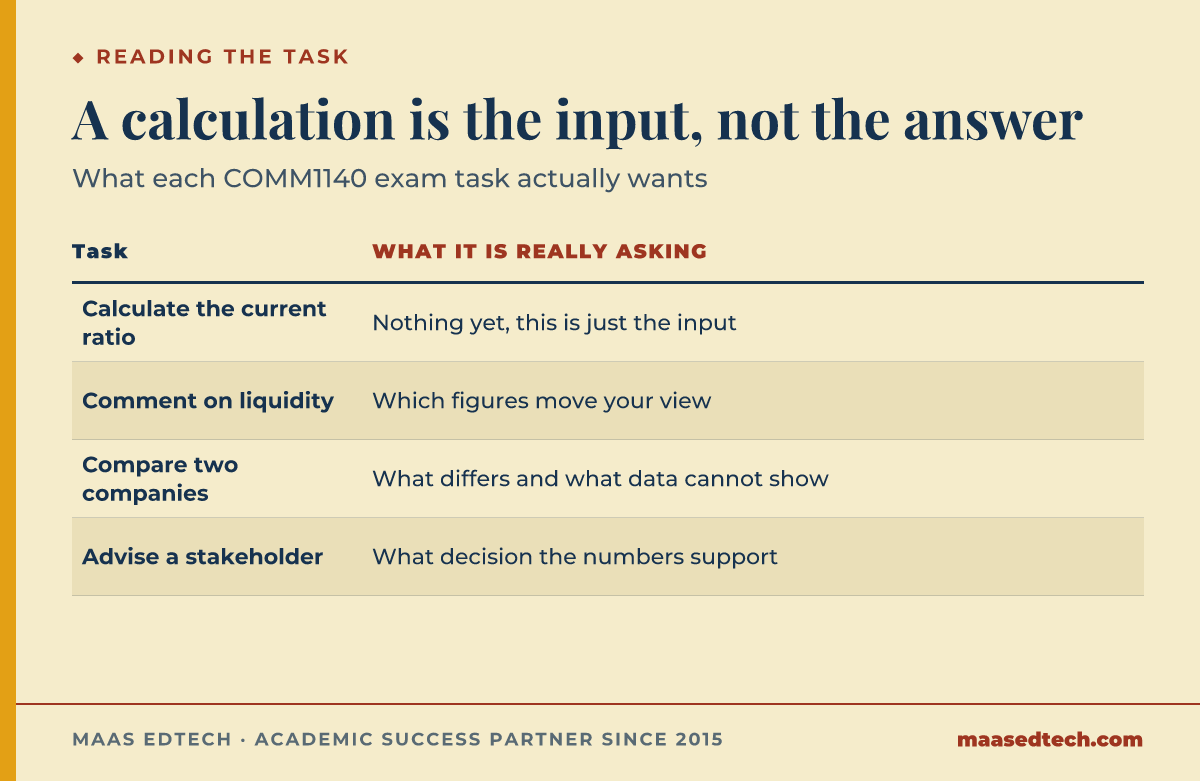
The distinction is visible in how questions are worded. A question asking you to calculate a ratio has one answer and is worth few marks. Even the textbook rule of thumb that treats a current ratio near 2 to 1 as comfortable is not, by itself, an assessable claim. A question asking what the movement in that ratio suggests about the company, or which of two firms is in the better position and why, has no single answer and carries the weight. Students who prepare only for the first kind arrive fluent at the cheap part of the paper.
| The task looks like | What it is really asking |
|---|---|
| Calculate the current ratio | Nothing yet, this is the input |
| Comment on liquidity | Which specific figures move your view, and in which direction |
| Compare two companies | What differs, why it might differ, and what you cannot tell from these statements |
| Advise a stakeholder | What decision the numbers support, and what would change your advice |
Evidence: Marton and Säljö (1976) distinguished a surface approach to learning, focused on reproducing material, from a deep approach focused on the meaning behind it, and found the two produce measurably different outcomes on tasks requiring understanding. Biggs and Collis (1982), in Evaluating the Quality of Learning, later formalised this gap in the SOLO Taxonomy, where correctly reproducing isolated facts sits well below relating those facts to a conclusion the way an interpretation question demands. Drilling procedures is a well-executed surface approach. It is efficient for reproduction and does not transfer to a question that asks what something means, which is why the extra hours often fail to move the mark.
Example: Asked to comment on a company's liquidity, one student produced three correctly calculated ratios and a sentence saying liquidity was adequate. The stronger answer used one ratio, noted that the improvement came almost entirely from a rise in receivables rather than cash, and observed that this weakens rather than strengthens the liquidity picture. Fewer calculations, more marks.
Why do profit and cash keep coming apart?
Direct answer: Because accrual accounting records revenues and expenses when they occur rather than when cash moves, so a profitable company can run short of cash and a loss-making one can be cash-positive. This is the single most examinable idea in the course and the one students most often state correctly without being able to use.
Evidence: The separation between the income statement and the cash flow statement exists precisely to make this visible, and it is written directly into the standards: AASB 101 governs presentation of the income statement, AASB 107 governs the statement of cash flows, and the two are deliberately kept as separate statements rather than reconciled into one. In Australia the underlying obligation to prepare these reports sits in the Corporations Act 2001, which is what gives AASB 101 and AASB 107 legal force rather than leaving them as best-practice guidance. That is why questions so often set the two against each other, and why the accrual basis sits at the centre of the International Financial Reporting Standards (IFRS), as adopted locally by the Australian Accounting Standards Board (AASB) for reporting periods beginning on or after 1 January 2005. Knowing the definition of accrual accounting is not the same as being able to explain why a company reporting record profit is struggling to pay suppliers. The first is a fact and the second is an inference, and only the second is worth real marks.
Example: Given a company with rising profit and falling operating cash flow, a weak answer restates that profit and cash differ under accrual accounting. A strong answer identifies where the difference sits, notes that receivables and inventory have both grown faster than sales, and draws the conclusion that the company may be recognising revenue it has not collected while tying up cash in unsold stock.
How to practise this: take any set of statements and ask one question before anything else, namely where profit and operating cash flow disagree and what accounts explain the gap. That single habit converts a large share of the course's harder questions into familiar ground.
What about the sustainability and non-financial reporting content?
Direct answer: The sustainability and non-financial reporting content is examinable, it is where a lot of vague writing appears, and it is the part most study resources handle badly because they are recycled from older accounting material.
Contemporary financial reporting courses extend beyond the core statements into non-financial disclosure, covering how organisations report their social and environmental impact and the frameworks that attempt to bring this together with financial performance. At UNSW this emphasis is not incidental: the course sits in a school where non-financial disclosure is an active research area, and it is taught by staff working in that field.
Evidence: de Villiers, Rinaldi and Unerman (2014), in the Accounting, Auditing & Accountability Journal, surveyed the emerging research on integrated reporting and identified both what the field claimed and where the evidence was thin, which is a useful posture to borrow. The paper states that purpose directly, in its own abstract: "The purpose of this paper is to synthesise insights from accounting and accountability research into the rapidly emerging field of integrated reporting and proposes a comprehensive agenda for future research in this area" (de Villiers, Rinaldi, & Unerman, 2014). The disclosure indicators the course expects you to recognise sit alongside frameworks such as those published by the Global Reporting Initiative (GRI), founded in 1997 and still the most widely used non-financial disclosure framework, and the more recent International Sustainability Standards Board (ISSB) standards, IFRS S1 and IFRS S2, issued in 2023 and increasingly referenced by large Australian firms. Integrated reporting is a contested practice with genuine criticisms attached to it, including concerns about whether it delivers accountability or presentation. An answer that treats it as self-evidently good is weaker than one that explains the intended benefit and names a limitation.
Example: A student wrote that integrated reporting helps companies be more transparent and sustainable. Nothing there is false and nothing is assessable. Rewritten to say that integrated reporting aims to connect financial and non-financial performance in a single account, but that reporting is largely voluntary and firm-selected, so comparability between companies remains limited, it became a claim with a position.
Compliance point worth knowing: avoid asserting that a specific company is or is not sustainable based on its own report. The report is the company's account of itself, and treating it as neutral evidence is exactly the analytical error these sections are testing for.
Where do international students most often lose marks?
Direct answer: On short written answers rather than on computation, and usually by describing when the question asked them to evaluate.
Students from schooling systems that reward accurate reproduction often arrive very strong at the mechanical parts of this course and comparatively unpractised at writing a defensible short judgment in a few sentences. Hyland (1998) found that hedges such as appears to and suggests mark appropriate caution rather than uncertainty, which is worth knowing before you strip them out to sound more confident. The problem is compounded by the format: a three-line answer offers nowhere to hide, so a habit of summarising the situation before committing to a view consumes the whole answer and leaves no room for the view itself.
The practical fix is structural. Lead with the judgment, then support it, then note the limitation. The company's liquidity position has weakened. The improvement in the current ratio comes from receivables rather than cash, and collection appears to be slowing. This reading assumes the receivables are genuinely collectable, which the statements alone do not show. Three sentences, a position, evidence and a caveat.
A note on terminology: keep the technical terms in English and use them exactly. Revenue, profit, cash flow and equity are not interchangeable, and neither are liquidity and solvency. Using them loosely reads as a conceptual gap rather than a language one, and in this course the marker cannot tell the difference.
How should you prepare for the exam?
Direct answer: By practising interpretation on statements you have not seen, in writing, under time pressure.
The efficient routine is short. Take a real set of published financial statements, spend 10 minutes, and write three sentences: what stands out, what explains it, and what you cannot determine from these statements alone. The third sentence is the one that separates strong answers, because knowing the limits of the evidence is part of what analysis means.
Evidence: This mirrors the assessed task in a way that redoing worked examples cannot. A worked example already contains the interpretation, so re-reading it rehearses recognition rather than production, which is the same trap Marton and Säljö identified.
What do MAAS mentors actually do on a course like this?
MAAS works as an academic advisor. On COMM1140 the useful work sits almost entirely on the interpretation side rather than on checking arithmetic. A mentor will ask what a number means before asking whether it is right, push you to commit to a position in a short answer rather than describing the situation, check whether your sustainability sections make a claim or merely sound positive, and read your written answers for whether the evidence you cite actually supports the judgment you drew. You do your own calculations, form your own view and submit your own work.
Frequently asked questions
Which university does this guide describe?
UNSW Sydney, where COMM1140 is Financial Management, worth 6 units of credit (UOC) in the integrated first year of the Bachelor of Commerce. Course codes beginning COMM are used at other institutions for unrelated subjects, so confirm the course title on your own enrolment.
Is this an accounting course or a finance course?
It is a financial reporting and analysis course, despite the name. The emphasis is on understanding and interpreting what organisations report rather than on valuation or corporate finance, which come later.
Do I need an accounting background?
No. It is a first-year course in the integrated core and is taken by students across the Bachelor of Commerce, including many with no intention of majoring in accounting. Prior exposure helps with the mechanics and does not help with the interpretation, which is where the marks concentrate.
How many courses is the integrated first year?
The Business School's published progression material sets it at 48 units of credit (UOC) across eight courses, with COMM1140 among them, plus the myBCom portfolio requirements. Program structures are revised, so check the handbook entry for your commencing year.
What is the most common avoidable mistake?
Answering a why or what-does-this-mean question with a calculation. If the question does not ask for a number, a number is not the answer.
Does this course matter if I am majoring in marketing or management?
Yes, and more than students expect. Reading financial statements is assumed in later core courses and in most graduate roles, and the integrated first-year design means later courses build on it rather than reteaching it.
Related reading
- ECON1101: microeconomics 1
- ACC311: strategic and sustainable accounting
- Academic support from MAAS mentors
Talk to a MAAS mentor about your course
References
Biggs, J. B., & Collis, K. F. (1982). Evaluating the quality of learning: The SOLO taxonomy. Academic Press.
de Villiers, C., Rinaldi, L., & Unerman, J. (2014). Integrated reporting: Insights, gaps and an agenda for future research. Accounting, Auditing & Accountability Journal, 27(7), 1042–1067. https://doi.org/10.1108/AAAJ-06-2014-1736
Hyland, K. (1998). Hedging in scientific research articles. John Benjamins Publishing.
Marton, F., & Säljö, R. (1976). On qualitative differences in learning: I. Outcome and process. British Journal of Educational Psychology, 46(1), 4–11. https://doi.org/10.1111/j.2044-8279.1976.tb02980.x