
Students arrive at Strategic and Sustainable Accounting with 3 years of technical training and assume the hard part will be the numbers. It rarely is. The subject sits late in the accounting degree because it asks students to carry a calculation into a decision, defend that decision to people whose interests conflict, and account for consequences the cost ledger never shows. A product-mix answer that is arithmetically perfect and stops there is a partial submission.
Author: MAAS Editorial Team
Last updated: 2026-08-11
Category: accounting-finance

First, which ACC311 are you enrolled in?
Direct answer: Check the university before trusting any study material under this code. At Charles Sturt University (CSU), ACC311 is Strategic and Sustainable Accounting, worth 8 credit points, taken late in the accounting degree. The same five characters at the University of Texas at Austin denote Fundamentals of Financial Accounting, an introductory unit in a different degree and country.
Evidence: CSU publishes the subject openly in its handbook, including the description, learning outcomes and indicative topics. The overlapping codes elsewhere are equally public. Because course codes are internal to each institution, collisions of this kind are ordinary, and search results mix them without warning.
Example: A student spent most of a weekend on financial-statement preparation exercises found under her own subject code before noticing that nothing in her subject outline mentioned preparing statements at all. The material was sound. It belonged to a different country's syllabus.
This guide describes the CSU subject. If your outline is about debits, credits and preparing a balance sheet, you are on the wrong page.
What is this subject actually asking of you?
Direct answer: It asks you to use accounting information to evaluate existing competitive strategies, develop new ones, and monitor progress towards them, while applying sustainability concepts to accounting and business practice. The published outcomes also expect you to generate and use both quantitative and non-financial information to measure performance, including indicators of the kind published by the Global Reporting Initiative (GRI), to analyse how the international business environment and societal expectations shape management accounting, and to build and evaluate spreadsheet models that support decision analysis. The indicative topics run through cost behaviour, decision making, capital expenditure, inventory, pricing and cost-volume-profit (CVP) analysis, and performance measurement and evaluation.
Evidence: These published outcomes and topics come from the university's own handbook entry, which states plainly that the subject requires you to synthesise and integrate the theory and practice learned across the accounting degree, drawing on frameworks such as those issued by the Australian Accounting Standards Board (AASB) and the International Financial Reporting Standards (IFRS), in order to structure and resolve problems for organisations operating with a sustainable business model. That sentence is the marking philosophy in miniature: synthesise and integrate, not recall and reproduce.
Example: Asked to advise on discontinuing a product line, one student produced a clean relevant-costing schedule and a one-line conclusion. A stronger submission used the same schedule, then noted which fixed costs would genuinely disappear rather than be reallocated, what the decision would do to the remaining lines' absorption, and what non-financial consequence the client had not priced. The arithmetic was identical in both.
Why does a correct number score so poorly on its own?
Direct answer: Because in a decision-oriented subject the calculation establishes only that you are eligible to have an opinion. The marks sit in the reasoning that surrounds it: which costs you treated as relevant and why, what you assumed, how sensitive the recommendation is to those assumptions, and what you would advise if one of them failed.
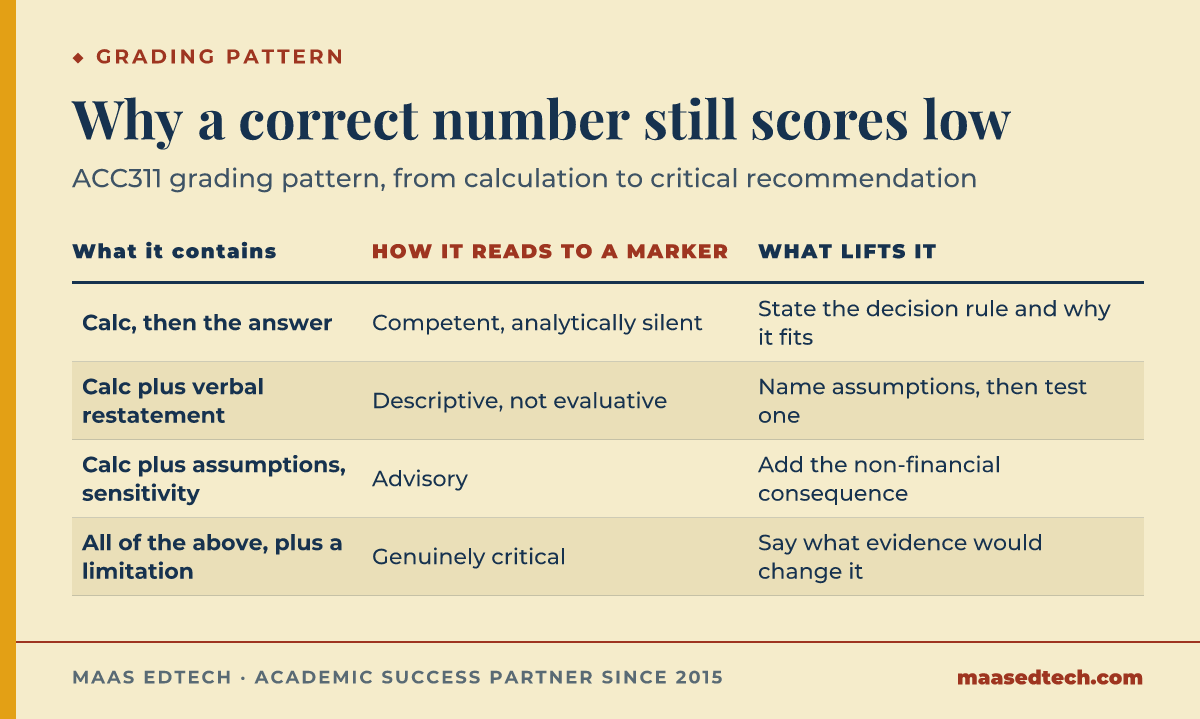
| What the submission contains | How it typically reads to a marker | What lifts it |
|---|---|---|
| Calculation, then the answer | Technically competent, analytically silent | State the decision rule you applied and why it fits this problem |
| Calculation plus a restatement of the result in words | Descriptive rather than evaluative | Name the assumptions that drive the result, then test one |
| Calculation, assumptions, sensitivity, recommendation | Advisory | Add the non-financial consequence the numbers do not capture |
| All of the above, with a stated limitation | Genuinely critical | Say what evidence would change your recommendation |
Evidence: The subject's own outcomes require you to generate, evaluate and use information, and the verbs matter. Evaluation is a distinct cognitive step from generation, and a submission that performs only the first has met part of an outcome. This is also why the outcome about spreadsheet models says develop and evaluate: a model you cannot interrogate is a model you cannot defend.
Example: Two capital-expenditure answers reached the same net present value (NPV) and internal rate of return (IRR). The first reported both figures. The second reported them, showed that the recommendation reversed if the discount rate moved by two percentage points, and said which of the project's assumptions was least secure. The second is the one an employer would pay for, and the marking criteria are written to reward it.
How do you handle the sustainability component without writing an essay about ethics?
Direct answer: By keeping it inside the decision rather than appending it to the end. Sustainability in this subject is a set of consequences and measures, of the kind the Triple Bottom Line (Elkington, 1997) tries to capture, that belong in the analysis, not a moral coda attached after the recommendation is already made.
Evidence: The scholarly literature is clear that sustainability accounting is contested in exactly this way. Elkington (1997) named this the Triple Bottom Line, arguing that organisations should be judged on social and environmental results alongside financial ones. Burritt and Schaltegger (2010) distinguish a critical path, which treats sustainability reporting largely as an exercise in managing external impressions, from a managerial path, which treats sustainability information as decision support for management, and conclude that "the development of sustainability accounting and reporting should be orientated more towards improving management decision making" (Burritt & Schaltegger, 2010). Gray (2010) goes further, arguing that much of what organisations label accounting for sustainability does not engage with sustainability at any meaningful level of analysis, even as professional bodies such as the International Federation of Accountants (IFAC) now treat sustainability reporting as core competency. You are not required to resolve that debate, but a submission that shows awareness of it reads very differently from one that assumes reporting and performance are the same thing.
Example: Asked to comment on a client's sustainability initiative, a weaker answer summarised the initiative and called it positive. A stronger one asked what the initiative was measured by, noted that the measure captured effort rather than outcome, and proposed a non-financial indicator that would actually move if the initiative worked. The second answer never used the word ethics and was far more critical.
What does integration mean in practice for a late-degree subject?
Direct answer: Integration here means the marker expects you to reach back into management accounting, strategy and financial reporting within a single answer, and to notice when they disagree. The friction between them is usually where the marks are.
Evidence: The relationship between control systems and strategy has been a recognised research problem for decades rather than a settled procedure. Langfield-Smith (1997) reviewed this literature and found that the fit between a firm's strategy and its control systems is contingent rather than universal, which is precisely why a subject at this level asks you to reason about a specific organisation instead of applying a fixed template. Simons (1995) frames the same tension as four levers of control operating in balance rather than a single correct system. Kaplan and Norton (1996) make a related point in proposing the Balanced Scorecard, arguing that financial measures alone are backward-looking and need to be balanced against customer, internal-process and learning perspectives if they are to support strategy at all.
Example: One student analysed a transfer-pricing problem correctly from the divisional manager's perspective and recommended the price that maximised the division's return on investment (ROI) rather than its residual income (RI). The stronger version made the same calculation, then observed that the divisional incentive and the group's interest pointed in opposite directions, and named that conflict as the real finding. The problem was never about the price.
Where do Vietnamese students most often lose marks here?
Direct answer: On the shift from computation to judgement, and on hedging. Both are habits carried from an earlier stage of training rather than gaps in accounting knowledge, and both are fixable within a session.
The first is a genuine change of task. Where earlier subjects had a right answer, this one has a defensible answer, and students who have been rewarded for accuracy often read the absence of a single correct result as a sign they have misunderstood the question. They then retreat into more calculation, which is the one thing that cannot rescue the mark.
The second is linguistic. Academic English distinguishes carefully between what the evidence shows, what it suggests, and what remains uncertain, and that distinction carries real weight in an advisory answer. Hyland (1998) treats hedges like indicate and suggest as signalling appropriate caution, not weakness, and Swales and Feak (2012) list these same stems among the standard moves of graduate academic writing. Writing that a course of action will increase profit, when your own sensitivity analysis shows it depends on an assumption, reads as overclaiming even when the underlying work is good. The usable stems are ordinary: the analysis indicates that, this holds provided that, the recommendation is sensitive to, on the available evidence.
A note on terminology: keep the technical terms in English rather than translating them privately. Relevant cost, contribution margin, transfer price and balanced scorecard have precise meanings that everyday translation blurs, and a blurred term produces a blurred recommendation.
What should a working method look like across the session?
Direct answer: Build the model first, interrogate it second, and write the recommendation last, leaving enough time that the writing is analysis rather than transcription.
A pattern that works on assessment of this shape: read the scenario twice before touching a spreadsheet, once for the decision being asked and once for the constraints and stakeholders. Build the quantitative analysis in a spreadsheet with assumptions in labelled input cells rather than hard-coded inside formulas, because the outcome about evaluating models is unreachable if you cannot change an input and see what happens. Then run at least one sensitivity test and record what you learned from it. Only then write, keeping the recommendation and its stated limitation together in roughly 150 to 250 words, since a recommendation without a stated limitation is the most common way a strong analysis ends up reading as an overclaim.
Evidence: The labelled-input habit is not presentational. It is what makes the difference between a model you can evaluate and a set of numbers you can only report, which is the distinction the learning outcome draws.
What do MAAS mentors actually do on a subject like this?
MAAS works as an academic advisor. On an integrating subject, the useful work is rarely checking arithmetic. A mentor will ask you to explain which costs you treated as relevant and why, press on the assumption your recommendation rests on, look at whether your sustainability discussion is inside the decision or bolted on afterwards, and read your draft for places where the language claims more certainty than your own analysis supports. You build your own model, form your own recommendation, and submit your own work, with referencing checked inside the review.
Frequently asked questions
Which university does this guide describe?
CSU, where ACC311 is Strategic and Sustainable Accounting, worth 8 credit points in the accounting degree. The same characters at the University of Texas at Austin denote an unrelated introductory subject.
What does the subject cover?
Published material lists cost behaviour, decision making, capital expenditure, inventory, pricing and cost-volume-profit (CVP) analysis, and performance measurement and evaluation, including non-financial indicators of the kind published by the Global Reporting Initiative (GRI), framed by conceptual and behavioural issues in strategic and sustainable accounting.
How is it assessed?
Published indicative assessment for an earlier online offering was built around applied decision cases, including strategy, product mix and tactical decisions, and sustainability, transfer pricing and investment decisions. Task types and weightings are revised between sessions, so your own subject outline is the authority on what counts this session.
Do I need advanced maths?
No. The quantitative demands sit within standard management accounting technique built up over the first 2 years of the degree, such as CVP analysis and relevant costing. The difficulty is analytical rather than mathematical, which is why students with strong technical marks can still find this subject harder than expected.
How much does the spreadsheet work matter?
Enough that it appears in the learning outcomes in its own right. The outcome asks you to develop and evaluate models that aid decision analysis, so a spreadsheet that produces an NPV or IRR figure but cannot be re-run under different assumptions only meets half of it.
Is sustainability a separate section of the answer?
Usually it should not be. The stronger submissions treat sustainability consequences and measures, including Triple Bottom Line indicators (Elkington, 1997), as part of the decision analysis, which is also closer to how the subject describes organisations operating with a sustainable business model.
Related reading
- ACCT2105: accounting in organisations and society
- ACC304: company accounting
- Academic support from MAAS mentors
Talk to a MAAS mentor about your subject
References
Burritt, R. L., & Schaltegger, S. (2010). Sustainability accounting and reporting: Fad or trend? Accounting, Auditing & Accountability Journal, 23(7), 829–846. https://doi.org/10.1108/09513571011080144
Elkington, J. (1997). Cannibals with forks: The triple bottom line of 21st century business. Capstone Publishing.
Gray, R. (2010). Is accounting for sustainability actually accounting for sustainability... and how would we know? An exploration of narratives of organisations and the planet. Accounting, Organizations and Society, 35(1), 47–62. https://doi.org/10.1016/j.aos.2009.04.006
Hyland, K. (1998). Hedging in scientific research articles. John Benjamins Publishing.
Kaplan, R. S., & Norton, D. P. (1996). The balanced scorecard: Translating strategy into action. Harvard Business School Press.
Langfield-Smith, K. (1997). Management control systems and strategy: A critical review. Accounting, Organizations and Society, 22(2), 207–232. https://doi.org/10.1016/S0361-3682(95)00040-2
Simons, R. (1995). Levers of control: How managers use innovative control systems to drive strategic renewal. Harvard Business School Press.
Swales, J. M., & Feak, C. B. (2012). Academic writing for graduate students: Essential tasks and skills (3rd ed.). University of Michigan Press.