
Most students who struggle with this RMIT accounting course are not short on technical skill. They arrive expecting debits and credits, and meet instead a course built around a different question: not how to prepare accounts, but why an organisation chooses to report what it reports. The instinct trained by earlier units, writing descriptive essays about what a company reported, is exactly the instinct this course marks down.
Author: MAAS Editorial Team
Last updated: 2026-07-20
Category: accounting-finance

What is ACCT2105 Accounting in Organisations and Society about?
Direct answer: ACCT2105 is an RMIT accounting course about the role of accounting in organisations and wider society, not the mechanics of preparing statements. It covers the purposes and users of accounting information, the regulatory environment, corporate governance, voluntary disclosure including sustainability reporting, and the incentives that shape what managers disclose.
Evidence: The teaching frame draws on the social and critical accounting literature: legitimacy theory and stakeholder theory as the dominant explanations for voluntary disclosure, Deegan's work applying legitimacy theory to corporate social disclosure, Gray, Owen and Adams on accounting and accountability, and the standard-setting and conceptual-framework material that defines who financial reporting is meant to serve.
Example: A Vietnamese student at RMIT Vietnam arrived at MAAS with a draft summarising the sustainability section of a company's annual report. Her mentor asked the analytical question: why did this company disclose this, in this year, in this tone? Once legitimacy theory was applied to a timeline that included a public incident, the description became an argument and her mark moved from a Pass-level draft to a Distinction.
What assessment does the ACCT2105 assignment usually involve?
Direct answer: Courses of this type are commonly assessed through an individual essay or report analysing a company's disclosures or an accounting issue through a theoretical lens, often with a group component, a presentation, and sometimes reflective or discussion tasks. You are typically asked to select an organisation or issue, apply an accounting theory such as legitimacy or stakeholder theory, evaluate the disclosure or practice critically, and reach a justified conclusion about accountability. Always confirm the exact task, word count, and weighting in your own Canvas shell, because assessment structure changes by semester and campus.
Evidence: RMIT business assessments are criterion-referenced, meaning marks are awarded against published rubric criteria rather than ranked against classmates. This is set out in RMIT's Assessment policy, which is why decoding the rubric matters far more than how much of the annual report you summarise.
Example: A Vietnamese RMIT student spent half of a 1,500-word essay summarising a company's reported figures. His MAAS mentor cut the summary to a short paragraph and reallocated the words to why the disclosure changed after a regulatory inquiry. Same company, same word count, the theory-led version earned a clear Distinction.
How is the ACCT2105 assignment graded, what does the rubric actually reward?
Direct answer: Rubrics for this course type reward four things, roughly in this order: (1) correct application of accounting theory to a specific disclosure or practice rather than theory described in a standalone section, (2) evidence drawn from actual reports, standards, or documented events, (3) critical evaluation, whose interests the practice serves, what is omitted, and whether the accountability claim holds and (4) academic writing and Harvard referencing. Summarising what a company reported earns almost no marks: the question is always why, and for whom.
Evidence: RMIT business rubrics use criterion bands (Pass / Credit / Distinction / High Distinction). The jump from Credit to Distinction is almost always defined by the words "critical" and "justified", critical evaluation of accountability, justified use of theory, not by covering more of the annual report.
Example: A MAAS mentor marked one Vietnamese student's draft by asking of each paragraph: does this tell me what was disclosed, or why? Three quarters answered "what". After a rewrite that attached a theoretical explanation to each disclosure choice, the same evidence moved up two full rubric bands.
Which theories should you use in ACCT2105?
Direct answer: Anchor the analysis in one or two theories applied properly rather than a survey of all of them. Legitimacy theory explains disclosure as a response to threats to the organisation's social licence; stakeholder theory explains it as management of relationships with those who affect or are affected by the firm; institutional theory explains why firms in the same field come to look alike; agency theory explains disclosure as a response to information asymmetry between managers and owners; and a critical or accountability lens asks whose voice is absent from the report altogether. Pick the lens that best explains your evidence, and say why the others fit less well.
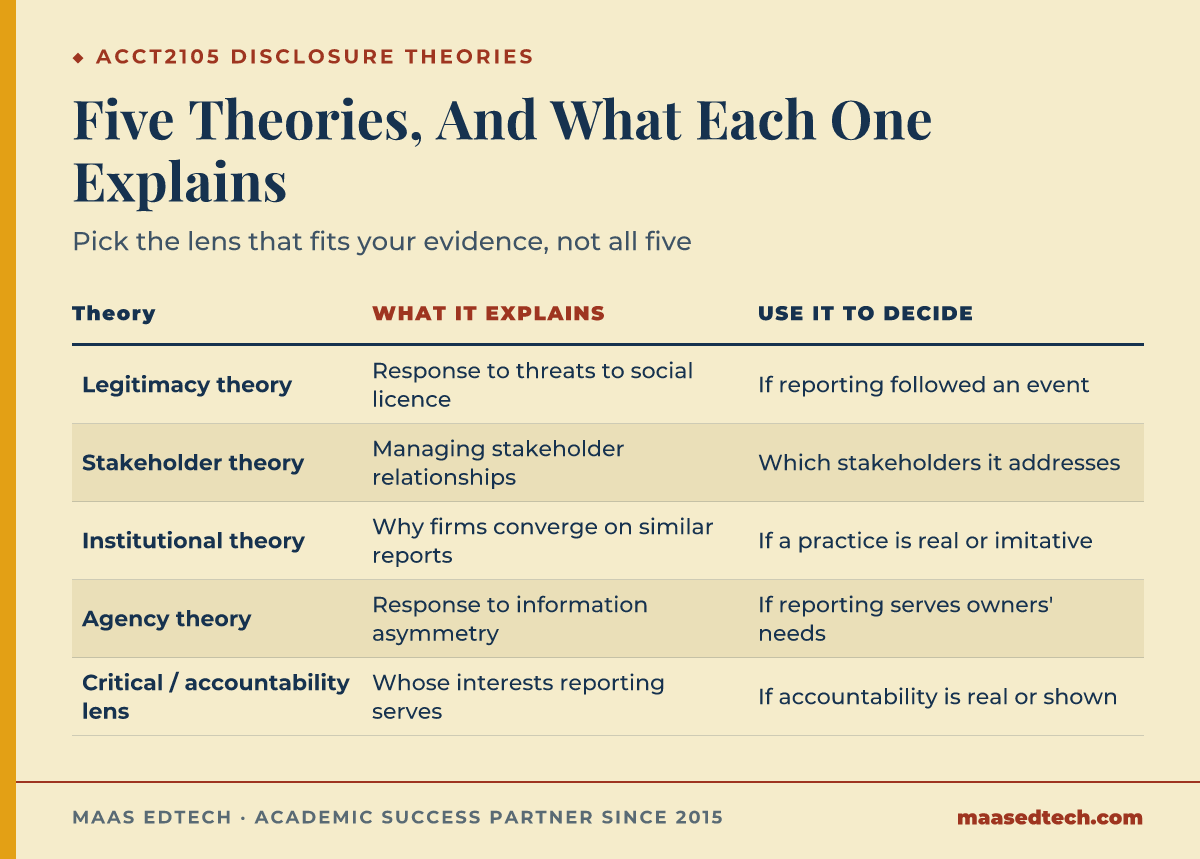
| Theory | What it explains | Use it to decide |
|---|---|---|
| Legitimacy theory | Disclosure as a response to threats to the social licence to operate | Whether reporting followed an event, and what it was managing |
| Stakeholder theory | Disclosure as management of specific stakeholder relationships | Which stakeholders the report actually addresses |
| Institutional theory | Why firms in one industry converge on similar reporting | Whether a practice is substantive or imitative |
| Agency theory | Disclosure as a response to information asymmetry and contracts | Whether reporting serves owners' monitoring needs |
| Critical / accountability lens | Whose interests the reporting system serves, and who is silent in it | Whether accountability is real or presentational |
Evidence: These five theories are examiner-recognised foundations: Deegan (2019) for the application of legitimacy theory to social disclosure, Gray, Owen and Adams (2014) for accountability and social accounting, Freeman (1984) for stakeholder theory, DiMaggio and Powell (1983) for institutional isomorphism, and Jensen and Meckling (1976) for agency theory. Jensen and Meckling state the mechanism agency theory formalises in plain terms: "If both parties to the relationship are utility maximizers there is good reason to believe that the agent will not always act in the best interests of the principal" (Jensen & Meckling, 1976, p. 308). Note the standing debate, legitimacy and stakeholder theory often predict the same disclosure, so a Distinction-level answer says which prediction the evidence actually distinguishes.
Example: A Vietnamese RMIT student applied four theories to one disclosure, each in two sentences. Her MAAS mentor kept legitimacy theory, built the timeline that supported it, and added one paragraph explaining why stakeholder theory predicted the same disclosure but explained the timing less well. Fewer theories, sharper argument, higher mark.
How should you structure the ACCT2105 essay?
Direct answer: Use an argument-led structure: (1) an introduction naming the organisation or issue and your position, (2) the theoretical lens briefly explained and justified as the best fit, (3) the evidence, specific disclosures, standards, events, dates, analysed rather than summarised, (4) a critical evaluation covering omissions, competing explanations, and whose interests are served, and (5) a justified conclusion about accountability. Keep company background under 10% of the word count and never leave a theory section stranded with no link to the evidence that follows.
Evidence: Criterion-referenced rubrics weight "application of theory", "critical evaluation", and "use of evidence" far above "description of the company". Matching your word budget to the rubric weighting is the most reliable way to lift a grade without finding new material.
Example: A Vietnamese RMIT student submitted an essay with a 400-word theory section that was never mentioned again. His MAAS mentor cut it to 120 words and wove the remainder into the analysis, so each disclosure carried its explanation. Same content, the essay moved from a borderline Credit to a Distinction.
What are the most common mistakes that lose marks in ACCT2105?
Direct answer: Three recurring mistakes show up across MAAS accounting coaching. First, description in place of analysis, a tour of what a company reported, with no explanation of why. Second, a detached theory block: legitimacy theory defined at length, then never used to explain a single disclosure choice. Third, uncritical acceptance of the report's own framing, taking a sustainability claim at face value with no attention to what is measured, what is omitted, and whether it is assured. Fixing these three lifts most drafts by at least one rubric band.
Evidence: Across MAAS accounting coaching, marker feedback before intervention clusters heavily on "too descriptive" and "theory not applied", the two phrases that most often separate a Credit from a Distinction in social and critical accounting rubrics.
Example: A Vietnamese student praised a company's carbon disclosure as evidence of strong accountability. His MAAS mentor asked which scope of emissions was reported, whether the figures were independently assured, and what happened to the reporting boundary after a divestment. The revised essay showed the disclosure was narrower than it appeared and that analysis earned the marks the praise had not.
How long is the ACCT2105 assignment and what referencing style does it use?
Direct answer: Confirm the exact word count and style in your assessment brief, individual essays at this level commonly sit between 1,500 and 2,500 words, with reference lists usually excluded, and use Harvard referencing, which is RMIT's default business style. Stay within the 10% tolerance band. Cite theory from journal articles and textbooks rather than summary websites, and reference every company claim to the annual report, sustainability report, or regulatory filing with its year and page or section, because in this course your evidence is the disclosure document.
Evidence: RMIT's Business school uses RMIT Harvard as its standard referencing style, documented in RMIT's Easy Cite referencing tool. Markers routinely deduct marks for unreferenced disclosure claims, secondary citations of theorists, or inconsistent Harvard formatting even when the analysis is strong.
Example: A Vietnamese RMIT student lost several marks because his quotations from a sustainability report carried no year or page reference and his in-text citations did not match his reference list. A MAAS pre-submission audit closed the gaps in under an hour. On his next ACCT2105 task, clean sourcing recovered marks on a criterion requiring no extra analysis.
Frequently asked questions
Is ACCT2105 a hard course?
It surprises students more than it defeats them. Many arrive expecting technical accounting and find an essay-based course requiring theory and argument. Students who treat it as "summarise the annual report" struggle; students who treat it as "explain why this organisation reports as it does" do well.
Do I need technical accounting knowledge?
Enough to read a financial and sustainability report accurately, what the statements contain, what an assurance statement means, what a reporting boundary is. The marks, however, come from analysis of purpose and accountability rather than from computation.
Can I analyse a Vietnamese company?
Often yes, if the brief allows your own choice and the company publishes reports you can cite. Listed companies and large state-linked firms usually publish enough; check the disclosure is accessible and in a language you can quote accurately before committing.
Is it acceptable to criticise the company I chose?
Yes, critical evaluation is a rubric criterion. Criticism must be evidenced from the disclosures themselves rather than asserted, and a balanced analysis that acknowledges genuine improvements is stronger than blanket condemnation.
What referencing style does ACCT2105 use?
RMIT Harvard is the default for business courses, and it applies to annual reports, standards, and regulatory documents as well as literature. Confirm in your own brief and use RMIT's Easy Cite tool for consistency.
Can MAAS help me with ACCT2105?
Yes. MAAS Assignment & Essay Support coaches you through the assignment with the Outline, Draft, Final model, choosing the right theory, building the evidence timeline, moving from description to critique, and a pre-submission referencing audit, all with discipline-matched experts. We coach your work; we do not write it for you.
Ready to approach ACCT2105 with a clear strategy?
If you have the report but not the argument, that is exactly where a discipline-matched expert helps most. MAAS Assignment & Essay Support is an academic support partner; we work alongside you through Outline, Draft, Final so the analysis stays yours and the structure earns the marks.
Bring your ACCT2105 brief and we will match you to an accounting mentor, 23% of our 100+ experts hold a PhD, within 48 hours when our network already covers that field. If it does not, MAAS opens a dedicated recruitment round for your case, which usually takes about two weeks.
Book a free 15-minute ACCT2105 consultation with MAAS Assignment & Essay Support →
Related guides
- BUSM4692 assignment: how do you approach Global Corporate Responsibility?: sibling guide on CSR, ESG, and corporate accountability
- BUSM2575 assignment: how do you approach Business in Society?: for the stakeholder and legitimacy debates
- Assignment command words explained: what "evaluate", "analyse", and "justify" actually require
- MAAS Academic Mentoring service: 1:1 coaching with PhD-level mentors in your discipline
- Course-code assignment coaching: pillar guide on tackling any unit assignment with a MAAS mentor
References
- Deegan, C. (2019). Legitimacy theory: Despite its enduring popularity and contribution, time is right for a necessary makeover. Accounting, Auditing & Accountability Journal, 32(8), 2307–2329. https://doi.org/10.1108/AAAJ-08-2018-3638
- DiMaggio, P. J., & Powell, W. W. (1983). The iron cage revisited: Institutional isomorphism and collective rationality in organizational fields. American Sociological Review, 48(2), 147–160. https://doi.org/10.2307/2095101
- Freeman, R. E. (1984). Strategic management: A stakeholder approach. Pitman.
- Gray, R., Owen, D., & Adams, C. (2014). Accountability, social responsibility and sustainability: Accounting for society and the environment. Pearson.
- Jensen, M. C., & Meckling, W. H. (1976). Theory of the firm: Managerial behavior, agency costs and ownership structure. Journal of Financial Economics, 3(4), 305–360. https://doi.org/10.1016/0304-405X(76)90026-X
Tools & resources
- RMIT University. (n.d.). Assessment and exams. Retrieved July 20, 2026, from https://www.rmit.edu.au/students/student-essentials/assessment-and-exams
- RMIT University. (n.d.). Easy Cite referencing tool. Retrieved July 20, 2026, from https://www.rmit.edu.au/library/study/referencing
This article is part of the MAAS Journal series for Vietnamese international students. MAAS Assignment & Essay Support is an academic support partner; we coach students through the Outline, Draft, Final delivery model with developmental feedback from discipline-matched experts. We do not write or submit work on a student's behalf.