
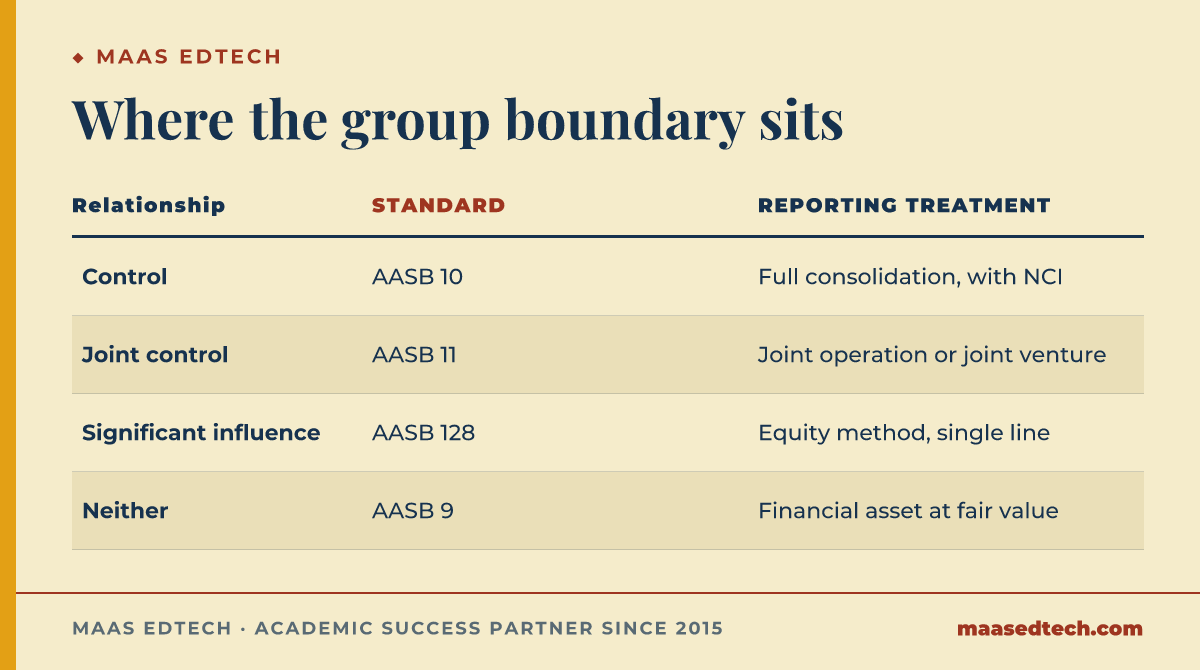
Most students arrive at ACCT3011 expecting a mechanics unit, and the worksheet mechanics are real. The marks, however, cluster somewhere else. Before a single elimination entry can be written, somebody has to decide which investees are consolidated line by line, which are equity accounted, and which sit outside the group entirely and are disclosed instead. That decision is a judgement made on the facts of a case, and the rest of the answer is only as good as the reasoning behind it. This guide sets out how MAAS mentors read a group reporting assignment at the University of Sydney.
Author: MAAS Editorial Team
Last updated: 2026-09-21
Category: accounting-finance

What is the unit, and where does it sit in the degree?
Direct answer: ACCT3011 Reporting on Business Groups is a 6 credit point undergraduate unit at the University of Sydney Business School, taught in both Semester 1 and Semester 2 2026. Its prerequisite is ACCT2011, it is core for the Accounting major, and it is itself a prerequisite for the capstone unit ACCT3600.
Evidence: The unit is taught by the Accounting, Governance and Regulation academic unit at the Camperdown and Darlington campus, and it is also a selective for the Accounting minor. The 2026 unit page describes a sequence rather than a topic list. Students first consider where a consolidated financial report is necessary, then learn to prepare one, including goodwill, intra-group transactions and non-controlling interests, before moving on to equity accounting, segment disclosures, related party disclosures and foreign currency translation. The unit then extends into complex financial instruments and current issues in accounting regulation and practice, including the politics of the standard-setting process. The stated aim is that students develop written communication and critical-thinking skills through analysis of corporate group activities, with a focus on the role of professional judgement and the potential impacts on users. Note the ordering: necessity comes before preparation.
Example: Material for the unit is still filed under Financial Accounting B on note-sharing sites, the title it carried in University of Sydney handbooks up to at least 2020. The content overlaps, but the current description gives professional judgement far more prominence, so notes inherited from an older cohort will under-prepare you for the written component.
How do you decide which entities belong inside the group?
Direct answer: By placing each investment on a continuum rather than answering a yes or no question. Control leads to full consolidation under AASB 10, significant influence to the equity method under AASB 128, and joint control to AASB 11, which splits again into a joint venture and a joint operation. Anything below that is a financial asset under AASB 9.
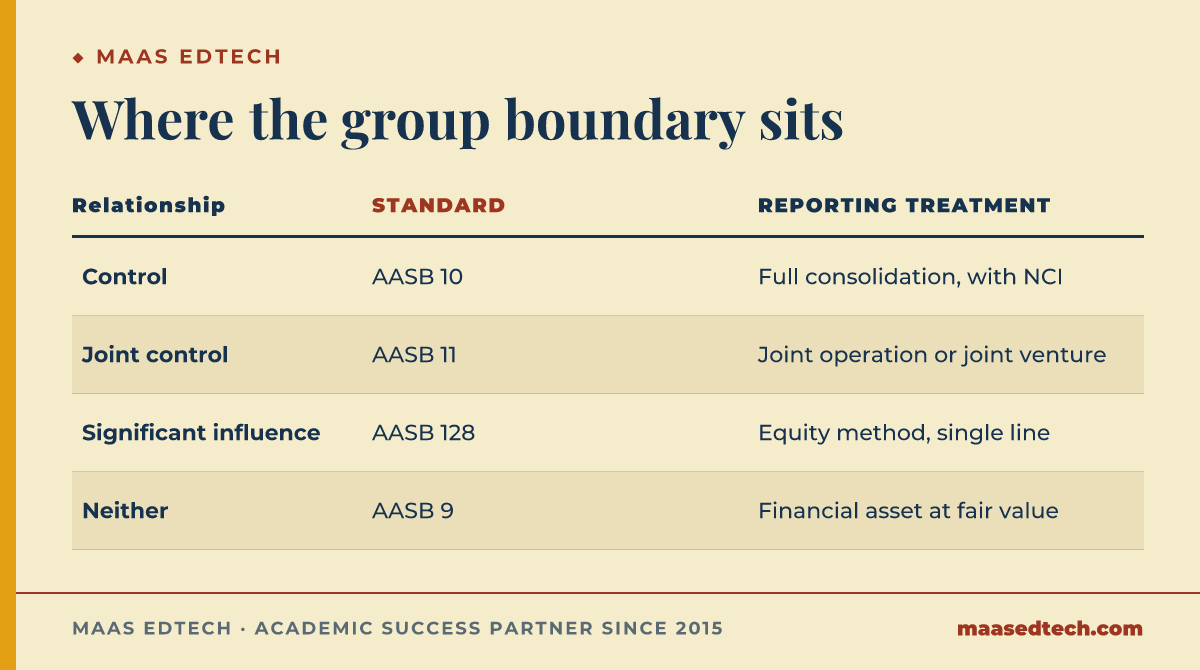
Evidence: The AASB 11 split matters because only the joint venture is equity accounted; a joint operator instead recognises its own share of the assets, liabilities, revenue and expenses. Because the classification drives everything downstream, it belongs at the front of your answer, argued rather than asserted. AASB 10 defines control through three elements that must all be present: power over the relevant activities of the investee, exposure or rights to variable returns from involvement with it, and the ability to use that power to affect those returns. None of the three is settled by a shareholding percentage alone, which is why a case can give you 45 per cent with board control or 55 per cent with a contractual veto held by another party. Bradbury, Mehnaz and Scott (2022), writing in Accounting & Finance, examined how equity accounting is actually used and how useful it is to readers of financial statements, and their work is a reminder that the equity method is a reporting decision with consequences rather than a default resting place for awkward holdings.
Example: One submission opened with "Parent Ltd holds 60 per cent of Sub Ltd and therefore consolidates". It was not wrong, and it earned almost nothing, because the case had placed a shareholders' agreement in the appendix that gave the 40 per cent holder a veto over the operating budget. The answer that scored well spent a paragraph on that agreement, worked through the three limbs of AASB 10 against it, and reached a conclusion the marker could disagree with on stated grounds.
How should you present goodwill, and does the NCI measurement choice matter?
Direct answer: Present goodwill as a schedule, not as prose, and treat the measurement of non-controlling interests as a policy choice you justify. Where the NCI is a present ownership interest, AASB 3 lets an acquirer measure it at fair value, producing full goodwill, or at a proportionate share, producing partial goodwill.
Evidence: That choice changes both reported goodwill and reported equity. The AASB 3 option is about how NCI itself is measured, and the second of the two measures is a proportionate share of the identifiable net assets. It is available transaction by transaction rather than as a once-and-for-all group policy, and is a live question in the research literature rather than a textbook curiosity. Sotti, Rinaldi and Gavana (2015), in Corporate Ownership and Control, examined the two measurement options and the consistency problems they create within a single set of consolidated statements. Lopes, Lourenço and Soliman (2013), writing in the Australian Journal of Management, asked whether alternative methods of reporting non-controlling interests really matter to users, and found that the market priced NCI the same way whether they were presented inside equity or outside it. Frii and Hamberg (2021), in Accounting in Europe, looked at what motives shape the initial accounting for goodwill under IFRS 3 where controlling owners dominate. Sotti and colleagues put the consequence plainly, writing that their simulations demonstrate that "subsidiaries with similar underlying economics might have a different impact on the calculation of the group equity and income" (Sotti et al., 2015, p. 293), purely because of the approach the parent selected. Citing one of these turns a mechanical paragraph into an argued one.
| Element of the schedule | What the marker is checking | Where answers lose marks |
|---|---|---|
| Consideration transferred | Fair value at acquisition date, including contingent consideration | Using the cash figure and ignoring deferred or contingent amounts |
| NCI at acquisition | Which AASB 3 option was chosen, and why | Applying an option without naming it |
| Fair value of identifiable net assets | Adjustments to carrying amounts, with deferred tax recognised | Forgetting the deferred tax effect of fair value uplifts under AASB 112 |
| Resulting goodwill or bargain purchase gain | The arithmetic, the reassessment AASB 3 requires first, and the consequence of a gain | Treating a bargain purchase as an error rather than as a gain in profit or loss |
Example: Two students applied the fair value option correctly. The first showed the schedule and moved on. The second added two sentences noting that the option had been chosen because the group had signalled an intention to acquire the remaining shares, and that the choice therefore carried information for users. Only the second engaged the "impacts on users" language the unit description uses.
How do you handle intra-group transactions without losing the thread?
Direct answer: By remembering where the entries live. Consolidation adjustments are prepared on a worksheet each reporting period and are never posted to the ledgers of the parent or the subsidiary, which is why last period's eliminations have to be reconstructed this period rather than carried forward.
Evidence: The common adjustments in a group reporting case fall into a small number of families: intra-group sales and purchases with unrealised profit remaining in closing inventory, transfers of non-current assets with the depreciation consequences that follow, intra-group loans with their interest, dividends declared within the group, and management fees. Each carries a tax effect under AASB 112 that students routinely omit. The discipline that protects marks is arithmetic housekeeping: give every adjustment a reference number, and make sure each one appears in the worksheet column and in your narrative under the same reference.
Example: An unrealised profit adjustment was calculated correctly and then applied to the full profit on the sale, although only 40 per cent of the goods remained unsold at year end. The error was not conceptual. It came from writing the adjustment straight into the worksheet without a line stating what proportion remained in inventory, so nothing in the working flagged the missing step.
Why do the disclosure standards carry more marks than expected?
Direct answer: Because the boundary of the group is a judgement, the standards require you to tell readers where you drew it and what sits just outside it. AASB 12 governs disclosure of interests in other entities, AASB 124 related party disclosures, AASB 8 operating segment information on a management approach, and AASB 121 the translation of a foreign operation.
Evidence: These four standards reward the student who reads the case as a business rather than as a set of accounts. AASB 8 is the clearest example of why disclosure is analytical rather than clerical. It requires segments to be reported the way the chief operating decision maker actually reviews them, so the answer depends on facts about internal reporting that the case will give you somewhere other than the financial statements. AASB 121 adds a second layer: a subsidiary whose functional currency differs from the group's presentation currency has its assets and liabilities translated at the closing rate and its income and expenses at transaction date rates, with the difference recognised in other comprehensive income rather than profit or loss. Lourenço and Curto (2010), writing in the European Accounting Review on the determinants of accounting choice for interests in jointly controlled entities under the pre-AASB 11 rules, found that where a standard offered a choice of reporting method the selection was shaped by firm circumstances rather than being a neutral technical one. The same reading is worth carrying into your segment and translation decisions.
Example: A case described a group running two brands through a single legal entity while the board received separate monthly reports for each. Several answers reported one segment because there was one entity. The stronger answers reported two, on the ground that AASB 8 follows the internal reporting rather than the legal structure, and said so in one sentence.
How do you connect the treatment to the facts rather than describing the rules?
Direct answer: By writing the case detail into the sentence that states the rule. A paragraph that would read identically for any company has described a standard; a paragraph that could only have been written about this case has applied one. The unit description names professional judgement explicitly, and judgement is only visible where the facts are.
Evidence: The pattern that works is three moves in order. State what the standard requires, quote or paraphrase the specific fact in the case that engages it, then state the consequence for the consolidated numbers. Where the facts are genuinely ambiguous, say which way you have resolved the ambiguity and what would change your conclusion. That last sentence is often the difference between a distinction and a credit, because it demonstrates you know the answer is a judgement rather than a lookup.
Example: Two answers addressed the same related party question. The first set out the AASB 124 definition in full and concluded that disclosure was required. The second quoted the sentence in the case describing a director's spouse as a supplier, explained why that brought the arrangement within the definition of a close family member, and noted that the amount was immaterial but the relationship still required disclosure because AASB 124 is about the existence of the relationship rather than the size of the balance.
A practical order of work
Direct answer: Work through six steps in order: classify every investment before touching numbers, build the worksheet with referenced adjustments, prepare the goodwill schedule with its policy choice named, work the intra-group families with their tax effects, decide the disclosures from the business facts, and finish with the sentence stating what would change your conclusion.
- Classify every investment in the case and write one paragraph justifying each classification against AASB 10, AASB 11 or AASB 128 before you calculate anything.
- Build the worksheet with a reference number on every adjustment, and keep the narrative and the worksheet using the same references.
- Prepare the goodwill schedule separately, name the AASB 3 measurement option you have used for NCI, and say why.
- Work through the intra-group families one at a time, and attach the AASB 112 tax effect to each before moving on.
- Decide the AASB 8, AASB 124 and AASB 121 disclosures from facts about how the business is run, not from the face of the statements.
- Close each judgement with a sentence on what evidence would change it. Never present a judgement as if it were arithmetic.
Frequently asked questions
Is ACCT3011 the same unit as Financial Accounting B?
It is the same unit code under a later title. University of Sydney handbooks up to 2020 list ACCT3011 as Financial Accounting B, and the current description carries the title Reporting on Business Groups. The consolidation content is continuous, but the current framing gives professional judgement and the standard-setting debate more weight, so older notes are an incomplete guide.
Do I need to memorise the AASB paragraph numbers?
You need to cite the right standard and, where a specific requirement matters, the right paragraph. What earns marks is applying the requirement to the facts. A correctly numbered citation attached to a generic paragraph still reads as description.
How much does the equity method really come up?
Enough to be worth preparing properly. The unit lists equity accounting alongside consolidation, and a case that contains only subsidiaries would not test the classification judgement the unit is built around. Bradbury et al. (2022) is a useful short read on how equity accounting is used in practice.
What is the single most common avoidable error?
Omitting the deferred tax consequences of fair value adjustments and unrealised profits. It is mechanical, it comes up in almost every assessment cycle, and it is the error most often caused by working quickly rather than by misunderstanding.
Should I discuss the politics of standard setting if the question does not ask?
Only where it bears on the treatment in front of you. The unit description does include the politics of the standard-setting process, so a short, anchored observation about why an option exists can strengthen an answer. A general essay on standard setting bolted onto a technical question will not.
Where MAAS fits
MAAS mentors work alongside students at the University of Sydney and other Australian universities on units like this rather than in place of them. On a group reporting assignment, the most useful work is usually structural: checking that every classification in your answer is argued against the three limbs of AASB 10 rather than assumed from a percentage, confirming that each worksheet adjustment carries its tax effect, and asking whether your disclosure section came from how the business is run or from the face of the statements. The analysis stays yours. If that is useful, our academic support service and our tutoring service are the two places to start.
References
Bradbury, M. E., Mehnaz, L., & Scott, T. (2022). The use and usefulness of equity accounting. Accounting & Finance, 62(S1), 1957–1981. https://doi.org/10.1111/acfi.12845
Frii, P., & Hamberg, M. (2021). What motives shape the initial accounting for goodwill under IFRS 3 in a setting dominated by controlling owners? Accounting in Europe, 18(2), 218–248. https://doi.org/10.1080/17449480.2021.1912369
Lopes, A. I., Lourenço, I., & Soliman, M. (2013). Do alternative methods of reporting non-controlling interests really matter? Australian Journal of Management, 38(1), 7–30. https://doi.org/10.1177/0312896212458788
Lourenço, I. C., & Curto, J. D. (2010). Determinants of the accounting choice between alternative reporting methods for interests in jointly controlled entities. European Accounting Review, 19(4), 739–773. https://doi.org/10.1080/09638181003687844
Sotti, F., Rinaldi, L., & Gavana, G. (2015). Measurement options for non-controlling interests and their effects on consolidated financial statements consistency: Which should the disclosure be? Corporate Ownership and Control, 12(2), 293–302. https://doi.org/10.22495/cocv12i2c2p3
Tools & resources
The University of Sydney. (n.d.). ACCT3011: Reporting on Business Groups. https://www.sydney.edu.au/units/ACCT3011