
◆ Accounting & Finance
ACC304 Company Accounting: how do you approach the assignment?
ACC304 Company Accounting asks you to apply Australian Accounting Standards to real corporate reporting problems, and the marks sit in your justification, not your journal entries. Most students who lose marks here can post a consolidation entry correctly but cannot explain why the standard requires it, or what changes when the facts change. This guide answers the seven questions Vietnamese students ask MAAS mentors most often before they start an ACC304 assignment.

◆ Question 1 / 7 · The course
What is ACC304 Company Accounting about?
Direct answer: ACC304 is a company (corporate) accounting course examining how companies prepare external financial reports under the Australian Accounting Standards Board (AASB) framework. The dominant topics are company income tax, business combinations, consolidation of parent and subsidiary statements, associates and joint arrangements, and foreign currency issues. The course wants a financial-report preparer who defends every number against a standard.
Evidence: Courses of this type map closely onto a stable set of AASB standards, AASB 3 Business Combinations, AASB 10 Consolidated Financial Statements, AASB 128 Investments in Associates and Joint Ventures, AASB 112 Income Taxes, and AASB 121 The Effects of Changes in Foreign Exchange Rates. These standards are the examinable spine, and the marking criteria reward correct application far more than they reward recall.
Example: A Vietnamese student came to MAAS convinced ACC304 was "Excel plus journal entries". Her mentor reframed it: every entry is a claim, and the standard is the evidence for that claim. Once she started writing one sentence of justification beside each consolidation adjustment, her problem-solving marks moved from a Pass level to a Distinction, because the marker could finally see the reasoning behind the numbers.
◆ Question 2 / 7 · Assessment
What assessment does the ACC304 assignment usually involve?
Direct answer: Company accounting courses at this level are typically assessed through a combination of technical problem sets (consolidation worksheets, tax-effect calculations, acquisition analysis) and a written component that asks you to explain or evaluate a reporting treatment. You are often given a scenario, a parent acquiring a subsidiary, an intra-group transaction, a deferred tax question, and asked both to prepare the correct entries and to justify them with reference to the relevant standard. Always confirm the exact brief, weighting, and reference style in your own course shell, because structure changes by campus and semester.
Evidence: Australian business-school assessment is criterion-referenced, meaning your work is marked against published rubric criteria rather than ranked against classmates. This is why a technically correct worksheet with no explanation still stalls in the middle bands: the criteria explicitly reward communication of the reasoning, not just the arithmetic.
Example: A student submitted a flawless consolidation worksheet and expected a High Distinction. He earned a Credit. His MAAS mentor showed him the rubric line that awarded marks for "justification with reference to accounting standards", a line he had left almost blank. The numbers were never the problem; the missing argument was.
◆ Question 3 / 7 · Rubric
How is the ACC304 assignment graded, what does the rubric actually reward?
Direct answer: ACC304 rubrics at this level reward four things, in roughly this order: (1) technical accuracy of the accounting treatment, (2) correct and explicit reference to the relevant AASB standard, (3) critical explanation of why the treatment applies and how it affects the financial statements, and (4) clear, professional communication with correct referencing. The jump from a Credit to a Distinction is almost always the difference between a correct entry and a correct entry that is argued.
Evidence: Australian rubrics use criterion bands (Pass / Credit / Distinction / High Distinction), and the higher bands are defined by evaluative language, "critically applies", "justifies with reference to standards", "evaluates the impact". A student who only describes the mechanics of consolidation cannot reach those bands, however neat the worksheet.
| Rubric focus | Describe (lower band) | Analyse and justify (higher band) |
|---|---|---|
| Consolidation entry | States the elimination entry | Explains why AASB 10 requires elimination and its effect on group equity |
| Deferred tax | Calculates the temporary difference | Argues why the difference is temporary and how AASB 112 measures it |
| Business combination | Lists the fair value of net assets acquired | Justifies each fair-value adjustment and its goodwill consequence |
| Associate | Applies the equity method mechanically | Evaluates why significant influence, not control, drives AASB 128 |
Example: A MAAS mentor colour-coded a student's draft, green for a justified sentence, red for a bare calculation. The draft was mostly red. After one pass that added a single justifying clause to each answer, quoting AASB 3's own measurement principle that "the acquirer shall measure the identifiable assets acquired and the liabilities assumed at their acquisition-date fair values" (Australian Accounting Standards Board, 2015), the same worksheet moved up two full bands.
◆ Question 4 / 7 · Standards
Which standards and frameworks should you anchor an ACC304 answer in?
Direct answer: Anchor each answer in the specific standard that governs it rather than gesturing at "the accounting standards" in general. For a business combination, cite AASB 3 and work through the acquisition method. For consolidation, cite AASB 10 and the control model. For an investment that gives significant influence, cite AASB 128 and the equity method. For tax-effect accounting, cite AASB 112 and the temporary-difference approach. Naming the right standard, and using it correctly, is the single clearest signal of competence in this subject.
Evidence: The AASB standards are principle-based, which means the marker expects you to apply a principle to the facts, not to recite a rule (Picker et al., 2019). AASB 10, for instance, defines control through power, exposure to variable returns, and the ability to affect those returns, a test you must actually apply to the scenario, not merely quote (Australian Accounting Standards Board, 2015). The same discipline carries across the other two standards on this list: AASB 128 draws the line at significant influence rather than control, and AASB 112 requires deferred tax to be measured on the temporary difference between an asset's carrying amount and its tax base, not on cash-basis income (Australian Accounting Standards Board, 2015).
Example: A Vietnamese student analysing a partial acquisition kept writing "we consolidate because it is a subsidiary". His mentor pushed him to apply the AASB 10 control test explicitly: who holds the power over relevant activities, and who is exposed to variable returns. Once he argued control from the facts rather than assuming it, his answer read like a preparer's, and the mark reflected it.
◆ Question 5 / 7 · Report structure
How should you structure the written component of an ACC304 report?
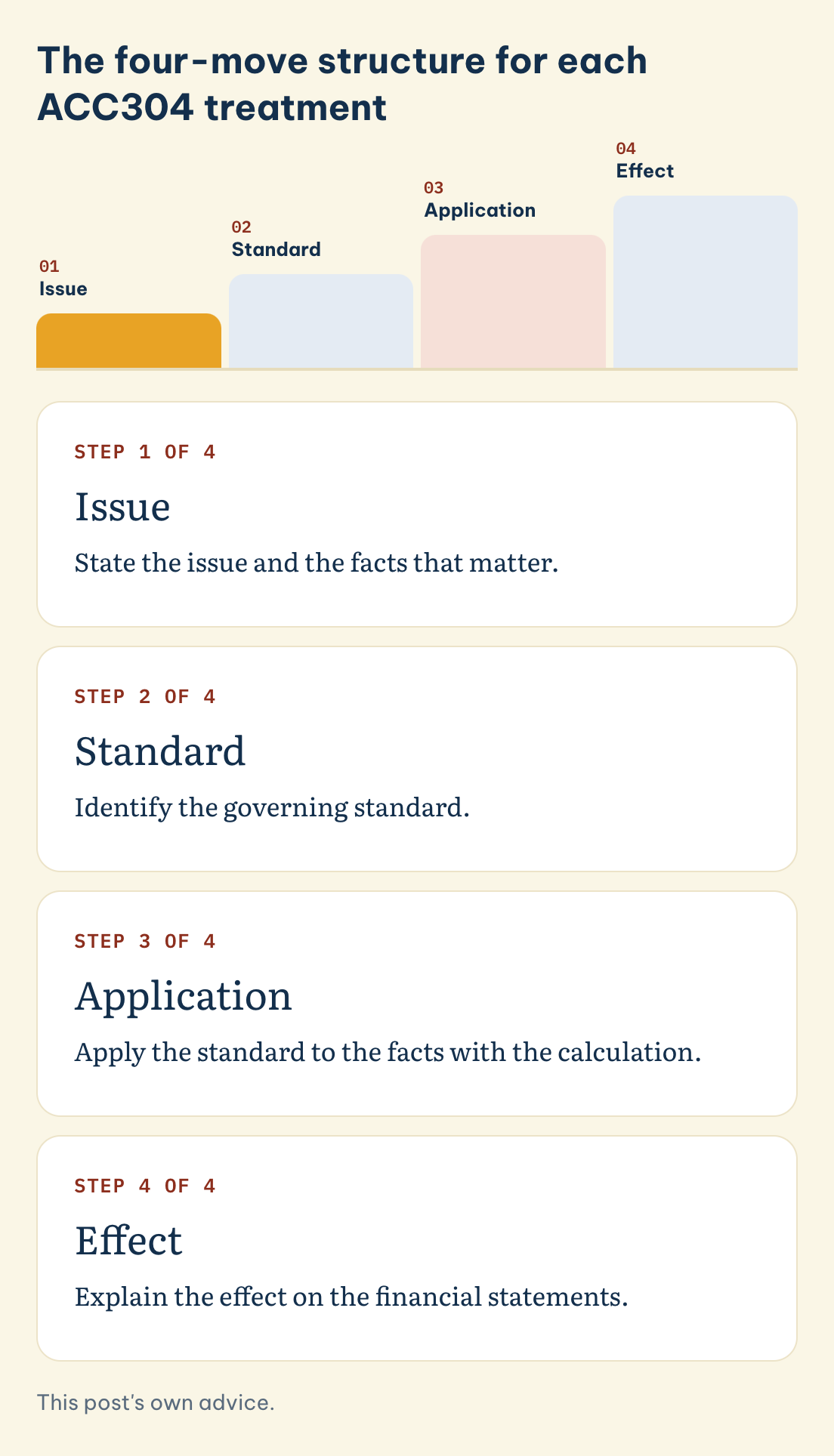
Direct answer: For each required treatment, use a consistent four-move structure: (1) state the issue and the facts that matter, (2) identify the governing standard, (3) apply the standard to the facts with the calculation, and (4) explain the effect on the financial statements. Keep description of the scenario short; spend your words on application and effect, where the marks concentrate. If your report is a series of numbers with no connective reasoning, restructure it around this issue-standard-application-effect spine.
The four-move structure for each ACC304 treatment
Select a step to read what it asks for. The post advises these four moves for each required treatment. The bar heights and colours only mark the order and carry no weight.
Step 1 of 4
Issue
State the issue and the facts that matter.
Step 2 of 4
Standard
Identify the governing standard.
Step 3 of 4
Application
Apply the standard to the facts with the calculation.
Step 4 of 4
Effect
Explain the effect on the financial statements.
Save this figure
Evidence: The higher rubric bands reward "logical, well-supported reasoning", which is exactly what a repeatable issue-standard-application-effect structure produces. It also protects you against the most common failure in company accounting: a correct answer that the marker cannot follow because the reasoning is implicit.
Example: A student's consolidation report was a wall of worksheets with no narrative. His mentor kept the numbers untouched but added a two-line explanation before each schedule, what the issue was, and which standard resolved it. The content did not change; the readability and the mark both jumped, because the marker could finally trace the argument.
◆ Question 6 / 7 · Common mistakes
What are the most common mistakes Vietnamese students make in ACC304?
Direct answer: The recurring mistakes are: treating consolidation as mechanical entry-posting without justifying elimination against AASB 10; confusing an associate (significant influence, equity method) with a subsidiary (control, full consolidation); ignoring the tax effect of fair-value adjustments in a business combination; forgetting to eliminate unrealised profit on intra-group transactions; and writing calculations with no reference to any standard. Each of these is a marks-loser even when the arithmetic is correct.
Evidence: Because the subject is criterion-referenced and principle-based, the marker penalises unjustified treatment and rewards the argument. A student who eliminates intra-group profit but never explains why unrealised profit must be removed from group results, because it has not yet been earned from a party outside the economic entity (Loftus et al., 2020), has done the mechanics without earning the analysis marks.
Example: A Vietnamese student consolidated a subsidiary correctly but applied the equity method to a genuine controlled entity in the same assignment, mixing up control and significant influence. His MAAS mentor did not fix the entries for him; he asked one question, "does the parent control this entity or merely influence it?", and let the student re-argue the classification himself. The correction stuck because the student reasoned to it.
◆ Question 7 / 7 · MAAS mentor
How can a MAAS mentor help you approach ACC304 without crossing the line?
Direct answer: A MAAS mentor works alongside you, not instead of you. The mentor helps you decode the brief and rubric, walks you through the logic of a standard until you can apply it yourself, reviews a draft worksheet and points to where justification is thin, and models how a professional preparer argues a treatment. You keep authorship of every entry and every sentence; the mentor raises the ceiling of what you can defend on your own.
Evidence: Because ACC304 is graded on justified application rather than answer-matching, the durable gain comes from understanding the control model, the acquisition method, and the tax-effect logic well enough to reapply them in an exam or a job. Coaching that builds that reasoning is what moves marks and, more importantly, what survives the semester.
Example: A Vietnamese student arrived able to post consolidation entries but unable to explain any of them. Over a few sessions his MAAS mentor had him narrate each entry aloud against its standard until the justification became automatic. He wrote and submitted the assignment himself. The mark rose, and so did his confidence walking into the final exam.
Frequently asked questions
Is ACC304 Company Accounting hard for international students?
The arithmetic is manageable; the difficulty is justification. Many international students can complete a consolidation worksheet but lose marks because they never explain the treatment against a standard. Building the habit of writing one justifying sentence per answer closes most of that gap.
Which AASB standards matter most in ACC304?
The examinable spine is usually AASB 3 (business combinations), AASB 10 (consolidation), AASB 128 (associates and joint ventures), AASB 112 (income taxes), and AASB 121 (foreign exchange). Confirm the emphasis in your own course outline.
What is the difference between an associate and a subsidiary in ACC304?
A subsidiary is controlled by the parent and is fully consolidated under AASB 10; an associate is subject only to significant influence and is accounted for using the equity method under AASB 128. Misclassifying the two is one of the most common and costly errors in the subject.
Does MAAS write the ACC304 assignment for me?
No. MAAS provides mentoring and review. A mentor helps you decode the rubric, understand the standards, and strengthen your own draft, but you remain the author of every entry and explanation you submit.
How long should the written component be?
Follow your own brief. Company accounting reports are usually concise; markers reward tight, well-justified reasoning over length. If you are padding scenario description to hit a word count, you are spending words where marks are thin.
Can I use MAAS if I only need help understanding consolidation?
Yes. Many students book a short session to work through the control model or the equity method until they can apply it independently, then complete the assignment on their own.
How MAAS mentors support ACC304 students
If you are approaching an ACC304 Company Accounting assignment and want a clearer path, MAAS offers a free 20-minute consultation to review your brief and map your approach. Bring your assignment brief and we will match you with a subject mentor within 48 hours when our network already covers that field. If it does not, MAAS opens a dedicated recruitment round for your case, which usually takes about two weeks. Around 23% of MAAS experts hold a PhD, and our accounting mentors are qualified practitioners who work with you to raise what you can defend on your own, never to write the work for you.
Related reading: see our guide to how assignment rubrics reward analysis over description and our academic support service for how mentoring works end to end.
References
Australian Accounting Standards Board. (2015). AASB 3 Business combinations. AASB. https://www.aasb.gov.au/admin/file/content105/c9/AASB3_08-15.pdf
Australian Accounting Standards Board. (2015). AASB 10 Consolidated financial statements. AASB. https://www.aasb.gov.au/admin/file/content105/c9/AASB10_08-15.pdf
Australian Accounting Standards Board. (2015). AASB 112 Income taxes. AASB. https://www.aasb.gov.au/admin/file/content105/c9/AASB112_08-15.pdf
Australian Accounting Standards Board. (2015). AASB 128 Investments in associates and joint ventures. AASB. https://www.aasb.gov.au/admin/file/content105/c9/AASB128_08-15.pdf
Loftus, J., Leo, K., Daniliuc, S., Boys, N., Luke, B., Ang, H., & Byrnes, K. (2020). Financial reporting (3rd ed.). Wiley.
Picker, R., Clark, K., Dunn, J., Kolitz, D., Livne, G., Loftus, J., & van der Tas, L. (2019). Applying IFRS standards (4th ed.). Wiley.
A free 20-minute consultation is a conversation about where you are with ACC304.
Book a free consultation ▸