
Microeconomics 1 at UNSW sits early in a business degree and functions as a gate: other courses assume it, so a weak result does not stay contained within one term. The course looks familiar, since supply, demand, elasticity and market structure appear in high school economics in several countries, and students who met the vocabulary before often arrive confident and leave the mid-term surprised. The difficulty is that recognising a diagram stops earning marks; using one does.
Author: MAAS Editorial Team
Last updated: 2026-08-11
Category: economics
What is the course, in the university's own words?
Direct answer: ECON1101 Microeconomics 1 is a 6-unit-of-credit introductory course in the School of Economics at UNSW Sydney. It introduces the theory of markets with applications to business, social and individual issues, covering the principles of rational choice by individual economic agents and the role of government in keeping markets operating efficiently.
Evidence: UNSW publishes the course in its handbook, including the unit value and the school that owns it. The stated outcomes ask students to apply economic concepts appropriately, use economic reasoning in decision making, recognise how different market structures affect business and personal choices, and understand the rationale for government microeconomic policy and its effects. Note the verbs: apply, use, recognise, understand. None of them is state. In Australian public debate, that same rationale is what bodies such as the Reserve Bank of Australia, the Productivity Commission, and the Australian Competition and Consumer Commission (ACCC) draw on when they publish commentary on markets, and it is worth noticing that their reasoning follows the same demand-and-supply logic taught in week one.
UNSW's standard four-band grading scale typically runs High Distinction from 85% and above, Distinction from 75% to 84%, Credit from 65% to 74%, and Pass from 50% to 64%, though individual course profiles can adjust the exact cut-offs. A student who can only reproduce a diagram from memory tends to sit at the Pass or Credit end, because Distinction and High Distinction marks reward the applied reasoning the outcomes describe, not recognition alone.
Example: A student who could reproduce a monopoly diagram from memory could not say what happened to consumer surplus when the firm was allowed to price discriminate. He had learned the picture rather than the reasoning the picture encodes, the same gap between recognition and application that separates a Credit answer from a Distinction one under UNSW's own grading bands.
Why is the graph not the answer?
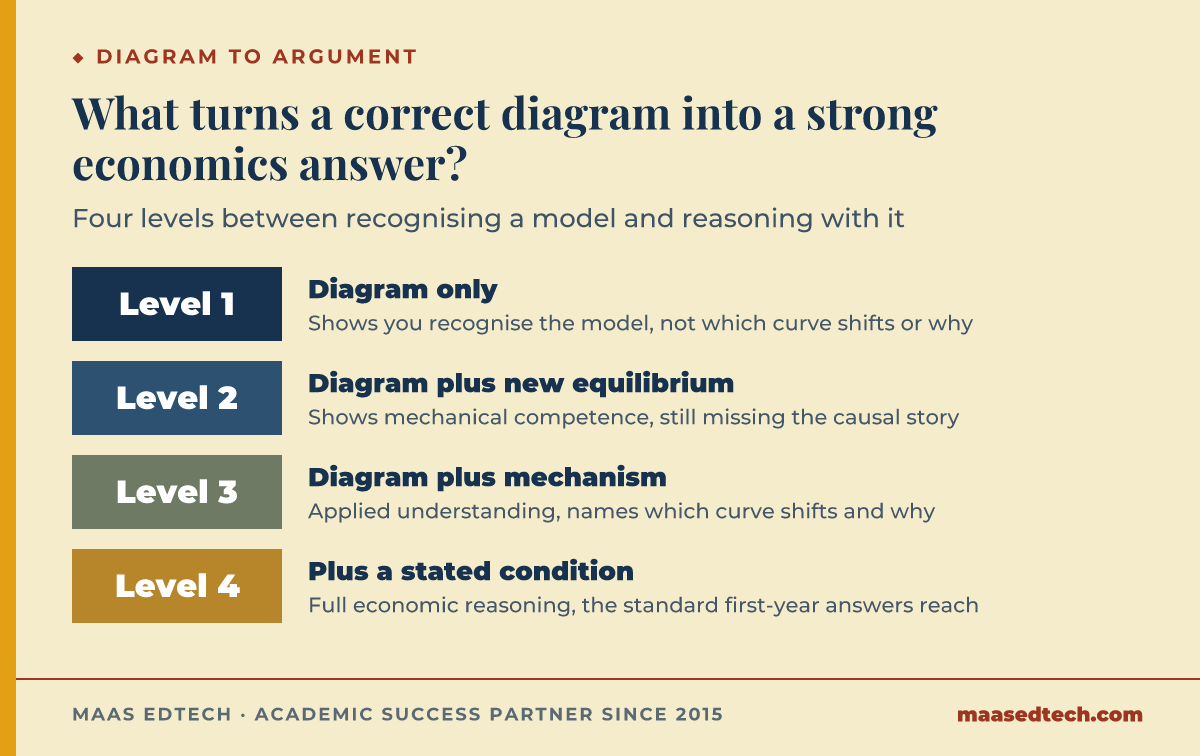
Direct answer: Because a diagram in microeconomics is an argument in compressed form, and the marks attach to the argument. A correct graph with no reasoning states a conclusion. A correct graph accompanied by the direction of change, the mechanism producing it, and the assumption the mechanism depends on constitutes an answer.
| What a student produces | What it demonstrates | What is missing |
|---|---|---|
| The right diagram, drawn accurately | Recognition of the model | Which curve shifts, and why |
| The diagram plus the new equilibrium | Mechanical competence | The economic story linking cause to effect |
| Diagram, shift, mechanism | Applied understanding | What the result depends on |
| All of the above plus a stated condition | Economic reasoning | Little, at first-year level |
Evidence: This maps onto how the course outcomes are worded. Applying a concept appropriately means selecting the right model for the situation and knowing its limits, which is a different skill from drawing it. Examiners can distinguish the two quickly, because a student who has memorised the picture will describe the movement and a student who understands will name the cause.
Example: Asked what a per-unit tax on producers does, one answer shifted supply left and reported a higher price and lower quantity. That is correct and partial. The fuller answer added that the share of the tax borne by consumers depends on the relative elasticities of supply and demand, and that with highly inelastic demand consumers bear almost all of it. Same diagram, considerably more economics, and the same elasticity logic that sits behind any serious account of who bears a tax change.
Which concept causes the most trouble, and why is that reassuring?
Direct answer: Opportunity cost. It is introduced in the first week, sounds simple, and is applied incorrectly by a large share of students all term. This is worth knowing early, because students who get it wrong usually conclude they are bad at economics, when in fact they have collided with a concept that is genuinely slippery.
Evidence: Ferraro and Taylor (2005) put a multiple-choice question about opportunity cost to 199 professional economists at a national conference and found that only around 22% selected the answer the authors judged correct, a rate close to what random guessing across four options would produce. Their conclusion was blunt about the profession's own grasp of the concept. As the authors put it: "The results are not consistent with our expectation that graduate training leads to a deeper understanding of the concept" (Ferraro & Taylor, 2005). The finding has not gone unchallenged: Potter and Sanders (2012) argued that the question itself embedded a contestable definition, and that the poor performance says more about ambiguity in how opportunity cost is specified than about economists' understanding. For a first-year student, the useful lesson survives either reading. If the concept can generate a published dispute among professionals, then finding it slippery is not a sign of weakness, and the response should be to be explicit about what is being given up and over what period, rather than to memorise a definition.
Example: Asked for the opportunity cost of attending a free concert she would have valued at fifty dollars, given that her alternative was a shift paying forty dollars, one student answered fifty. The cost of attending is the best forgone alternative, which is the forty dollars she did not earn. Writing out what was given up, explicitly, fixed the error faster than re-reading the definition ever did, the same slip Ferraro and Taylor (2005) documented among professional economists rather than students.
How should you study for a course assessed largely under time pressure?
Direct answer: By testing yourself rather than reviewing. In a course where much of the mark sits in tutorial tests and a final exam, the ability to produce an explanation without notes is the assessed skill, and re-reading does not build it.
Evidence: The finding here is unusually robust in learning science. Karpicke and Blunt (2011) compared studying by concept mapping against practising retrieval on the same material and found that retrieval practice produced better performance on later tests of meaningful learning, including questions requiring inference rather than recall. This built on earlier work by Roediger and Karpicke (2006), who showed the same testing effect on long-term retention rather than just the next lecture. The result matters for this course because concept mapping resembles what many students actually do, which is redrawing the diagrams neatly and colour-coding the shifts. That work feels productive and builds recognition rather than recall.
Example: A student in trouble after the first tutorial test kept a study log showing eleven hours of reading and no self-testing. Switching to closed-book practice questions, then checking, changed his marks over three weeks without increasing his hours. What changed was that he discovered his gaps before the test did, exactly the mechanism Karpicke and Blunt (2011) describe.
A workable weekly rhythm: read the chapter once before the lecture so the lecture is a second exposure rather than a first, attempt tutorial problems before the tutorial rather than after, and once a week take a blank page and write out one model from memory including what each axis measures and what each curve assumes. The blank page is the diagnostic. Anything you cannot produce from memory is not yet learned, regardless of how familiar it looked in the textbook, the same testing effect Roediger and Karpicke (2006) tracked over the long term rather than the next lecture.
Where do international students most often lose marks?
Direct answer: On short-answer questions asking why or what happens if, where the marks sit in the explanation rather than the result, and on the habit of answering in the wrong register.
Many students arriving from an education system that rewards a correct final figure will write the answer and stop, because in their previous training the working was scaffolding rather than substance. Students who came through a British-style system may also expect a different grading map: First Class Honours from 70% and above, Upper Second (2:1) from 60% to 69%, Lower Second (2:2) from 50% to 59%, and Third Class from 40% to 49%. UNSW's own bands run higher, so translating a percentage mark across systems by habit is a common and avoidable source of confusion. Whichever scale you grew up with, your transcript will only show the UNSW mark and its Grade Point Average (GPA) weighting, so it is worth learning the local bands rather than converting in your head every time. In microeconomics the causal chain is the substance, and an unexplained correct answer will often score around 50%. The fix is mechanical rather than conceptual: after stating a result, write one sentence naming the mechanism and one naming the condition it depends on.
The second habit is linguistic. Economic explanation runs on connectives that carry causal weight: because, therefore, this implies, holding other things constant, provided that. Answers written without them read as a list of true statements rather than an argument, even when every statement is correct. The phrase ceteris paribus is not decoration; it marks precisely which other things you are holding fixed while you reason about one change.
A note on terminology: keep the technical terms in English rather than translating them mentally. Elasticity, deadweight loss, marginal cost and consumer surplus have exact meanings, and everyday translation makes them approximate. Under exam pressure an approximate term produces an approximate answer.
What does a strong short answer look like in practice?
Direct answer: Result, mechanism, condition, in that order, in three or four sentences.
Take a question asking what happens in the market for a good when a close substitute falls in price. A weak answer says demand falls. A strong answer says demand for the good falls because consumers substitute towards the now cheaper alternative, which shifts the demand curve left and lowers both equilibrium price and quantity, and adds that the size of the effect depends on how close the substitution is, since goods that are poor substitutes will show little movement. Nothing in the second version is advanced. It is the same knowledge, ordered so that the reasoning is visible.
Evidence: This structure aligns with what the stated outcomes ask for, since using economic reasoning for decision making requires the reasoning to be on the page. It also protects partial credit under UNSW's marking scheme. A student who states a mechanism and reaches a slightly wrong conclusion usually earns more than a student who states the right conclusion and nothing else.
What do MAAS mentors actually do on a course like this?
MAAS works as an academic advisor. On a first-year theory course, the useful work is diagnostic rather than editorial. A mentor will ask you to explain a model without your notes and listen for where the explanation breaks, look at a marked test with you to separate what you did not know from what you knew but could not retrieve in time, and check whether your written answers carry the mechanism or only the result. You attend your own tutorials, sit your own assessments and submit your own work.
Frequently asked questions
Which university does this guide describe?
UNSW Sydney, where ECON1101 is Microeconomics 1, a 6-unit-of-credit course in the School of Economics. The same code appears at other institutions, including North American universities where it commonly denotes a principles of microeconomics course, so check that any study material you find matches your own course outline before relying on it, and confirm the credit value against the UNSW handbook rather than a search result.
Do I need to be good at maths?
Not at an advanced level. The course uses graphs, simple algebra and arithmetic rather than the calculus tested in a course like MATH1131. Students who struggle usually do so with the reasoning rather than the computation, which is why more practice problems help only when you are checking your explanations, not just your answers.
How is it assessed?
Published outlines for this course have used a combination of in-tutorial tests, participation, online activities and a final examination, with a substantial share of the mark sitting in timed conditions. Structures and weightings are revised between terms, so your own course outline for the current term is the authority.
I studied economics at high school. Is this a repeat?
The vocabulary will be familiar and the expected standard of explanation will not be. Students with prior exposure often perform well early and plateau at the point where questions move from describing a model to applying it to an unfamiliar case.
Does ECON1101 matter beyond itself?
Yes, which is the main practical reason to take it seriously. It underpins later economics and business courses, so gaps carry forward rather than closing on their own.
Is there much writing?
Less than in most business courses, but the short-answer components are written, and they are marked on explanation. Being able to write three precise sentences about a mechanism is a genuinely assessed skill here.
Related reading
- ECON1269: business in the globalised economy
- How to revise for final exams effectively
- Tutoring support from MAAS mentors
Talk to a MAAS mentor about your course
References
Ferraro, P. J., & Taylor, L. O. (2005). Do economists recognize an opportunity cost when they see one? A dismal performance from the dismal science. Contributions in Economic Analysis & Policy, 4(1), Article 7. https://doi.org/10.2202/1538-0645.1469
Karpicke, J. D., & Blunt, J. R. (2011). Retrieval practice produces more learning than elaborative studying with concept mapping. Science, 331(6018), 772–775. https://doi.org/10.1126/science.1199327
Potter, J., & Sanders, S. (2012). Do economists recognize an opportunity cost when they see one? A dismal performance or an arbitrary concept? Southern Economic Journal, 79(2), 248–256. https://doi.org/10.4284/0038-4038-2011.218
Roediger, H. L., & Karpicke, J. D. (2006). Test-enhanced learning: Taking memory tests improves long-term retention. Psychological Science, 17(3), 249–255. https://doi.org/10.1111/j.1467-9280.2006.01693.x