
◆ Economics
ECON1102: why does knowing about the economy make macroeconomics harder?
Almost every student arrives at ECON1102 Macroeconomics 1, a 6 unit of credit course at UNSW Business School, already holding views about inflation, interest rates and unemployment, because those things have been in the news for their whole adult life. That is a different starting position from microeconomics, where prior knowledge comes from a textbook. Here it comes from headlines and politics, confident, unsystematic and often the exact thing standing between a student and a correct answer.
◆ Section 1 / 7 · Which ECON1102
First, confirm which ECON1102 you are enrolled in
Direct answer: This guide describes the UNSW Sydney course ECON1102 Macroeconomics 1, a 6 unit of credit course in the School of Economics within UNSW Business School. The UNSW Handbook lists ECON1101 as the prerequisite, so the course assumes you have completed Microeconomics 1 first.
Evidence: The 2026 UNSW Handbook confirms the code, title and 6 UOC. The prerequisite, ECON1101, and school details come from the UNSW Handbook entry for the course. Assessment weightings are set in each term's course outline rather than in the handbook, and they change between terms, so this guide deliberately does not state them. Get them from your own outline on Moodle before you plan anything around them.
Example: A student planned his term around a weighting split a friend had described from an earlier offering. The topics were identical and the split was not. Nothing about the economics had changed, only the arithmetic of where his hours should go.
◆ Section 2 / 7 · What it is about
What is the course actually about?
Direct answer: Aggregate economic behaviour, examined through the key macroeconomic variables: output, employment, inflation, interest rates and exchange rates. The handbook describes 4 activities rather than one, and they are worth separating: measuring these variables, building models and theories that explain them, evaluating those models against empirical evidence, and understanding how government policy affects the outcomes.
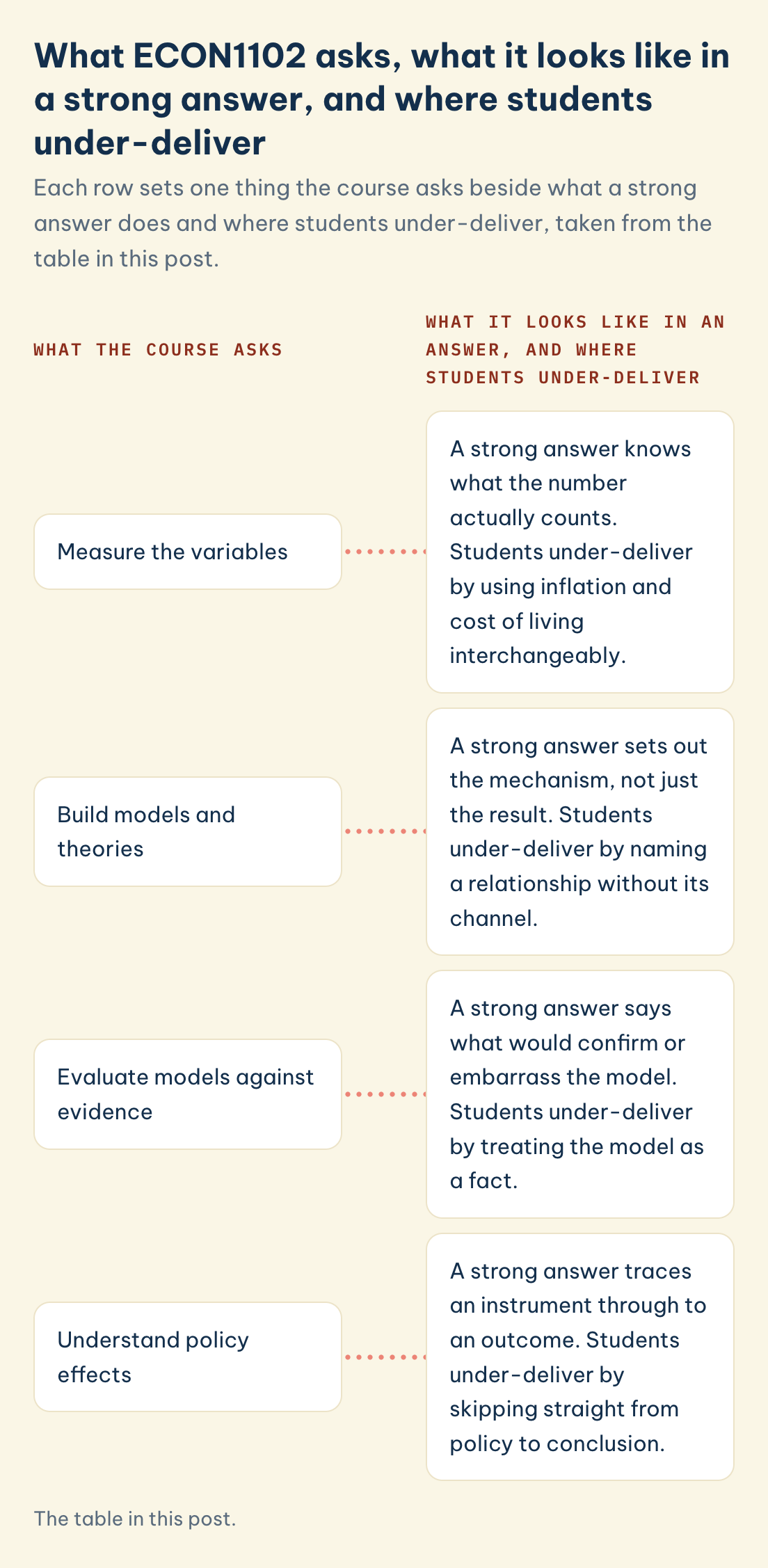
What ECON1102 asks, what it looks like in a strong answer, and where students under-deliver
Each row sets one thing the course asks beside what a strong answer does and where students under-deliver, taken from the table in this post.
What the course asks
What it looks like in an answer, and where students under-deliver
Measure the variables
A strong answer knows what the number actually counts. Students under-deliver by using inflation and cost of living interchangeably.
Build models and theories
A strong answer sets out the mechanism, not just the result. Students under-deliver by naming a relationship without its channel.
Evaluate models against evidence
A strong answer says what would confirm or embarrass the model. Students under-deliver by treating the model as a fact.
Understand policy effects
A strong answer traces an instrument through to an outcome. Students under-deliver by skipping straight from policy to conclusion.
Save this figure
Evidence: Notice the third of those. Evaluating a model against evidence is not the same activity as applying it, and it is the one students are least likely to have practised. In microeconomics you are usually asked whether you have applied the model correctly. Here you are also asked whether the model is the right one for the question.
Example: Asked what happens to output when the Reserve Bank of Australia (RBA) raises the policy rate, a student produced the transmission chain accurately and stopped. A stronger answer did the same and then noted which link in that chain is weakest empirically, and what would have to be true of household balance sheets for the effect to be as large as the model implies. It also helps to know what the RBA is actually aiming for: an inflation target of 2% to 3% on average over the cycle, an arrangement agreed with the Australian Government and reviewed periodically since 1996.
| What the course asks | What it looks like in an answer | Where students under-deliver |
|---|---|---|
| Measure the variables | Knowing what the number actually counts | Using inflation and cost of living interchangeably |
| Build models and theories | Setting out the mechanism, not just the result | Naming a relationship without its channel |
| Evaluate models against evidence | Saying what would confirm or embarrass the model | Treating the model as a fact |
| Understand policy effects | Tracing an instrument through to an outcome | Skipping straight from policy to conclusion |
◆ Section 3 / 7 · Prior knowledge
The prior knowledge that gets in the way
Direct answer: Everyone has opinions about the macroeconomy, and macroeconomic questions covered in ECON1102 are politically loaded in a way that microeconomic ones usually are not. The course does not ask you to abandon your views. It asks you to hold them separately from the analysis, so that you can trace what a model implies even when you dislike the implication.
Evidence: Asking you to hold your views separately from the analysis is not a suggestion that the profession has settled matters and students merely need to catch up. Blanchard (2018), writing in the Oxford Review of Economic Policy, argues that the models used in macroeconomics performed poorly through the financial crisis of 2008. As he puts it: "current DSGE models are flawed, but they contain the right foundations and must be improved rather than discarded" (Blanchard, 2018, p. 43), while proposing that different kinds of models exist for different purposes rather than one model doing everything. That is an honest description of a field in argument with itself.
Example: Asked whether a minimum wage increase would raise unemployment, a student wrote 100 words about fairness and living costs. Both matter and neither was the question. The question asked what a particular model predicts and how confident we should be in that prediction, which is answerable in a way that a values dispute is not.
How to use this in an exam. When a question feels political, find the mechanism first, in 2 to 3 sentences. Say what channel the effect travels through, what it depends on, and what evidence would tell you the channel is working. A conclusion reached that way survives a marker who disagrees with you.
◆ Section 4 / 7 · Taught versus done
Why the gap between what is taught and what is done matters here
Direct answer: Introductory macroeconomics necessarily teaches simplified models, and a first-year student can reasonably mistake the simplification for the state of the discipline. Knowing that the teaching version is a teaching version changes how you write about it.
Evidence: Colander (2005), writing in the Journal of Economic Education, argued that a gap has opened between what economists research and what principles courses teach, and while his target was the principles curriculum broadly, the observation applies with force to macroeconomics, where the research frontier moved sharply after the 2008 financial crisis. The point for a student is not to distrust the course. It is to write with the right amount of confidence.
Example: A student who wrote that a Reserve Bank of Australia policy "will" produce a given outcome lost marks that a student writing "would be expected to, provided the transmission channel holds" did not. Both understood the model. Only one signalled that they understood what a model is.
◆ Section 5 / 7 · Measurement
Measurement is not the boring part
Direct answer: The handbook lists measuring the variables first, before modelling them, and that ordering is not accidental. A large share of lost marks in first-year macroeconomics are definitional rather than analytical, because the everyday meaning of these words and their technical meaning have drifted apart.
Evidence: Inflation is a rate of change in a price index, not a level of prices, so an economy can have falling inflation and rising prices at the same time, which is exactly the situation most students have lived through and most often describe incorrectly. Unemployment counts only people who are without work and actively seeking it, so a person who stops looking leaves the labour force altogether and disappears from the rate, despite still not having a job. Gross domestic product (GDP) measures production within a territory, which is why a country hosting large foreign-owned operations can show output that its residents do not receive as income. The Australian Bureau of Statistics publishes the Consumer Price Index (CPI) quarterly and the Labour Force Survey monthly, and those two release calendars, not a lecture slide, are the actual source of the numbers this course asks you to interpret.
Example: Asked why measured unemployment fell during a weak period, a student concluded that the labour market had improved, missing what the Australian Bureau of Statistics (ABS) participation rate data in the same release showed. The stronger answer noted that the participation rate had fallen at the same time, meaning some of the improvement was people leaving the search rather than finding work. The data were identical. One answer knew what the number counts.
Build the glossary in week 1 and keep it to a page, roughly 15 to 20 terms. Each entry needs the definition, the thing it is most often confused with, and one sentence on when that confusion changes the answer.
◆ Section 6 / 7 · A strong answer
What a strong macro answer looks like
Direct answer: It names the variable precisely, states the mechanism as a chain rather than a jump, marks its own confidence, and in 1 to 2 sentences says what would change the answer.
Evidence: Each of those 4 elements maps onto something the UNSW Handbook describes. Precision maps to measurement. The chain maps to model building. Confidence maps to evaluating models against evidence. The final move, saying what would change the answer, is what turns an application into an evaluation, and it is usually the difference between a solid answer and a strong one.
Example: Two answers on an exchange rate depreciation reached the same conclusion about net exports. The weaker one asserted it. The stronger one traced relative prices to volumes, noted that the effect depends on how quickly quantities respond, and observed that the short-run answer can run the opposite way before it turns. That last sentence cost 15 words and demonstrated three outcomes at once.
Related reading
If you are taking the prerequisite this term or are revisiting it, our guide to ECON1101 Microeconomics 1, the 6 unit of credit course also taught by the UNSW School of Economics, covers the earlier course in the sequence and the diagram-reading habits it builds. If you meet the same macroeconomic ideas through self-paced online study instead, our guide to ECON 248 Macroeconomics at Athabasca University shows how a course with six quizzes, two assignments and one invigilated final sets out the same material.
◆ Section 7 / 7 · Six things to do
Six things worth doing in this course
- Get the current assessment weightings from your own course outline on Moodle. They are set per term, Term 1 through Term 3, and they move.
- Keep a one-page glossary of variables with what each one actually measures. Most macro confusion is definitional before it is analytical.
- For every relationship, write the channel it travels through. A relationship without a channel is a memorised result.
- Attach a confidence marker to conclusions. Learn to write "would be expected to" and mean it.
- When a question touches politics, answer the mechanism, not the merits.
- Practise the closing move of saying what would change the answer. It is cheap in words, often under 20 words, and it demonstrates the evaluation outcome directly.
Frequently asked questions
What is the prerequisite for ECON1102?
The UNSW Handbook lists ECON1101 Microeconomics 1. The course is taught by the UNSW School of Economics within UNSW Business School and carries 6 units of credit.
Why does this guide not list the assessment weightings?
Because they are set in each term's course outline rather than in the handbook, and they differ between offerings. Quoting a number from a previous term would be worse than useless, since it looks authoritative while being wrong for you. Your outline on Moodle is the source.
Is macroeconomics harder than microeconomics?
Not necessarily harder, but differently hard. Micro problems usually have a determinate answer once you apply the model correctly, as in ECON1101. Macro questions more often require you to say how confident the model lets you be, which is an unfamiliar demand at first-year level. Blanchard (2018) makes essentially the same point about the discipline itself: some macro models fit some situations and not others, and part of first-year training is learning which model the question is actually asking you to run.
Can I use my own view about economic policy in an answer?
You can reach a conclusion, but it has to arrive through the analysis. State the mechanism, state what it depends on, then conclude. An answer that starts from the conclusion reads as an opinion regardless of whether the conclusion is defensible.
Do I need to follow economic news for this course?
It helps for intuition and it is not a substitute for the course material covered across the 4 activities the UNSW Handbook describes. Treat the monthly Labour Force Survey and the quarterly Consumer Price Index release, not a headline, as the examples to test the models against.
Where MAAS fits
MAAS mentors work alongside students in courses like this rather than in place of them. In first-year macroeconomics, the 2 most useful things a mentor does are to make you state the channel every time, so that results stop being things you remember and start being things you can derive, and to press on your confidence markers until they match what the evidence actually supports. The work stays yours. If you are moving on to the second-year course, our guide to ECON2102 Macroeconomics 2 covers the intermediate models this course leads into and the rubric that governs them. If that is useful, our academic support service and our tutoring service are the two places to start.
References
Blanchard, O. (2018). On the future of macroeconomic models. Oxford Review of Economic Policy, 34(1–2), 43–54. https://doi.org/10.1093/oxrep/grx045
Colander, D. (2005). What economists teach and what economists do. Journal of Economic Education, 36(3), 249–260. https://doi.org/10.3200/JECE.36.3.249-260
Tools & resources
UNSW Sydney. (2026). ECON1102: Macroeconomics 1. https://www.handbook.unsw.edu.au/undergraduate/courses/2026/ECON1102
A free 20-minute consultation is a conversation about where you are with ECON1102.
Book a free consultation ▸