
◆ Economics
ECON2102: why can correct algebra still score zero?
The ANU rubric for Macroeconomics 2 states the penalty in one sentence: work that reproduces mathematics or diagrams without explained reasoning "will attract zero marks." Not reduced marks. Zero. A student can solve the model correctly, present the right steady state, and still lose the entire question because the reasoning was never written down.
◆ Section 1 / 8 · Which ECON2102
Which ECON2102 are you enrolled in?
Direct answer: Two Australian universities use this code for a course called Macroeconomics 2. ANU offers a 6-unit version through the Research School of Economics; UNSW offers a 6 UOC version through the School of Economics. Same name, different prerequisites, different assessment, different exam rules.
Evidence: Both versions carry 6 credit points, and both sit at second-year level, so the prerequisites are where the two courses separate, and they separate in a way that changes what your assignment will demand. To enrol at ANU you must have completed ECON1102 (or ECON1100), and you must also have completed or be concurrently enrolled in ECON2101 Microeconomics 2; the course is incompatible with ECON2016. UNSW instead lists ECON1102 and ECON1203 as prerequisites, and ECON1203 is the statistics course.
The pairing is worth reading carefully. ANU pairs its macro course with intermediate microeconomics, which signals a course built on consumer and firm optimisation as the foundation of the macro model. UNSW pairs its version with statistics, which points towards data handling in assessment. This is an inference from published enrolment rules rather than a claim about any particular assignment brief, so treat it as a hypothesis to check against your own course outline, not a fact about your marking.
| ANU ECON2102 | UNSW ECON2102 | |
|---|---|---|
| FACULTY | ANU College of Business and Economics | UNSW Business School |
| CREDIT | 6 units | 6 UOC |
| PREREQUISITE | ECON1102 or ECON1100, plus ECON2101 completed or concurrent | ECON1102 and ECON1203 |
| INCOMPATIBLE WITH | ECON2016 | Not listed in the same form |
| TEACHING PERIOD | Semester 1 and Semester 2 | Term 1 and Term 3 |
| STATED WORKLOAD | 130 hours total | Not published in the handbook entry |
The rest of this article works from the ANU course, because ANU publishes its assessment structure, its weekly schedule and its marking criteria in full. If you are at UNSW, the reasoning sections still apply, but every percentage below does not.
◆ Section 2 / 8 · Assessment and weights
How is ECON2102 assessed, and can the weighting really change?
Direct answer: At ANU in Semester 2, 2026, learning activities carry 34% and the final exam carries 66%. The learning activities are optional. Students who skip them do not lose those marks; the weight transfers to the final exam automatically at the end of semester.
How the ANU ECON2102 class summary for Semester 2, 2026 weights its assessment
The bar shows the weights if you complete every learning activity.
Learning activities (optional)
34
% of the course mark
Final exam (in person, short-answer)
66
% of the course mark
Save this figure
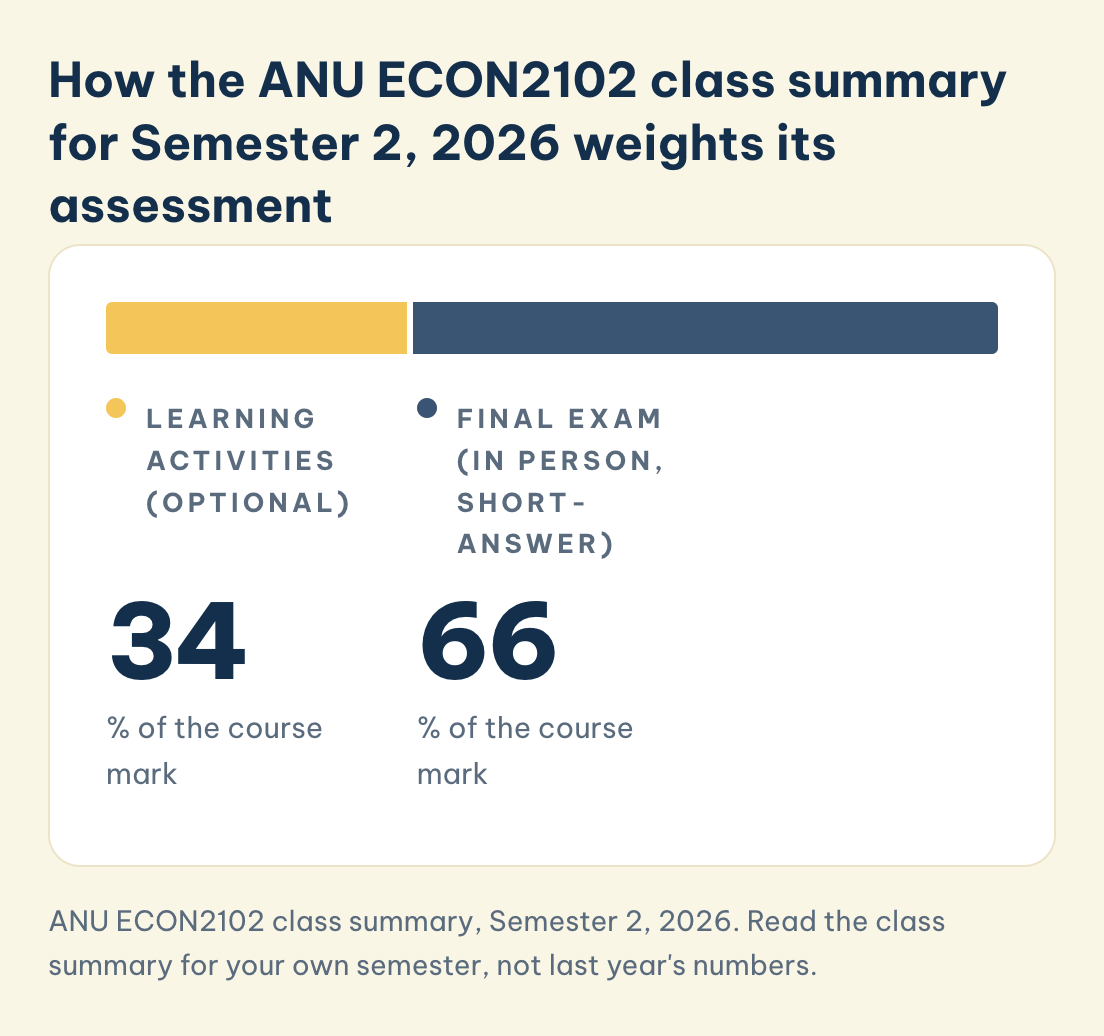
Evidence: The optional-weighting arrangement is unusual enough that most students misread it. The Semester 2, 2026 class summary lists five learning activities spread across the teaching weeks: an in-person activity during a tutorial in Week 6 worth 14%, and online activities in Weeks 8, 10 and 12 worth 5% each. The course states plainly that participation is optional, that students who choose not to participate need not contact the lecturer or tutors, and that the weighting adjustment is applied automatically.
The consequence is a decision, not an accident. If you complete every learning activity, your final exam is worth 66% of the course. If you complete none, the same exam becomes worth 100%, sat in person over a period of up to 180 minutes on 5 November 2026, in short-answer format. There is no third option where you skip the activities and keep a safety net.
The weighting also moves between offerings, which is why a guide written from last year's numbers will mislead you. In Semester 1, 2026 the same course ran on a different structure: online quizzes at 40%, in-person workshop participation at 20%, and a final exam at 40%, with results returned on 2 July 2026. In 2024 it was assignments 30%, in-tutorial exercises 10%, final exam 60%. In 2022 there was a mid-semester exam worth 20% and a homework assignment worth 15%, with the final exam at 50%. Four offerings, four structures. Open the class summary for your own semester and read the weights there; do not trust any figure in this article, or any figure an AI assistant gives you, as a substitute.
◆ Section 3 / 8 · What the rubric rewards
What does the ECON2102 rubric actually reward?
Direct answer: Explained reasoning, not correct output. The published ANU criteria allocate up to 70% for critical analysis of a case or policy scenario using appropriate modelling tools, up to 20% for organisation and clear writing including well-labelled diagrams, and up to 10% for care and attention to the reader.
Evidence: The strongest sentence in the criteria is the negative one. Mechanical and verbatim reproduction of information, whether mathematics, jargon or diagrams, without clearly explained logical reasoning or analysis "will attract zero marks." That phrasing does not describe a deduction, it describes a floor. The three bands behind it are worth holding in view while you write, because 70% of the available credit sits in the analysis band, 20% in organisation and labelled diagrams, and only 10% in presentation care. A page of algebra that arrives at the correct answer, presented without the sentences explaining why each step follows, is treated as if the question had not been attempted.
The demand for explained reasoning is not an ANU eccentricity, and the research on teaching intermediate macroeconomics points the same way. Strasser and Halova Wolfe (2014) built a semester-long project in which students write as economic advisors, and argued that the value of intermediate macro theory lies in equipping students to enter policy debates and support their positions with tight macroeconomic reasoning. Josephson et al. (2019) found that when a macroeconomics course was redesigned around application and analysis, student performance on application and analysis questions rose while performance on memorisation questions fell. The finding cuts both ways, and it is the honest version: courses that reward reasoning stop rewarding recall.
The rubric bands translate into one practical habit. After every derivation you complete, write one sentence beginning "This means that" and finish it in economic terms. If you cannot finish that sentence, you have not yet answered the question, however clean the algebra looks.
◆ Section 4 / 8 · Which model
Which model does the question require?
Direct answer: The ANU weekly schedule maps each topic to a specific model, so the answer is usually determined by which week the question comes from. Working out that mapping before you write is faster than trying to recall every framework at once.
Evidence: The Semester 2, 2026 sequence is explicit, and it follows Williamson (2018) chapter by chapter. Week 6 covers special topics in fiscal stimulus, deficits and fiscal limits. Week 7 covers the two-period model, drawing on Chapters 9 and 10. Weeks 8 and 9 set up the dynamic general equilibrium model and then apply it to fiscal policy, both from Chapter 11. Week 10 builds the real business cycle model from Chapter 12. Week 11 covers the New Keynesian model of money, business cycles and stabilisation policy across Chapters 12 and 13. Week 12 turns to quantitative easing, inflation and budget repair.
Earlier offerings show the same architecture with different emphases: a search model of unemployment from Chapter 6, a monetary intertemporal model from Chapter 12, and international macroeconomics from Chapters 16 and 17. The whole course is a ladder from one-period optimisation to dynamic general equilibrium, and each rung has a named home in the textbook.
So when a question asks what happens to output and interest rates after an increase in government spending, the useful first move is not to reach for every model you know. It is to identify the week the question belongs to, open the chapter that week points at, and use that framework. Introducing an unrelated model does not read as breadth; it reads as uncertainty about which one applies.
◆ Section 5 / 8 · Euler equation
What goes wrong when students derive an Euler equation?
Direct answer: Three failures recur in marked work. Students state the equation without setting out the intertemporal budget constraint that generates it, skip the one algebraic step where the economic intuition actually lives, and then stop at the mathematical result without saying what it implies about consumption and saving behaviour.
Evidence: The Euler equation sits at the centre of the two-period model in Week 7, and it is the point where the course stops being first-year macroeconomics. It comes out of a consumer choosing consumption today against consumption tomorrow, subject to an intertemporal budget constraint, with preferences that trade the two off. Each of those three ingredients is an assumption you were given, and each one must appear in your answer before the equation does.
A working structure that holds up under marking runs in five moves: state the given, write the model, substitute, solve, then interpret. The fifth move is the one that is skipped and the one that carries the marks. Ending an answer at a numerical result leaves the marker with no evidence that you understand the mechanism, which is exactly the failure the ANU rubric names.
Pavlov et al. (2025) offer a useful diagnostic here. Working with causal diagrams in macroeconomics teaching, they report that "while students generally improved in identifying cause-and-effect relationships in economic models, the concept of causal polarity remained challenging" (Pavlov et al., 2025). Causal polarity is simply the direction of the effect, and it is the part your interpretation has to pin down. If you are unsure whether your answer is complete, test the polarity in words. Say out loud whether the variable rises or falls and why, and see whether the sentence survives.
◆ Section 6 / 8 · Diagrams and data
How should diagrams and data be presented?
Direct answer: Label both axes, label every curve and every equilibrium point, and refer to the diagram by name in your written analysis. The ANU criteria award the 20% presentation band partly for well-labelled diagrams with easy-to-follow references made from the written text.
Evidence: The phrasing in the criteria is precise about the link between the two. It is not enough for the diagram to be correct and the prose to be correct separately; the prose has to point at the diagram. A shift you describe in words should be identifiable as a specific labelled movement on the figure, and a curve that moves on the figure should have a sentence explaining what caused it.
For empirical sections, name the data source and the period before you present anything, keep the table or figure clean, and tie each piece of evidence back to a prediction the model made. The order matters. Evidence introduced before the prediction it tests reads as decoration; evidence introduced after reads as a test.
Hashimzade et al. (2026) describe running a Lucas Islands classroom game in intermediate macroeconomics, where students make labour supply decisions under imperfect information and the resulting forecast errors generate a short-run supply relationship in real time. Their point is that the connection between a theoretical prediction and an empirical pattern is something students grasp when they can see the two placed against each other. Your empirical section should do the same work on the page.
◆ Section 7 / 8 · Weekly plan
What weekly plan works for an ECON2102 assignment?
Direct answer: Plan backwards from the due date and reserve the last block for interpretation rather than calculation. The ANU workload figure of 130 hours across the semester leaves less discretionary time than most students assume once lectures and tutorials are removed.
Evidence: A workable sequence puts the mechanical work first and the reasoning last, because the reasoning is what gets cut when time runs out and it is also what carries most of the marks. Read the brief and note the constraints that are easy to breach without noticing: submission format, file naming, platform, and the late policy. Then identify, for each question, which week and which chapter it belongs to. Then do the derivations in a working file, separate from the document you will submit. Only then write the interpretation, and give it a session of its own rather than appending it to a long night of algebra.
One caution about the optional learning activities. Deciding early to skip them is a defensible choice for some students, but it should be a decision you make in Week 4 with the final exam date in front of you, not a default that arrives because Week 6 was busy. The automatic reweighting means the course will not warn you.
◆ Section 8 / 8 · How MAAS mentors help
How MAAS mentors support ECON2102 students
MAAS works as an academic advisor, not a writing service. For a course built this way, that usually means three things: a session where a mentor helps you read your own course outline and locate the weights that actually apply to your semester, a structural review of how you have set out a derivation before you write the interpretation, and feedback that shows where a correct calculation is still missing the sentence that makes it an answer. You do the economics; the mentor helps you see the page the way the rubric does.
If you are working through the earlier course in this sequence, our guide to ECON1102 Macroeconomics 1 covers the foundations this course builds on, and our guide to ECON2050 Money and Finance covers a neighbouring second-year rubric. You can also read how our academic support service works before you get in touch.
Frequently asked questions
Is ECON2102 at ANU the same course as ECON2102 at UNSW?
No. Both are called Macroeconomics 2 and both carry 6 units of credit, but they sit in different faculties with different prerequisites. ANU requires ECON2101 completed or concurrent; UNSW requires ECON1203, the statistics course. Assessment structures are set separately by each school, so no percentage transfers between them.
Are the ANU learning activities really optional?
Yes, in Semester 2, 2026. The course states that participation is optional, that students need not notify staff if they choose not to participate, and that the weighting of the final examination increases automatically for those who skip them. The trade is that the exam then carries the full weight of the course.
Why does my course outline show different percentages from this article?
Because the weighting changes between offerings. Semester 2, 2026 ran on 34% learning activities and a 66% final exam, while Semester 1, 2026 ran on 40% quizzes, 20% workshop participation and a 40% final exam. Always read the class summary for your own semester and treat it as the only authority.
Can I lose all the marks on a question I answered correctly?
The published ANU criteria say that reproducing mathematics, jargon or diagrams without clearly explained logical reasoning will attract zero marks. So a correct result presented without reasoning is at risk in a way that most students underestimate.
What is the ECON2102 final exam format at ANU?
For Semester 2, 2026 it is an in-person invigilated exam of up to 180 minutes, run by ANU Examinations, consisting of short-answer questions. The course notes that the exam covers content from Week 4 onward and that detailed instructions are posted on the course site in Week 10.
References
Hashimzade, N., Kirsanov, O., & Kirsanova, T. (2026). Lucas Islands game in intermediate macroeconomics. The Journal of Economic Education. https://doi.org/10.1080/00220485.2026.2629813
Josephson, A., DeBoer, L., Nelson, D., & Zissimopoulos, K. (2019). Learning to: Facilitating practice in a large introductory macroeconomics course. The Journal of Economic Education, 50(2), 142–156.
Pavlov, O. V., Smirnova, N. V., & Smirnova, E. (2025). Enhancing economic literacy through causal diagrams. arXiv. https://doi.org/10.48550/arXiv.2501.12639
Strasser, G., & Halova Wolfe, M. (2014). Learning to argue with intermediate macro theory: A semester-long team writing project. The Journal of Economic Education, 45(3), 191–210.
Williamson, S. D. (2018). Macroeconomics (6th ed.). Pearson.
Tools & resources
- ANU Programs and Courses, ECON2102 Macroeconomics 2: https://programsandcourses.anu.edu.au/course/ECON2102
- UNSW Handbook, ECON2102 Macroeconomics 2: https://www.handbook.unsw.edu.au/undergraduate/courses/2026/ECON2102
A free 20-minute consultation is a conversation about where you are with ECON2102.
Book a free consultation ▸