
The hardest idea in this course is not a calculation. It is that the consolidated financial statements a term is spent learning to prepare describe an entity that does not legally exist, built from entries never recorded in anyone's ledger. Students who miss that keep looking for where the consolidation journals get posted, while students who grasp it understand why the course keeps asking about control, judgement and disclosure rather than only debits and credits.
Author: MAAS Editorial Team
Last updated: 2026-08-12
Category: accounting-finance

What is the course, and where does it sit?
Direct answer: At UNSW, ACCT2542 is Corporate Financial Reporting and Analysis, a 6 unit of credit undergraduate course delivered by the School of Accounting, Auditing and Taxation in the Business School. It is an intermediate financial accounting course building on ACCT1501 and ACCT1511, covering reporting on and analysis of more complex transactions, events and structures.
Evidence: The published description names the territory precisely: accounting for various types of equity investments including subsidiaries, associates and joint ventures, tax effect accounting, disclosure issues, and understanding the regulatory environment in which financial statements are prepared. It also names its audience, which is students who will prepare or use corporate financial reports as accountants, financial executives, auditors, financial analysts, actuaries or legal advisors.
Example: A student treated the course as the next accounting unit in a sequence and was surprised by how much of it was about regulation and disclosure rather than technique. That balance is not a quirk of one teaching term. It is in the course description.
Why is control the concept everything else hangs on?
Direct answer: Because control determines whether an investee is consolidated at all, and that single decision changes every number in the group statements. Get the boundary wrong and technically perfect consolidation entries produce a wrong answer.
Evidence: Control under IFRS 10 is a judgement rather than a threshold, which is precisely why students find it slippery. The standard sets out principles for determining whether control exists in fact, not simply whether an investor holds a majority of votes. The International Accounting Standards Board issued IFRS 10 in May 2011 to replace the control guidance that had previously been split across IAS 27 and SIC-12, and the standard became mandatory for annual reporting periods beginning on or after 1 January 2013 (International Accounting Standards Board, 2011). That single-model replacement is part of why judgement now sits at the centre of the question rather than at its edge. Because ACCT2542 is taught in Australia, the local mirror of that standard matters just as much: the Australian Accounting Standards Board issued the equivalent standard, AASB 10 Consolidated Financial Statements, on 29 August 2011 under the Corporations Act 2001, applying from the same 1 January 2013 start date and superseding AASB 127 and the earlier special-purpose-entity interpretation it replaced (Australian Accounting Standards Board, 2011). Examining 237 consolidated financial statements prepared under IFRS, Generalova and Popova (2016) found that a substantial proportion of companies, 40.0% of the Russian sample and 43.93% of the European sample, relied on judgement in determining control over an investee. They also note that the concept of de facto control can be interpreted differently by different accountants, with the range of interpretation influenced by company size, industry and local law.
Example: Asked whether a 45% holding gave control, a weaker answer said no because it is below half. A stronger one asked how the remaining 55% was distributed, noted that widely dispersed holdings can leave a 45% investor able to direct relevant activities in practice, and identified what further information would settle the question. The same boundary judgement is examined at third year in other Australian programs, for instance in the ACCT3011 group reporting unit at the University of Sydney, where the classification decision extends across consolidation, the equity method and disclosure.
What do consolidation entries actually do?
Direct answer: They adjust the arithmetic sum of two sets of accounts into a single set that presents the group as though it were one entity. They live on a worksheet. They are not journalised in the parent's books or the subsidiary's books, because neither of those legal entities has had a transaction.
Evidence: This follows from what a group is. A parent and a subsidiary remain separate legal entities that each keep their own records; the group is a reporting construct that exists only in the consolidated statements. That is why the same elimination entries have to be redone every reporting period rather than carried forward as balances, and it is why intragroup transactions are removed. From the group's perspective, a sale from parent to subsidiary moved inventory from one room to another and generated no revenue at all.
Example: A student prepared correct elimination entries in year one and in year two treated the prior year's eliminations as opening balances. The individual entries were textbook-correct and the year two statements were wrong, because nothing had been recorded anywhere for them to carry forward from.
How should you handle tax effect accounting without drowning in it?
Direct answer: By holding on to the idea that it exists to reconcile two different timelines. Accounting recognises items when they meet accounting criteria; tax law recognises them when tax law says so. Deferred tax is the bookkeeping for that gap.
Evidence: The course lists tax effect accounting alongside equity investments and disclosure, which places it as a reporting problem rather than a taxation problem. The balance sheet approach asks what the carrying amount of an asset or liability is, what its tax base is, and what future tax consequence the difference creates. That approach is not a classroom simplification. It is the method IAS 12 has required since the International Accounting Standards Committee reissued the standard in October 1996, effective for periods beginning on or after 1 January 1998 (International Accounting Standards Committee, 1996). The International Accounting Standards Board has kept adjusting the detail since then. On 19 January 2016 it issued amendments clarifying how deferred tax assets for unrealised losses on debt instruments should be recognised, effective for annual periods beginning on or after 1 January 2017 (International Accounting Standards Board, 2016). Once a student holds that structure, individual items become instances of one question instead of a list to memorise.
Example: A student who had memorised the treatment of six specific temporary differences failed a question about a seventh. A student who understood carrying amount versus tax base worked the seventh out in the exam without ever having seen it.
What does the course want in the written and analytical components?
Direct answer: The course wants five things done well: argue the relationship (control, significant influence or joint control) from facts rather than stating a percentage, apply the specific criterion at issue, state what each consolidation entry achieves, disclose what users need to know, and name the judgement involved with the alternative treatment acknowledged.
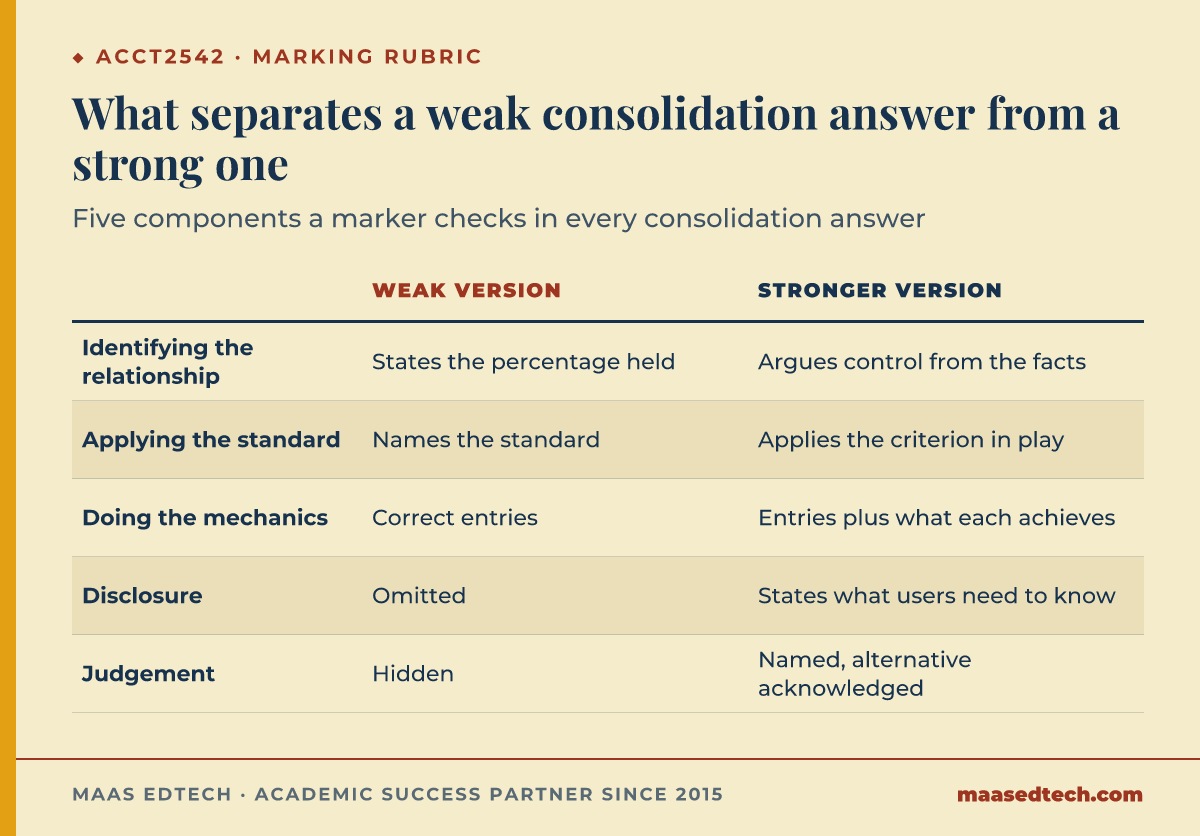
| Component of an answer | Weak version | Stronger version |
|---|---|---|
| Identifying the relationship | States the percentage held | Argues control, significant influence or joint control from the facts |
| Applying the standard | Names the standard | Applies the specific criterion the facts turn on |
| Doing the mechanics | Correct entries | Correct entries plus a statement of what each achieves |
| Disclosure | Omitted | Says what users need told and why |
| Judgement | Hidden | Named, with the alternative treatment acknowledged |
Evidence: The description places disclosure and the regulatory environment alongside the technical content deliberately. Financial reporting exists so that users outside the entity can make decisions, and a treatment that is technically defensible but undisclosed still fails the purpose. This also explains why courses at this level ask you to write rather than only compute.
Example: Two answers classified an investment as an associate and applied equity accounting correctly. The second added one sentence on why significant influence rather than control was the right conclusion on those facts, and one on what the notes would need to disclose. That is where the marks separated.
How much should you engage with the regulatory debate?
Direct answer: Enough to show that standards are the outcome of a process rather than facts of nature, and no further than your outline invites.
Evidence: These standards are actively reviewed. The IASB ran its post-implementation review of IFRS 10, IFRS 11 and IFRS 12 from 2019 to 2022, held more than 35 stakeholder consultation meetings in the process, and published its project report and feedback statement on 20 June 2022, concluding that the three standards were working as intended and that none of the matters raised in the review was high or medium priority (IFRS Foundation, 2022). In the report's own words: "the IASB assessed none of the matters arising from the Post-implementation Review to be of high or medium priority" (IFRS Foundation, 2022). That conclusion is a matter of public record and a useful reminder that the boundary questions you are wrestling with are the same ones the standard-setter monitors. Later work in the same area continues to examine the same question: reviewing 250 IFRS consolidated financial statements, Generalova and Gorlovaya (2019) report that 41.54% of Russian companies declared they had applied judgement in determining the scope of consolidation in their 2015 statements.
Example: A student wrote that IFRS 10 defines control. Accurate and thin. A stronger sentence said that IFRS 10 replaced a previous approach in order to bring a single control model to a question that had been answered inconsistently, and that the standard-setter has since reviewed how well that has worked in practice.
A practical order of work
Direct answer: Six steps in order: fix the relationship before any numbers, argue disputed relationships from stated facts, rebuild eliminations from scratch each period rather than carrying balances forward, state what each entry achieves in one clause, write carrying amount and tax base first for tax items, and finish by naming what disclosure adds.
- Establish the relationship before touching any numbers. Subsidiary, associate and joint venture lead to three different methods.
- Where the relationship is arguable, argue it. State the facts that point each way and say which you find decisive.
- Rebuild eliminations from scratch each period. If you find yourself carrying a consolidation balance forward, stop.
- For every entry, write what it achieves in one clause. This catches mechanical errors faster than checking the arithmetic.
- For tax effect items, always write carrying amount and tax base before writing anything else.
- Finish with disclosure. Ask what an external user could not work out from the face of the statements, and say that is what the notes are for.
Frequently asked questions
Is ACCT2542 mostly consolidation?
Consolidation is the largest technical block, but the course also covers tax effect accounting, disclosure and the regulatory environment, and later questions tend to combine them rather than keep them separate.
Do I need to memorise the standards?
No, and trying to is a poor use of time. What you need is to know which standard governs which question and to apply the criterion the facts actually turn on.
Why do consolidation entries have to be repeated every year?
Because they were never recorded anywhere. The parent and subsidiary keep their own books, and the consolidated statements are prepared afresh each period from those separate records.
How do I decide between control and significant influence?
By looking at what the investor can actually do, not only at the percentage. Voting rights matter, but so do the dispersion of other holdings, contractual arrangements and the ability to direct the activities that drive returns.
Does this course matter for later study?
Yes. It is a prerequisite for later financial reporting courses, and it is part of the core curriculum recognised by the Australian professional accounting bodies. Consolidated reporting under IFRS 10 and its Australian mirror AASB 10 has applied to companies here since the same 1 January 2013 start date, so the judgement calls this course teaches are the ones every group financial statement prepared in Australia has had to make since then.
Where MAAS fits
MAAS mentors work alongside students on courses like this rather than in place of them. In corporate reporting the most useful review is often the simplest: reading your answer back to see whether the classification decision was argued or assumed, and whether each entry has a stated purpose rather than only a correct form. Students usually find their mechanics were fine and their reasoning was invisible. The work stays yours. If that is useful, our academic support service and our tutoring service are the two places to start.
References
Generalova, N., & Gorlovaya, E. (2019). Conceptual transformation of "de facto" control in preparing consolidated financial statements: The experience of Russian companies. In Proceedings of the Third International Economic Symposium (IES 2018) (pp. 264–272). Atlantis Press. https://doi.org/10.2991/ies-18.2019.28
Generalova, N., & Popova, E. (2016). Application of professional judgement by Russian and European companies in determining the scope of consolidation. In Proceedings of the 5th International Conference on Accounting, Auditing, and Taxation (ICAAT 2016) (pp. 63–71). Atlantis Press. https://doi.org/10.2991/icaat-16.2016.7
International Accounting Standards Board. (2011). IFRS 10: Consolidated financial statements. IFRS Foundation.
Australian Accounting Standards Board. (2011). AASB 10: Consolidated financial statements.
International Accounting Standards Committee. (1996). IAS 12: Income taxes.
International Accounting Standards Board. (2016). Recognition of deferred tax assets for unrealised losses (Amendments to IAS 12). IFRS Foundation.
IFRS Foundation. (2022). Post-implementation review of IFRS 10, IFRS 11 and IFRS 12: Project report and feedback statement. https://www.ifrs.org/content/dam/ifrs/project/pir-10-11-12/pir-ifrs10-12-fbs-june2022.pdf
Tools & resources
UNSW Sydney. (2025). ACCT2542: Corporate Financial Reporting and Analysis. https://www.handbook.unsw.edu.au/undergraduate/courses/2025/ACCT2542