
There is a predictable split in how first-year students handle this course. Asked about capital, they reach for numbers. Asked about people or technology, they reach for adjectives. The course rejects that distinction, and so does the marking: Organisational Resources treats people, technology and capital as resources to be measured, compared and traded off against one another. A paragraph about engagement is expected to carry evidence the way a paragraph about capital does.
Author: MAAS Editorial Team
Last updated: 2026-08-10
Category: business-management

What is COMM1170 and where does it sit?
Direct answer: COMM1170 Organisational Resources is a 6-unit-of-credit undergraduate course in the UNSW Business School, a Group of Eight university, taught at the Sydney campus across all three teaching terms. It asks students to identify financial and non-financial resources, then concentrate on people, technology and capital, and how each creates value for stakeholders. It feeds directly into COMM1180 Creating Value.
Evidence: These details come from the UNSW handbook entry and the university's published class timetable, which record the credit value, the faculty, the campus and the availability across Term 1, Term 2 and Term 3. The timetable also shows lecture streams carrying a couple of hundred students each in a single term.
Example: Treating the course as general business studies, one student revised by reading widely around each topic. The reading was not wasted, but her answers stayed at the level of what an organisation might do, when the course was asking how you would know whether it had worked.
The link forward to COMM1180 is worth taking seriously rather than noting in passing. Resources are framed here as the thing an organisation has; value creation is what it does with them. If you leave this course still thinking of resources as a list, the next one becomes much harder.
Why does the soft-topic instinct cost marks?
Direct answer: Because the course is built on the claim that non-financial resources can be measured, and writing about them impressionistically quietly rejects the claim the course is teaching.
Evidence: The move from financial-only reporting to broader performance measurement is one of the better-documented shifts in management. Eccles (1991) had already called for this shift in the Harvard Business Review 5 years earlier, arguing that firms needed a genuine performance measurement manifesto rather than incremental additions to financial reporting. Kaplan and Norton (1996), in the balanced scorecard model published by Harvard Business School Press, argued that financial measures alone tell you about past performance and say little about the capabilities that produce future performance, which is exactly the reasoning behind giving people and technology their own measures. Neely, Gregory and Platts (1995) reach the same conclusion from a different angle in their review of the performance measurement literature. Later work on intangible assets makes the same case from the accounting side: the resources that increasingly drive firm value are the ones traditional statements capture least well (Lev, 2001). Edmans (2011) later supplied direct evidence for the people side of that argument, showing that employee satisfaction scores predicted stock returns over the following 12 months in a large US sample, a rare case of a soft-sounding resource producing a hard financial result. When your submission handles capital with ratios such as return on capital employed (ROCE) and handles people with sentiment, it has reproduced the problem the field spent 30 years correcting.
Example: A student wrote that a company's staff were "highly motivated and committed." Asked what she would look at to check that, she moved to voluntary turnover in the first year, internal promotion rates and absenteeism, and found that two of the three did not support her claim. Her paragraph became shorter, more specific, and defensible, and it landed close to the evidence Huselid (1995) used to link HR practice bundles to firm performance across a large sample of US firms, which is why turnover and promotion data carry real weight in this course rather than sitting there as HR record-keeping. Combs, Liu, Hall and Ketchen (2006) later confirmed the pattern across dozens of studies in their meta-analysis of high-performance work practices.
What does a measured treatment of each resource look like?
Direct answer: Name the resource precisely, choose a measure that reflects what you claim about it, and say what the measure misses. The third step is what separates a first-year answer that scores well from one that reads as competent and stops.
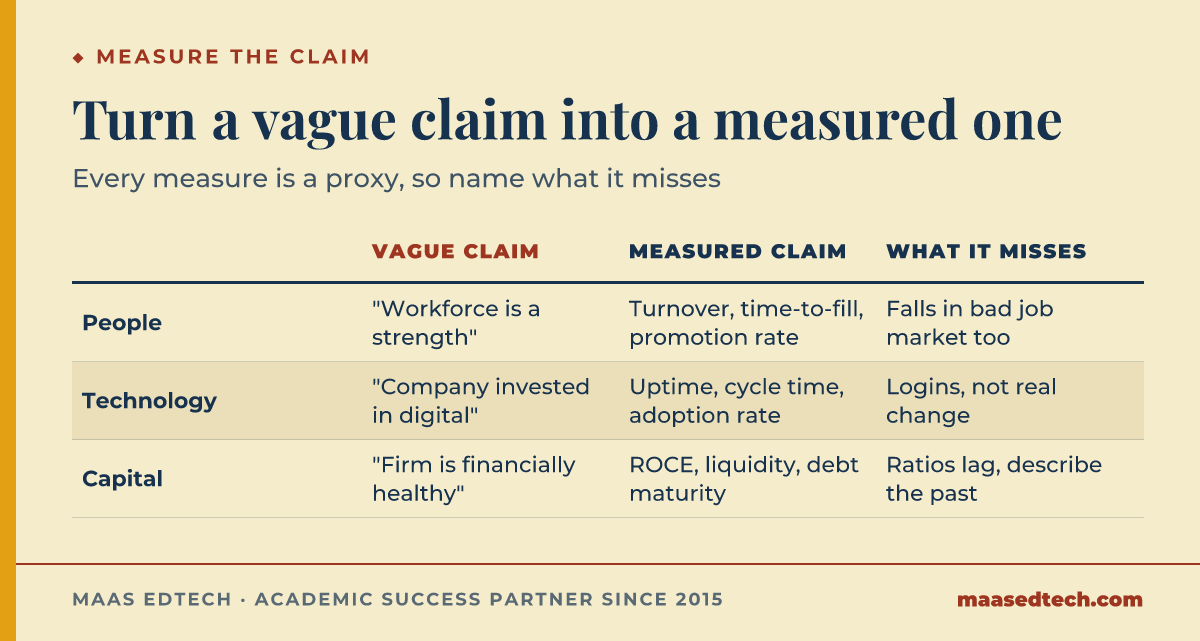
| Resource | A vague claim | A measured claim | What the measure misses |
|---|---|---|---|
| People | "The workforce is a key strength." | Voluntary turnover in critical roles, time to fill vacancies, internal promotion rate | Turnover can fall in a bad labour market without anything improving |
| Technology | "The company has invested in digital." | System availability, process cycle time before and after, adoption across eligible users | Adoption counts logins, not whether the work changed |
| Capital | "The firm is financially healthy." | Return on capital employed, liquidity position, debt maturity profile | Ratios lag; they describe the position you were in |
Evidence: Every measure in the middle column is a proxy rather than the thing itself, which is why the right-hand column exists. This is a general property of performance measurement rather than a flaw in any particular metric: what gets measured attracts effort, and a measure that becomes a target stops describing what it originally described. Neely, Gregory and Platts open their review of this literature by naming exactly the gap a vague resource paragraph falls into: "Performance measurement is a topic which is often discussed but rarely defined" (Neely, Gregory, & Platts, 1995). Acknowledging that in your writing is not hedging. It is the difference between using a measure and being used by one. Ulrich (1997) made a similar argument specifically for the people column, insisting that HR measures earn credibility only when they connect to a business outcome a manager already cares about, a point Boxall and Purcell (2016) treat as standard in strategic HRM texts.
Example: One analysis praised a firm for cutting average call handling time by 20%. Asked what could produce that number without service improving, the writer identified staff ending calls early and problems returning as repeat contacts. Adding first-contact resolution alongside the original figure turned a compliment into an analysis.
Where are the marks that most students leave behind?
Direct answer: In the trade-offs between the three resources. The course names people, technology and capital together for a reason, and a submission that handles them in three sealed sections has answered three smaller questions instead of the one that was asked.
Evidence: Resources compete for the same finite capital, and the interesting managerial questions live in the exchange rates between them. Automating a process is simultaneously a technology decision, a capital decision and a people decision, and its effect on stakeholders depends on all three at once. The stakeholder framing in the course description points the same way: value is created for major stakeholders, and different stakeholders experience the same resource decision differently.
Example: A report recommended investing in a new system to reduce labour costs and treated the saving as the result. The section on people, written separately, had already noted low morale after an earlier restructure. Once the writer put the two together, the recommendation acquired a condition about how the change was introduced, and the analysis finally used both sections it had already written.
How should you use frameworks without listing them?
Direct answer: Use one framework as a lens and let the evidence do the arguing. First-year submissions frequently include a framework because it belongs to the topic rather than because it answers the question in front of them.
Evidence: The resource-based view is the natural anchor here, first sketched by Wernerfelt (1984) in the Strategic Management Journal and developed into the widely used VRIO test by Barney (1991): a resource has to be valuable, rare, hard to imitate and supported by the organisation. Wright, Dunford and Snell (2001), writing in the same Journal of Management that carried Barney's original article, apply the same logic directly to people as a resource, which is worth citing when your paragraph is about staff rather than technology or capital. Prahalad and Hamel (1990) offer a related test in the Harvard Business Review, asking whether a capability opens access to a range of markets, adds real customer value and is hard for a rival to copy, which is a useful cross-check when a resource-based view claim feels thin. That test is useful precisely because most resources fail it, and saying so about a specific resource is an analytical move. A framework applied to everything equally has been used as decoration.
Example: One submission applied the same four-part test to six of a company's resources in turn, concluding each time that the resource was valuable. Asked which one a competitor could copy within 12 months, its author found that four of the six could be, and the two that could not became the actual subject of the essay.
Where do Vietnamese students most often lose marks?
Direct answer: In describing rather than evaluating, and in praising the organisation being analysed. Both are more visible in a resources course than elsewhere, because a resource description reads as neutral even when it is doing no analytical work.
Evidence: A first-year business rubric distinguishes description from analysis explicitly, and the distinction is easy to test yourself: if a sentence could appear unchanged in the company's own annual report, it is description. Evaluation requires you to compare, to weigh, or to say what would have to be true for the claim to hold. Note also that criticising an organisation's resource position is not rudeness; it is the analytical stance the task assumes.
Example: A paragraph explained a firm's training programme in detail and closed by calling it comprehensive. The rewrite kept two sentences of description and spent the rest asking whether the programme addressed the capability gap the firm actually faced, which it partly did not. The tone became less flattering and the mark went up.
A note on terminology: keep terms such as tangible, intangible, capability and stakeholder precise, in the sense Lev (2001) uses them when distinguishing intangible resources from the assets a balance sheet captures. Pfeffer (1998) used capability in this same disciplined way when he argued that people practices only count as a competitive resource once they are difficult for a rival firm to copy. In everyday Vietnamese these blur into approximate equivalents, and the rubric depends on the distinctions holding.
How should you prepare across the term?
Direct answer: Build a habit of attaching a measure to every claim, starting from week one, because the habit is what the assessment tests and it does not form during revision.
A pattern that works: as each resource category is introduced, write down three measures you could actually obtain for a company you can research, along with one weakness of each. By mid-term you will have a working measurement vocabulary rather than a list of concepts. When you reach a draft, take every evaluative adjective you have used, strong, effective, robust, and check whether evidence sits within a sentence or two of it. Adjectives without nearby evidence are where marks quietly go.
Evidence: Assessment tasks and weightings vary between terms, and your own course outline, published through the Business School before teaching begins, is the authority. What holds across offerings is the course's interest in measurement, since it sits in the course description rather than in any one task.
What do MAAS mentors actually do on this course?
MAAS works as an academic advisor. The most useful early exercise here is deliberately narrow: you bring a paragraph, and a mentor asks what evidence would change your mind about the claim in it. If nothing would, the claim is not yet an argument. After that the work is ordinary, meaning a read of your draft against the course criteria, a check on whether your measures support the weight you have put on them, and attention to whether your three resources are talking to each other. You write and submit your own work, and referencing is checked inside that read.
Frequently asked questions
How many units of credit is COMM1170, and when does it run?
6 units of credit, offered in all three UNSW teaching terms at the Sydney campus through the UNSW Business School.
Which three resources does it focus on?
People, technology and capital, examined in terms of how they create value for an organisation's major stakeholders, after a broader look at financial and non-financial resource categories.
How does it relate to COMM1180?
It is designed to prepare you for Creating Value, where the focus shifts from what an organisation has to what it does with it. Treating resources as a static list here makes that transition harder.
Do I need accounting knowledge?
Not beyond interpreting common measures such as ROCE. You need to read a ratio and understand what it does and does not tell you, which is a different demand from preparing financial statements.
Is it acceptable to criticise the company I analyse?
Yes, and it is usually necessary. Evaluation requires a position. What is not acceptable is criticism without evidence, which fails for the same reason praise without evidence fails.
How is it assessed?
Tasks and weightings differ between terms and your course outline is the authority. Whichever form the tasks take, the course description makes measurement and stakeholder value assessable throughout.
Related reading
- COMM1190: why does a correct chart still score in the middle?
- HR9413: people, management and organisations
- MGMT2004: the organisational behaviour course COMM1170 unlocks
- ACCT2522: the second-year course COMM1170 unlocks
- Academic support from MAAS mentors
Talk to a MAAS mentor about your course
References
Barney, J. (1991). Firm resources and sustained competitive advantage. Journal of Management, 17(1), 99–120. https://doi.org/10.1177/014920639101700108
Combs, J., Liu, Y., Hall, A., & Ketchen, D. (2006). How much do high-performance work practices matter? A meta-analysis of their effects on organizational performance. Personnel Psychology, 59(3), 501–528. https://doi.org/10.1111/j.1744-6570.2006.00045.x
Eccles, R. G. (1991). The performance measurement manifesto. Harvard Business Review, 69(1), 131–137.
Edmans, A. (2011). Does the stock market fully value intangibles? Employee satisfaction and equity prices. Journal of Financial Economics, 101(3), 621–640. https://doi.org/10.1016/j.jfineco.2011.03.021
Huselid, M. A. (1995). The impact of human resource management practices on turnover, productivity, and corporate financial performance. Academy of Management Journal, 38(3), 635–672.
Kaplan, R. S., & Norton, D. P. (1996). The balanced scorecard: Translating strategy into action. Harvard Business School Press.
Lev, B. (2001). Intangibles: Management, measurement, and reporting. Brookings Institution Press.
Boxall, P., & Purcell, J. (2016). Strategy and human resource management (4th ed.). Palgrave Macmillan.
Neely, A., Gregory, M., & Platts, K. (1995). Performance measurement system design: A literature review and research agenda. International Journal of Operations & Production Management, 15(4), 80–116. https://doi.org/10.1108/01443579510083622
Pfeffer, J. (1998). The human equation: Building profits by putting people first. Harvard Business School Press.
Prahalad, C. K., & Hamel, G. (1990). The core competence of the corporation. Harvard Business Review, 68(3), 79–91.
Ulrich, D. (1997). Human resource champions: The next agenda for adding value and delivering results. Harvard Business School Press.
Wernerfelt, B. (1984). A resource-based view of the firm. Strategic Management Journal, 5(2), 171–180. https://doi.org/10.1002/smj.4250050207
Wright, P. M., Dunford, B. B., & Snell, S. A. (2001). Human resources and the resource based view of the firm. Journal of Management, 27(6), 701–721. https://doi.org/10.1177/014920630102700607