
◆ Business & Management
MGMT2004 Managing Organisational Behaviour: approach at UNSW
Treat it as a course about your own behaviour in teams, examined through theory. Managing Organisational Behaviour at UNSW Sydney puts 60% of the grade on an individual task that asks you to apply course concepts to personal learning activities and reflect on them, and another 20% on a team presentation built around an Everest exercise. Students who revise OB as a list of definitions tend to find that the marks sit somewhere else.

◆ Question 1 / 9 · Which course
Which MGMT2004 are you looking at?
Direct answer: This guide covers the UNSW Sydney course MGMT2004 Managing Organisational Behaviour, a 6 units of credit undergraduate course taught by the School of Management and Governance in the UNSW Business School. The Australian National University uses MGMT2004 for Negotiation, and Curtin University once used it for Business and Sustainable Development, so notes found under this code may describe another course.
Evidence: Course codes belong to the university that issues them, not to the discipline. The ANU course is an elective on principled negotiation, BATNA and cross-cultural bargaining, while the Curtin unit surveyed environmental issues for managers. Neither overlaps much with the UNSW course, which the handbook describes as taking "a micro focus on employee behaviour in organisations".
Example: A student who searches the code and lands on a negotiation study guide could spend a fortnight on bargaining tactics that the UNSW course never assesses. If your course lists MGMT1001, COMM1170, COMM1100, COMM1120 or COMM1900 as a prerequisite, you are reading the right guide.
◆ Question 2 / 9 · The course
What is MGMT2004 about, and where does it sit in the degree?
Direct answer: MGMT2004 explores individual, team and organisational behaviour, then looks at interventions such as leadership, work design and organisational culture that improve performance and well-being. It runs in Term 1 and Term 3, with 3.5 contact hours a week, and is offered fully online, in person and in a multimodal format.
Evidence: Each delivery mode lists 3.5 contact hours a week. The handbook positions the course as a foundation for later management study, naming Human Resource Management (MGMT2718), Industrial Relations (MGMT2705) and Managing Across Cultures (MGMT2102) as courses that build on it. It closes its description by calling people "the most important asset organisations have". The course was previously coded MGMT1002, and students who completed MGMT1002 cannot enrol. MGMT2721 Managing People is listed as an equivalent.
Example: Because the course sits early in the management sequence, the habits it builds carry forward. A student who learns here to explain why a team stalled, instead of recounting that it stalled, arrives at Human Resource Management already able to write the analytical paragraphs that course expects.
◆ Question 3 / 9 · Assessment
How is MGMT2004 assessed?
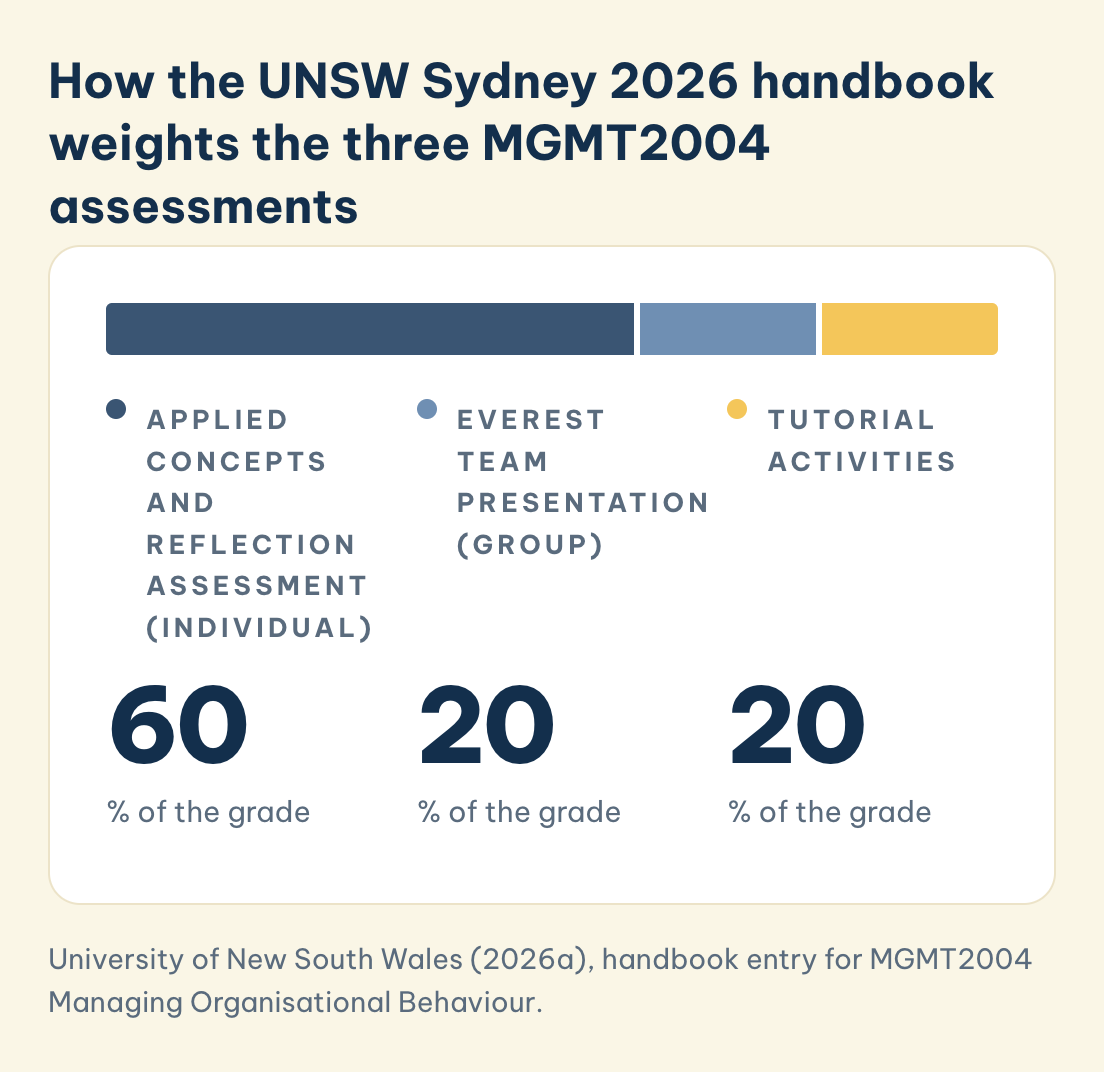
Direct answer: The 2026 handbook lists three assessments, identical across all three delivery modes: an individual Applied Concepts and Reflection Assessment worth 60%, a group Everest Team Presentation worth 20%, and Tutorial Activities worth 20%, which covers participation, learning activities and quizzes. Confirm details in your course outline for your term.
How the UNSW Sydney 2026 handbook weights the three MGMT2004 assessments
These are the weights the handbook entry lists for MGMT2004, shown as a share of the grade.
Applied Concepts and Reflection Assessment (individual)
60
% of the grade
Everest Team Presentation (group)
20
% of the grade
Tutorial Activities
20
% of the grade
Save this figure
| Assessment | Weight | Format | What it really tests |
|---|---|---|---|
| Applied Concepts and Reflection | 60% | Individual assignment | Applying concepts to your own learning activities, then reflecting |
| Everest Team Presentation | 20% | Group assignment | Team presentation linked to the Everest exercise (see your course outline for the brief) |
| Tutorial Activities | 20% | Participation, activities, quizzes | Steady weekly engagement with the content |
Evidence: The weightings come from the University of New South Wales (2026a) handbook entry, which also maps each task to the five course learning outcomes. The 60% task alone is mapped to four of them, covering application, communication, collaboration and leadership reflection.
Example: Study notes circulating online describe an older structure with a separate key concepts video and a points-based tutorial mark. Planning against those notes means planning for a course that has since been restructured, so check the handbook year before trusting any breakdown.
◆ Question 4 / 9 · Learning outcomes
What do the five learning outcomes actually ask for?
Direct answer: The outcomes move from describing OB concepts with critical inquiry, to applying them to ambiguous problems, communicating in several modes, collaborating on team tasks, and reflecting on leadership experience. Only the first asks you to describe, and even that asks for critical inquiry, so a descriptive answer is rarely enough.
The second outcome sets the standard for most written work. It asks you to "Effectively break down, analyse and apply organisational behaviour concepts and findings to solve complex and ambiguous real-world problems." The verbs matter more than the nouns. Breaking down means separating a messy situation into the behaviours inside it; applying means choosing which concept explains each behaviour and saying why.
Evidence: The third outcome names video, writing and formal presentations as modes, which explains why the course mixes formats. The fourth lists team planning, goal setting, task coordination and monitoring of progress as the collaboration skills being assessed. The fifth asks you to reflect on leadership experience and use the lessons learnt.
Example: "Our team had poor communication" describes. "Two members held information the rest of us needed and did not share it, which fits what research on psychological safety predicts when members fear looking incompetent" breaks the behaviour down and applies a concept to it.
◆ Question 5 / 9 · Your own experience
How do you connect your own experience to OB theory?
Direct answer: Start from a specific moment, name the concept that explains it, test whether the concept really fits, and state what you would do differently. Kolb (1984) describes learning as a cycle of concrete experience, reflective observation, abstract conceptualisation and active experimentation, and a strong reflection visibly moves through all four stages.
Evidence: Reflection is easy to write as a diary. What turns it into analysis is the third stage, where theory enters. Hackman and Oldham (1976) proposed five core job characteristics (skill variety, task identity, task significance, autonomy and feedback) that shape motivation, which gives you a vocabulary to explain why one piece of group work energised you and another did not. Barrick and Mount (1991) found in their meta-analysis that conscientiousness related consistently to job performance across all the occupational groups they studied, a useful anchor if your reflection touches personality.
Example: "I felt unmotivated in week 4" is experience. "The task gave me almost no autonomy and no feedback until the deadline, two of the characteristics Hackman and Oldham link to motivation, so next time I would ask the group for an interim check-in" completes the cycle.
A useful test is whether you could swap your name for anyone else's and the paragraph would still read the same. If it would, the reflection is still generic.
◆ Question 6 / 9 · Everest presentation
How should you approach the Everest team presentation?
Direct answer: The assessment name matches the Everest simulation by Roberto and Edmondson (2017), published by Harvard Business Impact, though your course outline should confirm this. Because the course outcomes stress analysis over description, a presentation that analyses your team's decisions is likely to do better than a replay of what happened.
Evidence: Harvard Business Impact states that the simulation examines how teams make decisions, how asymmetric information and opposing interests affect team dynamics, and how cognitive biases impair decisions. In its current version, teams climb through five camps across six simulated days. Edmondson (1999) found, in a study of 51 work teams in a manufacturing company, that team psychological safety was associated with learning behaviour while team efficacy was not, which makes her construct a natural lens for asking why information stayed hidden. She defines team psychological safety as "a shared belief held by members of a team that the team is safe for interpersonal risk taking" (Edmondson, 1999, p. 350), and quoting that definition exactly keeps your analysis anchored to what the construct measures.
Example: A team that reached the summit might assume it has little to analyse. A stronger presentation asks whether the team succeeded because it shared information or despite not sharing it, and uses Tuckman's (1965) sequence of forming, storming, norming and performing to locate the point where the group's way of working changed.
Keep notes during play: who held which information, when it was shared, and who made the final call. Those notes become your evidence.
◆ Question 7 / 9 · Lost marks
Where do students most often lose marks?
Direct answer: Marks are usually lost in four places: describing events without analysing them, naming theories without testing their fit, writing reflection that could belong to anyone, and treating tutorial activities as optional when they carry 20% of the grade. Each of these is easy to fix once you can see it in your own draft.
Evidence: The pattern follows from the outcomes. Four of the five ask you to apply, communicate, collaborate or reflect, so a paper built mostly on definitions leaves those outcomes untouched. Theory dropping is a related problem: listing Tuckman, Hackman and Edmondson in one paragraph shows you have read them, but not that you can use any of them.
Example: For students from Vietnam, one quieter risk is the reflection itself. Students, including many from Vietnam, who come from schooling where writing about your own failures in an assessed task feels unusual, and they soften every setback. A reflection that admits a real mistake and explains it with theory is usually stronger than one where everything went well.
◆ Question 8 / 9 · Planning the term
How can Vietnamese students plan the term?
Direct answer: Map the three assessments onto the term calendar in week 1, start a personal log for the reflection task immediately, and treat each tutorial as rehearsal for the 60% task. Know the census date for your term, because it decides how long you can still leave the course without paying for it.
Evidence: The University of New South Wales (2026b) class timetable for MGMT2004 shows that in Term 3 of 2026 the teaching period runs from 14 September to 13 December, with the census date on 8 October. The census date matters because it is the last day to drop the course without financial liability, which is worth knowing before committing to a team.
Example: A short weekly log, with one incident, one concept and one question, means you reach the reflection task with material already sorted, whereas reconstructing ten weeks of experience in the final week tends to produce a more generic account.
◆ Question 9 / 9 · MAAS mentors
What do MAAS mentors do on this course?
MAAS mentors work with you on your own drafts and ideas: talking through which concept fits an incident you observed, questioning whether a reflection is specific enough, or rehearsing a team presentation. Your analysis and your reflections stay your own, which is also what the course is assessing.
Frequently asked questions
How many units of credit is MGMT2004 worth?
6 units of credit at UNSW Sydney. It is an undergraduate course taught by the School of Management and Governance.
Which terms is MGMT2004 offered in?
The 2026 handbook lists Term 1 and Term 3. Check the class timetable for your year before planning.
What are the prerequisites?
MGMT1001, COMM1170, COMM1100, COMM1120 or COMM1900. Students who completed MGMT1002, the course's former code, cannot enrol.
Is the Everest task the Harvard simulation?
The assessment name matches the Roberto and Edmondson simulation published by Harvard Business Impact, but the handbook does not name the product. Your course outline is the place to confirm it.
Can I take MGMT2004 fully online?
The 2026 handbook lists fully online, in-person and multimodal delivery, all with the same three assessments. Availability in a given term depends on the timetable. In Term 3 2026, for example, the timetable lists in-person classes only.
Is this the same MGMT2004 taught at ANU?
No. ANU uses the code for Negotiation, a different course with its own learning outcomes and assessment.
Ready to work through MGMT2004 with a mentor?
If your reflection keeps drifting into description, or your team is unsure how to analyse the Everest exercise, a short conversation often clarifies where the analysis should start. Book a free 20-minute consultation and bring your assessment brief. MAAS matches you with a subject mentor within 48 hours when the network already has a suitable person; otherwise a dedicated search usually takes around two weeks. 23% of MAAS experts hold a PhD.
Explore one-to-one subject tutoring
Related guides
References
Barrick, M. R., & Mount, M. K. (1991). The Big Five personality dimensions and job performance: A meta-analysis. Personnel Psychology, 44(1), 1-26. https://doi.org/10.1111/j.1744-6570.1991.tb00688.x
Edmondson, A. (1999). Psychological safety and learning behavior in work teams. Administrative Science Quarterly, 44(2), 350-383. https://doi.org/10.2307/2666999
Hackman, J. R., & Oldham, G. R. (1976). Motivation through the design of work: Test of a theory. Organizational Behavior and Human Performance, 16(2), 250-279. https://doi.org/10.1016/0030-5073(76)90016-7
Kolb, D. A. (1984). Experiential learning: Experience as the source of learning and development. Prentice-Hall.
Roberto, M. A., & Edmondson, A. C. (2017). Leadership and team simulation: Everest V3 [Simulation]. Harvard Business Impact. https://hbsp.harvard.edu/product/8867-HTM-ENG
Tuckman, B. W. (1965). Developmental sequence in small groups. Psychological Bulletin, 63(6), 384-399. https://doi.org/10.1037/h0022100
University of New South Wales. (2026a). MGMT2004: Managing organisational behaviour [Handbook entry]. https://www.handbook.unsw.edu.au/undergraduate/courses/2026/MGMT2004
University of New South Wales. (2026b). MGMT2004 class details, 2026 [Class timetable]. https://timetable.unsw.edu.au/2026/MGMT2004.html
Tools & resources
A free 20-minute consultation is a conversation about where you are with MGMT2004.
Book a free consultation ▸